
Trying to launch your B2B tech startup without a solid plan is like sailing into a storm without a map. A go-to-market (GTM) strategy is that map. It’s your operational playbook, the single source of truth that gets your product, sales, and marketing teams rowing in the same direction. This isn’t just some document that collects dust; it’s the practical guide that turns a great idea into a real business.
Your GTM Is More Than a Plan It’s Your North Star
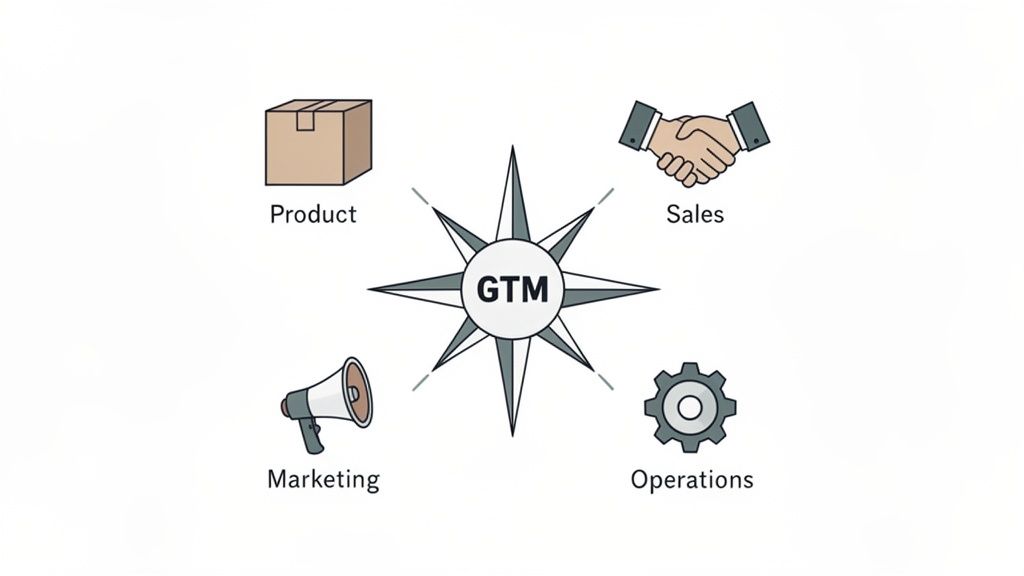
Let's cut through the jargon. A GTM strategy is simply the playbook for how you'll reach your target customers and beat the competition. It’s the connective tissue that makes sure every department is speaking the same language and working toward the same revenue goals.
Without it, even brilliant products die on the vine. Teams work in silos, marketing burns cash on the wrong channels, and sales calls completely miss the mark. The result? A slow, painful grind with almost no traction.
The Real Cost of a Shaky Strategy
I’ve seen it happen time and again: a weak or nonexistent GTM plan creates a predictable set of problems for early-stage B2B companies. And trust me, the consequences are almost always severe.
- Wasted Capital: Pouring money into marketing channels that your ideal customer never sees.
- Misaligned Teams: Sales, marketing, and product all have conflicting priorities and are chasing different metrics.
- Product-Market Misfit: Building features nobody asked for because you never truly understood the core problem you solve.
- Stalled Growth: Inconsistent lead flow and a pipeline that just never seems to gain momentum.
This isn't just theory. The data proves how critical a defined approach is. Recent insights show that roughly 85% of enterprises say their GTM strategies have been highly effective at driving revenue. That number is staggering, and it highlights why founders simply can't afford to wing it. You can read the full analysis on go-to-market effectiveness to dig deeper.
Here's a quick look at the core components we'll be building throughout this guide. Think of this as your high-level checklist.
Core Components of a Startup GTM Strategy
| Component | The Core Question It Answers | Why It's a Must-Have |
|---|---|---|
| ICP & Personas | Who are our absolute best-fit customers? | Prevents wasting time and money on leads that will never close. |
| Value Proposition | Why should they choose us over anyone else? | Forms the foundation of all your messaging and sales conversations. |
| Positioning | Where do we fit in the market and in our customer's mind? | Differentiates you from the noise and makes you memorable. |
| Channel Strategy | Where will we find and engage our target audience? | Focuses your resources on the channels with the highest potential ROI. |
| Revenue Model | How will we price our product and generate revenue? | Directly impacts your ability to scale profitably and attract investment. |
| Sales & Marketing Plan | What specific tactics will we use to create pipeline and close deals? | Translates high-level strategy into a concrete, day-to-day action plan. |
Each of these pieces builds on the last, creating a powerful, cohesive engine for growth.
The Upside of a Cohesive GTM Plan
On the flip side, a rock-solid GTM strategy delivers a massive advantage. It forces you to answer the hardest questions upfront, creating a foundation for sustainable growth.
A great GTM strategy doesn’t just tell you what to do; it tells you what not to do. It’s a framework for making disciplined decisions, ensuring every dollar and every hour is invested in activities that actually move the needle.
This discipline pays off with real, tangible results. A well-executed plan leads to faster market traction, healthier conversion rates from lead to customer, and the kind of momentum that attracts investors, top talent, and—most importantly—loyal customers. It’s the ultimate playbook for building your company's growth engine, ensuring every move you make is a deliberate step forward.
Defining Your Ideal Customer and Core Value

Before you spend a single dollar on marketing, you need to get obsessed with two things: who you serve and why they should care. This isn't just a "nice-to-have" exercise; it's the bedrock of your entire go-to-market strategy.
Get this right, and everything that follows—messaging, channel selection, sales outreach—becomes exponentially more effective. The goal here is to move from fuzzy assumptions ("we target small businesses") to a crystal-clear, data-backed picture of your Ideal Customer Profile (ICP). This is all about pinpointing the specific companies that get the most value from your product and, in turn, provide the most value back to you.
Going Beyond Surface-Level Demographics
A true ICP is more than just company size and industry. It digs into the firmographics and behavioral signals that scream "perfect fit." You’re looking for the triggers that make a company a prime candidate for your solution right now.
Think about what makes an account ideal for you:
- Company Size: Are you best for a 50-person scale-up or a 500-person enterprise?
- Industry/Vertical: Which specific sectors feel the pain you solve most acutely?
- Technology Stack: Do they use complementary software (like Salesforce or HubSpot) that makes your solution a no-brainer?
- Growth Signals: Have they recently received funding, posted specific job roles, or announced an expansion?
These details help you filter the entire market down to a manageable list of high-potential targets. Instead of boiling the ocean, you're fishing in a well-stocked pond. For more guidance, our Ideal Customer Profile template is designed specifically for B2B startups.
Uncovering the Human Element with Personas
With your target company defined, it's time to zoom in on the people inside. Who’s the champion that will fight for your product? Who holds the budget? Who is the end-user whose daily life you'll improve?
This is where buyer personas come in. A fundamental step here is to learn how to create buyer personas that actually reflect your target market. These aren't just fictional characters; they are composites of real people, built on actual research.
Get on the phone. Conduct Zoom interviews. Ask probing questions that go way beyond their job title:
- Pain Points: What keeps them up at night? What manual processes are driving them crazy?
- Professional Goals: What does success look like for them? How can you help them get a promotion?
- Buying Triggers: What event would make them actively search for a solution like yours?
- Watering Holes: Where do they go for information? What blogs, podcasts, or communities do they trust?
Mining competitor reviews, scrolling through industry forums, and listening to sales call recordings are all fantastic ways to gather this raw, unfiltered feedback.
The most powerful insights don't come from your internal brainstorming sessions. They come directly from the mouths of your target customers. Listen more than you talk.
Crafting Your Unshakable Value Proposition
Once you deeply understand your ICP and their specific pains, you can finally articulate your 'why'—your core value proposition. This is your promise, explaining precisely how you solve a critical problem better than anyone else.
A strong value prop isn't a slogan. It’s a clear, concise statement that answers three questions from the customer's perspective:
- What do you do? (Relevancy)
- What specific benefit do I get? (Quantified Value)
- Why should I choose you over the alternative? (Unique Differentiation)
Try this simple framework: We help [ICP] who struggle with [Problem] to achieve [Outcome] by providing [Your Unique Solution].
This structure forces clarity. It connects your product’s features directly to the tangible outcomes your ideal customer desperately needs. Your value proposition then becomes the core message fueling all your marketing and sales materials, ensuring every touchpoint is consistent and compelling.
Choosing Your Battleground Channels and Message
So, you've got a brilliant product and you know exactly who your ideal customer is. That’s a huge win. But if they never actually hear about you, you’re basically shouting into the void. This is the point where your go-to-market plan moves from theory to action—picking the right channels to get your message heard.
Forget the old "spray and pray" approach. Early-stage startups can't afford that luxury. The real goal here is surgical precision. Find the one or two channels where your ideal customers already hang out, and focus all your energy on winning there first.
Pinpointing Your Highest-Impact Channels
That ICP research you did? It's your treasure map. You need to know where your ideal customers "live" online. Are they scrolling LinkedIn for industry news? Are they deep in niche Slack communities asking technical questions? Or are they on Google, actively searching for a solution to a problem you can solve?
Don't just guess. Your channel strategy has to be a direct reflection of your customer's daily habits.
- For the Problem-Aware Buyer (Inbound): If your ICP is already searching for a solution, channels like SEO and targeted content marketing are your best friends. They put you right in front of your customer the moment they have a need, positioning you as the helpful expert.
- For the Unaware but High-Value Buyer (Outbound): What if your product solves a problem your ideal customer doesn't even realize they can fix? This is where a hyper-targeted outbound approach, like personalized email or direct LinkedIn outreach, becomes essential to educate and create demand.
- For the Community-Driven Buyer (Partnerships & Niche Groups): Does your ICP trust industry influencers, technology partners, or specific online communities? Building relationships and adding real value in these digital "watering holes" can generate incredible trust and warm leads. A smart guide on building a B2B social media strategy is key here.
The biggest mistake I see founders make is spreading their resources too thin. Pick two channels, max. Get really, really good at them before you even think about adding a third.
Testing Assumptions Without Burning Cash
Once you have a hypothesis about your best channels, you need to test it—quickly and cheaply. The goal isn't to hit massive scale on day one. It's to find those early signals that you're on the right track.
For example, before you commit to a six-month SEO retainer, why not run a small Google Ads campaign? Target a handful of high-intent keywords. The goal isn't immediate ROI; it's to validate whether your audience is actually searching for the terms you think they are.
Same goes for outbound. Before hiring an SDR, the founder can personally send 50-100 highly personalized emails. The raw, unfiltered feedback you get from those first interactions is pure gold. It will shape your messaging for months to come.
Your early GTM efforts are less about selling and more about learning. Every interaction is a data point that refines your messaging, your channel focus, and your understanding of the customer's real-world pain.
Tailoring Your Message for Every Platform
Your core value proposition is your North Star, but how you communicate it has to adapt to the channel. A message that works on a LinkedIn feed will fall flat in a technical blog post or a cold email.
Think of it this way: your core message is the song, but the channel is the musical arrangement.
- LinkedIn: Keep it concise, professional, and laser-focused on business outcomes. Use visuals and hard data to grab attention fast.
- Content/SEO: Here, you have room to go deep. Your message can be educational, exploring the customer's problem in detail and showcasing your expertise.
- Outbound Email: This is your most direct shot. The message must be hyper-personalized, zeroed in on the recipient's specific pain point, and offer a crystal-clear reason to hit reply.
This channel-specific messaging is how you cut through the noise. It shows you understand the context of the platform and respect your audience's time. Getting this wrong has serious consequences. In fact, data shows half of startups convert less than 10% of their potential customers, and those who fall short are 50% less likely to survive five years. This highlights the danger of only targeting the 5% of buyers in-market, ignoring the vast majority who represent future growth. You can see the full data behind this in GTMonday's deep-dive on market penetration. By adapting your story, you create a consistent narrative that builds authority and opens conversations with the entire market.
Building Your Launch Roadmap and Measuring What Matters
You’ve got your strategy nailed down and you know who you're selling to. Awesome. But a plan on a slide deck is just an idea. Now it's time to turn that thinking into a concrete launch roadmap—a commitment to action that spells out exactly how you'll generate buzz, go live, and start optimizing from day one.
A launch isn't just a single event; it's a process with distinct phases. Think of it as a three-act play: the pre-launch warm-up, the main event, and the post-launch optimization. Each stage demands a different focus, whether you're building a waitlist, gathering early feedback, or refining your approach based on what real users are doing. This is the operational discipline that separates startups that take off from the ones that fizzle out.
From Vanity Metrics to Business Health
Defining success is one of the most critical—and most often botched—parts of any go-to-market plan. It's so tempting to chase "vanity metrics" like website traffic or a spike in social media likes. They feel good, but they don't pay the bills.
You have to move past the surface-level fluff and get obsessed with the KPIs that truly reflect the health of your business:
- Customer Acquisition Cost (CAC): How much are you actually spending in sales and marketing to land one new paying customer?
- Lifetime Value (LTV): What’s the total revenue you can realistically expect from a single customer over time?
- Sales Cycle Length: How many days does it take to turn a fresh lead into a closed deal? If this number is shrinking, you're getting more efficient.
- Lead-to-Customer Conversion Rate: What percentage of your qualified leads end up buying? This is a raw look at how effective your sales process is.
These aren't just numbers for a board meeting. They are your startup's vital signs. They tell you exactly what's working and where you need to make immediate adjustments.
Your first launch isn't about perfection; it’s about learning. The goal is to get a minimum viable product into the market to start collecting real data on what messages resonate and which channels perform, allowing you to iterate your way to product-market fit.
This is where your messaging becomes a live experiment. You need a simple, powerful process for refining it based on actual market feedback.
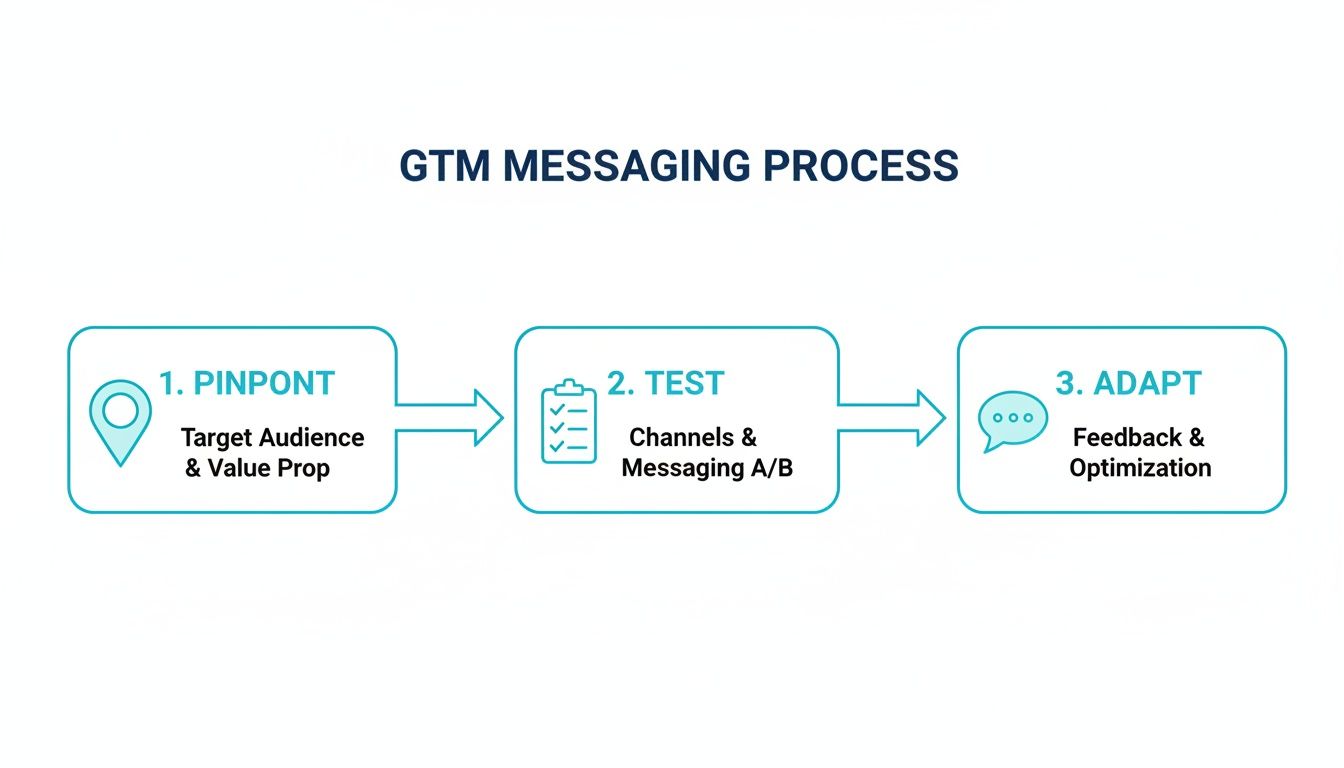
The key takeaway here? Your messaging is a living thing. It has to be tested and adapted based on every single customer interaction.
Aligning Sales and Marketing for Impact
One of the most common failure points for a startup is the chasm between sales and marketing. Marketing generates leads that sales claims they can't close. Sales complains about lead quality. The only solution is radical alignment, right from the start. Both teams must agree on the definition of a qualified lead and, most importantly, share the same revenue goals.
This alignment has to extend to the tools and materials you build. Sales enablement isn't just a buzzword; it's about giving your sales team the resources they need to win. This means compelling case studies, crisp one-pagers, and email templates that hammer home your core value proposition.
Building a simple, effective tech stack is another piece of the puzzle. You don't need a dozen expensive tools to get started. A lean setup is best: a CRM to manage relationships, a marketing automation tool for email, and an analytics platform to track your KPIs. The goal is just enough tech to execute your plan and measure what matters. For a practical guide on planning this out, our marketing roadmap template can be a huge help.
This proactive approach is more important than ever. A J.P. Morgan outlook found that 58% of US business leaders plan to launch new products by 2026, which is fueling a massive demand for GTM strategies that actually work. Yet so many founders still skip these foundational steps, leading to failure even when the product itself is great.
A core part of this is knowing how to measure advertising effectiveness to fine-tune your GTM spend. By tracking these core business metrics and keeping your teams in lockstep, you build a culture of accountability and empower yourself to make smart, data-backed decisions from day one.
When to Call for Strategic Reinforcements
As a founder, you're wearing a dozen hats. You’re the head of product, the lead salesperson, and the chief visionary all at once. But the one hat that often feels the heaviest is "Head of Growth," because being a jack-of-all-trades won't scale the company.
Knowing when to bring in expert help isn't a sign of weakness; it's a strategic advantage. It’s about recognizing that your time is best spent on the things only you can do. The hard part is spotting the signals that it's time for senior marketing leadership.
Recognizing the Warning Signs
Are you facing any of these classic founder pain points? If these sound familiar, your go-to-market strategy might be hitting a ceiling that requires a new level of expertise.
- Your Pipeline Has Stalled: You had some early wins, but now lead flow is unpredictable. Your team is busy, but the activity isn't translating into qualified opportunities.
- The Launch Keeps Getting Delayed: Your product is nearly ready, but the actual launch plan feels vague and overwhelming. You're stuck in a cycle of "one more tweak" because you lack a clear GTM execution plan.
- Your Junior Team Needs Direction: You've hired some smart, energetic marketers, but they lack the strategic framework to prioritize their efforts. They need a coach, not just a manager.
These aren't minor operational hiccups; they are symptoms of a strategy gap. This is the exact moment when bringing in outside strategic reinforcements can completely change your trajectory.
Demystifying the Fractional CMO
The idea of hiring a C-level executive can feel daunting, especially for a capital-conscious startup. But you don't always need a full-time, six-figure hire to get the executive-level thinking you're missing. This is where a fractional CMO comes in.
A fractional CMO provides the high-level strategy, planning, and leadership of an experienced marketing executive without the full-time cost and commitment. It’s about getting the brain, not the full-time body, precisely when you need it most.
This model is built for B2B tech startups. It's a capital-efficient move that provides immediate access to senior talent who has built a go-to-market strategy for a startup before. They aren't there to just create slide decks; they roll up their sleeves to build your growth engine alongside you.
Is a Fractional Engagement Right for You?
Think of it as having a strategic co-pilot for your next stage of growth. They help clarify your message, focus your team on the right channels, and implement the metrics that actually matter. It's about building momentum and making smarter decisions, faster.
Ask yourself these key questions:
- Do we have a clear, documented GTM strategy that our whole team understands and is executing against?
- Is our marketing spend generating a predictable and scalable pipeline of qualified leads?
- Does our current marketing leader have the experience to guide us through our next two stages of growth?
If the answer to any of these is "no" or "I'm not sure," it’s a strong signal that it's time to call for reinforcements. Accessing this top-tier guidance can accelerate your GTM execution and help you confidently navigate your next growth inflection point.
Your Go-To-Market Strategy Questions Answered
We’ve covered a ton of ground, but when you're in the trenches, the same questions always pop up. Let's get straight to the ones I hear most from founders building their go-to-market plan. No fluff, just direct answers to help you get moving.
GTM Strategy vs. Marketing Plan: What's the Difference?
This one trips up a lot of people. It’s actually pretty simple.
Think of your GTM strategy as the architectural blueprint for a house. It answers the big, foundational questions: Who are we building this for (your ICP)? Why will they choose our house over others (your value proposition)? And on what plot of land will we build it (your channels)? It’s the high-level plan that gets everyone—product, sales, marketing—pointing in the same direction.
The marketing plan is the interior design and construction schedule. It’s pure execution. It details the specific campaigns, content, ads, and activities needed to bring the blueprint to life. You can’t have a solid marketing plan without a GTM strategy to guide it. The blueprint always comes first.
What Are the Biggest GTM Mistakes Founders Make?
I see the same few mistakes over and over again with B2B tech startups. If you can sidestep these, you’re already way ahead of the game.
The absolute biggest error is assuming you know your customer without actually talking to them. Founders fall in love with their idea and skip the hard, qualitative research. This leads to messaging that completely misses the mark because you’ve built a solution for a customer who doesn't really exist.
Another classic mistake is trying to be everywhere at once. Founders get excited and spread their budget thin across LinkedIn, SEO, outbound, and events. In the early days, focus beats breadth every single time. Find the one or two channels where your ICP really lives and dominate them.
So many startups fail to set clear success metrics from day one. You can't tell if you're winning or just burning cash if you don't know what a good Customer Acquisition Cost (CAC) or conversion rate even looks like for your business.
Finally, nothing kills a launch faster than sales and marketing teams that aren't on the same page. If they can’t agree on what a "good lead" is, you just create friction and waste everyone's time. They have to be tied to the same revenue goals, period.
How Long Does It Take to Build a GTM Strategy?
This isn't an afternoon project, but it shouldn't take you a year, either. For an early-stage B2B startup, I'd block out four to twelve weeks to build your first real GTM strategy.
That timeline gives you enough room for the essentials:
- Customer Research: Deep-dive interviews with at least 10-15 potential customers.
- Competitive Analysis: Mapping out the landscape to find your unique spot.
- Internal Workshops: Getting the founding team aligned on the ICP, value prop, and messaging.
- Channel Selection: Researching and prioritizing your go-to marketing and sales channels.
But here’s the thing: a GTM strategy is never really "done." It’s a living document. The goal is to build a solid version 1.0 that gets you into the market so you can start collecting real-world data. The real work of testing, learning, and iterating starts after you launch.
When Should a Startup Revise Its GTM Strategy?
Your GTM strategy isn't meant to be framed and hung on the wall. The market moves, your product gets better, and customers change. Knowing when to revisit your core assumptions is a critical skill.
Plan on doing a formal review at a few key moments:
- Launching a Major New Product: A new product might serve a different buyer or solve a totally different problem. That calls for a fresh GTM approach.
- Entering a New Market Segment: What worked for enterprise tech in North America probably won't work for SMBs in Europe. New markets mean new rules.
- Facing a Disruptive Competitor: If a new player is suddenly winning deals you thought were yours, it's time to re-evaluate your positioning immediately.
- Seeing Key Metrics Decline: Are your win rates, sales cycle length, or conversion rates tanking for more than a quarter? That’s a massive red flag. Something in your strategy is broken.
It’s also smart to do a thorough review right after you close a new round of funding. More capital means higher expectations. Your GTM strategy has to be strong enough to hit those new targets.
Ready to build a go-to-market strategy that drives real results but need expert guidance to get there? Value CMO provides the senior marketing leadership B2B tech startups need to clarify their strategy, align their teams, and build a scalable growth engine—all without the cost of a full-time hire. Learn how we can accelerate your path to market.