Let's be honest, "digital marketing outsourcing" is just a fancy way of saying you’re hiring an expert, an agency, or a consultant to run your marketing. For a B2B tech startup, it’s a strategic shortcut. You get your hands on proven growth playbooks and senior-level skills without the six-figure salary and slow ramp-up of building an in-house team from the ground up.
This isn't just about saving a few bucks—it’s about moving faster and smarter.
When to Outsource Your Digital Marketing
As a founder, you're already the CEO, the lead developer, and the head of sales. "Marketing guru" is probably another hat you’re wearing, and let's face it, it's likely not your favorite. You know you need marketing, but finding the time, budget, and know-how to make it actually work feels like an impossible task.
The real question isn't if you should do marketing, but how.
This is where digital marketing outsourcing stops being a "nice-to-have" and becomes a game-changing strategic move. Think of it this way: you wouldn't try to architect your own office building just because you bought the land. You’d hire a specialist who already has the blueprint. Outsourcing your marketing works the same way—you bring in an expert to build a solid foundation for predictable revenue.
Before we dive deeper, let's look at a quick comparison between building a team and bringing in a partner.
In-House vs Outsourcing Quick Comparison
Here’s a simple, high-level look at the key differences B2B tech founders should think about when deciding between hiring internally and outsourcing their marketing.
| Factor | In-House Team | Outsourcing Partner |
|---|---|---|
| Cost | High fixed costs (salaries, benefits, overhead) | Lower, flexible costs (monthly retainer or project fee) |
| Speed to Impact | Slow ramp-up (hiring, onboarding, training) | Fast start (often within weeks) with immediate expertise |
| Skill Access | Limited to the skills of your hires | Access to a full team of specialists (SEO, PPC, Content, etc.) |
| Scalability | Difficult to scale up or down quickly | Easy to adjust scope and spend as your needs change |
| Focus | Deep product and company knowledge | Broad industry perspective and ideas from other sectors |
| Accountability | Managed through internal performance reviews | Defined by SLAs, contracts, and crystal-clear performance metrics |
While an in-house team offers deep cultural immersion, an outsourcing partner provides immediate firepower and flexibility—a massive advantage for startups needing to show traction, fast.
The Tipping Point for Outsourcing
So, when is it time to stop the DIY struggle and call in the pros? There are a few clear signals that you’ve hit a growth ceiling that a single internal hire just can't break through on their own.
Look for these critical triggers:
- Your Sales Pipeline is Flat or Unpredictable: If leads are sporadic and your sales team is constantly starved for opportunities, it’s a sign that whatever you're doing now isn't building a reliable engine.
- Product Launches or Go-to-Market Plans are Delayed: A brilliant product with a weak marketing plan is a recipe for a launch that lands with a thud. When marketing becomes the bottleneck, it's time for outside help.
- You Lack the Specialized Skills to Compete: SEO, paid media, and content strategy are deep, complex disciplines. If you realize your team can’t go toe-to-toe with established competitors, outsourcing gives you that expertise overnight.
This isn't some niche trend; it's a major strategic shift. The global market for digital marketing outsourcing is on track to jump from $25.4 billion in 2024 to $74.76 billion by 2034. Why? Because smart founders know that building a full in-house team is often too slow and too expensive. You can check out the full marketing outsourcing statistics to see why tech companies are leading the charge.
Ultimately, outsourcing isn't just a line item on your budget; it’s a growth lever. It gives you immediate access to senior-level thinking that builds a powerful marketing machine, letting you skip the months-long, costly process of hiring a full-time team before you're truly ready for it.
Choosing Your Growth Engine: Four Outsourcing Models
Once you've decided that outsourcing marketing is the right play, the next question is a big one: what kind of help do you actually need? This isn't a one-size-fits-all decision. Picking the wrong model is like trying to build a race car with tractor parts—it's expensive, frustrating, and definitely won't get you where you need to go.
Think of it as choosing your growth engine. Each model is built for a different job, whether you need a high-level strategist to chart the course or a specialized crew to handle the technical heavy lifting. Understanding these four primary options is the key to making sure your investment lines up with your real-world goals as a B2B tech startup.
This flowchart breaks down the common triggers I see that push founders to look for outside help.
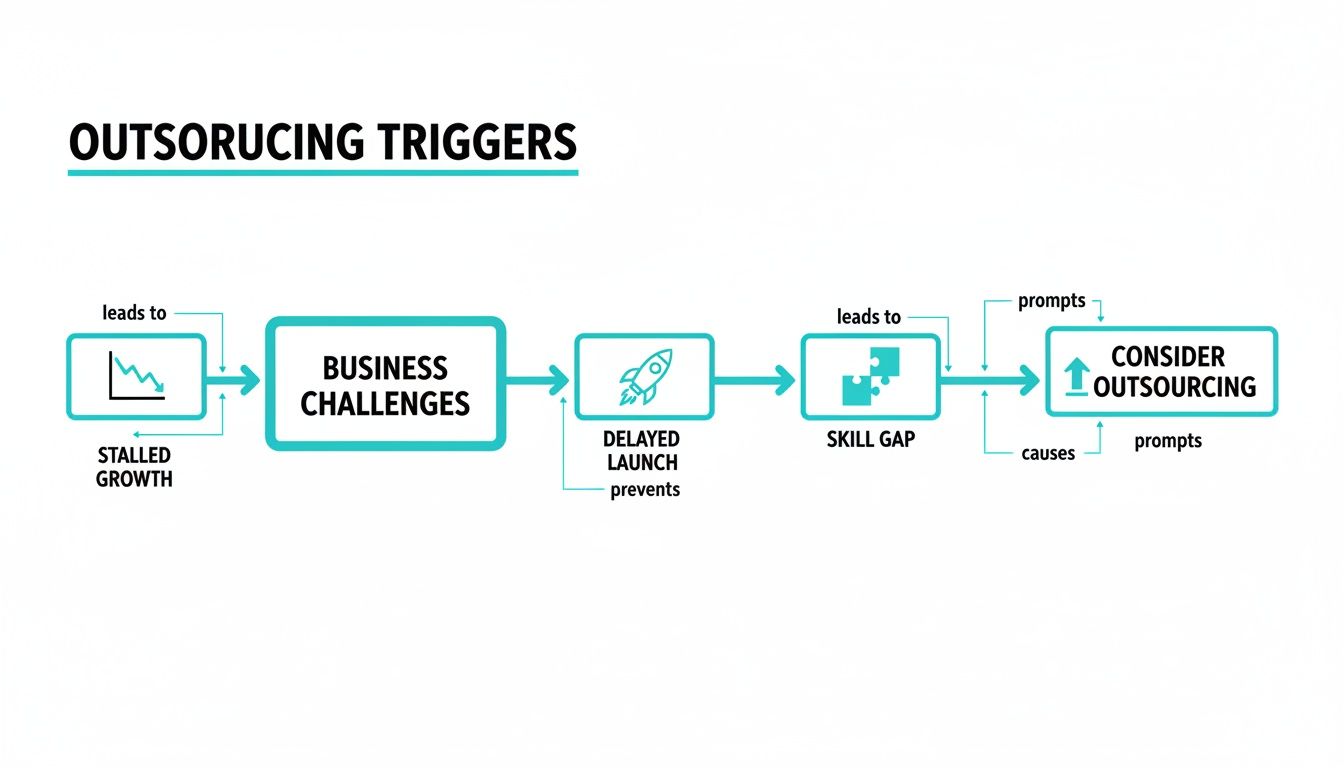
Whether you're hitting a growth plateau, a product launch is dragging, or you're missing a critical skill set, these challenges almost always point toward needing an external partner to get things moving again.
The Full-Service Agency: Your All-in-One Marketing Department
The full-service agency is the classic outsourcing model. Think of it as renting an entire marketing department. They offer a whole suite of services under one roof—from SEO and content creation to PPC ads and social media management.
This is a great fit for companies that need comprehensive, hands-on execution across a bunch of channels but don't have the internal team to pull it off. The agency brings in its own specialists, a project manager, and proven processes to run your campaigns from A to Z.
But there's a trade-off. That breadth of services can sometimes come at the cost of depth. Agencies juggle a lot of clients, and it's not uncommon for junior-level staff to handle the day-to-day work. You have to make sure you're paying for genuine expertise that gets your niche, not just for their overhead.
The Fractional CMO: Your On-Demand Strategic Leader
If a full-service agency is the entire crew of a ship, a Fractional Chief Marketing Officer (CMO) is the seasoned captain who sets the destination and plots the course. This model gives you access to C-suite strategic thinking without the hefty price tag of a full-time executive salary.
A Fractional CMO typically doesn't get bogged down in the daily execution. Instead, they own the high-level strategy that actually drives growth:
- Nailing down your go-to-market plan and Ideal Customer Profile (ICP).
- Building a marketing roadmap and setting KPIs that make sense.
- Mentoring your junior marketers or managing other vendors for you.
- Making the tough calls on budget allocation and your tech stack.
This model is perfect for founders who need a strategic partner to build a solid foundation but aren't ready to hire a full-time C-suite executive. It’s all about getting the "what" and the "why" right before you burn cash on the "how."
Managed Services: Your Specialized Task Force
So what if you have a solid strategy but just don't have the deep expertise to execute a key part of it? That’s where managed services come in. This model is about outsourcing a single, specialized function to a firm that does one thing incredibly well.
Think of them as a specialized task force you call in for a specific mission. Common examples include:
- An SEO-only firm to handle technical optimization and keyword strategy.
- A PPC agency to run your Google Ads or LinkedIn campaigns.
- A content marketing provider to create and distribute your blog posts and ebooks.
This approach works wonders when you've identified a clear need and want to bring in best-in-class expertise to solve it. It's less about broad strategy and all about top-tier execution in one specific channel.
The key difference is focus. A full-service agency covers many channels, but a managed services provider aims for mastery in one. That targeted approach often delivers much better results for that specific function.
Staff Augmentation: Your Rent-an-Expert
Sometimes, you don’t need a whole team or a strategist—you just need an extra pair of skilled hands to fill a temporary gap. Staff augmentation, which usually means hiring a freelance contractor, lets you do just that.
It's like "renting an expert" to supplement your in-house team's capabilities. For instance, you might hire a freelance graphic designer for a website refresh or bring on a technical SEO consultant for a site audit.
Staff augmentation is incredibly flexible and cost-effective for short-term projects or to cover a skill your team lacks right now. The big difference from other models is that you manage the freelancer directly. They become an extension of your team, while agencies and Fractional CMOs operate more independently. Choosing the right one comes down to your immediate needs, long-term goals, and who you already have on your team.
The Fractional CMO: A Founder's Secret Weapon
Let’s zoom in on the outsourcing model that’s become a genuine game-changer for B2B tech startups: the Fractional CMO. This isn’t just another way to delegate tasks. It’s about embedding senior-level strategic leadership into your company—without the six-figure salary and long-term baggage of a full-time executive.
Think of it like getting a seasoned ship captain to chart your course, check your rigging, and train your crew for a few days a week. That’s a Fractional CMO. They aren't there to swab the decks; they're there to make sure the entire voyage is pointed toward the right destination: profitable growth.
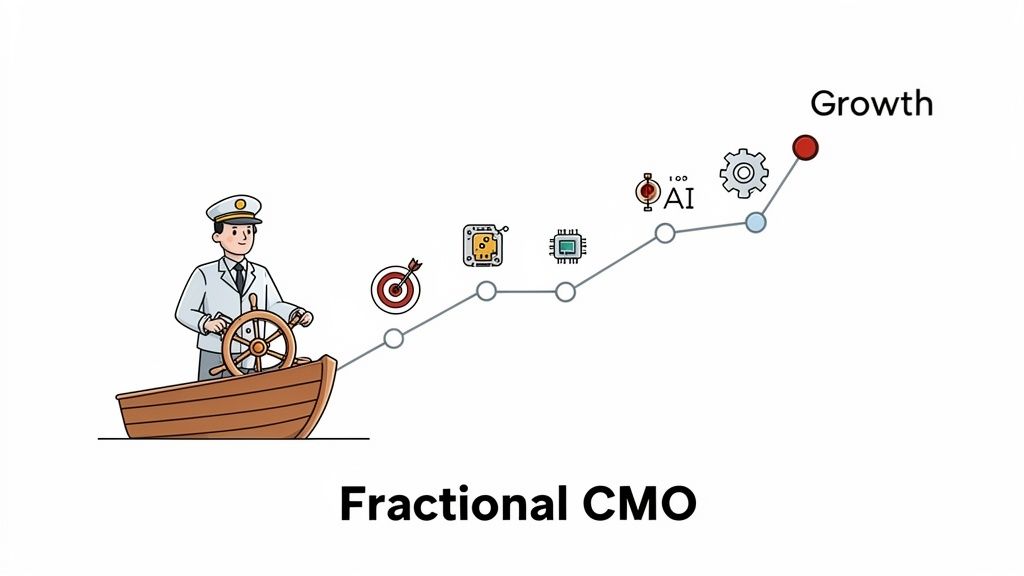
This model bridges the dangerous gap between a founder’s vision and the tactical execution needed to make it real. For a lot of startups, this is the missing piece that finally connects marketing spend to measurable business outcomes.
When a Fractional CMO Makes Perfect Sense
A Fractional CMO isn’t for everyone. But for certain critical moments in a startup’s journey, they are the perfect fit. Their value shines brightest when you need high-level direction far more than you need another pair of hands to write blog posts.
This kind of partnership is a killer move in a few specific scenarios:
- You need to mentor a junior team. You have talented, energetic marketers, but they lack the experience to build a cohesive strategy. A Fractional CMO acts as their coach, guiding their work and leveling up their skills.
- Your sales pipeline has stalled. Lead flow has gone flat, and nothing you try seems to move the needle. A top-tier fractional leader steps in to diagnose the problem, rebuild your demand engine, and get sales the qualified opportunities they need.
- You have a leadership gap. You're not ready to hire a full-time VP of Marketing, but you can’t afford to wait six months to start building momentum. A Fractional CMO fills that void, setting the stage for a future executive hire.
- Your product launch is behind schedule. The go-to-market plan is fuzzy or falling apart. The Fractional CMO crystallizes the strategy, maps out the launch sequence, and makes sure you hit the market with impact.
In every case, the focus is on building a repeatable system for growth, not just checking off a list of tasks.
From Big Ideas to Tangible Action
The real power of this digital marketing outsourcing model is its ability to turn a high-level vision into a concrete action plan. A great Fractional CMO doesn’t just talk about strategy; they roll up their sleeves and build the foundational pillars of a strong marketing function.
This is where they start to think and act like a co-founder, not just another vendor.
A Fractional CMO’s main job is to answer the tough questions: Who is our Ideal Customer Profile (ICP), really? What channels will actually give us the best return? How do we structure our budget to prove marketing’s contribution to revenue?
They connect the dots from a founder's whiteboard sketch to a fully operational marketing plan. This usually means making critical calls on your marketing tech, putting AI and automation in place to scale your efforts, and setting up the KPIs that actually matter. It’s about building a solid engine that will keep running long after their engagement ends. You can learn more about this strategic approach and its benefits by exploring what a fractional CMO service truly entails.
Ultimately, this model is for the founder who knows they need more than just another service provider. They need a strategic partner who can navigate the complexities of B2B tech marketing, make tough decisions, and hold the whole process accountable for one thing: driving measurable growth.
How to Choose the Right Marketing Partner
For a founder, picking a marketing partner is one of the highest-stakes decisions you'll make. Get it right, and you’ve just built a growth engine that will fuel your startup for years. Get it wrong, and you'll burn through precious runway with little more than vanity metrics and a whole lot of frustration to show for it.
This isn’t about hiring a vendor to just check boxes and run campaigns. It's about finding a true strategic ally who understands the unique pressures of a B2B tech startup. You need someone who can translate your big-picture vision into a measurable, revenue-generating pipeline.
To cut through all the noise and slick agency sales pitches, you have to walk into those discovery calls armed with the right questions. Forget about their fancy office or big-name client list. The goal is to uncover their actual process, their real-world expertise, and whether they have the strategic depth to be a true partner in your growth.
Asking the Right Questions
Most agencies are pros at telling you what they think you want to hear. Your job is to ask the kind of questions that reveal how they actually operate behind the scenes. Zero in on their direct experience with companies just like yours, their approach to building a strategy from the ground up, and how they define and measure real success.
Think of the table below as your personal vetting checklist. Use it to steer your conversations and compare potential partners on the things that actually matter.
Essential Questions to Ask a Potential Marketing Partner
Before you sign any contracts, you need to be confident you're bringing on a team that can deliver. Here are the questions that will help you separate the talkers from the doers.
| Category | Key Question | What to Listen For |
|---|---|---|
| Industry Experience | Can you show me case studies from B2B tech companies similar to ours? | Look for specific, metric-driven results (e.g., pipeline growth, reduced CAC), not just "increased traffic." A great answer shows they understand your market challenges and customers. |
| Strategic Depth | How do you connect marketing activities to our actual business goals, like revenue? | They should talk about aligning with your sales team, tracking MQLs to closed deals, and proving ROI. If they only focus on clicks and impressions, they lack strategic thinking. |
| Technical Expertise | How do you approach building and managing our tech stack? | A strong partner will discuss integrating tools like your CRM and marketing automation. They should have a clear vision for using a marketing technology stack to make your campaigns more efficient. |
| Communication | What does your communication and reporting cadence look like? | A good answer includes regular, scheduled meetings (weekly or bi-weekly), clear reporting dashboards, and a dedicated point of contact. Vague promises of "staying in touch" are a red flag. |
| Cultural Fit | How do you handle disagreements or campaigns that aren't performing as expected? | You want a partner who is proactive and data-driven, not defensive. They should describe a clear process for spotting issues, testing new ideas, and pivoting quickly based on performance data. |
After running through these questions, you'll have a much clearer picture of who can truly move the needle for your business.
A partner who can't provide clear, confident answers to these questions is likely more focused on signing contracts than delivering results. True experts welcome tough questions because it allows them to showcase their value beyond a slick presentation.
Ultimately, choosing the right partner is less about finding a "perfect" agency and more about finding the right fit for your startup's current stage. This often means prioritizing a partner who brings both strategic leadership and a roll-up-their-sleeves attitude to the table. A team that can help you build the plane while you're flying it is absolutely invaluable.
To understand how this works in practice, you might be interested in our guide on what an outsourced marketing service provides for B2B tech companies.
Setting Your Partnership Up for Success
Signing the contract isn't the finish line. It’s the starting gun.
A great outsourcing partnership is built in the first few weeks, turning a vendor relationship into a true extension of your team. Without a tight plan for onboarding and management, even the most promising agencies can fizzle out, tripped up by misaligned expectations.
Those first 30 days are everything. This isn't just about handing over logins; it’s about deep integration. The goal is to get your new partner fluent in your business, your customers, and your goals so they can start delivering value, fast.
The Essential First 30 Days
Think of onboarding as a knowledge transfer sprint. Your outsourced team needs to absorb your company’s DNA. This phase has to be structured and intentional, built to get everyone on the same page and build momentum right out of the gate.
A well-run onboarding process always includes a few key moves:
- A Formal Kick-off Meeting: Get all the key players from both sides in one room (virtual is fine) to lock in the project scope, high-level goals, and what happens next.
- Deep Dive Discovery Sessions: Your partner needs to get inside the head of your Ideal Customer Profile (ICP). Share everything—past wins, failed experiments, raw customer feedback, your product’s real value prop, and the competitive battlefield.
- Granting Access to Tools: Provide immediate access to your CRM, Google Analytics, marketing automation software, and anything else they'll need. Delays here are delays in progress. It's that simple.
- Defining Initial KPIs: Agree on the top 2-3 metrics you’ll use to measure success in the first 90 days. This makes sure everyone is rowing toward the same, measurable outcomes from day one.
The onboarding process sets the tone for the entire relationship. A chaotic, disorganized start almost always leads to a chaotic, disorganized partnership. A structured, collaborative kickoff builds the trust and alignment you need to win together.
Establishing a Rhythm for Collaboration
Once onboarding is done, the focus shifts to day-to-day management and communication. The key is creating a predictable cadence that keeps everyone in sync without drowning them in meetings. You need a system that keeps the work moving and the strategy aligned.
This is where you establish the operational heartbeat of the partnership.
A strong communication framework is simple but non-negotiable:
- Weekly Check-ins: A mandatory 30-minute tactical meeting each week. You'll review progress against KPIs, tackle roadblocks, and map out the coming week’s priorities. This keeps momentum high and stops small issues from becoming big problems.
- Shared Project Management: Use a tool like Asana, Trello, or Monday.com to keep every task, deadline, and progress update in one transparent place. It becomes the single source of truth for all work.
- Monthly Strategic Reviews: This is a deeper, data-driven meeting to review performance against goals, talk through strategic shifts, and plan the month ahead. It’s your chance to zoom out from the day-to-day tactics and look at the bigger picture.
When you build this kind of collaborative environment, your outsourced partner stops feeling like an external vendor and starts operating like an integrated part of your growth engine.
Measuring What Matters: Pricing and Proving ROI
Let’s talk about money. When it comes to digital marketing outsourcing, this conversation shouldn't be complicated. The real question is simple: How do you know if your investment is actually paying off? It's time to move beyond hope and into hard numbers.
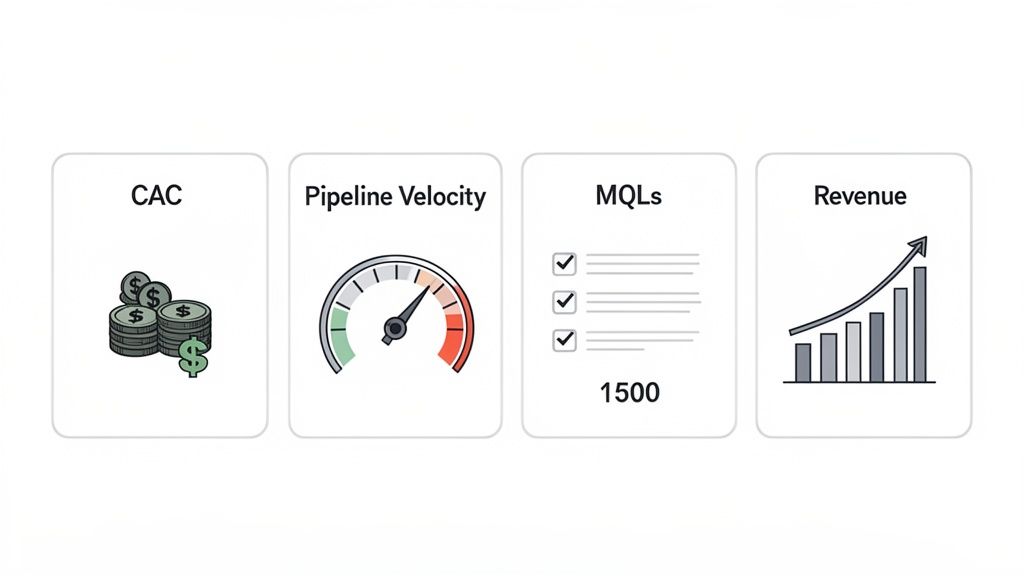
First, you need to understand how your partner gets paid. For B2B tech startups, pricing usually falls into one of three buckets. Each has its pros and cons for your budget.
Common Pricing Models Explained
- Retainers: This is the most common setup. You pay a fixed monthly fee for a pre-defined scope of work. It’s predictable and great for budgeting, but you need crystal-clear deliverables to make sure you're getting consistent value.
- Project-Based: Here, you pay a flat fee for a specific, one-time project—think a website redesign or building a go-to-market strategy. It’s perfect for defined needs but doesn't work for the day-to-day grind of ongoing marketing.
- Performance-Based: In this model, the partner’s fee is tied directly to results, like the number of leads generated. It sounds great on paper, but it can create an incentive to chase quantity over quality. If you go this route, be ruthless about defining what a "good" lead actually is.
For most startups, a monthly retainer strikes the right balance. It gives you predictability while offering the flexibility to adapt as your company’s needs change.
The model you choose is less important than the mindset behind it. Stop thinking of outsourcing as an expense and start treating it as an investment designed to produce a measurable return. The question isn't "How much does it cost?" but rather, "What business growth will this drive?"
Moving Beyond Clicks and Impressions
Real ROI isn’t found in website traffic or social media likes. Those are vanity metrics. For a B2B tech startup, success is measured in two things: pipeline and revenue. Your partner should be just as obsessed with those numbers as you are.
This means you need to focus on business-critical Key Performance Indicators (KPIs) that connect what marketing is doing to what sales is closing. These are the metrics that tell the true story of your growth.
The KPIs That Actually Matter
These are the four pillars of B2B marketing ROI. Any outsourced partner worth their salt should be tracking and reporting on these without you ever having to ask.
- Customer Acquisition Cost (CAC): This is your total marketing and sales spend divided by the number of new customers you landed. A falling CAC means you’re getting more efficient at turning your investment into revenue. It's as simple as that.
- Marketing-Qualified Leads (MQLs): These are leads that have shown enough interest to get handed over to sales. Tracking MQLs tells you if your marketing is attracting the right kind of prospects, not just filling the top of the funnel with noise.
- Pipeline Velocity: This measures how fast a lead moves through your sales funnel, from the very first touch to a closed deal. A faster velocity means your marketing is doing its job warming up prospects and shortening the sales cycle.
- Direct Contribution to Revenue: This is the bottom line. It answers the one question that matters most: How many closed-won deals can be directly tied to marketing's efforts? This is the clearest proof of your marketing ROI. For a deeper look, check out our guide on how to measure marketing ROI with a simple, effective framework.
By focusing on these KPIs, you build a system of accountability. It ensures your partner isn't just busy—they're busy driving the results that actually grow your business.
Frequently Asked Questions About Outsourcing
Stepping into digital marketing outsourcing can feel like a big leap, especially for a B2B tech founder. It’s totally normal to have questions about budget, control, and what the partnership actually looks like day-to-day. Let's clear up some of the most common concerns.
How Much Should a B2B Tech Startup Budget for Outsourcing?
There’s no magic number here. A healthy starting point is a budget that allows for consistent, strategic action—not just sporadic, one-off tasks. Most successful partnerships kick off with a monthly retainer that covers both strategy and execution.
Try to avoid thinking in terms of the lowest possible cost. A better way to frame it is an investment in your growth engine. A good partner will help you build a budget tied directly to business goals, like hitting a certain number of Marketing Qualified Leads (MQLs) or chipping away at your Customer Acquisition Cost (CAC) over time.
The right budget isn't just a line item; it's the fuel for a predictable revenue machine. The real goal is to fund activities that generate a clear, positive return, turning your marketing from a cost center into a profit driver.
Will I Lose Control Over My Brand and Messaging?
This is a common fear, but a good outsourcing relationship is a partnership, not a handover. You’re still the ultimate authority on your brand, vision, and voice. The outsourced team’s job is to translate that vision into marketing campaigns that actually work.
A structured onboarding process is everything. Your partner should spend serious time learning your company culture, ideal customer, and what makes you different. Regular check-ins, shared project management tools, and clear approval workflows make sure you always have the final say and the messaging stays true to your brand.
What Happens to the Work if We Part Ways?
Concerns about intellectual property (IP) are completely valid. Before you sign anything, get clear on who owns the marketing assets created during the partnership. This means everything from website content and ad creative to the strategic playbooks themselves.
Typically, the client owns all the work produced on their behalf once it's paid for. It's standard practice to have this spelled out clearly in the contract. A transparent partner won't have any issue with this, ensuring you keep all the valuable assets you paid to create. When you're looking at providers, it's smart to check their own list of frequently asked questions to see their policies on IP and other operational details before you even hop on a call.
Ready to build a predictable growth engine without the cost and delay of a full-time hire? Value CMO delivers the senior-level marketing leadership B2B tech startups need to accelerate revenue. Get your custom growth roadmap.