A growth strategy consultant is the expert you call when your business hits a plateau. They’re the specialist who steps in to figure out why you've stopped growing and then builds a custom roadmap to get your momentum back. Think of them as moving beyond generic advice to give you a clear, actionable plan for sustainable revenue.
What Does a Growth Strategy Consultant Actually Do?
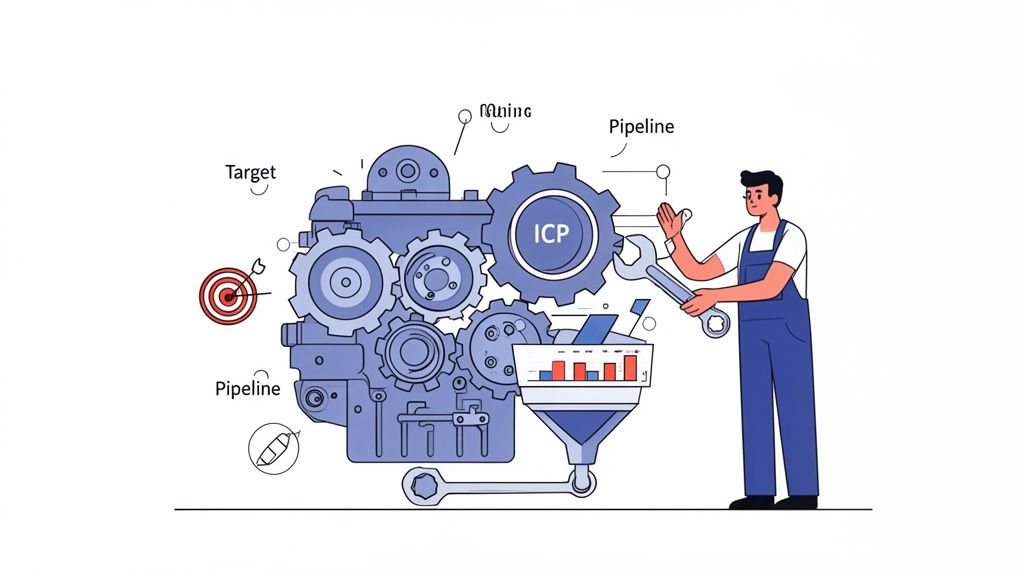
Imagine your B2B tech startup has a powerful engine, but for some reason, you're stuck in first gear. You can feel the potential, but the acceleration just isn't there.
A growth strategy consultant is the master mechanic who gets under the hood. They diagnose the friction points holding you back and tune your engine for peak performance. They don't just tell you to "go faster"—they rebuild the systems that create speed.
This role is about so much more than buzzwords and a dense report. The best ones roll up their sleeves and work right alongside your team, building a clear, data-backed plan that fixes the core issues stalling your growth.
The Architect of Your Growth Engine
A consultant's real job is to bring an objective, outside perspective to your most stubborn challenges. They connect the dots between your product, your market, and your customers in ways an internal team, buried in the day-to-day, often can't.
Their work usually zooms in on a few critical areas:
- Clarifying Your Go-to-Market (GTM) Strategy: They help you nail down exactly who you're selling to, what problem you truly solve for them, and the most direct ways to get their attention.
- Sharpening Your Ideal Customer Profile (ICP): This isn't about broad demographics. It's about building a laser-focused profile of the companies that get the most value from you and are the most profitable to land.
- Diagnosing and Fixing a Stalled Pipeline: They comb through your entire sales and marketing funnel to find the bottlenecks, leaks, and hidden opportunities for improvement.
- Aligning Leadership and Teams: A great consultant acts as a facilitator, getting sales, marketing, and product all rowing in the same direction with shared goals and metrics.
It's easy to think growth consultants only deal with marketing tactics. In reality, their true value is in building the strategic foundation that makes every tactic more effective. They architect the "why" and "who" before defining the "how."
From Insight to Actionable Roadmap
At the end of the day, a growth strategy consultant turns complex market analysis and internal diagnostics into a practical, step-by-step roadmap. To really get what they do, it helps to understand what a conversion optimization expert actually does, since that's often a key piece of the puzzle.
They give you top-tier strategic leadership without the cost and commitment of a full-time executive hire, making them the perfect co-pilot for ambitious startups ready to scale. If you're curious about the broader field, we have a detailed guide on what marketing consultants do.
When to Call In a Growth Strategist: The Telltale Signs
Is your team running flat out, but the growth needle just won’t move? It’s a classic founder headache. You see the effort, the long hours, but the results feel disconnected, random, or just plain flat. This isn’t a sign you’re failing—it’s a signal that your strategy is out of sync with your execution.
Think of this as a quick diagnostic. If a few of these points feel uncomfortably familiar, it’s probably time to bring in an expert growth strategy consultant for an objective look.
Your Sales Pipeline Is Stagnant or Unpredictable
This is one of the biggest red flags. A healthy pipeline should be growing, but yours looks more like a flatline. Your sales team might be busy, but deals aren't closing. Or worse, you have no idea what next month’s pipeline will even look like.
This problem usually runs deeper than sales tactics. The symptoms often include:
- Bad Leads: Marketing is sending leads over, but sales complains they’re junk. This creates friction and wastes everyone's time.
- Deals Go Dark: Prospects seem interested at first, then disappear mid-cycle for no clear reason.
- Zero Predictability: You can’t forecast revenue for the next quarter with any confidence. That makes it impossible to plan hiring, budget, or product updates.
A strategist comes in and maps the entire journey from first touch to closed deal to find the leaks. They don't just look at sales activity; they diagnose why the whole system is broken.
Your Marketing Feels Like Random Acts of Marketing
Is your marketing team constantly busy with a flurry of activity—blog posts, social media, webinars—that doesn't seem to connect to a bigger plan? This "spaghetti-at-the-wall" approach is a sure sign you’re missing a coherent growth strategy.
Your team might be great at executing tasks, but without a North Star, their efforts are fragmented. It creates a lot of motion without any real forward momentum.
This usually happens when leadership can’t agree on the fundamentals. A growth strategist helps you have those tough conversations, ensuring every marketing dollar and hour is spent driving toward one clear, agreed-upon goal.
Leadership Is Misaligned on Your Ideal Customer
Ask your Head of Product, Head of Sales, and CEO to describe your Ideal Customer Profile (ICP). Do you get three different answers?
This is toxic for growth. When your leaders aren't on the same page, the whole company suffers:
- Product builds features for a user that Sales isn't even talking to.
- Marketing creates campaigns that attract prospects who will never buy.
- Sales wastes cycles on leads who are a poor fit and will probably churn.
A good growth strategist acts as a neutral third party. They step in with data, customer interviews, and market analysis to build a single, validated ICP the entire organization can get behind. Once everyone knows exactly who they're building for, marketing to, and selling to, the entire growth engine becomes dramatically more efficient.
A Look Inside a Growth Strategy Engagement
Hiring a consultant can feel like a black box. You know you need help, but what actually happens after you sign the contract? Forget dusty old reports that sit on a shelf. A modern engagement with a growth strategy consultant is all about building momentum, making fast decisions, and getting real results.
It’s a hands-on, collaborative process designed to bring clarity and drive action—fast. Let’s pull back the curtain and see what a productive partnership actually looks like.
Phase 1: The Diagnostic and Discovery Sprint
First things first: a consultant can't fix a problem they don't fully understand. The initial phase is an intense deep dive where they become a temporary expert on your company, your market, and your customers.
They’ll dig into everything:
- Data Analysis: They’ll get their hands dirty in your CRM, website analytics, and sales metrics to find the patterns, bottlenecks, and hidden opportunities.
- Stakeholder Interviews: They'll talk to your leadership team, sales reps, marketers, and even customer service to get a 360-degree view of the real challenges.
- Customer Conversations: This is non-negotiable. They’ll talk directly to your best customers (and maybe a few who left) to understand why they buy, what they value, and where the friction is.
This isn’t about pointing fingers. It's about building a shared picture of reality based on evidence, not assumptions. The outcome? A crystal-clear diagnosis of the core issues holding you back.
This is often where the most common red flags pop up, signaling the need for a strategic reset.
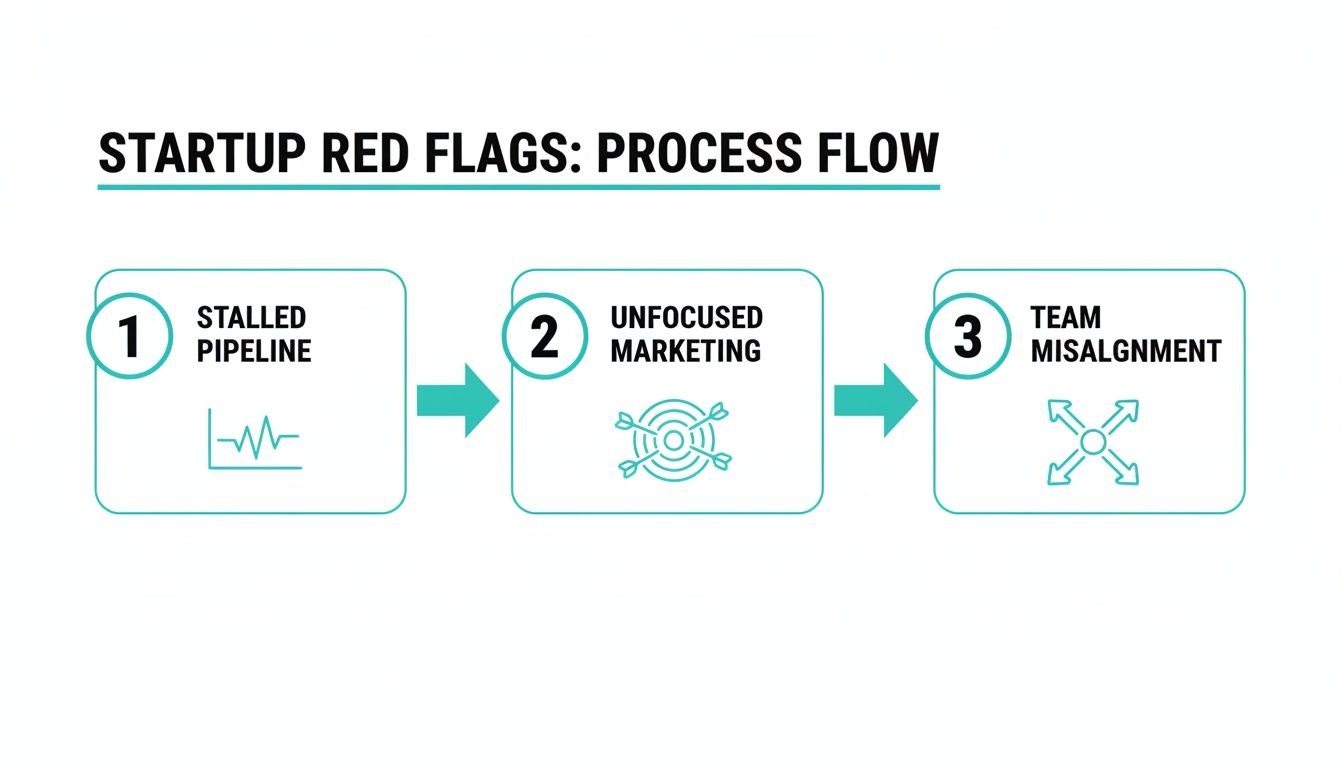
As you can see, a stalled pipeline isn’t just a sales problem. It’s usually connected to unfocused marketing and a team that isn't on the same page—all things a cohesive strategy has to tackle at once.
Phase 2: Strategic Planning and Alignment
Once the problems are out in the open, it's time to build the roadmap. This is where the consultant facilitates those critical, sometimes tough, conversations with your leadership team to get everyone rowing in the same direction. The goal is to ditch the dozen competing priorities and focus on the one or two big moves that will actually make a difference.
Key deliverables from this stage often include:
- A Validated Ideal Customer Profile (ICP): A sharp, data-backed definition of your best-fit customer that sales, marketing, and product can all rally behind.
- A Documented Customer Journey Map: A visual map showing how customers find, evaluate, and buy from you, pinpointing the key touchpoints and moments of friction.
- A Vetted Tech Stack Recommendation: An audit of your current tools with clear advice on what to keep, cut, or add to make your team more efficient and your data more reliable.
- An Actionable Campaign Roadmap: A prioritized, quarter-by-quarter plan with clear owners, timelines, and success metrics. No fluff.
The most crucial output of this phase isn’t a document—it’s alignment. When every leader agrees on the "who, what, and why," execution becomes exponentially more powerful.
Phase 3: Execution and Momentum Building
Now it's time to turn strategy into action. A modern growth consultant doesn’t just hand you a plan and wish you luck. They stick around to help you get it done, often acting as a fractional leader to guide your team, manage initiatives, and keep the plan from getting derailed.
This hands-on support is what separates a great engagement from a good one. They help you build momentum by clearing roadblocks, coaching your team, and making sure the small wins stack up into real progress. This need for actionable strategic guidance is why the global strategy consulting market, valued at USD 81.51 billion in 2025, is projected to more than double to USD 163.26 billion by 2033. Businesses are hungry for external expertise that can navigate complexity and actually execute. You can discover more insights about the strategy consulting market on snsinsider.com.
So, what does an engagement actually look like? The right model depends entirely on your needs. A quick diagnostic might be enough for some, while others need long-term leadership to see things through.
Comparing Growth Strategy Engagement Models
Choosing the right type of engagement is critical. This table breaks down the common models to help you decide what fits your immediate needs, timeline, and goals.
| Engagement Model | Best For | Typical Timeline | Key Deliverables |
|---|---|---|---|
| Ignition Plan | Startups needing quick clarity and a prioritized action plan to fix an immediate problem like a leaky funnel. | 2-4 Weeks | A diagnostic report, a validated ICP, and a 90-day execution roadmap. |
| Alignment Sprint | Companies with leadership misalignment on strategy, target customers, or technology investments. | 4-6 Weeks | Facilitated workshops, a unified GTM strategy, a vetted tech stack, and an aligned roadmap. |
| CMO Accelerator | Businesses needing ongoing strategic leadership to guide their team, manage execution, and build a scalable growth engine. | 6-12+ Months | End-to-end strategic leadership, budget planning, team coaching, and campaign oversight. |
Whether you need a quick fix or a long-term partner, the goal is the same: move from uncertainty to a clear, actionable plan that delivers measurable growth.
How to Hire the Right Growth Consultant for Your Startup
Picking a growth partner is one of the most important calls you'll make as a founder. This isn't just about hiring a contractor; it’s about bringing someone into your inner circle who can see your blind spots and find the hidden leverage in your business.
The right growth strategy consultant accelerates everything, while the wrong one burns through your cash and your team's morale. So, how do you find someone who actually knows B2B tech growth, not just talks a good game? You have to get past the slick decks and focus on their real-world track record with companies at your exact stage.
Key Criteria for Vetting a Consultant
Forget about being impressed by a big corporate logo on a resume. Growing a B2B startup is a completely different sport. You need a specialist who lives and breathes this stuff, not a generalist.
Here are the non-negotiables:
- Startup-Specific Experience: Have they worked with companies your size, in your industry, and at your funding stage? The playbook for a Fortune 500 company is useless for a Series A startup trying to nail product-market fit.
- A Bias for Action: The best consultants are player-coaches. They don't just hand you a strategy doc and walk away. They roll up their sleeves, get in the trenches with your team, and help you execute the first critical moves.
- Strong Diagnostic Skills: Can they quickly pinpoint the real reason you aren't growing? Their value comes from identifying the actual bottleneck, not just slapping a bandage on the most obvious symptom.
- Data Fluency: They need to be comfortable digging into your CRM, analytics, and financials to find the story the numbers are telling. Their recommendations must be backed by data, not just gut feelings or generic "best practices."
Insightful Interview Questions to Ask
Once you have a shortlist, the interview is where you separate the talkers from the doers. Get beyond the canned "tell me about yourself" questions.
The goal here isn't just to hear the right answers. It's to see how they think, how they solve problems, and if they have the confidence to challenge your assumptions.
Try these questions to get a real sense of their strategic depth:
- "Walk me through how you would diagnose our current growth challenges in the first 30 days." This peels back the curtain on their process. A great answer involves a mix of data analysis, customer interviews, and workshops with your team.
- "Tell me about a time a growth strategy you built failed or needed a major pivot. What did you learn?" This is a test for humility and adaptability. You want someone who has scars and has learned from them, not someone who claims to be perfect.
- "How do you balance building a long-term strategic foundation with the need for short-term wins?" Startups die without momentum. This question reveals if they understand how to deliver immediate results while still building for the future.
- "What specific KPIs would you use to measure the success of our engagement?" A vague answer here is a huge red flag. They should immediately start talking about metrics like pipeline velocity, customer acquisition cost (CAC), and lead-to-customer conversion rates.
Demystifying Common Pricing Models
Knowing how consultants structure their fees is critical to making a smart financial decision. The demand for sharp strategic advice is high. In the US alone, management consulting revenue has grown at a 3.7% CAGR over the last five years, with strategy work leading the pack. For B2B founders, these numbers highlight a massive market for this kind of guidance. You can learn more about management consulting market trends.
Here’s a breakdown of the three models you’ll see most often:
- Retainer: You pay a fixed monthly fee for ongoing access and strategic guidance. This works best for longer-term engagements where you need continuous leadership and support.
- Project-Based: A flat fee for a specific, time-bound project, like building a go-to-market strategy or running a customer research sprint. It's ideal when you have a well-defined problem you need solved.
- Fractional: This is a hybrid model, usually on a retainer, where the consultant acts as a part-time member of your executive team (like a Fractional CMO). It’s perfect for startups that need senior-level expertise without the full-time executive price tag.
The right model really depends on your budget, timeline, and the specific challenge you’re trying to tackle. Be upfront about your goals to make sure the pricing aligns with the results you expect.
Consultant vs. Agency vs. Full-Time Hire
When you know you need serious marketing leadership, you hit a fork in the road. Do you hire a consultant, sign with an agency, or start the long, expensive hunt for a full-time executive? Each path has its perks, but the right answer for your startup hinges on what you need most right now: cost, speed, or deep-seated ownership.
Figuring this out isn’t just about comparing price tags. It’s about matching the right model to your specific growth stage. Let’s break down how these options really differ so you can make a smart, capital-efficient call for your business.
The Fractional Expert: Your Agile Strategist
Hiring a growth strategy consultant, usually on a fractional basis, is like bringing in a seasoned film director to fix a single, crucial scene. You get C-suite expertise aimed squarely at your biggest problem—maybe a leaky pipeline or a muddled go-to-market plan—without the C-suite salary or long-term baggage.
This model is built for speed. Consultants diagnose the issue, draw up a roadmap, and often help execute the first critical steps, all on a set timeline. Their whole game is transferring knowledge, mentoring your junior team, and getting your internal engine running smoothly so they can step away. It’s the perfect fix for bridging a leadership gap or getting an objective take from someone who’s solved your exact problem a dozen times before.
The Marketing Agency: Your Execution Engine
A marketing agency is your tactical army. They’re the specialists you bring on to do the work: run your ad campaigns, manage your social feeds, or handle your SEO. While some agencies talk strategy, their real strength—and their business model—is built on executing specific channels at scale.
This is a great move when you already have a clear strategy and just need more hands on deck to make it happen. But if your strategy is fuzzy or your leadership is out of sync, an agency can easily burn through your budget, spinning its wheels on tactics that don't ladder up to a real business goal.
The Full-Time Hire: Your Long-Term Owner
Bringing on a full-time executive, like a VP of Marketing or a CMO, is a massive long-term investment in your company’s DNA. This person gets deeply woven into your culture, owns the marketing function from top to bottom, and is responsible for building and leading a team over several years.
This is the right play when you have product-market fit, a predictable revenue stream, and you’re ready to scale a permanent marketing department. It’s also the most expensive and slowest option. It can take 4-6 months just to find and hire the right person, not to mention the hefty salary and equity that come with the role. For an early-stage company, that commitment can be premature and incredibly costly.
The core difference is focus. A full-time hire owns the entire function, forever. An agency owns the execution of specific tasks. A consultant owns the diagnosis and solution for a specific strategic problem.
This shift toward specialized, outside help is only getting faster. While 84% of firms see their IT staff needs doubling in five years, an alarming 81% plan to lean more heavily on consultants first. As leaders look to fix pipeline issues with quick, KPI-driven sprints, the market is favoring agile consulting focused on AI, cloud, and risk management. You can read the full analysis on the global technology consulting market at consultancy.uk.
Making the right choice means being honest about what your business actually needs. Do you need more hands for execution, or a strategic brain to help steer the ship? If you’re looking for that strategic brain, check out our guide on the benefits of outsourced marketing.
Measuring the Real ROI of Your Growth Consultant
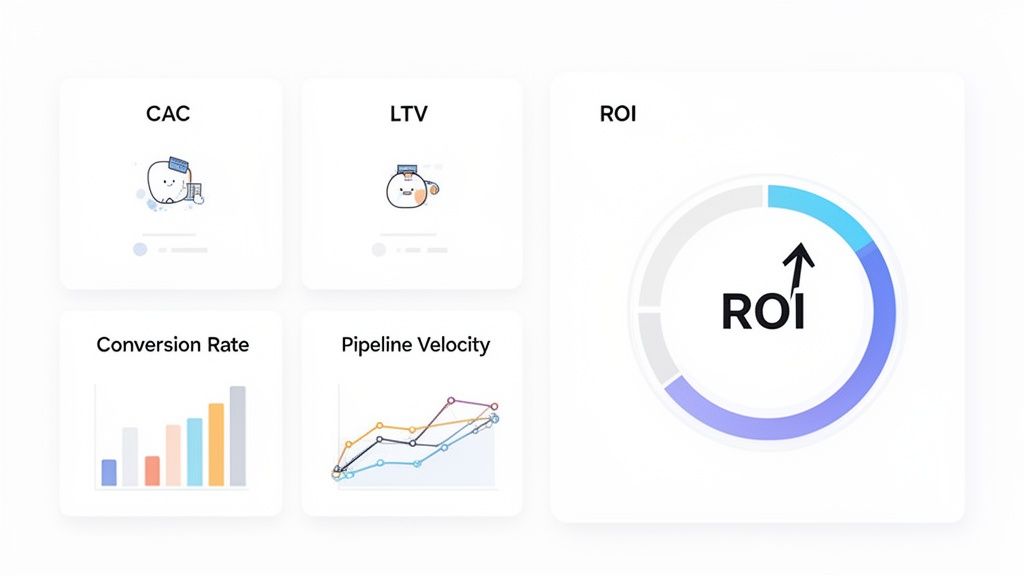
Hiring a consultant should never feel like a shot in the dark. A great growth strategy consultant makes sure every dollar you spend is tied directly to a measurable business outcome, turning what feels like an expense into a strategic investment in growth.
Think of your core metrics as the health indicators for your growth engine. The goal is to watch those numbers turn from red to green as your consultant finds and fixes the leaks. We've seen it happen time and again.
- A B2B startup saved $200K a year after a 40% reduction in CAC from smarter targeting.
- Another scale-up cut its deal cycle from 90 to 45 days by doubling its pipeline velocity.
- Lifting a lead-to-customer conversion rate from 15% to 25% drove a 67% revenue jump.
- Increasing LTV by 20% not only kept customers around longer but also widened profit margins.
These aren't vanity metrics. These are real wins tied to the numbers that matter: Customer Acquisition Cost (CAC), Lifetime Value (LTV), pipeline velocity, and conversion rates.
Tracking Core Metrics
So, how do you track this? To find your CAC, just divide your total sales and marketing spend by the number of new customers you brought in over a set period. A consultant who can slash that CAC by 40% is essentially freeing up a huge chunk of your budget to reinvest in other growth channels.
“Reducing CAC dramatically amplifies every dollar you reinvest into growth.”
LTV tells the other side of the story—how much a customer is worth to you over their entire relationship with your company. Doubling LTV without spending more to acquire customers is a direct hit to the bottom line. It's pure profit.
Analyzing Pipeline Velocity
Pipeline velocity is all about speed. It measures how quickly deals move from initial contact to closed-won. One startup we worked with saw its velocity double in just three months, simply by helping their sales team prioritize the highest-value leads first. That, combined with a higher lead-to-customer conversion rate, is how you tie funnel efficiency directly to revenue.
Here’s a simple four-step process to get started:
- Pull the raw data from your CRM and analytics tools.
- Calculate CAC: total spend divided by new customers.
- Measure LTV: average revenue per customer over their lifespan.
- Compute pipeline velocity: (# of opportunities × average deal size × win rate) ÷ sales cycle length.
Tracking these four numbers gives you a crystal-clear picture of your consultant’s impact.
| Metric | Before | After |
|---|---|---|
| CAC | $500 | $300 |
| Pipeline Velocity | 1.2 | 2.4 |
| Lead-to-Customer Conv | 15% | 25% |
| LTV | $8,000 | $10,000 |
Presenting Your Findings
Once you have this data, don’t keep it to yourself. Share it with stakeholders in simple reports or at quarterly meetings to keep everyone aligned and informed. For some helpful templates, check out our guide on measuring marketing ROI.
- Use live dashboards to track real-time CAC and LTV so you can spot trends instantly.
- Schedule monthly reviews to focus your team’s actions on the metrics that matter most.
- Customize reports to highlight wins in pipeline velocity and conversion rates.
- Set clear KPI targets each quarter to keep everyone accountable.
“Data clarity turns consulting spend into strategic growth.”
Understanding how to measure marketing ROI effectively is non-negotiable when you’re evaluating a consultant's performance. This guide offers some great strategies to sharpen your reporting.
Use this ROI framework to fuel a sustainable, long-term growth journey. By integrating these metrics into your planning and holding weekly KPI check-ins, you'll build and maintain unstoppable momentum.
Common Questions About Growth Strategy Consultants
Taking a step back and inviting outside eyes onto your business is no small decision. It’s only natural to have a few lingering questions before you commit to a growth expert. Below are the three biggest concerns founders raise—and clear, experience-based answers to guide your next move.
Can We Afford a Consultant?
It’s usually the very first question—and for good reason. But consider this: what’s the true cost of not tackling a sluggish pipeline or a misaligned team? Those hidden drains can siphon cash far faster than any advisor’s fee.
Here’s why bringing in a consultant is more of an investment than an expense:
- They aim to lower your Customer Acquisition Cost (CAC) and boost Lifetime Value (LTV).
- They compress sales cycles, putting revenue on a faster track.
- Flexible engagement models—like project‐based sprints or fractional support—unlock senior-level expertise without a full-time C-suite salary.
In most cases, you’ll see returns that dwarf the upfront cost within months, not years.
Why Not Just Hire a Full-Time Employee?
Once your growth blueprint is proven, bringing on a senior leader makes sense. But the reality? Finding, interviewing, and onboarding that person can stretch 4–6 months. In the meantime, gaps widen, momentum stalls.
A growth strategy consultant acts like a pit-crew specialist. They race in with proven tactics, fix the engine, and have you back on track in weeks. Unlike a full-time hire, they:
- Deliver an objective, outside perspective honed on dozens of B2B tech businesses
- Tackle your most pressing challenge right away
- Bridge the gap until you’re ready to expand internally
A consultant’s job is to tune the engine and hand you the keys. A full-time hire steps in to drive day after day.
What If We Disagree with Their Recommendations?
Disagreement can actually be a sign you’ve chosen a thoughtful partner. The best consultants don’t simply drop a deck on your desk and vanish. They:
- Collaborate through every phase—from initial diagnostics to roadmap creation
- Support recommendations with data, customer interviews, and market research
- Invite healthy debate, ensuring your team feels ownership of the final plan
If someone can’t back up their strategy with clear evidence, it’s a red flag. Your goal is alignment, not a one-sided mandate. The right consultant leaves your team energized, aligned, and ready to execute.
Ready to stop guessing and build a clear, actionable roadmap? The team at Value CMO brings senior-level strategic leadership to B2B tech startups, fixing pipelines, aligning teams, and scaling with confidence. Find out how we can help.