Staring at an empty sales pipeline is a gut-punch for any B2B tech founder. Let's be honest: traditional outbound tactics are losing their edge. A solid inbound lead gen strategy isn't just a "nice-to-have" anymore—it's the engine for predictable revenue. This is about attracting customers who are already looking for a solution like yours, not chasing them down.
The Shift From Hunting to Harvesting Leads
If your pipeline feels dry, you’re probably spending too much energy hunting. The old playbook of cold calls and email blasts is a numbers game with shrinking returns. It’s exhausting for your team and, frankly, annoying for your potential customers.
Inbound marketing flips the script. Instead of interrupting, you attract.
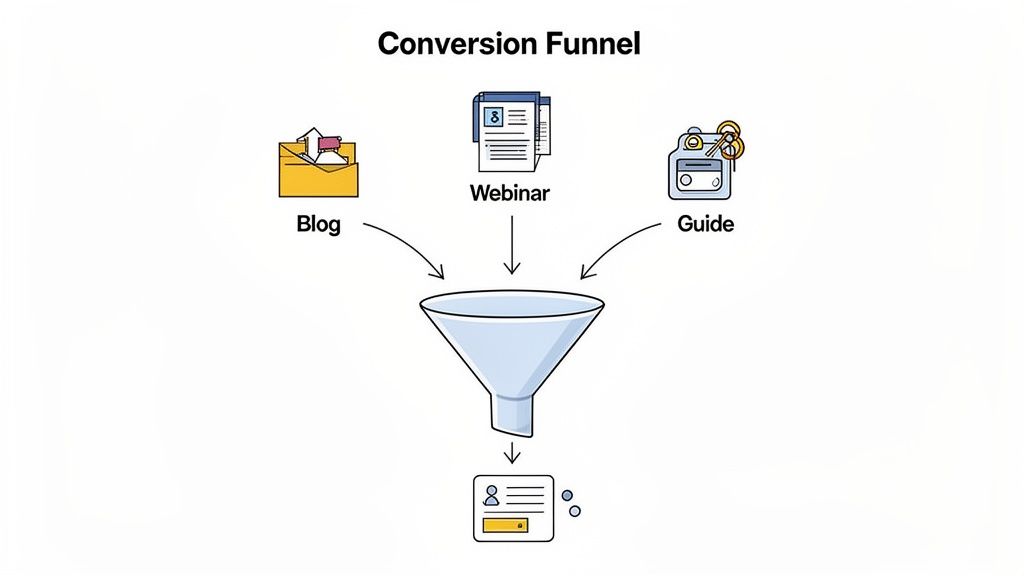
The whole idea is to become a magnet for your ideal customers. You do this by creating genuinely helpful content and experiences that solve their real-world problems. When a prospect finds you through a blog post that nails their issue, a webinar, or a practical guide, the conversation starts from a place of trust, not a hard pitch.
Why Inbound Lead Gen Just Works
The power of inbound comes down to a few core truths I've seen play out time and time again:
- You're Building Assets: Every article, video, or guide you publish is an asset. It works for you 24/7, pulling in visitors and leads long after you hit "publish."
- The Leads Are Better: Inbound leads are just flat-out more qualified. They sought you out, which means they already know they have a problem and are actively looking for a fix.
- Trust is Built-in: When you give value away first, you position your brand as a helpful authority, not just another vendor. This makes the eventual sales conversation so much warmer.
- It's More Cost-Effective: Over time, a well-oiled inbound machine generates leads at a much lower cost-per-acquisition than paid ads or outbound sales sprints.
The core concept is simple but powerful: Stop interrupting what people are interested in and be what they are interested in. This is the fundamental difference that turns a struggling pipeline into a thriving one.
To get that pipeline flowing, a tool like a lead generation chatbot can act as your 24/7 front-line qualifier, ensuring no interested prospect slips through the cracks. The entire system, visualized below, follows a simple, three-stage process.
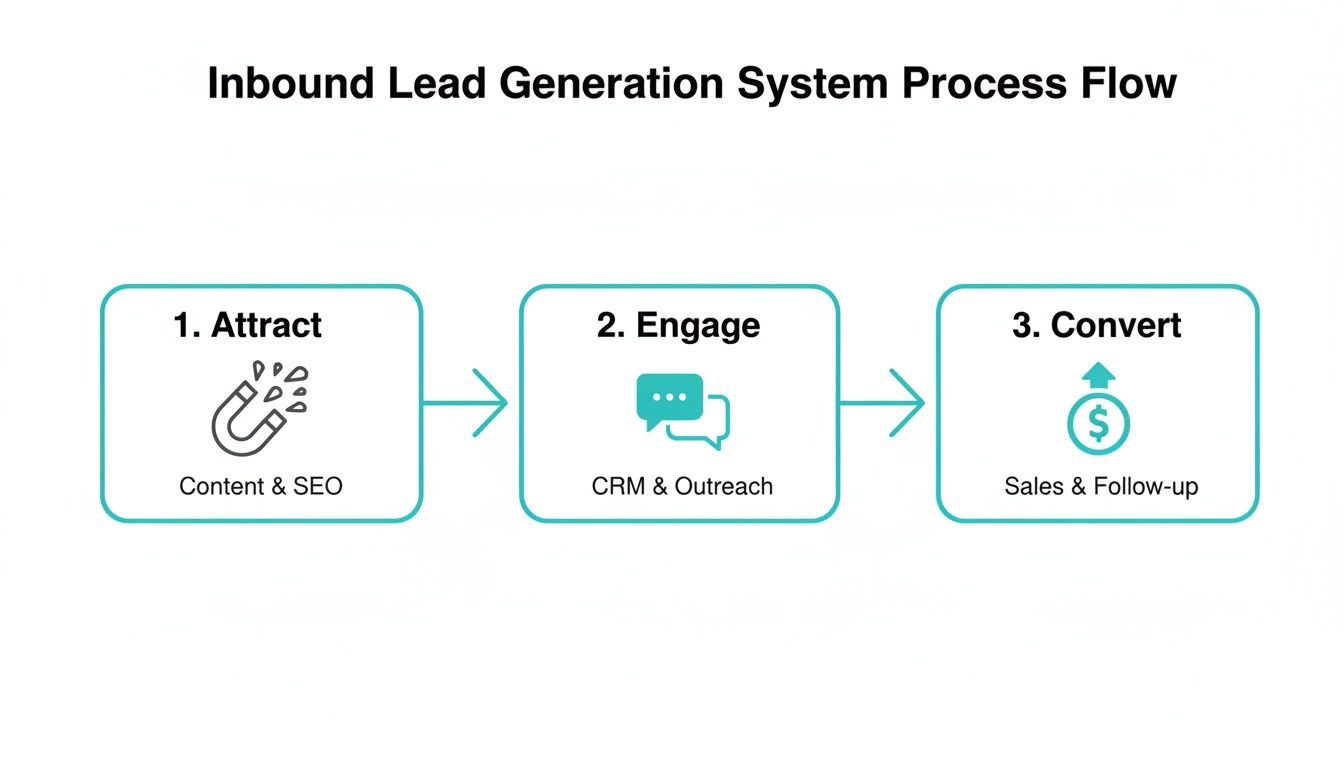
This isn't about a single tactic. It's about a connected system designed to guide prospects from their first moment of awareness all the way through to a purchasing decision.
Pinpointing Your Ideal Customer and Their Journey
Every powerful inbound strategy starts with a simple, brutal truth: if you’re talking to everyone, you’re talking to no one. Before you write a single blog post or launch a single ad, you need an almost obsessive understanding of who you’re trying to reach. This is the step most B2B startups either rush or skip entirely—and it’s precisely why their content never quite lands.
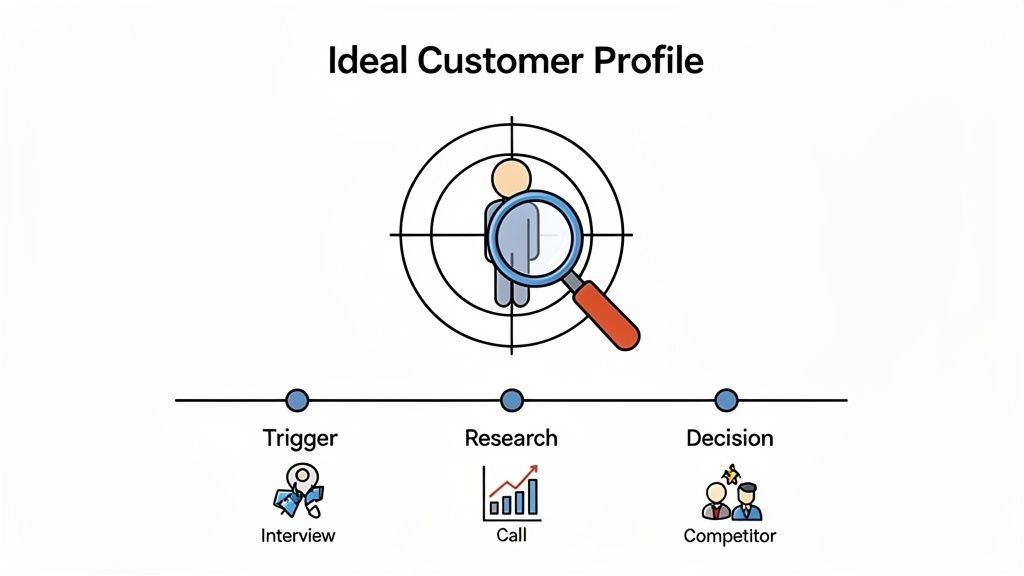
We're not talking about a vague persona with a stock photo and a cute name. We need to build a data-informed Ideal Customer Profile (ICP). Think of it as a living document that describes the exact type of company that feels the pain you solve most acutely and will get massive value from your solution.
Building Your Ideal Customer Profile
Your ICP isn't a guess; it's a conclusion drawn from real data. It goes way beyond simple firmographics like company size and industry. A strong ICP identifies the companies that are not just a good fit, but the best fit—those with the highest success potential and lifetime value.
So, where do you find this clarity?
- Your Best Customers: Look at your happiest, most successful clients. What do they have in common? Maybe it’s their tech stack, their growth stage, or the internal chaos they were facing right before they found you.
- Sales Team Feedback: Your sales reps are on the front lines. They know which leads are a dream to work with and which are a dead end. Get their intel on the common questions, objections, and "aha!" moments that signal a great fit.
- Customer Interviews: Just talk to your customers. Ask them about the "before"—what was so painful it forced them to start looking for a solution? What alternatives did they consider? Their language is your best source for marketing copy.
Putting this all together gives you a sharp, focused target. To see a practical framework for this, check out our guide on creating a detailed Ideal Customer Profile template that goes beyond the basics.
An ICP is your strategic filter. It tells you who to obsess over and, just as importantly, who to ignore. Chasing everyone is a surefire way to connect with no one.
Mapping the Buyer's Journey
Once you know who you're talking to, you need to understand how they buy. The B2B buyer's journey isn't a straight line from A to B. It’s a winding path of questions, research, and internal politics. Your job is to show up with the right answer at every turn.
Mapping this journey means getting inside their head. I like to think of it as a three-act play.
Act 1: The Trigger and Awareness Stage
Something has to happen to kickstart their search. Maybe their current system breaks, they miss a revenue target, or a competitor launches something new. At this point, they aren't looking for your product—they're just trying to understand their problem.
They're asking questions like:
- "Why is our sales pipeline so unpredictable?"
- "How can we improve our lead follow-up time?"
- "What are the best ways to measure marketing ROI?"
Your content here should be purely educational. Blog posts, articles, and short videos that define their problem are perfect. You’re building trust by being the helpful expert, not a salesperson.
Act 2: The Research and Consideration Stage
Okay, now they’ve put a name to their problem and are actively hunting for solutions. They’re comparing different approaches, methodologies, and categories of tools. Their Google searches get way more specific.
They're looking for things like:
- "HubSpot vs. Marketo for startups"
- "Guide to implementing lead scoring"
- "Case studies for improving MQL-to-SQL conversion rate"
This is where you can start introducing your solution as a real contender. Your content needs more depth—think webinars, detailed guides, and comparison sheets that help them evaluate their options intelligently.
Act 3: The Decision Stage
Finally, they’ve narrowed it down to a shortlist. They’re ready to pull the trigger but are looking for that last piece of validation that they’re picking the right partner.
Their focus shifts to:
- "Product demos and pricing"
- "Customer reviews and testimonials"
- "Implementation support and onboarding"
Here, your content needs to seal the deal. Case studies, free trials, and demo videos provide the proof they need to feel confident. Nailing this path is how you build an inbound lead gen machine that feels helpful, not pushy.
Creating Content That Actually Converts
Content is the fuel for your inbound engine. But let's be clear: churning out generic blog posts is a fast track to burnout with an empty pipeline to show for it. The goal isn’t to make noise; it’s to become the most trusted, indispensable resource for your Ideal Customer Profile (ICP).
You have to shift your mindset from being a content factory to a strategic publisher. Every single piece you create needs to be a direct answer to a burning question your ICP is typing into Google, addressing a specific pain point you found when mapping their buyer's journey.
Building Your Content Pillars
Stop chasing random keywords. Instead, think in terms of "content pillars"—large, foundational topics that are central to your business and your customer's biggest problems. If you sell project management software, your pillars might be "Agile Methodology for Remote Teams" or "Resource Allocation and Planning."
From each pillar, you can then break out a dozen smaller, more specific topics. This approach keeps your content focused and builds topical authority, which is exactly what search engines reward.
Here’s a quick way to get started:
- List your ICP's top 5 challenges. What keeps them up at night?
- Turn each challenge into a pillar. These are now your core content themes.
- Brainstorm 10-15 specific questions for each pillar. These become your future blog posts, guides, and webinar topics.
This simple exercise takes you from reactive to proactive, building a library of assets that directly serves your business goals. For a deeper dive, check out some proven B2B content marketing best practices that fast-growing startups rely on.
Going Beyond the Standard Blog Post
While blog posts are the backbone of any inbound strategy, serious buyers crave depth. High-value formats are what separate you from the rest of the pack.
- Long-Form Guides: Think comprehensive, 3,000+ word deep dives that cover a topic from A to Z. They're magnets for backlinks and instantly position you as an authority.
- Webinars: A webinar lets you connect directly with dozens of prospects at once, answer questions in real-time, and show off your expertise. The numbers don't lie: 20-40% of webinar attendees typically become qualified leads.
- Original Data & Research: Survey your audience or analyze industry trends to produce a unique report. This is a power move. This kind of content gets shared widely and establishes you as a primary source of information.
The extra effort these bigger assets require pays off. We’ve seen content marketing deliver up to 62% cost savings while generating three times more leads than old-school methods. And blogs that exceed 2,000 words generate nine times more leads than shorter posts, proving that depth drives real results. You can find more stats on effective lead generation strategies at keywordseverywhere.com.
The question isn't "Should I create content?" It's "Am I creating content so valuable that my ideal customer would be at a disadvantage not to consume it?" That's the bar.
Mastering the Gating Strategy
Now for the million-dollar question: what do you give away, and what goes behind a form? Getting your gating strategy right is make-or-break for lead gen. Gate too much, and you create friction. Gate nothing, and you get traffic but no leads.
It’s a simple value exchange. You should only ask for an email address if what you're offering is truly worth it.
Here’s a simple framework I use:
| Content Type | Gating Strategy | Why It Works |
|---|---|---|
| Blog Posts & Articles | Ungated | Maximizes reach, builds SEO authority, and establishes initial trust. |
| Webinars & Events | Gated | The live, interactive format is a high-value experience. People get the trade-off. |
| Templates & Checklists | Gated | These are practical tools that solve an immediate problem. It’s a fair exchange for an email. |
| Ebooks & Whitepapers | Gated | In-depth content signals high intent. Anyone willing to download a 30-page guide is a serious prospect. |
The rule is simple: the more effort and unique value packed into a piece of content, the more justified you are in asking for contact information. Use ungated content to build an audience and gated content to convert that audience into leads you can actually talk to.
Choosing Your Channels and Building Your Tech Stack
You’ve built an incredible piece of content that speaks directly to your ideal customer's biggest pain points. Now what? The worst thing you can do is just let it sit on your blog, hoping someone stumbles upon it. Great content needs a great distribution plan.
Spreading yourself thin across every social media platform is a classic startup mistake. It’s a fast track to burnout with very little to show for it. Instead of being everywhere, you need to be exactly where your ICP spends their time.
The goal is surgical precision, not a shotgun blast.
Finding Where Your ICP Actually Lives
For most B2B tech companies, the answer isn’t complicated. You need to focus your energy on one or two core channels where you can build real momentum. Forget trying to master TikTok, Facebook, and X all at once. Go deep, not wide.
So, where do you start?
- LinkedIn is Your Home Base: For the vast majority of B2B tech, LinkedIn is non-negotiable. It’s the professional network where your buyers are actively discussing business challenges and solutions.
- Niche Communities: Where do your customers go to ask for advice? This could be specific Slack channels, industry forums, or Subreddits. Being a helpful voice in these communities is incredibly powerful.
- Industry Newsletters: Identify the top 3-5 newsletters your ICP reads every week. Engaging with these, either through sponsorship or by building relationships with the creators, can get you directly into their inbox.
The data backs this up. For B2B, LinkedIn is a powerhouse, with 44% of marketers ranking it as their top social platform for lead generation. It's the digital town square for your industry.
Your content distribution strategy shouldn't feel like a chore. It should feel like joining a conversation that's already happening. Find that conversation, add value, and you'll naturally attract the right people.
Building Your Lean Martech Stack
Now, let's talk about the engine that runs your inbound machine: your marketing technology stack. The term "martech" can be intimidating, conjuring images of complex dashboards and six-figure software contracts. But for a startup, it doesn't have to be that way.
You don’t need a dozen expensive tools to get started. In fact, you can build a powerful system for your inbound lead gen with just three core components. The key is to choose tools that are affordable, easy to implement, and can grow with you.
Here’s a quick look at the essentials.
Essential Martech Stack for B2B Startups
| Tech Category | Core Function | Example Tools for Startups |
|---|---|---|
| CRM | Your single source of truth for all lead and customer data. Tracks every interaction from first touch to closed deal. | HubSpot CRM, Zoho CRM, Pipedrive |
| Marketing Automation | The "brains" of the operation. Handles email nurturing, landing pages, lead scoring, and campaign workflows. | HubSpot Marketing Hub, ActiveCampaign, Klaviyo |
| Analytics | Measures website traffic, user behavior, and conversion rates to show you what's working and what's not. | Google Analytics, Hotjar, Mixpanel |
These three tools work together to create a seamless flow from the first touchpoint to the final sale, ensuring no prospect falls through the cracks.
Marketing automation, in particular, has become essential infrastructure. A staggering 91% of marketers believe it's critical for nurturing leads effectively. Even better, companies that implement automated lead nurturing report 10% revenue increases within 6-9 months. You can explore more about these trends and their impact on inbound marketing strategies at userguiding.com.
Getting your tech stack right is crucial. For more guidance on choosing the right platforms, you might be interested in our detailed look at building effective marketing tech stacks for growing businesses. A simple, integrated stack frees up your team to focus on strategy, not manual tasks.
Perfecting the Sales Handoff and Measuring What Matters
Getting a prospect to fill out a form is a milestone, not the finish line. The real magic—and where most inbound systems break down—happens in the moments right after that click. A clunky, slow, or misaligned handoff between marketing and sales is where countless valuable opportunities go to die.
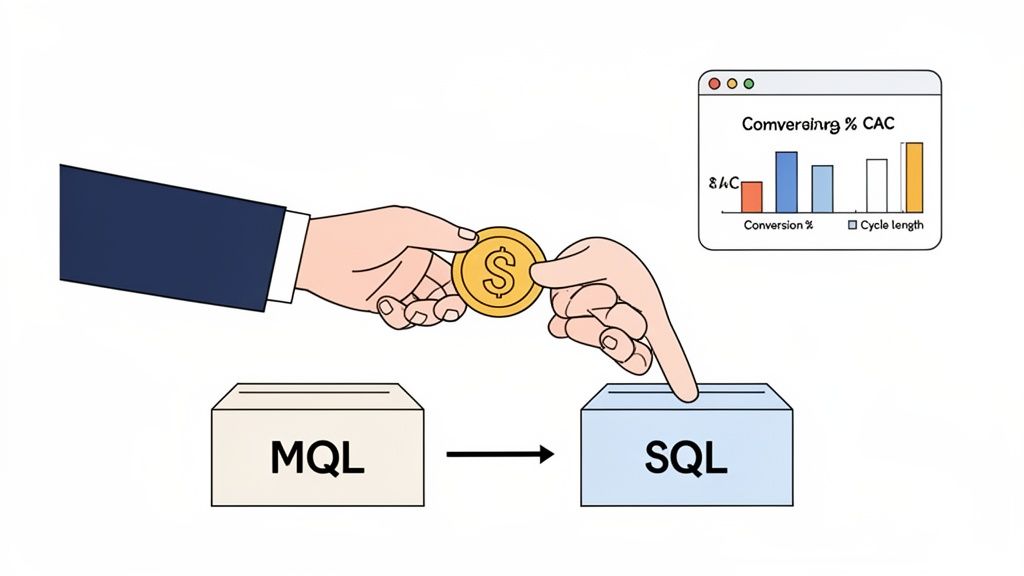
This whole process hinges on a shared language. Marketing and sales absolutely have to agree on the exact definitions of a Marketing Qualified Lead (MQL) and a Sales Qualified Lead (SQL). Without that universal understanding, you get a classic standoff: marketing celebrates leads that sales rejects, creating friction and burning cash.
Defining Your Lead Stages
The MQL-to-SQL handoff is the most critical moment in the entire customer journey. Nailing it starts with clear, mutually agreed-upon criteria.
Marketing Qualified Lead (MQL): This is a lead marketing has flagged as more likely to become a customer based on who they are and what they’ve done. They fit your ICP, downloaded an ebook, attended a webinar, or visited your pricing page multiple times. They've shown real interest.
Sales Qualified Lead (SQL): An SQL is an MQL that the sales team has accepted and personally vetted. They’ve confirmed the prospect has the budget, authority, need, and a realistic timeline (BANT) to actually make a purchase.
A lead isn't just a contact; it's a conversation waiting to happen. The MQL/SQL framework ensures you’re only passing the conversations that are truly ready, letting sales focus on closing, not chasing unqualified prospects.
Think of it like a relay race. Marketing runs the first leg, building momentum. The handoff to sales has to be perfect—no fumbled batons.
Prioritizing Leads with Scoring and Speed
Not all MQLs are created equal. Someone who downloaded an introductory guide is miles behind a director-level contact from a target account who just watched your full product demo. This is where lead scoring becomes your secret weapon.
Lead scoring is just assigning points to leads based on their attributes (job title, company size) and their actions (pages visited, content downloaded). When a lead hits a certain score, an automation can instantly ping the right sales rep. It’s a simple, data-driven way to make sure your sales team always focuses on the hottest prospects first.
Speed is just as critical. The data is clear: following up within 10 minutes dramatically boosts conversion. This isn't just a nice-to-have; it's a core principle. The average lead conversion timeline stretches 64.5 days from first touch to close, so every second counts. Companies that get this right see a 35% conversion lift, often by using AI to score and route leads instantly.
Measuring the Metrics That Drive Revenue
Traffic and social media likes feel good, but they don’t pay the bills. To really scale your inbound engine, you have to move beyond vanity metrics and focus on the numbers that reflect pipeline health and business impact. Once your handoff is smooth, it's time to obsess over the right lead generation KPIs.
Here are the core metrics every B2B tech startup should be tracking:
- Lead-to-MQL Rate: What percentage of raw leads are actually a good fit? If this is low, your content is probably attracting the wrong crowd.
- MQL-to-SQL Rate: This is the ultimate health check for sales and marketing alignment. A high rate means marketing is sending quality leads that sales agrees are valuable.
- SQL-to-Customer Rate: How efficient is your sales team at closing qualified conversations? This shows you what’s turning into actual revenue.
- Sales Cycle Length: How long does it take, on average, to turn a new lead into a paying customer? This helps you forecast revenue and spot bottlenecks.
- Customer Acquisition Cost (CAC): The bottom line. How much does it cost in total marketing and sales spend to acquire one new customer? Your goal is to see this number trend down over time.
These metrics give you a clear, data-driven view of your entire funnel. They’re what turn your inbound strategy from a series of disconnected activities into a predictable system for generating revenue.
A Few Questions I Hear All the Time
Even with a solid playbook, I get it—diving into a full-scale inbound strategy can feel like a big leap. It’s smart to have questions about how this all plays out in the real world. Let's tackle the ones that come up most often in my conversations with founders and marketing leaders.
How Long Until We Actually See Results?
This is always the first question, and the honest answer is this: patience is your most valuable asset. Inbound isn't like flipping a switch on a paid ad campaign where you see an immediate, if temporary, spike. You're not renting attention; you're building a long-term, compounding asset.
Realistically, you can expect to see early signs of life—like a noticeable uptick in organic traffic and better keyword rankings—within 3-4 months of consistent work. But generating a predictable, steady stream of truly qualified leads? That usually takes between 6 and 9 months.
The payoff for that patience is a sustainable, cost-effective lead source that gets stronger over time. You’re building an engine that frees you from the treadmill of constantly feeding an ad budget.
Think of it like planting a tree. The first few months are all about developing strong roots underground that no one sees. The real, visible growth comes later, but it’s built on that essential early foundation.
What’s the Biggest Mistake Startups Make Here?
The most common—and frankly, heartbreaking—mistake is giving up too soon. I've seen it happen countless times. A startup publishes a handful of amazing blog posts, doesn't see a flood of demo requests in week one, and then throws in the towel, declaring, "inbound doesn't work for us."
Inbound is all about momentum. Each piece of content you create adds to the last, building your authority and search footprint piece by piece. Quitting early is like stopping a flywheel just before it gains enough speed to turn on its own.
The second biggest mistake? Creating content that's all about your product features instead of your customer's problems. Your content should be 90% educational and 10% promotional. Solve their problems first. That earns you the right to sell them your solution later.
Should I Gate All My Content to Get More Leads?
Definitely not. I know it’s a tempting trap to fall into, but gating everything is a surefire way to kill your reach and annoy potential customers. A prospect who's just starting their research isn't ready to trade their email for a simple checklist. You have to earn that.
A balanced strategy is always the way to go.
- Keep Top-of-Funnel Content Open: Blog posts, short videos, and articles should always be free and easy to access. Their job is to attract the biggest possible audience, build awareness, and establish trust.
- Gate High-Value, Mid-Funnel Assets: Save the forms for your most valuable, in-depth resources. These are the assets someone would genuinely feel is a fair trade for their contact info.
Here’s a simple rule of thumb: If it’s a comprehensive ebook, an original research report, a detailed webinar recording, or a practical template, then you can confidently put it behind a form. This ensures you’re capturing contact information from people who have signaled real interest and intent.
Do I Need a Big Team or Budget to Get Started?
No, and that’s the real beauty of a smart inbound strategy. A small, focused team—or even a single dedicated marketer—can make a massive impact by being strategic and ruthlessly consistent.
You don't need to be everywhere. Start with one core channel where your ICP actually lives (for most B2B tech, that’s LinkedIn) and one content format you can execute exceptionally well. For example, commit to publishing one truly in-depth, high-value blog post a week and promoting it relentlessly on LinkedIn. That's it.
Your primary initial investment is time and brainpower, not a massive ad budget. You can always scale up your team and your efforts as the revenue and results start rolling in. The key is to start small, stay focused, and build that momentum.
At Value CMO, we specialize in building these focused, data-driven growth roadmaps for B2B tech startups just like yours. If you need senior marketing leadership to design and execute a practical inbound plan without the full-time overhead, let's talk about how we can accelerate your pipeline growth. Learn more at https://valuecmo.com.