A SaaS go-to-market strategy is your playbook for launching a product and turning it into a real business. Think of it as the nitty-gritty plan that gets your product, sales, and marketing teams aligned on who you’re selling to, how you’ll reach them, and what you’ll say to get them to buy.
Building a Rock-Solid Foundation for Your GTM Plan
Jumping into a SaaS launch without a solid go-to-market strategy is like setting sail without a rudder. You’ll just drift aimlessly. Before you even think about marketing channels or sales tactics, you have to build a rock-solid foundation. This is where you get brutally honest about what your product actually does and, more importantly, who it's for.

So many founders get caught up in the excitement of growth hacks and flashy campaign ideas. But if your foundation is shaky, all you’re doing is guaranteeing wasted effort and burned cash. Think of this as the strategic huddle before the big game—it ensures every move you make later on is deliberate and aligned.
Moving Beyond Generic Personas
First things first: you have to move past generic buyer personas and build a data-backed Ideal Customer Profile (ICP). An ICP isn't some vague description like "Marketing Mary." It’s a laser-focused profile of the company that feels the pain your SaaS solves most acutely and gets the most value from your solution.
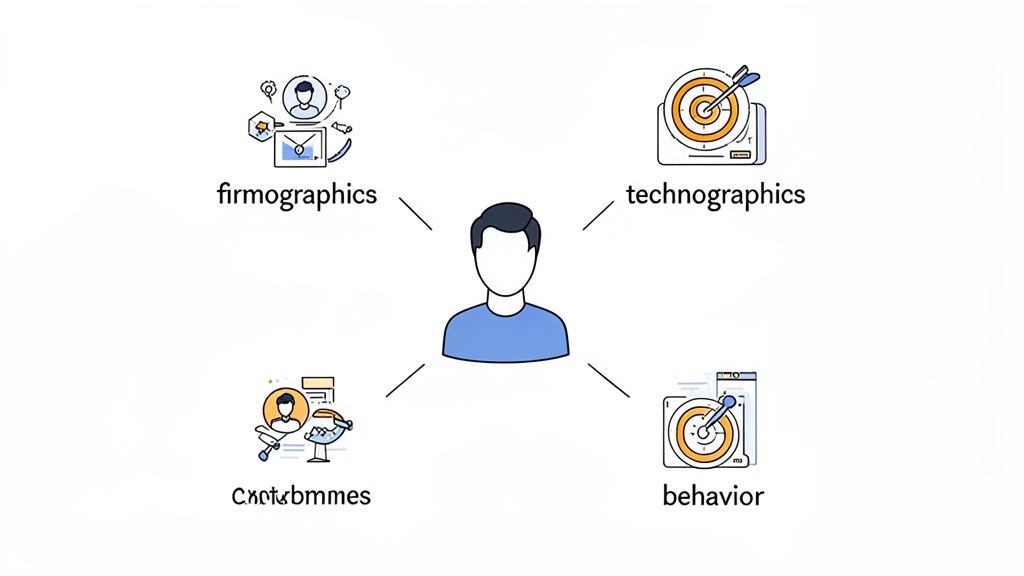
A strong ICP is built on real data that signals a perfect fit. You'll need to dig into:
- Firmographics: What's the company size? What industry are they in? Where are they located?
- Technographics: What other software are they already using? Does their current tech stack have a gap your product can fill?
- Behavioral Signals: Are they hiring for roles your software supports? Did they just land a new round of funding?
Getting this level of detail transforms your ICP from a theoretical exercise into a practical targeting machine. Suddenly, your entire GTM motion—from ad targeting to sales outreach—becomes razor-sharp.
A well-defined ICP is the north star for your entire go-to-market strategy. When you know exactly who you're selling to, every decision—from product features to marketing copy—becomes exponentially clearer and more effective.
Carving Out Your Space in the Market
Once you know who you're talking to, the next challenge is figuring out what to say. This is where product positioning comes in. Positioning is all about carving out a unique and memorable space for your product in a crowded market. It’s the answer to the question: "Why should my ideal customer choose us over everyone else?"
To nail this, you have to be brutally honest about your unique strengths. Are you the fastest? The most secure? The easiest to use? Trying to be everything to everyone is a recipe for being nothing to anyone.
For example, say you’re building a project management tool. You’re up against giants. Instead of a generic claim like "the best project management tool," you could position yourself as "the project management tool built for asynchronous remote teams." That kind of specificity immediately tells a key market segment that you built this just for them. A great way to see this in action is to study powerful product-led growth examples where the product’s value does the talking.
Crafting a Value Proposition That Clicks
Your positioning directly feeds into your value proposition—the clear, concise promise of value you deliver. A killer value prop resonates instantly with your ICP. It’s not a slogan or a list of features; it’s the tangible outcome a customer gets by using your software.
Put your claims through the "so what?" test.
Your product has AI-powered analytics. So what?
So customers can cut down reporting time by 50%.
Your platform integrates with 100 other apps. So what?
So teams can consolidate their workflow into a single hub, saving hours every week.
This foundation—a sharp ICP, clear positioning, and a compelling value proposition—is the bedrock of any successful SaaS go-to-market strategy. As we cover in our guide on creating a B2B marketing strategy framework, getting these fundamentals right is non-negotiable. Without them, you're just guessing. With them, you have a plan.
Pinpointing Your Ideal Customer and Crafting Your Message
Your Ideal Customer Profile is way more than a slide in a pitch deck; it's the engine driving your entire SaaS go-to-market strategy. When you know exactly who you're building for and selling to, every decision—from product to pricing to sales outreach—gets sharper and more effective.
This is where we get practical and move past vague demographics.
We're going to dig into the real-world signals that point to a company that feels the pain your SaaS solves most acutely. Once that picture is crystal clear, we can build a message that actually connects.
Defining Your ICP Beyond the Basics
Forget fluffy personas. A powerful ICP for B2B SaaS is a detailed spec sheet of the company that is a perfect fit for your product. To do this right, you need to look beyond the surface level and analyze a few key data categories that predict success.
Firmographics: This is your baseline. Think company size (either employee count or revenue), their specific industry or vertical, and geographic location. For example, a fintech compliance tool might target U.S.-based financial services companies with 50-250 employees.
Technographics: What technology are they already using? A company that has already invested in a sophisticated CRM like Salesforce is a much better fit for your advanced sales analytics tool than one still fumbling with spreadsheets. Tools like BuiltWith can peel back the curtain on a prospect’s tech stack.
Behavioral Signals: These are the buying-intent indicators that tell you someone is in-market. Are they hiring roles that would use your software? Did they just announce a new round of funding? Are their execs talking about the specific challenges your product solves on LinkedIn?
These layers transform your ICP from a static document into a dynamic targeting tool. You're not just looking for companies of a certain size; you're looking for companies of a certain size that use a specific CRM and just hired a new VP of Sales.
For a deeper dive, check out this excellent ideal customer profile template and guide.
From Features to Outcomes in Your Messaging
Once you know who you’re talking to, the next challenge is figuring out what to say. Here’s a hard truth I’ve learned over the years: your customers don’t really care about your product’s features. They care about what those features do for them.
Effective messaging translates your product's functionality into a customer's achievement. It’s the bridge between "what it is" and "what I get."
A simple but powerful exercise I use is the "So What?" test. Every time you list a feature, ask "so what?" until you land on a tangible business outcome.
Here’s how it works:
Let’s say you have a feature like "AI-powered contract analysis."
- Feature: AI-powered contract analysis. (So what?)
- Advantage: It automatically flags risky clauses and missing terms. (So what?)
- Benefit: Your legal team can review contracts in 80% less time and slash your exposure to legal risk.
That last point—the quantifiable, tangible outcome—is what sells. That’s the core of your message.
Building a Consistent Messaging Matrix
To make sure your value proposition is communicated consistently everywhere, from your website to your sales decks, create a messaging matrix. It’s a simple framework that maps your key customer segments to their specific pain points and the corresponding benefits your product delivers.
| Customer Segment | Primary Pain Point | Feature | Benefit/Outcome | Key Message |
|---|---|---|---|---|
| Startup Founders | "I can't afford an in-house legal team for every contract." | AI-Powered Review | "Get enterprise-grade legal review without the overhead." | "Protect your startup with AI." |
| Scale-up GCs | "My team is a bottleneck during sales cycles." | Workflow Automation | "Accelerate deal velocity by cutting review time by 80%." | "Close deals faster, securely." |
This simple tool ensures your landing pages, email campaigns, sales demos, and social media posts all speak the same language. It guarantees that no matter where a potential customer finds you, they hear a clear and compelling story about the value you create—specifically for them.
Designing a Pricing Model That Drives Adoption
Pricing is one of the most powerful—and most misunderstood—levers in your entire go-to-market strategy. Get it right, and you create a smooth path to adoption and revenue. Get it wrong, and you can kill your growth before you even get started, no matter how great the product is.
The goal here isn't guesswork. It's about building a strategic framework that feels fair to your customers, scales with their success, and maximizes your revenue without creating a bunch of friction.
From Cost-Plus to Value-Based Pricing
The old way of thinking was cost-plus pricing: figure out your costs, tack on a margin, and call it a day. That model is completely broken for SaaS. The real key is value-based pricing, where your price is directly tied to the tangible business results your customers get from your product.
This forces you to have a deep, almost uncomfortable understanding of your Ideal Customer Profile. What's the measurable outcome they're achieving with your tool? Are they saving time, cutting operational costs, or driving more revenue? Your pricing tiers need to be a direct reflection of that value.
A marketing automation platform, for instance, might tie its pricing to the number of contacts in a customer's database. This works perfectly because as the customer grows their audience (and their business), the value they get from the tool increases, easily justifying the higher price. Looking at different tiered pricing strategy examples can really help spark some ideas for your own model.
Structuring Packages for Natural Expansion
Your pricing packages shouldn't just be a menu of options. They should tell a story and guide your customer on a journey. A smartly designed tiered structure creates a natural upsell path, turning small initial accounts into major enterprise contracts over time.
Think about how you can align features with your customer's maturity level:
- Starter Tier: All about the core "aha!" moment. It's built for smaller teams or even individual users to get in and see the value quickly.
- Pro Tier: Adds the features that growing teams need—think collaboration, automation, and better reporting.
- Enterprise Tier: This is where you unlock the advanced security, compliance, and dedicated support that large organizations demand.
This structure lets customers start small, prove the value for themselves, and then expand their investment as their own needs and budgets grow. It aligns your success directly with theirs. We get into more detail on this in our guide to pricing and positioning.
Your pricing page is one of your most important sales assets. It needs to clearly communicate the value at each tier and make the decision to upgrade feel like the obvious next step for a growing customer.
Choosing the Right Pricing Model
Picking the right model is critical for cutting friction and hitting escape velocity. The top-performing B2B SaaS companies reach 1,000 subscribers in just 11 months, while the median company takes a full two years. A huge part of that is aligning the pricing with the GTM motion.
Companies with lower price points—under $25 per month—that go all-in on product-led growth see a median new business ARR growth of 20%. Compare that to 0% for those who add sales friction too early.
Here are the most common models:
- Freemium: You offer a free-forever plan with limited features to drive massive top-of-funnel adoption. This is great for products with network effects, but it can get expensive to support all those free users.
- Usage-Based: Customers pay based on how much they consume (e.g., API calls, data stored, minutes used). This model aligns cost directly with value and is a favorite for infrastructure and developer tools.
- Per-User, Per-Month: The classic SaaS model. It's simple and predictable, but it can create friction when a customer wants to add more team members and faces a big price jump.
The best choice always comes back to your product, your ICP, and the specific value you deliver. The ultimate goal is a pricing model that feels like a partnership, not a penalty, as your customers find success.
Choosing the Right Channels to Reach Your Customers
Your customers are definitely out there, but they aren't everywhere. A "spray and pray" approach is one of the fastest ways to burn through cash and team morale. This is where you get strategic, placing smart bets on a few channels instead of spreading your resources too thin.
The key is to match your GTM motion—how you actually engage and sell to customers—with your product, pricing, and ICP. It’s all about building an efficient, scalable distribution engine that works for your specific business, not a generic template.
Aligning GTM Motions with Your Business
Not all go-to-market strategies are created equal. The right approach for a simple, low-cost tool sold to SMBs will be a disaster for a complex, high-ticket platform sold to enterprise buyers. Understanding the dominant motions is the first step.
Here are the core GTM motions in the SaaS world:
- Product-Led Growth (PLG): The product itself is the main driver of acquisition, conversion, and expansion. Think freemium models and self-serve sign-ups where users see the value before ever talking to a salesperson. Slack and Calendly are the poster children for this.
- Sales-Led Growth (SLG): This is the traditional B2B sales model where a sales team actively finds, qualifies, and closes deals. It’s essential for complex products with high price points and long sales cycles, like those sold by Salesforce or Workday.
- Inbound-Led: This motion is all about creating valuable content (blogs, webinars, ebooks) to attract your ICP to you. You build authority and generate a steady stream of qualified leads who are already looking for a solution. HubSpot basically wrote the book on this.
- Account-Based Marketing (ABM): Instead of casting a wide net, ABM treats individual target accounts as markets of one. Sales and marketing teams collaborate to run highly personalized campaigns for a small list of high-value prospects.
The reality for most SaaS companies is a hybrid model. You might use inbound marketing to fuel your sales-led motion or have a PLG product with a sales-assist team to help convert larger, more valuable accounts.
Making the Right Choice for Your SaaS
Your product's complexity and average contract value (ACV) are the biggest factors in deciding which GTM motion to lead with. This decision tree is a great visual for how pricing models often line up with these factors.
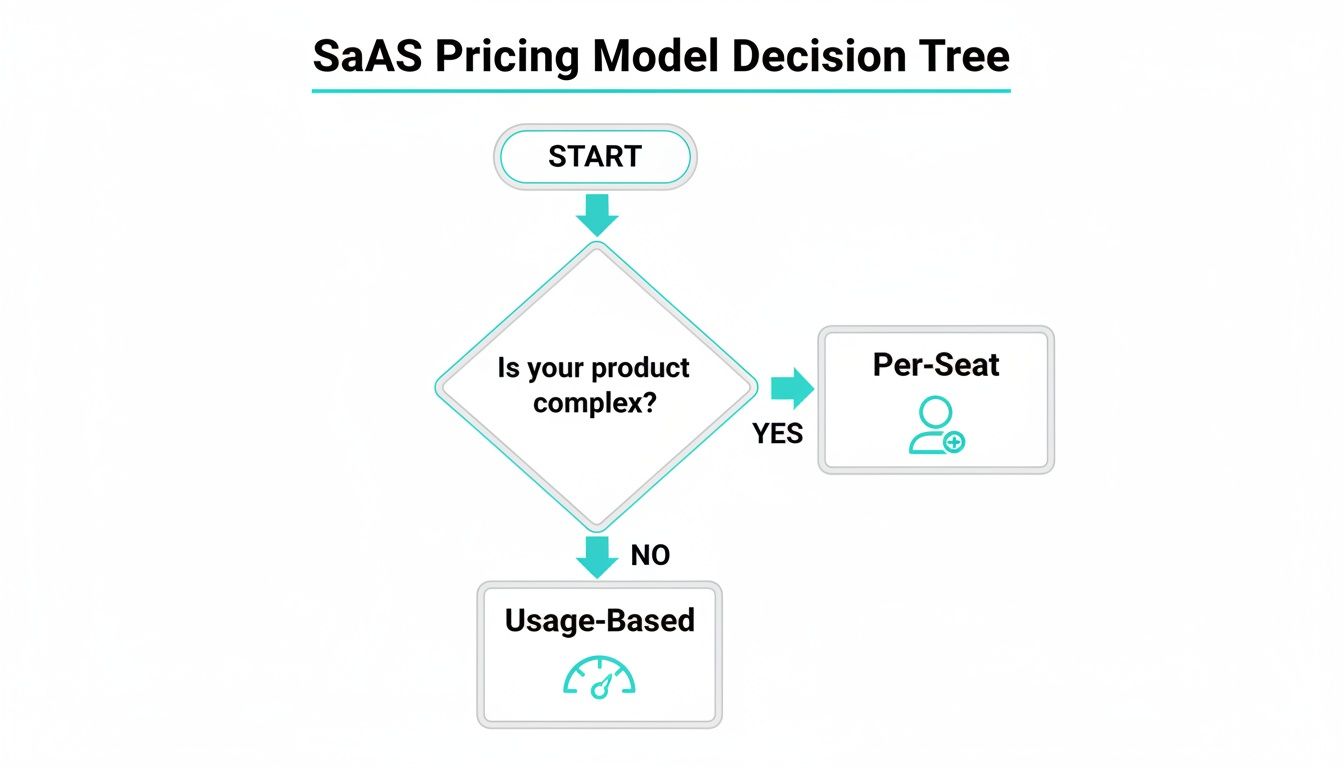
As you can see, more complex products often lean toward per-seat models, which are common in sales-led motions. Simpler, self-serve products can more easily adopt usage-based pricing, a hallmark of PLG.
Choosing the right primary motion is a crucial decision, especially when you look at the numbers. By 2026, B2B SaaS customer acquisition costs (CAC) have climbed to $2.00 per dollar of ARR, with sales cycles stretching to an average of 67 days. This economic pressure makes a capital-efficient GTM strategy absolutely essential.
Top-performing companies aim for a healthy LTV:CAC ratio of 3-4:1 and a payback period under 12 months. These numbers scream for precision. You can learn more from this breakdown of B2B SaaS GTM strategies.
To help clarify your decision, this table maps the primary GTM motions to their ideal ACV and complexity.
Choosing Your Primary SaaS Go-To-Market Motion
This table helps you align your product's Average Contract Value (ACV) and sales complexity with the most effective primary GTM motion.
| GTM Motion | Ideal ACV Range | Primary Customer | Key Success Metric |
|---|---|---|---|
| Product-Led (PLG) | < $5,000 | Individual Users & SMBs | Free-to-Paid Conversion Rate |
| Inbound-Led | $5,000 – $25,000 | SMBs & Mid-Market | Marketing Qualified Leads (MQLs) |
| Sales-Led (SLG) | $25,000 – $100,000+ | Mid-Market & Enterprise | Sales Qualified Opportunities |
| ABM | $50,000+ | Strategic & Enterprise Accounts | Target Account Pipeline |
While most companies eventually blend these approaches, picking a primary motion brings focus and clarity to your channel strategy.
Prioritizing Your Channels for Maximum Impact
Once you’ve picked your primary motion, you need to choose the specific channels where you’ll invest your time and budget. Don't try to be everywhere at once. It's a recipe for burnout. Start by focusing on just one or two channels you believe have the highest potential to reach your ICP.
The goal isn’t to master every channel. It’s to win decisively on the few channels that matter most to your ideal customers. Dominate one, then expand to the next.
To prioritize, run each potential channel through this simple filter:
- Audience Fit: Is my ICP actively spending time here? And are they in a mindset to discover solutions like mine? VPs of Sales are all over LinkedIn, but they probably aren't looking for new software while scrolling Instagram.
- Resource Alignment: Do we have the skills, budget, and time to execute well on this channel? A high-production video strategy is useless if you don't have a team that can create compelling content.
- Scalability: If this channel works, can we scale it? Cold email can be effective early on, but SEO offers much better long-term, scalable growth.
Answering these questions honestly moves you from a long list of possibilities to a short list of smart bets. Start small, validate your assumptions with data, and only double down on what works before you even think about adding another channel to the mix.
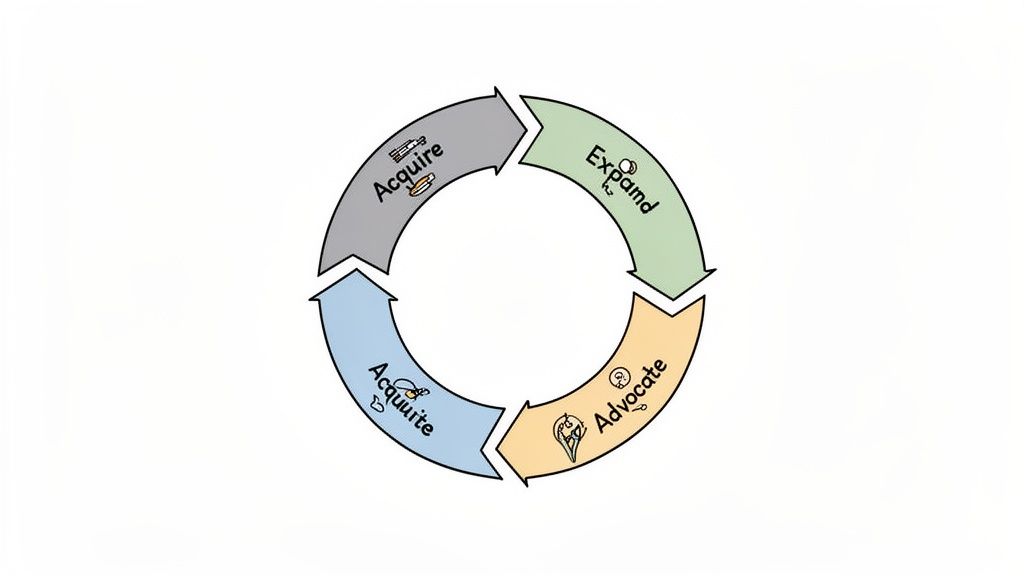
Building a Flywheel for Acquisition and Expansion
Getting a customer isn't the finish line; it’s the starting block. The smartest SaaS companies I've worked with know their biggest growth engine isn't just landing new logos—it's the customers they already have.
They engineer a growth flywheel where happy, successful users naturally create more revenue through retention, expansion, and advocacy. It’s about building a sustainable growth model where your existing customer base is your most valuable asset.
From Acquisition to Activation
The first critical handoff in the flywheel is from acquisition to activation. A user signup is a vanity metric. A user who actually experiences your product's core value? That's a growth metric.
Your goal is to get new users to their "aha!" moment as fast as humanly possible. This is that lightbulb moment when they truly get how your product makes their life easier.
To nail this, you have to be ruthless about optimizing your onboarding flow.
- Kill unnecessary steps: Does a new user really need to fill out 10 profile fields before they can use the main feature? Probably not. Cut the fluff.
- Give contextual guidance: Use smart in-app tours, checklists, and tooltips to nudge users toward the actions that deliver value.
- Celebrate the small wins: Acknowledge when someone completes a key setup task. A simple "congrats!" can go a long way.
A great onboarding experience doesn't just show off features; it guides people to value. This initial success is the spark that gets your flywheel spinning.
Turning Product Usage into Revenue Signals
Once users are activated, your product becomes your best salesperson. The trick is to instrument your product to spot Product-Qualified Leads (PQLs). These aren't just users who fit your ICP; they're users whose behavior screams they're ready to upgrade.
A PQL has already seen the value in your free or starter plan and is now bumping up against its limits.
What does this look like in the real world?
- A user on a free project management tool repeatedly tries to add a sixth team member when the limit is five.
- A customer on a basic marketing automation plan keeps visiting the landing page for your advanced analytics features.
- A team on a starter plan smashes their API call limit for three weeks straight.
These actions are massive buying signals. Set up alerts so your sales or customer success teams can jump in at just the right moment. This is how you turn product usage directly into revenue.
Don't just track what your users do. Track what they try to do but can't because of plan limitations. That's where you'll find your most qualified and easiest-to-close expansion leads.
Evolving Customer Success into a Revenue Engine
This intense focus on expansion has completely changed the role of Customer Success (CS). It's no longer just a support function for putting out fires. Today, CS is a proactive revenue engine laser-focused on driving Net Revenue Retention (NRR)—a metric that tracks revenue from existing customers, factoring in both churn and expansion.
The numbers are staggering. For top-tier SaaS companies, expansion revenue now drives over 50% of new ARR, with NRR targets hitting 110-120% or even higher. The new benchmark is for 40-60% of new annual recurring revenue to come from expansions—a strategy that's far faster and more cost-effective than chasing new logos. This reality flips the old growth playbook on its head.
As detailed in the 2026 B2B SaaS marketing blueprint, retention and upsells are now the core of a modern GTM strategy.
To make this shift, you have to equip your CS team to be strategic advisors, not just reactive problem-solvers. Their job is to make sure customers win, which naturally leads to deeper product adoption, bigger contracts, and powerful word-of-mouth.
Common SaaS GTM Questions, Answered
Even the best playbook hits reality at some point. Once you start executing your SaaS go-to-market strategy, the real work—and the real questions—begin. This is your quick-reference guide for the practical hurdles you’ll face along the way.
We'll tackle the most common queries B2B founders have, giving you clear, actionable answers to keep you moving forward. From measuring what actually matters to knowing when it's time to rip up the plan, let's get into it.
How Do I Measure GTM Success Beyond Vanity Metrics?
It's tempting to get excited about website traffic or a spike in social media followers. While those numbers aren't useless, they don't tell you if your go-to-market engine is actually working. You have to focus on the metrics that are tied directly to revenue and customer health.
These are the KPIs that need to be on your primary dashboard:
- Customer Acquisition Cost (CAC): The total cost of your sales and marketing efforts divided by the number of new customers. This tells you exactly how much you spend to land each new logo.
- Lifetime Value (LTV): This metric predicts the total revenue a single customer will bring in over their entire relationship with your company. A healthy SaaS business needs an LTV that’s at least 3x its CAC.
- CAC Payback Period: The number of months it takes to earn back the money spent to acquire a customer. For most B2B SaaS companies, the goal is under 12 months.
- Net Revenue Retention (NRR): This is arguably the most critical metric for any subscription business. It measures recurring revenue from your existing customers, factoring in upsells, downgrades, and churn. An NRR over 100% means your business is growing even without signing a single new customer.
Focusing on these numbers gives you an unflinching look at the health of your GTM strategy and helps you make smarter bets with your time and money.
Vanity metrics make you feel good. Revenue-centric metrics tell you the truth. Prioritize your LTV:CAC ratio, payback period, and NRR to know if your GTM strategy is truly working.
When Is the Right Time to Pivot My Strategy?
Pivoting can feel like admitting defeat, but sometimes it’s the smartest move you can make. The trick is knowing the difference between a temporary rough patch and a fundamental flaw in your approach. A real pivot isn't just tweaking an ad campaign; it’s changing a core assumption about your market, customer, or product.
Here are a few clear signals that it might be time to think about a pivot:
- Your Churn Rate Is Alarming: If you're losing customers almost as fast as you're acquiring them, that's a massive red flag. It often points to a disconnect between your marketing promise and the actual product value, or you're targeting the wrong ICP entirely.
- Your Sales Cycle Is Getting Longer: Are deals dragging on forever? Are win rates dropping? This could mean the market has shifted, or a competitor has changed the game. Your value proposition just isn't hitting hard enough anymore.
- You're Not Getting Traction: After a solid push (6-9 months), if you’re still struggling to get meetings, close deals, or even generate a flicker of interest from your ideal customers, you may have badly misjudged the market's need for what you're selling.
A pivot isn't a panic button—it's a data-driven course correction. Before you make a big move, dig into your metrics, talk to your customers (especially the ones you lost), and be brutally honest about what the numbers are telling you.
How Should I Structure My First GTM Team?
Your first GTM team structure depends heavily on your primary sales motion (product-led, sales-led, etc.) and your average contract value (ACV). For an early-stage B2B SaaS company, you don't need a massive department. You need a few versatile people who can wear multiple hats.
Here are a couple of common starting points:
For a Lower ACV / Product-Led Motion:
- Growth Marketer: This person owns the top of the funnel. They live and breathe content, SEO, and running experiments to drive sign-ups and user activation.
- Product Marketer: This role is the critical bridge between product and marketing. They own messaging, positioning, and user onboarding, all designed to get new users to that "aha!" moment fast.
- Sales-Assist / Customer Success: This person helps activated users on a free or trial plan see enough value to pull out their credit card. They also onboard new paying customers to ensure they stick around.
For a Higher ACV / Sales-Led Motion:
- Marketing Generalist: This individual handles demand generation—running webinars, creating lead magnets, and managing paid ad campaigns to fill the pipeline.
- Sales Development Representative (SDR): This person's job is to qualify inbound leads and hunt for outbound opportunities, booking qualified meetings for the Account Executive.
- Account Executive (AE): The AE is your closer. They run the demos, navigate the sales process, and are ultimately responsible for hitting revenue targets.
The key at this stage is agility. Hire people who are comfortable with ambiguity and obsessed with learning from the market. Your team will definitely evolve as you grow, but these core roles give you a solid foundation to build on.
At Value CMO, we help B2B tech founders build and execute a focused SaaS go-to-market strategy that drives real results. If you need senior marketing leadership to clarify your plan, accelerate your pipeline, and build a scalable growth engine, we can help. Learn more about our fractional CMO services.