Gone are the days when the Chief Marketing Officer just managed campaigns. Today’s CMO is a core growth engine in the C-suite, and their job is to own the entire customer journey and deliver real, measurable business growth. A great one connects product, sales, and the customer to create tangible company value.
The Modern CMO Is More Than a Marketer

Let’s get one thing straight: marketing is not the “arts and crafts” department. In the high-stakes world of B2B tech, the CMO is a revenue architect, not just a brand steward. They have a critical seat at the executive table because they are accountable for growth. Simple as that.
Think of a CMO as the general contractor building a house. They don't lay every brick or hammer every nail themselves. Instead, they own the master blueprint, hire the right specialists (from content creators to data analysts), and are ultimately on the hook for delivering a valuable, functional structure on time and on budget.
This shift in perspective is everything. It moves the conversation away from isolated marketing tactics and toward integrated business strategy. The responsibilities of a CMO today go far beyond managing ads and social media posts.
A Strategic Business Leader
The best marketing leaders I know have a deep, almost intuitive, grasp of the entire business, not just their department. They have to be fluent in the language of finance, operations, and product development to be effective.
Their primary duties now revolve around:
- Driving Revenue Growth: Directly connecting every single marketing activity to the sales pipeline and closed deals.
- Owning the Customer Experience: Mapping and relentlessly improving every touchpoint a customer has with the company.
- Building a Data-Driven Culture: Using analytics to inform decisions, prove ROI, and uncover new market opportunities.
- Aligning the Organization: Making sure sales, product, and customer success teams are all working from the same playbook.
The most effective CMOs operate as business leaders first and marketers second. They translate market insights into company-wide strategy, making them indispensable to the CEO and the board.
A CMO's role is to bridge the gap between what the company thinks the market wants and what the market actually values. The table below breaks down the core pillars of their responsibilities, separating the high-level strategy from the day-to-day execution that makes it all happen.
Core Pillars of the Modern B2B Tech CMO
| Strategic Pillar | Core Responsibilities |
|---|---|
| Market & Customer Intelligence | Define Ideal Customer Profile (ICP), map buyer journeys, conduct competitive analysis, and identify market trends. |
| Brand & Positioning | Craft the company’s core narrative, establish market positioning, and ensure brand consistency across all channels. |
| Revenue Architecture | Design the end-to-end demand generation engine, set pipeline targets, and align marketing spend with revenue goals. |
| Data & Technology | Build and manage the martech stack, establish key performance indicators (KPIs), and create a single source of truth for reporting. |
| Team & Organizational Alignment | Recruit and develop marketing talent, foster collaboration with Sales and Product, and champion a customer-centric culture. |
Ultimately, these pillars work together. The strategy sets the direction, but the operational duties are what turn that vision into pipeline and revenue.
The CMO Mandate in a Changing World
The pressure on marketing leaders has never been higher. With global marketing spend projected to hit $1.3 trillion by 2026, the CMO’s ability to allocate these massive resources effectively is under intense scrutiny. It's no wonder that leading CMOs who successfully turn data insights into actionable strategies deliver 79% greater total shareholder value compared to their peers. That number alone shows the staggering impact a truly strategic marketing leader can have on the bottom line. Discover more insights on the CMO's evolving role.
At the end of the day, the CMO is the executive most responsible for understanding the customer and the market. They take that understanding and use it to build a scalable engine for growth, making them one of the most vital roles in any modern B2B tech company.
Balancing Strategy and Operations
A great CMO lives in two worlds at once: the 30,000-foot view of strategy and the boots-on-the-ground reality of operations. It’s a constant balancing act, and it’s one of the most misunderstood parts of the job.
I like to think of it like being a film director. The director has the grand vision—the story, the tone, the emotional arc. That’s the strategy. But a vision means nothing if the cameras don't roll. That same director has to manage the actors, coordinate the crew, and make sure the whole production stays on schedule and on budget. That’s the operations.
A brilliant script with clumsy execution is a flop. So is a technically perfect film with no story. The two are inseparable. It’s the same for a B2B tech CMO. They have to own the blueprint (strategy) and manage the build (operations).
The Strategic Blueprint: The Why and What
Strategy is really just about making smart choices. It’s deciding where you’re going to play and how you’re going to win. For a CMO, this means answering the big-picture questions that give the entire marketing function its direction. Without a clear strategy, marketing devolves into a random mess of tactics that burn cash and time.
A CMO’s strategic responsibilities boil down to a few critical things:
- Defining Market Position: They need to nail down exactly what makes the company different and better than anyone else. This isn't just about a catchy tagline; it’s the core story that shapes every piece of content, every sales deck, and every product decision.
- Identifying the Ideal Customer Profile (ICP): The CMO owns the creation of a crystal-clear, data-driven picture of the perfect customer. Who are they? What are their biggest headaches? Where do they spend their time online?
- Crafting the Go-To-Market (GTM) Plan: This is the master plan for finding, engaging, and winning over your ideal customers. It details which channels to focus on, what messages will resonate, and how marketing’s efforts will directly fuel sales.
A great strategy is a filter. When a new "shiny object" marketing idea pops up, the CMO can hold it up against the strategy and ask, "Does this help us win with our ideal customer in our chosen market?" If the answer is no, it's an easy pass.
This kind of strategic thinking is what stops marketing from chasing trends. It ensures every dollar is put to work with purpose and gives everyone—from the CEO to the newest marketing hire—clarity on what the company is trying to achieve.
Operational Excellence: The How and Who
Once the blueprint is locked in, the focus shifts to execution. This is where the operational side of the CMO role takes over. A killer GTM strategy is just a PowerPoint deck if the team can't actually bring it to life.
The operational side is all about building the engine that delivers on the strategy. It’s where the “how” gets done.
Key operational duties include:
- Team Building and Leadership: A CMO has to recruit, coach, and lead a high-performing team. That means putting the right people in the right seats—whether that’s a content creator, a demand gen expert, or a product marketer.
- Technology and Systems Management: They're responsible for selecting and managing the marketing technology (martech) stack. This is everything from the CRM and automation platform to the analytics tools that measure performance. To see how these pieces fit together, it helps to understand the basics of marketing operations.
- Budget Management and Allocation: The CMO owns the marketing budget. They decide where to place the bets to get the highest impact and are responsible for proving a return on that investment.
- Campaign Execution and Oversight: While they aren’t personally running every campaign, the buck stops with them. They are ultimately accountable for making sure all marketing initiatives are on-brand, on-time, and on-budget.
In the end, strategy points to the destination, and operations build the vehicle to get you there. A world-class CMO doesn't just point to a spot on the map; they make sure the team has a reliable car, a full tank of gas, and a clear set of directions to follow.
How CMO Responsibilities Change with Company Growth
A CMO’s job isn’t static. The role shifts dramatically as a company grows, and what works at one stage can be a total disaster at the next.
I've seen this happen: a company hires a marketing leader with world-class scale-up experience for their seed-stage startup. It's a classic mistake. It's like asking a Formula 1 driver to navigate a muddy, winding backroad—their skills are impressive but completely wrong for the terrain.
Founders need to understand this evolution. It’s the key to hiring the right leader at the right time, setting both the CMO and your company up for a win. Each stage demands a different kind of marketing leader with a distinct focus, skill set, and mindset.
This diagram shows how a modern CMO balances high-level strategy and hands-on operations, a balance that changes as the company matures.
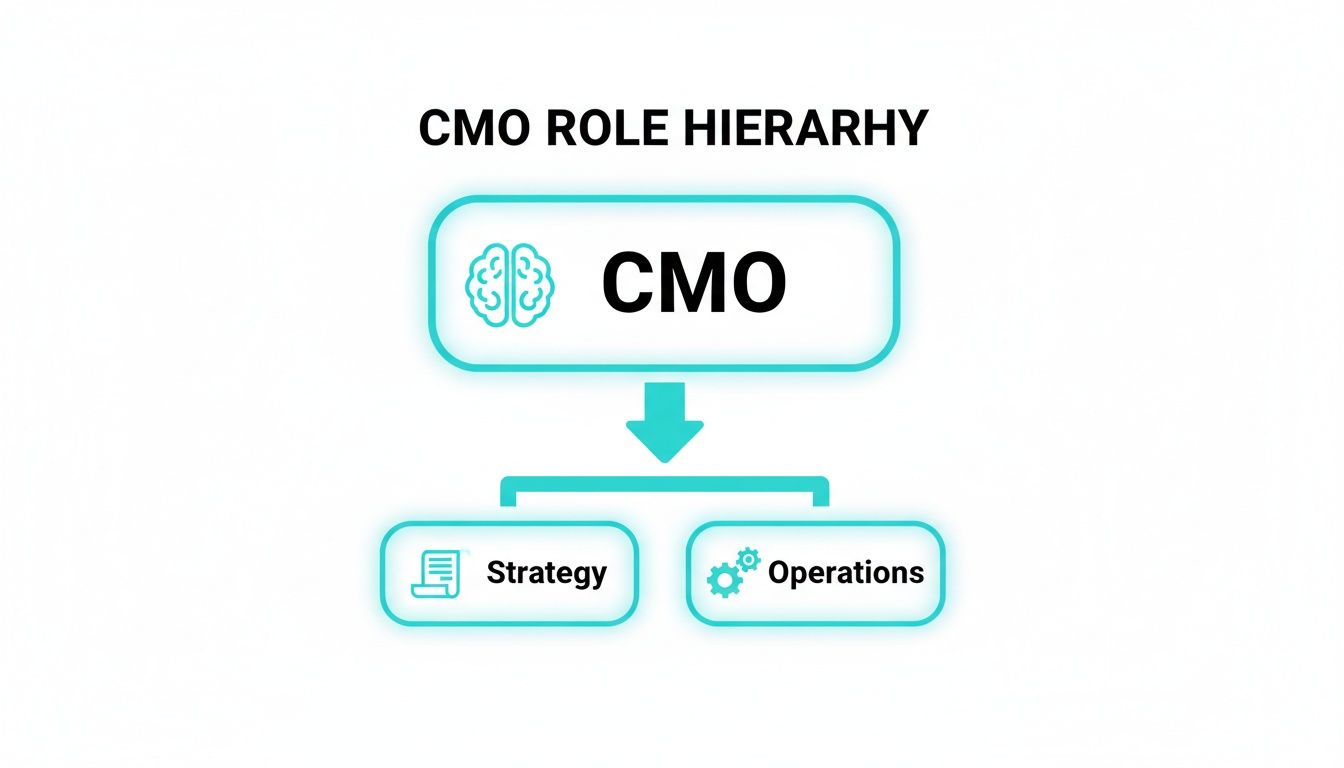
A great CMO has to own both the strategic "blueprint" and the operational "gears" that drive growth. The real trick is knowing which one needs more attention at any given time.
Here's a breakdown of how the CMO's priorities evolve, along with the key activities and metrics that define success at each stage.
| Company Stage | Primary Focus | Key CMO Responsibilities | Success Looks Like |
|---|---|---|---|
| Seed | Find Signal | Customer discovery, ICP validation, foundational messaging, running low-cost channel experiments. | Initial product-market fit, a handful of case studies, the first sparks of repeatable demand. |
| Series A | Build the Engine | Hiring the core team (demand gen, content), implementing a martech stack (CRM, automation), establishing KPIs, scaling proven channels. | A predictable pipeline, clear channel ROI, a scalable process for turning leads into customers. |
| Scale-Up | Optimize & Expand | Deep data analysis (CAC, LTV), improving channel efficiency, building a durable brand, market expansion, retaining top talent. | Lower CAC, higher LTV, strong brand equity, efficient growth, and a high-performing, stable team. |
As you can see, the job morphs from a scrappy generalist role into a sophisticated, data-driven leadership position. Let's dig into what that looks like in practice.
The Seed Stage CMO: The Pathfinder
In the very beginning, your marketing leader is a pathfinder. They are scrappy, hands-on, and totally comfortable with ambiguity. Their primary mission isn't to build complex, scalable systems—it's to find a signal in the noise.
The Pathfinder's world is all about experimentation. They’re laser-focused on answering fundamental questions: Who really is our customer? What’s the one core problem we solve better than anyone else? What message actually gets them to listen?
Key activities here are all about validation:
- Conducting customer interviews to nail down the Ideal Customer Profile (ICP).
- Creating foundational messaging and positioning that becomes the company’s story.
- Running low-cost experiments across different channels (think content, social, small-scale ads) to see what gets a bite.
- Generating the first case studies and testimonials to build that crucial early social proof.
The goal isn't a perfectly tuned marketing machine. Success is simply finding product-market fit and sparking the first embers of repeatable demand.
The Series A CMO: The Builder
Once you've found that initial traction and closed a Series A, the game changes. The mandate is clear: build a scalable, repeatable growth engine. This is where the Builder comes in.
This CMO is less of an experimenter and more of an architect. They take the early signals found by the Pathfinder and construct a formal marketing function around them. Their job is to turn those scrappy early wins into a predictable system for acquiring customers.
The Builder’s primary job is to create the marketing infrastructure—the people, processes, and technology—that can support 10x growth. They are laying the foundation for everything that comes next.
The Builder’s focus shifts to infrastructure and process:
- Hiring the core marketing team, often the first specialists for demand gen, content, and product marketing.
- Implementing a marketing technology stack, including a CRM and marketing automation platform.
- Establishing key performance indicators (KPIs) and building dashboards to track progress toward revenue.
- Formalizing the go-to-market strategy and pouring gas on the channels that proved effective in the seed stage.
A CMO at this stage is obsessed with creating processes that work. They are building the marketing playbook that will carry the company through its next phase of rapid growth. You can learn more about how to structure this team in our guide to building a B2B marketing team.
The Scale-Up CMO: The Optimizer
By the time a company is in scale-up mode, the marketing engine is running. The challenges are no longer about creation but about efficiency, optimization, and expansion. This stage demands an Optimizer.
This leader is deeply analytical and data-driven. They aren't just looking at leads and pipeline; they're dissecting customer acquisition cost (CAC), lifetime value (LTV), and channel ROI with surgical precision. Their goal is to make the entire growth engine more powerful and more efficient.
The Optimizer is a strategic leader who thinks about market expansion, competitive positioning, and building real brand equity. They're responsible not just for growing the business but for building a durable brand that can lead a category. Building and retaining a high-performing team also becomes a massive focus.
This is where navigating team dynamics becomes critical. Research shows that successful CMOs often have short tenures before moving to bigger roles—62% of CMO exits between 2021 and 2025 led to promotions or larger opportunities elsewhere, with 9% becoming CEOs. This trend highlights how the CMO role is now a launchpad for broader C-suite advancement, and it underscores the value of fractional services for coaching teams and providing senior leadership without a full-time hire.
Driving Revenue and Cross-Functional Alignment
In the modern C-suite, a CMO's worth isn't measured by clever campaigns or fuzzy brand metrics anymore. Today, they live and die by the numbers. The single most important job is drawing a straight, undeniable line from every marketing dollar spent to real business outcomes—especially revenue.
This isn't about looking busy; it's about proving impact. Think of the CMO as a portfolio manager for the company's growth investments. They can't just report on how many leads they generated. They have to show the actual return on those assets, measured in closed-won deals and customer lifetime value.
From Marketing Metrics to Boardroom Language
The board and CEO don't care about click-through rates or social media likes. They speak the language of business: revenue, profit, and market share. A top-tier CMO is a master translator, turning campaign data into a story the rest of the C-suite actually wants to hear.
This means obsessing over the metrics that reflect the company's financial health:
- Customer Acquisition Cost (CAC): How much do we spend to land one new paying customer? The CMO’s job is to drive this number down relentlessly.
- Lifetime Value (LTV): How much revenue will a customer generate over their entire relationship with us?
- LTV to CAC Ratio: This is the golden ratio. A healthy business usually sits at 3:1 or higher, proving that marketing is acquiring valuable customers efficiently.
- Sales Pipeline Contribution: What percentage of the sales pipeline did marketing source or influence? This shows marketing’s direct role in fueling sales.
- Marketing ROI: For every dollar we put into marketing, how many dollars of revenue came out? This is the ultimate proof of performance.
As more CMOs get saddled with direct revenue accountability, they need a system, not just a series of disconnected campaigns. That means implementing a modern B2B demand generation strategy designed to build a predictable, repeatable pipeline.
Building Bridges, Not Silos
Proving ROI with data is only half the battle. A CMO can't succeed alone. The best marketing leaders are expert collaborators who build strong alliances across the entire company. Marketing isn’t an island; it’s the central hub connecting sales, product, and finance.
Think of the CMO as a diplomat. Their job is to forge treaties and keep communication flowing between the key "nations" within the company.
A marketing leader who operates in a silo is a leader who is destined to fail. Cross-functional alignment isn't a "nice-to-have"; it's a non-negotiable requirement for sustainable growth.
These partnerships are where the real magic happens. By locking arms with other departments, the CMO ensures their team's efforts are amplified and directly tied to shared company goals.
The Critical C-Suite Partnerships
A CMO’s success is directly tied to how well they work with their peers. These relationships are the foundation of any successful growth strategy.
- The CFO (Chief Financial Officer): This is the CMO's most important ally. Together, they justify budgets with data-backed forecasts and prove the financial return on marketing spend. When marketing and finance are in sync, budget talks stop being a battle and start being a strategic conversation about growth investment.
- The Head of Sales: The friction between marketing and sales is legendary, but a great CMO turns it into a powerful partnership. They work together to define what a "qualified lead" actually is (using Service Level Agreements or SLAs), ensure a smooth handoff, and create tight feedback loops so marketing knows what’s actually converting into revenue.
- The CPO (Chief Product Officer): Marketing is the company's ear to the ground, gathering priceless customer insights from market research, win/loss calls, and campaign feedback. The CMO channels this intelligence back to the product team, helping shape the roadmap and ensuring they’re building something the market actually wants to buy.
This level of collaboration isn't optional. Recent data shows a key CMO responsibility is fostering this alignment, as 63% of marketing leaders say data clarity issues stop them from jumping on new opportunities. In a world where top performers generate 79% higher shareholder value by linking creative work to revenue, working closely with sales, product, and finance is the only way to win.
When a Fractional CMO Is the Right Answer
You know your growth stage, you see the need for a real marketing leader, but then reality hits. A full-time, heavyweight CMO—the kind who has scaled a company like yours before—is a massive investment. For most B2B tech startups, the six-figure salary, equity, and benefits are just not in the budget.
So what's the move? Hire a junior marketer and hope they figure it out? Let the founder keep running marketing off the side of their desk? This is a common trap, and it’s a dangerous one. This exact gap—needing senior strategy without the full-time cost—is where a fractional CMO becomes your secret weapon.
Think of it like renovating your kitchen. You wouldn't hire a full-time architect to live in your house. You'd bring in an expert to create the blueprint, guide the project, and let a skilled crew handle the build-out. A fractional CMO does the same thing for your marketing.

This model gives you instant access to top-tier strategic thinking on a part-time basis. It’s not a compromise. It’s a smart, nimble choice for tech companies that need to scale but also need to stay lean.
Identifying the Perfect Scenarios for a Fractional CMO
A fractional leader isn’t just a budget-friendly hire; they are a targeted solution for specific business pains. They step in to own the senior-level responsibilities of a CMO when bringing someone on full-time would be premature or impractical.
Here are the most common triggers for bringing in a fractional CMO:
- Your pipeline is flat or broken. If lead flow has stalled and the sales team is getting restless, a fractional CMO can diagnose the issue fast, rewire your demand gen engine, and get things moving again.
- Your junior marketing team is stuck. You have talented people, but they lack senior direction. A fractional leader acts as a player-coach, giving them the guidance needed to level up and execute with confidence.
- You're bridging a leadership gap. Your VP of Marketing just left, and you can’t afford to lose momentum during a long search. An interim CMO can step in, stabilize the team, and keep the strategy on track.
- You have a major product launch coming up. Getting a new product to market requires a disciplined go-to-market plan. An experienced operator can build and run the playbook to make sure you launch with real impact.
- You're building marketing from scratch. Moving from founder-led sales to a formal marketing function is a huge step. A fractional leader can lay the right foundation—ICP, messaging, channel plan, and budget—from day one.
A fractional CMO isn’t a consultant who drops off a strategy deck and disappears. They become part of your team, rolling up their sleeves to lead execution, manage people, and be accountable for results.
This approach delivers the strategic brainpower and operational muscle you need, right when you need it. You can get a deeper look at the role by exploring what a fractional CMO does in more detail.
The Strategic Advantages of Going Fractional
Opting for a fractional leader offers a lot more than just cost savings. For a growing B2B tech company, it provides a set of advantages that are perfectly tuned for speed and agility.
The benefits go way beyond the balance sheet. They're about getting the right expertise at the right time to solve your most immediate growth problems.
Here’s what you really gain:
- Speed to Impact: A seasoned fractional CMO can get up to speed and start adding value in days, not the months it takes to recruit and onboard a full-time exec. They’ve seen your challenges before and show up with a playbook ready to go.
- Unbiased, Expert Perspective: Because they aren't caught up in internal politics, a fractional leader gives you the unvarnished truth. They are laser-focused on one thing: hitting the goals you agreed on.
- Flexibility and Scalability: You can tailor the engagement to your exact needs. As you grow, you can dial their involvement up or down without the headaches of full-time employment changes.
- Access to a Wider Network: Great fractional CMOs bring a curated network of trusted freelancers, agencies, and tech vendors with them. This saves you the time and risk of finding and vetting partners yourself.
Ultimately, bringing on a fractional CMO lets a founder or CEO delegate the entire marketing function with confidence. It ensures a proven expert is handling the critical work, freeing you up to focus on product, fundraising, and running the business. It’s the smart way to get the marketing leadership you need to grow, without taking on unnecessary risk.
Your Top Questions About the CMO Role, Answered
Even after mapping out the modern CMO’s responsibilities, founders and CEOs still have questions. It’s a big hire, and the path isn’t always obvious. Let's cut through the noise with some straight answers to the questions I hear most often.
How Do I Know When It’s Time to Hire a CMO?
The most common trigger is pain. Simple as that. You know it’s time when the founder can’t be the one-person marketing department anymore and growth is starting to feel sluggish or unpredictable. It’s not about hitting a certain revenue number; it’s about hitting a complexity wall.
Look for these signs:
- Founder-Led Marketing Is Tapped Out: You're spending more time on marketing tasks than on your core job—vision, product, fundraising—and the results are getting shakier.
- Your Pipeline Is a Rollercoaster: One month is great, the next is a ghost town. There’s no repeatable process that feeds your sales team qualified opportunities they can actually close.
- Your Marketing Feels Random: You've got a blog post here, a LinkedIn ad there, but nothing connects. There's no unifying strategy, which means there’s no way to tell what’s actually working.
If that sounds painfully familiar, you've outgrown your current setup. You don't just need more tactics; you need a strategic leader to build a genuine growth engine. That's what a CMO is for.
What Should I Expect in the First 90 Days?
A great CMO doesn't walk in on day one and start launching a dozen new campaigns. The first 90 days are all about diagnosis before prescription. They need to listen, learn, and lay the right foundation for what's to come.
Here's how a solid 90-day plan usually breaks down:
- First 30 Days: Total Immersion. The CMO goes into full discovery mode. They’ll be interviewing the leadership team, top sales reps, and, most importantly, your best customers. They'll also be digging into your tech stack, budget, and past campaign data to see what’s really going on.
- Next 30 Days: Building the Blueprint. With all those insights, they’ll start to frame up the strategy. This means sharpening your Ideal Customer Profile (ICP), clarifying your messaging so it actually lands, and outlining a high-level go-to-market plan. They’ll bring this to the leadership team to get everyone on the same page.
- Final 30 Days: Quick Wins and the Roadmap. Now the focus shifts to action. They'll pinpoint a few high-impact, low-effort "quick wins" to get some momentum going. At the same time, they’ll build a detailed 6-12 month marketing roadmap and budget that outlines the real priorities and how success will be measured.
The goal of the first 90 days isn't to boil the ocean. It's to get crystal clear on the plan, align the entire company behind it, and build a data-backed strategy for scalable growth.
How Should We Measure a CMO’s Success?
Forget vanity metrics like website traffic or social media followers. A CMO’s job is tied directly to business outcomes. You need to hold them accountable for moving the numbers that the entire company cares about.
Your CMO’s core scorecard should track these four things:
- Pipeline Contribution: How much qualified sales pipeline is marketing sourcing and influencing? This is the most direct link to revenue and the clearest measure of their impact.
- Customer Acquisition Cost (CAC): Is the cost to land a new customer going down over time? This shows they’re spending the budget efficiently and getting smarter with every dollar.
- Lead-to-Close Rate: Are the leads marketing brings in actually turning into customers? This metric cuts right to the quality of their work and its alignment with what sales needs to win.
- Team and System Building: Have they built a high-performing team? Have they put the right processes and tech in place to scale? This is a less quantitative but absolutely critical measure of their leadership.
Ultimately, a successful CMO turns marketing from a cost center into a predictable revenue engine. They provide the strategic leadership you need to stop guessing and start winning.
If you need that kind of senior marketing leadership but aren’t ready for a full-time executive salary, Value CMO can help. We provide the strategic expertise and hands-on execution to build your growth engine. Get the marketing leadership you need.