
So you’re doing marketing at a startup. First step? Go ahead and toss that corporate playbook right out the window.
Unlike the predictable, steady world of big companies, marketing at a startup is a game of speed, smarts, and a relentless focus on what actually moves the needle. It’s all about making clever, high-impact bets with a lean budget to build a growth engine from scratch.
Why Startup Marketing Is a Different Game
If corporate marketing is like captaining a cruise ship—stable, powerful, and following a set course—then startup marketing is like racing a speedboat. You're fast, nimble, and can turn on a dime to chase an opportunity or dodge an obstacle. You don't have a massive crew or an endless supply of fuel. You have a small, dedicated team and just enough resources to get you to the next port.
This forces a completely different mindset. You’re not just managing massive budgets; you're trying to build momentum from a dead stop. Forget just running campaigns. You're building the entire marketing function while trying to prove your product even has a place in the market.
Startup Marketing vs Corporate Marketing Key Differences
To really get the shift in thinking, let's break down the core differences. One is about protecting and growing an existing empire; the other is about building one from the ground up.
| Aspect | Startup Marketing (The Speedboat) | Corporate Marketing (The Cruise Ship) |
|---|---|---|
| Primary Goal | Growth & Validation | Market Share & Brand Defense |
| Resources | Limited budget, small team | Large budgets, specialized teams |
| Pace | Weeks, even days | Quarters, even years |
| Risk Tolerance | High; failure is a learning event | Low; failure has big consequences |
| Decision-Making | Fast and data-driven | Slow and consensus-driven |
| Focus | Acquiring first customers, finding PMF | Optimizing existing channels, maintaining loyalty |
| Metrics | CAC, pipeline velocity, activation | Brand equity, share of voice, campaign ROI |
The takeaway here is simple: the tactics that work for a cruise ship will absolutely sink a speedboat. As a startup, you have to be scrappy, resourceful, and incredibly focused on what drives immediate value.
Speed Over Perfection
In the early days, perfection is your enemy. A large corporation might spend months debating a single campaign, but a startup has to launch, learn, and iterate in a matter of weeks, if not days. This isn't about being reckless. It’s about valuing real-world data over what you think might work in a boardroom. Every small experiment, every customer chat, every blog post is a chance to learn and get smarter.
From Big Budgets to Big Brains
That lack of resources? It’s actually a feature, not a bug. It forces you to be creative and laser-focused on what's efficient. You can't outspend your competitors, so you have to outthink them. This means ruthlessly prioritizing the activities that deliver the most bang for your buck.
This is exactly where many founders get stuck. While a staggering 94% of small businesses plan to boost their digital marketing spend, there's a critical gap. In the high-stakes B2B startup world, nearly 47% of businesses still don't have a real digital marketing strategy, which leads to wasted cash and missed opportunities.
A startup doesn't have the luxury of running ten different marketing initiatives and hoping one will work. You have to place one or two strategic bets, measure them obsessively, and have the discipline to double down or cut bait—fast.
Success isn't about doing more; it’s about doing the right things exceptionally well. It demands a crystal-clear understanding of the difference between busywork and work that actually creates impact. In fact, our guide on clarifying your strategic vs. tactical marketing efforts is a great place to start. Getting this right is the foundation for building a lean, effective growth engine that can compete with—and outmaneuver—the giants.
Navigating the Three Stages of Startup Growth
Startup marketing isn't a single playbook you follow from start to finish. It's a living, breathing thing that changes dramatically as your company grows. The scrappy tactics that get you your first ten customers will almost certainly fail to get you the next thousand.
Thinking about your journey in distinct stages is the key. It helps you focus your limited cash and energy on the right priorities at the right time.
This timeline shows the core mindset shift—from the old, slow "cruise ship" approach to the agile "speedboat" model that today's startup marketing demands.
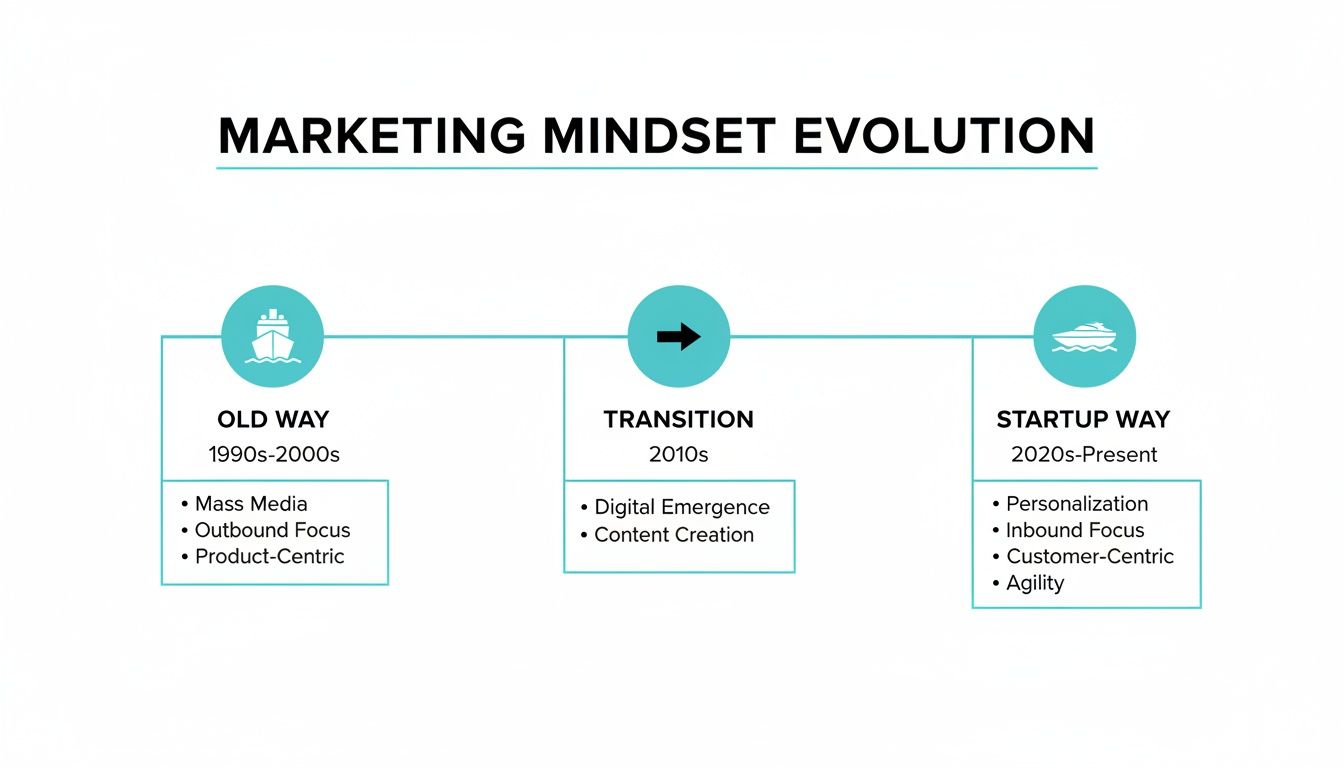
The lesson is simple: modern success requires a faster, more iterative loop of learning and validation, not just big-budget execution.
Stage 1: The Problem-Solution Fit Stage
Welcome to the garage. At this point, your entire world revolves around one question: Are we solving a real problem for a specific group of people who actually care?
This isn't about flashy campaigns or big ad spends. It's about validation, learning, and finding your first believers. Your main goal is to prove your core assumptions are correct. You’re not really selling a product yet; you're selling an idea to a handful of early adopters. Marketing here is less about broadcasting a message and more about direct, one-on-one conversations.
The most expensive mistake any startup can make is building something nobody wants. This first stage is your insurance policy against that, using marketing as a research tool to find your initial believers.
Learning how to validate a B2B startup idea is a non-negotiable first step. It saves so much time and money down the road. It’s all about conversations, interviews, and just listening to what the market is telling you.
Stage 2: The Product-Market Fit Stage
Okay, you've got a signal. You're solving a real problem, and your first customers are getting real value from what you've built. The game just changed.
Now, the mission is to figure out how to find more of them—predictably and repeatably. You’re shifting from manual, one-off efforts to building the very first version of your growth engine. You're no longer just validating an idea; you're actively building demand.
Key priorities here are:
- Building a Repeatable Playbook: Can you find a channel—like LinkedIn outreach or SEO-driven content—that consistently brings in people who need your help?
- Creating Foundational Content: This is when you build out your first case studies, webinars, and blog posts that speak directly to your ideal customer's pain points.
- Testing and Measuring: You'll start experimenting with different messages, channels, and offers to see what resonates. Data becomes your best friend.
The goal isn't to be everywhere. It's to find one or two channels that work and really start to master them.
Stage 3: The Scaling Stage
You’ve found product-market fit. You have a playbook for acquiring customers that works, and your unit economics (like the LTV to CAC ratio) look healthy. Now it's time to pour fuel on the fire.
Scaling is all about taking what works and doing more of it—smarter, faster, and more efficiently. This is where you graduate from a scrappy, founder-led marketing effort to a professional team and a more sophisticated tech stack. Your focus shifts from finding a spark to fanning the flames.
During the scaling stage, you will:
- Optimize and Diversify Channels: You’ll double down on what you know works while carefully testing new channels to expand your reach.
- Build a Specialized Team: This is when you might hire your first full-time content marketer, demand gen specialist, or even a VP of Marketing.
- Invest in MarTech: Tools for marketing automation, advanced analytics, and CRM become non-negotiable for managing growth at this speed.
This final stage is about building a durable, long-term marketing machine designed for sustainable growth. Each stage requires a different mindset and a different set of priorities. Knowing where you are is half the battle.
Your First 90-Day Marketing Ignition Plan
A strategy document gathering dust on a server won’t generate a single lead. The real challenge in startup marketing isn't just knowing what to do—it's turning that knowledge into focused, immediate action. This pragmatic 90-day plan is your roadmap from idea to tangible results, broken into three simple 30-day sprints.
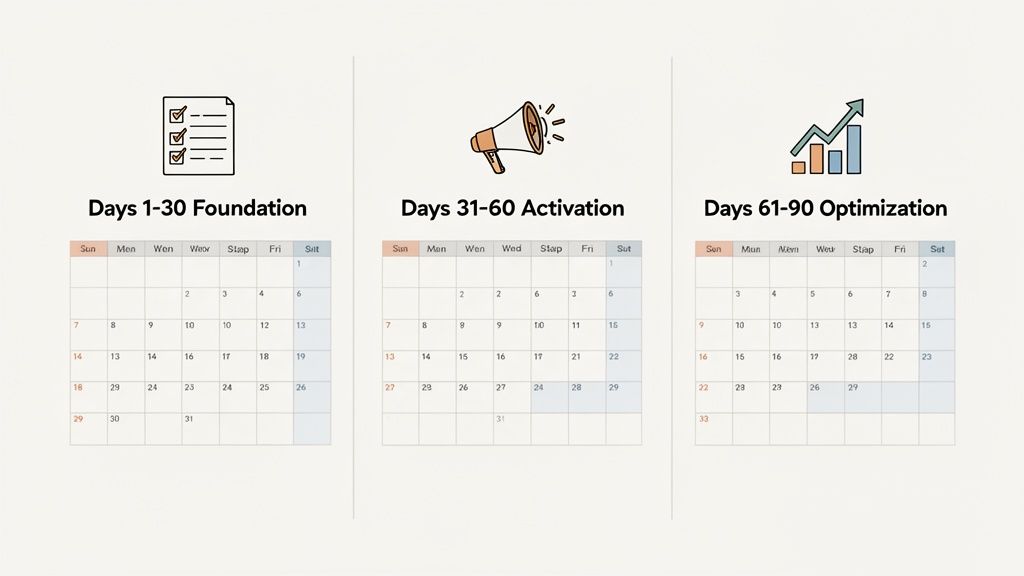
Think of it like building a campfire. First, you clear the ground and gather the right kindling. Then, you strike a match and get a small flame going. Only then do you carefully add more fuel to build a steady, reliable blaze. Let's get started.
Days 1-30: Foundation and Clarity
Your first month is all about laying a solid groundwork. Rushing this is like building a house on sand—everything you do later will be unstable. The goal here isn't to launch a dozen campaigns but to get crystal clear on who you're selling to and how you'll measure success.
This is where you answer the big questions before you spend a dime on ads. You’ll validate your Ideal Customer Profile (ICP) with real conversations, sharpen your core messaging, and get your essential analytics tools in place.
Your key activities for this first sprint include:
- ICP Validation: Get on the phone. Seriously. Conduct at least 10-15 interviews with potential customers to confirm their pain points and learn how they talk about their problems.
- Positioning and Messaging: Draft a one-pager that outlines your unique value prop, key messages, and a clear "before-and-after" story for your customer.
- Core Analytics Setup: Install and configure tools like Google Analytics and a simple CRM. You need to be able to track every visitor and lead from day one.
The only metric that matters this month is learning. Success is ending the month with a validated ICP and a clear message, not a flood of unqualified leads. To make this a bit easier, a good marketing campaign planning template can keep your initial efforts organized and on track.
Days 31-60: Activation and Learning
Now that the foundation is set, it's time to light the match. The second month is all about activation and experimentation. Forget about perfection or massive scale; the goal is to launch small, low-cost experiments to gather real-world data.
Pick just one or two channels where your ideal customers actually spend their time—maybe it's LinkedIn content, maybe it's targeted SEO—and run focused tests. This is where your theories meet reality. You’ll quickly learn which messages land, what calls to action get clicks, and what kind of content generates real engagement.
This sprint is about trading a small amount of budget and time for an enormous amount of market intelligence. You are buying data with your actions, not just your wallet.
This is your most critical learning period. You're searching for a repeatable motion that generates interest from the right people. This work is absolutely essential for building a predictable pipeline later on.
Days 61-90: Analysis and Optimization
Your final sprint is all about making smart, data-driven decisions. You now have a full 30 days of performance data from your initial experiments. The mission is simple: analyze, optimize, and double down on what worked.
Start by ruthlessly cutting what didn't. Did those LinkedIn posts get zero engagement from your target audience? Pause them. Did that one blog post on a niche topic drive three demo requests? That's your signal to write five more just like it.
This is the point where you shift from "random acts of marketing" to building a predictable system. By finding a winning tactic and pouring your energy into it, you start creating a reliable source of leads. This methodical approach is the core of effective startup marketing. For a more detailed look at this entire journey, a complete marketing roadmap template provides a structured framework for long-term success.
To make this even clearer, here's a quick summary of your first 90 days.
90-Day Marketing Plan at a Glance
| Phase | Focus | Key Activities | Success Metric |
|---|---|---|---|
| Days 1-30: Foundation | Research & Clarity | ICP interviews, messaging docs, analytics setup | Validated customer profile and clear messaging |
| Days 31-60: Activation | Experimentation & Data | Launch 1-2 channel tests, create initial content | Engagement data, initial lead flow, market feedback |
| Days 61-90: Optimization | Analysis & Scaling | Cut losing tactics, double down on winners | Improved CPL, repeatable lead generation process |
This framework isn't just a plan; it's a system for turning ambiguity into a predictable engine for growth, one 30-day sprint at a time.
Building Your Lean Marketing Machine
You can't do it all alone, but an early-stage startup definitely can't afford a massive marketing department. This is the classic founder's dilemma. The answer isn’t just to hire someone; it’s to build a lean, efficient machine that’s designed for your exact stage of growth.
The goal here is to get the right blend of strategy and execution without the full-time executive price tag. It’s all about being incredibly intentional with your first few people-related investments.
Your First Hire: The People Puzzle
When you’re finally ready to bring in help, you’re usually looking at a few different choices. Each one comes with its own mix of cost, expertise, and hands-on support. The right answer depends entirely on what you need right now.
Let's break down the most common paths for early-stage B2B startups.
- The Junior Marketer: This is usually the first instinct—hire an enthusiastic, affordable person to "do the marketing." They can be great for running with tasks like social media posts, blog uploads, and email campaigns after you've set the direction.
- The Specialist Agency: Need to get a specific channel running fast, like paid ads or SEO? An agency brings deep, specialized expertise and a team of pros. They’re built for executing on one particular area.
- The Fractional CMO: This option puts a senior-level strategist at the table for a fraction of the cost of a full-time VP of Marketing. They don’t just execute tasks; they build the entire marketing roadmap and can manage junior talent or agencies to make sure everything works together.
There's no single "best" choice, only the best fit for this moment. A junior hire without a clear strategy will just spin their wheels. An agency without a clear ICP and messaging will burn through your budget in a hurry.
The Fractional CMO: A Strategic Bridge to Growth
A fractional CMO is a powerful—and increasingly popular—solution, especially for startups that have a signal of product-market fit but lack senior marketing leadership. Think of them as a strategic co-pilot who comes in to build the flight plan before you hire the full-time crew.
They are the perfect fit when you need to:
- Bridge a Leadership Gap: You need a real marketing strategy, not just a to-do list, but you’re not ready for a $250,000+ executive salary.
- Install a Framework: They define your ICP, build your go-to-market plan, and create the repeatable playbook that a junior marketer or an agency can then run with.
- Mentor Junior Talent: A great fractional CMO can guide and upskill your first marketing hire, making sure their efforts are locked on business goals and maximizing their impact.
The real value of a fractional CMO isn't just their experience; it's their ability to install a proven system for growth. They build the marketing engine so that when you're ready to hire a full-time leader, you're handing them the keys to a high-performance machine, not a box of spare parts.
This model gives you access to top-tier strategic thinking precisely when you need it most. It makes sure your precious early-stage capital is spent on work that actually drives pipeline and revenue.
Building Your Lean MarTech Stack
Your team is one half of the machine; technology is the other. But too many founders fall into the trap of overinvesting in complicated tools they just don't need. A lean startup doesn’t need an enterprise-level MarTech stack. You just need a few core tools to get the job done.
Your initial stack should be simple, affordable, and focused on three key areas.
- Customer Relationship Management (CRM): This is your single source of truth for all your customer and lead interactions. A simple CRM (like HubSpot's free tier) is non-negotiable for tracking your pipeline from the very first conversation.
- Marketing Automation: You need a tool to manage email campaigns, build simple landing pages, and capture leads. This lets you start nurturing relationships at a small scale without manually handling every single email.
- Analytics and Reporting: You absolutely have to see what's working. Setting up Google Analytics is a foundational step to understand your website traffic, user behavior, and which channels are bringing people to your door.
The mantra here is "strategy before software." Don’t buy a tool hoping it will solve your marketing problems. First, build your plan, then find the simplest tool that helps you execute it. For a deeper dive, check out our guide on how to approach your marketing tech stack without breaking the bank.
Measuring What Actually Matters for Growth
In the startup world, it's so easy to get hooked on vanity metrics. A jump in website traffic or a spike in social media likes feels great, but those numbers don't impress investors and they certainly don't pay the bills.
Pipeline and revenue do.
This is your no-fluff guide to the Key Performance Indicators (KPIs) that truly signal the health of your B2B startup. Forget the surface-level stats; we're focusing on what helps you build a data-driven culture and make smarter decisions from day one.
Customer Acquisition Cost (CAC)
Think of Customer Acquisition Cost (CAC) as the price tag on winning a new customer. It’s the total you spend on sales and marketing to land a single new logo. To figure it out, just divide your total sales and marketing spend over a period by the number of new customers you won in that same timeframe.
For example, if you spent $10,000 last quarter and brought in 10 new customers, your CAC is $1,000. This simple number tells you exactly how efficient your growth engine is. A high CAC isn't always bad—especially with high-value customers—but an unchecked one can quietly bleed you dry.
A low CAC is your license to scale. It’s the clearest signal that you have a repeatable, profitable way to grow your business, giving you the confidence to invest more in what’s working.
Lifetime Value (LTV)
If CAC is what you pay, Lifetime Value (LTV) is what you get back. LTV is the total revenue you can reasonably expect from a single customer over their entire relationship with your company. It puts a hard dollar value on loyalty.
A strong LTV proves you’ve built something that solves a real, ongoing problem. More importantly, it tells you the absolute maximum you can afford to spend to acquire a customer and still stay profitable.
As a rule of thumb, a healthy B2B SaaS business aims for an LTV to CAC ratio of 3:1 or higher. For every dollar you spend, you should get at least three back. If your ratio is 1:1, you’re losing money on every new deal once you factor in other business costs.
Lead-to-Customer Conversion Rate
This metric is brutally honest. It shows you the percentage of leads that actually become paying customers, which makes it a direct reflection of how well your sales and marketing are aligned. A high conversion rate means you're not just generating leads; you're generating the right leads and moving them effectively through your pipeline.
This KPI is critical for marketing at a startup for a few key reasons:
- It exposes lead quality: A low conversion rate is often the first sign that you're talking to the wrong people.
- It finds the friction: Bottlenecks in your sales process become impossible to ignore.
- It gives you a clear target: Even small improvements here can have a massive impact on the bottom line.
If you have thousands of leads but only a handful of customers, you know exactly where to start digging.
Sales Pipeline Velocity
Sales Pipeline Velocity is basically the speedometer for your sales process. It measures how quickly deals are moving through your funnel and turning into revenue. For a cash-sensitive startup, a faster velocity is a lifeline.
The formula boils down to four key levers:
- The number of opportunities in your pipeline.
- Your average deal size in dollars.
- Your overall win rate percentage.
- The length of your sales cycle in days.
Improve any one of these—get more opportunities, increase deal size, close more often, or shorten the sales cycle—and you make money faster. It’s that simple.
Common Startup Marketing Mistakes to Avoid
The road to startup growth is littered with expensive lessons. While every founder’s journey is different, the marketing mistakes that sink promising companies are shockingly similar. Dodging these common landmines will save you a ton of cash, time, and sanity, letting you focus on what actually gets you customers.
Think of this as getting advice from someone who’s seen these same patterns derail startups over and over. Learning from what didn't work for others is one of your biggest advantages.
Hiring a Senior Leader Before Product-Market Fit
One of the most common and costly blunders is bringing on a full-time, senior marketing leader way too early. Founders feel the pressure to “get serious” about marketing and think a big-shot VP is the answer. But here's the problem: a senior leader’s job is to scale a system that already works, not to find the first flicker of a flame.
Before you have product-market fit, your marketing is all about discovery and experimentation. You need someone scrappy and hands-on, not a high-level strategist building complex plans for a playbook that doesn’t even exist yet.
The Fix: Start with a doer, a specialist, or a fractional CMO. A junior marketer can execute a clear plan, while a fractional leader provides the strategic oversight and builds your initial growth engine—all without the $250,000+ annual hit of a full-time exec.
Chasing Too Many Channels at Once
It’s tempting to be everywhere—LinkedIn, SEO, paid ads, TikTok, you name it. But spreading your limited resources that thin is a guarantee you’ll be mediocre at everything and a master of nothing. This "spray and pray" approach is the fastest way to burn through your budget with almost nothing to show for it.
Effective startup marketing is an exercise in ruthless focus. The goal isn't to be present on every channel; it's to find one or two that work and absolutely dominate them.
Pick your channels based on where your Ideal Customer Profile (ICP) actually hangs out and looks for answers, not based on what’s trending this week.
The Fix: For your first 90-day experiment, pick one primary channel and one secondary channel. Go deep. Learn the nuances. Measure everything. Once you have a repeatable, profitable system on one channel, you've earned the right to go test another.
Overinvesting in Tech Before Strategy
Another classic trap is buying a whole suite of expensive marketing tools before you have a clear strategy. Software doesn't fix a strategy problem. A fancy marketing automation platform is dead weight if you don’t know who you’re talking to or what you should be saying to them.
Your first MarTech stack should be lean, mean, and focused on the absolute essentials.
The Fix: Start with the basics. A free CRM, a simple email tool, and Google Analytics. Every new tool you add should solve a specific, immediate problem that’s holding you back. Just remember the mantra: strategy before software. A solid plan run with simple tools will beat a weak plan with expensive tech every single time.
Startup Marketing FAQ
Founders and CEOs always have questions as they start revving the growth engine. Here are the straight answers to the most common ones I hear.
How Much Should We Spend on Marketing?
There's no single magic number, but for B2B startups, a good starting point is somewhere around 10-20% of your projected annual revenue.
But what if you're pre-revenue? Forget percentages. Instead, carve out a fixed budget for smart, high-priority experiments over a three to six-month sprint. This lets you test channels and figure out what actually works before you start writing big checks. The game plan is simple: start small, track your ROI like a hawk, and only pour gas on the channels that are already proven to bring in qualified leads.
When Do I Hire a Full-Time Marketing Leader?
Hiring a VP of Marketing too early is a classic—and expensive—startup mistake. The right time to bring in a full-time executive is after you’ve nailed product-market fit and have a go-to-market motion that’s repeatable. Their job is to scale what's already working, not invent it from scratch.
Before you hit that point, a fractional CMO is a much more capital-efficient move. They can build your strategy and playbook while mentoring your junior team, all without the six-figure salary and long-term commitment.
Bringing in a senior leader before you have a repeatable marketing playbook is like hiring a chef to scale recipes for a restaurant that hasn't finalized its menu. First, find what the market wants, then hire the expert to produce it at scale.
Which Marketing Channel Should We Focus on First?
Stop trying to be everywhere. The right channel is wherever your Ideal Customer Profile (ICP) hangs out to find solutions. You have to go to them.
For most B2B startups, that usually means LinkedIn, niche online communities, or long-term inbound plays driven by SEO. The trick is to fight the urge to spread your time and money thin across a dozen different platforms.
Pick one or two channels, run focused experiments, and measure everything. Once you've mastered a channel and can generate a predictable pipeline from it, then you can think about adding another to your mix.
Ready to build a marketing engine that drives real growth? Value CMO provides the senior strategic leadership your B2B startup needs without the full-time executive cost. Let's build your roadmap to revenue. Learn more about our fractional CMO services at valuecmo.com.