
A tactical plan is the detailed, turn-by-turn roadmap that brings your big-picture strategy to life. It breaks down your mission into concrete actions, spelling out who will do what by when to hit your company's broader goals.
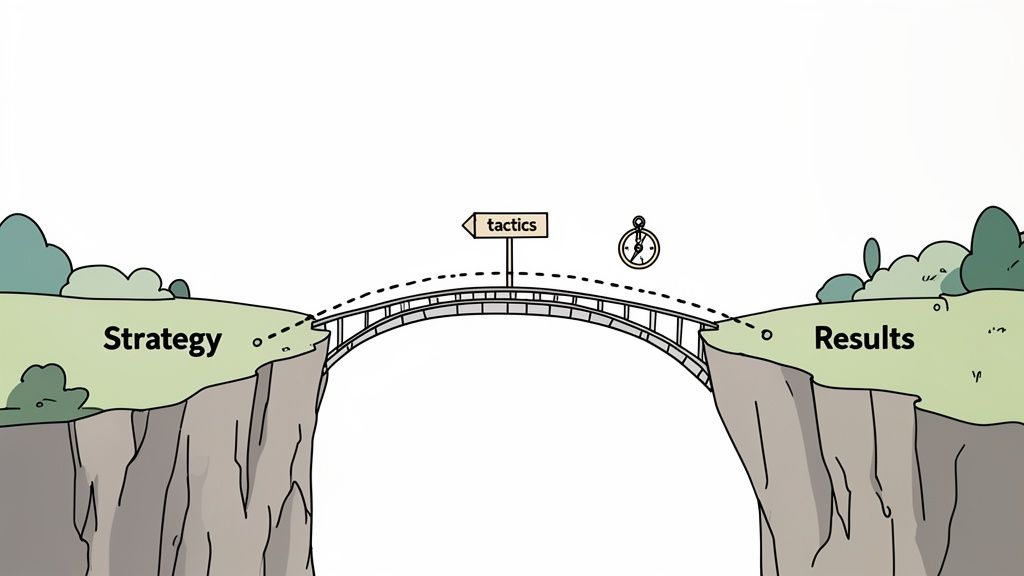
Think of it this way: Strategy is picking the destination. The tactical plan is the specific route you map out to get there.
Your Tactical Plan: The Bridge From Big Ideas to Real Results
So, you’ve got a brilliant strategy—a clear vision for where you want your B2B tech company to go. But how do you actually get there? That’s the million-dollar question that separates wishful thinking from tangible success.
The answer is your tactical plan. It’s the essential bridge connecting your ambitious ideas to the real-world results you need to see. Without it, even the sharpest strategy is just a concept collecting dust while your team scrambles with directionless tasks. For a B2B startup where every action, hour, and dollar is critical, this link is a must-have.
Clarifying Your Approach
Founders and marketing leaders live with the pressure to drive measurable pipeline growth and prove ROI. A tactical plan turns that pressure into a structured, manageable process.
It breaks down a huge strategic goal, like "become the market leader," into smaller, doable steps. Think launching a specific webinar series or kicking off a targeted account-based marketing campaign.
A great strategy gets you to the starting line. A great tactical plan helps you win the race. It’s about creating deliberate momentum, not just staying busy.
This focused approach is especially vital for today's marketers. Research shows that successful B2B marketers blend strategy with action. In fact, content tactics like blogging and social media can yield 13x the positive ROI and cost 62% less than traditional methods. (Discover more insights about marketing ROI on Optimizely).
But first, you have to get a handle on the different layers of planning.
Strategy vs. Tactics vs. Operations at a Glance
To build a plan that really works, you first need to see how all the pieces fit together. This quick comparison makes it clear what strategic, tactical, and operational planning each do in a B2B tech business.
| Planning Level | Primary Focus | Time Horizon | Key Question It Answers |
|---|---|---|---|
| Strategic | The "Why" and "What" – long-term vision | 3-5+ Years | Where are we going? |
| Tactical | The "How" – specific initiatives and actions | 6-18 Months | How will we get there? |
| Operational | The "Day-to-Day" – routine tasks and systems | Daily to Monthly | What needs to be done today? |
In short, strategy sets the course, tactics define the projects to get you there, and operations are the daily tasks that keep everything moving. Getting this hierarchy right is the first step to building a plan that actually works.
The Core Components of a Powerful Tactical Plan
A tactical plan isn't just a glorified to-do list. It’s a living guide with specific, interconnected parts that all work together. Skipping even one piece is like trying to build a stable chair with only three legs—it might stand for a moment, but it’s bound to collapse under pressure.
For B2B SaaS companies, especially startups with lean teams and tight budgets, getting these building blocks right is the key to turning limited resources into real momentum. Let's break down what every effective tactical plan needs to succeed.
Setting Specific Objectives
First, you need clearly defined objectives. These aren't your huge, five-year strategic goals. They’re the smaller, measurable outcomes your plan will achieve within its timeframe, directly supporting that larger strategy.
An objective has to be specific. "Increase brand awareness" is a vague wish, but "Generate 50 marketing qualified leads (MQLs) from organic search in Q3" is a clear target. This clarity is what makes a tactical plan actionable; it gives everyone a precise destination to aim for.
For a SaaS startup, this kind of focus stops the team from chasing vanity metrics. Instead, it concentrates their efforts on activities that directly impact pipeline and revenue growth.
Defining Key Initiatives and Actions
Once you have your objectives, you can outline your key initiatives. These are the major projects or campaigns you'll launch to hit those objectives. Think of them as the primary routes you'll take on your roadmap.
Each initiative then breaks down into a set of concrete actions or tasks. For example:
- Objective: Generate 50 MQLs from organic search in Q3.
- Initiative: Launch an SEO-focused content marketing campaign.
- Actions:
- Conduct keyword research for three high-intent topics.
- Write and publish four new blog posts (2,000+ words each).
- Create a downloadable e-book as a lead magnet.
- Build a dedicated landing page for the e-book.
This structure connects daily tasks directly to the bigger picture, making sure every action has a clear purpose.
Assigning Clear Ownership
A task without an owner is a task that won't get done. Every single initiative and action in your tactical plan must have a designated owner—one person who is ultimately responsible for its completion.
This doesn't mean they do all the work themselves. It just means they're the point person for progress, coordination, and problem-solving. In a startup, clear ownership eliminates confusion and builds a culture of accountability. When everyone knows who is responsible for what, things just move faster.
Without clear ownership, accountability becomes a game of hot potato. A tactical plan assigns a name to every task, ensuring that when the ball is passed, someone is always there to catch it.
Establishing Timelines and Budgets
Every tactical plan needs two critical guardrails: time and money. A timeline sets deadlines for each action and initiative, creating a sense of urgency and a schedule for execution. This helps you sequence activities logically and track whether you're on pace to meet your objectives.
Equally important is the budget. You need to allocate the necessary resources—whether it's money, people, or tech—to each initiative. For a B2B company keeping a close eye on its burn rate, a detailed budget ensures you're making smart investments and can accurately measure your marketing ROI later on.
Identifying Success Metrics
Finally, how will you know if your plan is working? That's where success metrics, or Key Performance Indicators (KPIs), come in. These are the specific, quantifiable data points you'll track to measure the performance of your initiatives and your progress toward the objectives.
For our SEO campaign example, your KPIs might include:
- Website Traffic: The number of unique visitors to the new blog posts.
- Conversion Rate: The percentage of landing page visitors who download the e-book.
- Leads Generated: The total number of form submissions.
- Cost Per Lead (CPL): The total campaign cost divided by the number of leads.
Tracking these metrics gives you the data you need to make informed decisions, pivot when something isn't working, and prove the value of your marketing efforts to the rest of the business.
How to Create Your Tactical Plan Step-by-Step
Okay, you get the theory. Now, let’s roll up our sleeves and build this thing.
Creating a tactical plan can feel like a huge task, but it’s really just a series of logical steps. Think of it less like writing a formal, stuffy document and more like mapping out a clear path with your team to get from Point A to Point B.
This guide breaks it down into a simple, repeatable process that works even if you're a busy founder or leading a small team. Let's get it done.
Step 1: Translate Strategy into Tactical Objectives
Everything flows from your high-level strategy. Start there.
Take a big, ambitious goal—like "Increase market share in the mid-market segment by 15% this year"—and break it into smaller, more immediate objectives for the next quarter. This is where you connect the long-term vision to the short-term grind.
The SMART framework (Specific, Measurable, Achievable, Relevant, Time-bound) is your best friend here. It’s the tool that turns vague wishes into concrete targets.
- Vague idea: "We need to generate more leads."
- SMART objective: "Generate 100 new SQLs from mid-market accounts in Q3 by launching our new integration feature."
See the difference? The SMART objective gives your team a clear finish line. It's specific (SQLs from mid-market), measurable (100), achievable (tied to a feature launch), relevant (supports the market share goal), and time-bound (Q3).
Step 2: Brainstorm and Prioritize Your Initiatives
With your objectives locked in, it’s time to figure out how you'll hit them. This is the fun part—a creative, collaborative session where you get all the possible initiatives on the table. No bad ideas at this stage.
Once you have a list, it’s time to get ruthless with prioritization. An impact/effort matrix is a simple but powerful way to do this. Just plot each idea on a four-quadrant grid:
- High Impact, Low Effort: These are your quick wins. Do them first.
- High Impact, High Effort: These are your big, strategic projects. Plan them carefully.
- Low Impact, Low Effort: Fit these in if you have downtime, but don't let them distract you.
- Low Impact, High Effort: Avoid these like the plague. They’re resource black holes.
This simple exercise forces you to focus your limited time and budget on the things that will actually move the needle.
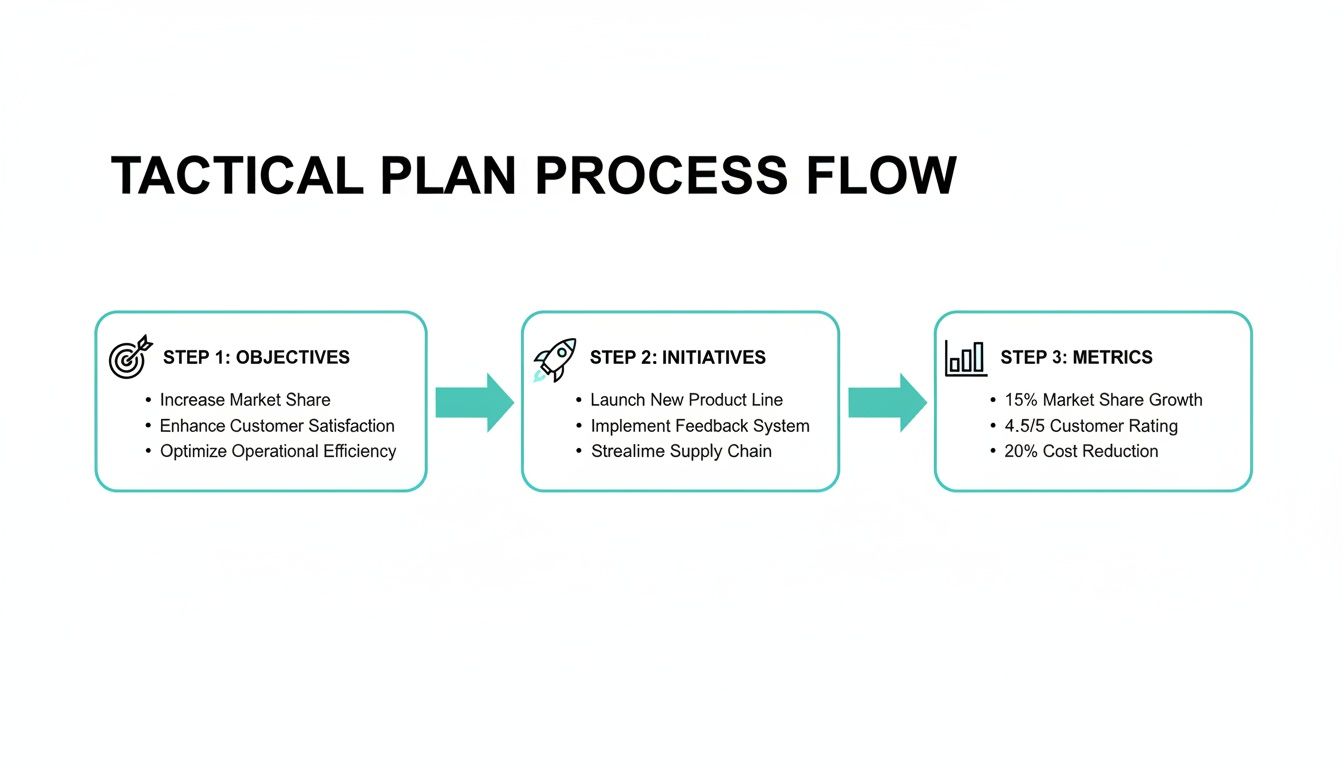
This workflow—from objective to initiative to metric—is the engine of your tactical plan. It creates a direct line between what you want to achieve, what you're going to do, and how you’ll know if it worked.
Step 3: Assign Ownership and Allocate Resources
An idea without an owner is just a wish. For every single initiative you've prioritized, assign one person to be the owner. This isn't about blame; it's about accountability. One person needs to be responsible for driving that task forward.
Next, get brutally honest about resources. What’s the budget for each initiative? Who on the team is needed, and how much of their time will it take? Do you need a contractor or a new piece of software to pull it off?
Nailing this down prevents nasty surprises later. It also builds a strong case for the resources you need to execute. The data backs this up: a recent Statista study found that 95% of marketers see success with data-driven strategies. Precision planning pays off.
Step 4: Establish Your Measurement Framework
Finally, define exactly how you'll keep score. For each initiative, list the specific KPIs you will track. This isn't arbitrary; these metrics should tie directly back to your SMART objectives.
Your measurement framework also needs a rhythm. Set up weekly or bi-weekly check-ins to review the numbers, talk about what’s working, and—just as importantly—what’s not. This isn’t about micromanagement. It's about being agile enough to pivot when the data tells you to.
A plan without metrics is just a collection of hopes. A tactical plan with clear KPIs is a machine for predictable growth.
By following these four steps, you turn a high-level goal into a living, breathing plan that guides your team’s daily work.
Real-World Tactical Plan Examples for B2B Tech
Theory is great, but seeing a tactical plan in the wild is where it all clicks. Let’s ditch the abstract and look at two real-world examples for common B2B tech companies.
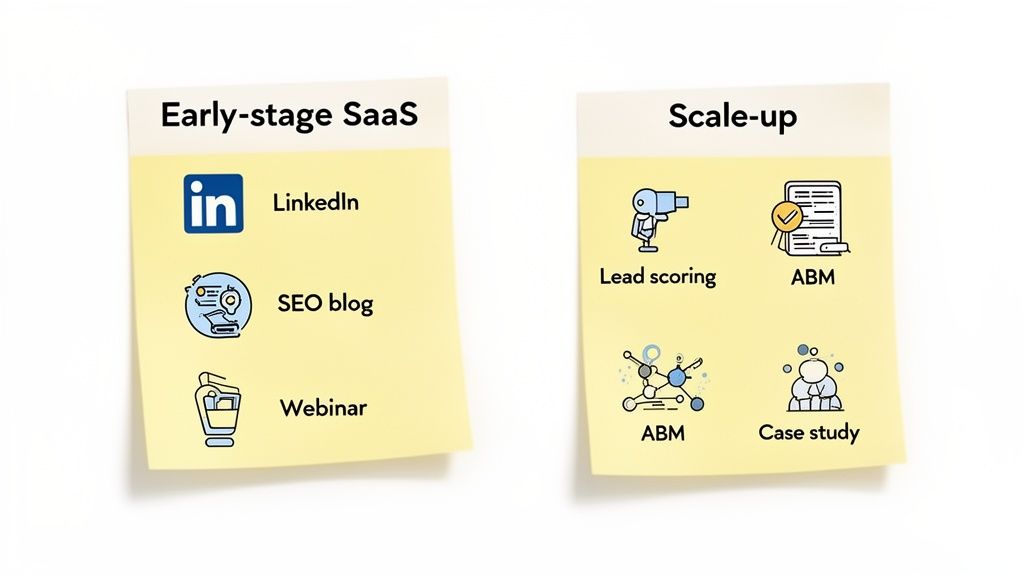
These quick case studies show exactly how an early-stage startup and a growing scale-up turn their big strategic goals into concrete, actionable steps. Watch how every piece—objectives, initiatives, owners, and KPIs—snaps together.
Example 1: The Early-Stage SaaS Startup
Picture a new SaaS company, "ConnectSphere," fresh off launching its project management tool. They have a small crew, a lean budget, and one massive strategic goal: get a foothold in the market. Their tactical plan is completely focused on landing those first critical customers.
Strategic Goal: Gain initial market traction and secure the first 10 paying customers in six months.
Tactical Objective (for Q1): Generate 50 new marketing qualified leads (MQLs) from their ideal customer profile—small marketing agencies.
This is the immediate mission. Here’s how their tactical plan breaks it down:
-
Initiative 1: Targeted Content Program
- Description: Create and push three deep-dive blog posts on topics their audience actually cares about, like "How Agencies Can Streamline Client Reporting." Each post will be SEO-optimized to start building a long-term traffic engine.
- Owner: Sarah, Content Marketing Manager
- KPIs: 5,000 organic pageviews, 20 MQLs from content downloads.
-
Initiative 2: Educational Webinar
- Description: Host a live webinar on "The Top 5 Project Management Mistakes Costing Your Agency Money," roping in a known agency consultant as a guest to boost credibility.
- Owner: David, Head of Growth
- KPIs: 150 webinar registrants, 20 MQLs (from post-webinar follow-up).
-
Initiative 3: LinkedIn Outreach Campaign
- Description: Fire up a targeted LinkedIn campaign to connect with 200 agency founders and project managers, offering a valuable resource (like an e-book) to get conversations started.
- Owner: Maria, Founder/CEO
- KPIs: 25% connection acceptance rate, 10 MQLs from direct conversations.
This simple plan gives the ConnectSphere team a clear, coordinated attack. Everyone knows their job, what winning looks like, and how their daily grind connects directly to hitting that 50-MQL target.
Example 2: The Scale-Up B2B Tech Company
Now let’s look at "DataDrive," an established B2B analytics platform. They’ve got leads coming in, but their sales cycle is dragging on way too long. Their strategic goal is to crank up revenue growth by making their sales process way more efficient.
Strategic Goal: Increase new annual recurring revenue (ARR) by 40% year-over-year.
Tactical Objective (for Q2): Increase pipeline velocity by 25%, cutting the average sales cycle from 90 days down to 68.
This objective demands a smarter tactical plan—one focused on optimization, not just lead volume.
-
Initiative 1: Implement a Lead Scoring Model
- Description: Build and deploy a predictive lead scoring model right inside their CRM. The goal is to automatically flag the hottest leads so the sales team can pounce, ensuring reps spend their time on accounts that are actually likely to close.
- Owner: Tom, Marketing Operations Lead
- KPIs: 90% of inbound leads scored automatically, 30% faster sales follow-up on high-scoring leads.
-
Initiative 2: Launch an ABM Pilot Program
- Description: Run a pilot account-based marketing (ABM) campaign aimed at 20 high-value enterprise accounts. This means creating personalized content and running coordinated ad campaigns for key decision-makers at those specific companies. For a deeper dive, check out our guide on building a B2B go-to-market strategy.
- Owner: Jessica, Demand Generation Director
- KPIs: 50% engagement rate from target accounts, 5 new sales opportunities created.
-
Initiative 3: Create a High-Impact Case Study
- Description: Work with their biggest customer to produce a killer video and written case study. This becomes a powerful sales tool to deploy mid-funnel, answering questions and building trust before the final pitch.
- Owner: Sarah, Content Marketing Manager
- KPIs: Case study used in 75% of active sales cycles, 10% drop in time spent in the proposal stage.
In both of these scenarios, the tactical plan delivers the "how." It’s the bridge that turns an ambitious goal into a clear set of marching orders. This is where strategy gets real.
Common Pitfalls to Avoid When Creating Your Plan
Building a tactical plan is one thing. Building one that actually works is a whole different ballgame. It's easy to get lost in the process and end up with a document that looks polished but shatters the second it hits the real world.
Knowing the common traps is the first step to sidestepping them. Let's get real about the challenges and walk through the frequent mistakes that derail even the best-laid plans. This will save you time, frustration, and a whole lot of wasted cash.
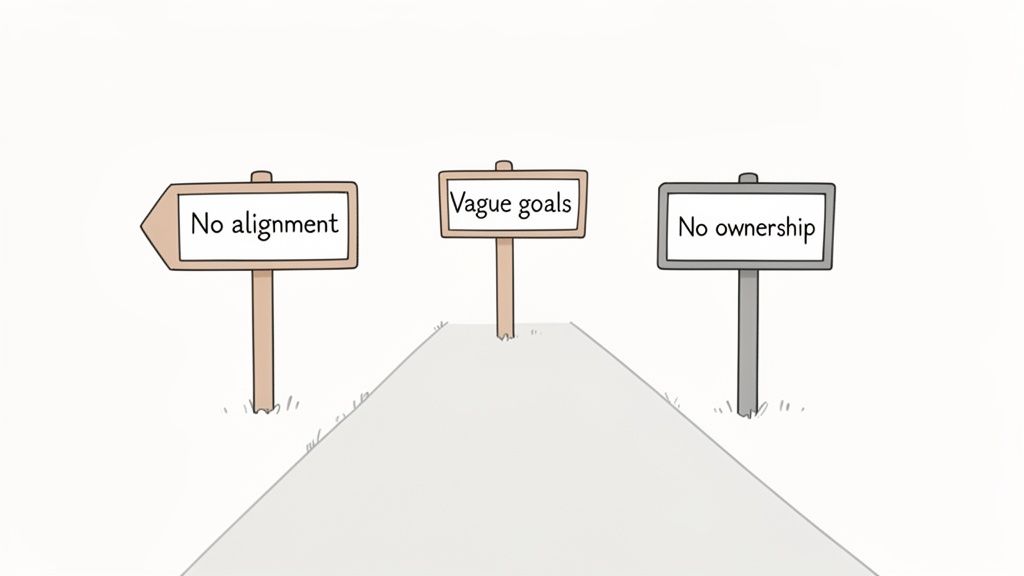
Creating Tactics in a Strategic Vacuum
This is probably the most dangerous mistake: developing tactics without a clear line of sight back to your overarching strategy. You end up with a bunch of disconnected activities that keep your team busy but don't actually move the business forward in any meaningful way.
- The Pitfall in Action: A marketing team launches a trendy TikTok campaign because "everyone's doing it," even though the company's strategic goal is landing high-value enterprise accounts who aren't on the platform. The campaign racks up views but delivers zero qualified leads.
- How to Avoid It: Before you brainstorm a single initiative, anchor the whole process to your strategic goals. Constantly ask, "How does this specific action help us hit our main business objective?" If there's no clear answer, that tactic doesn't belong in the plan.
Setting Vague Objectives
An objective like "increase sales" or "improve brand awareness" isn't an objective—it's a wish. Without specific, measurable targets, your team has no finish line to run toward, and you have no way of knowing if the plan is even working.
A tactical plan built on vague goals is like a ship without a rudder. It might be moving, but it has no direction and will likely end up drifting aimlessly.
This lack of clarity is why so many plans fail. When people don't see tangible results, they get cynical about the whole planning process. Clear, focused objectives keep everyone engaged and accountable.
Failing to Assign Clear Ownership
When everyone is responsible, no one is. A tactical plan that lists actions without assigning a single, specific owner to each one is setting itself up for failure. Tasks will inevitably fall through the cracks because everyone assumes someone else is handling it.
- The Pitfall in Action: The plan includes "Create a new sales deck," but no one person is assigned to lead it. The content team thinks sales is on it, sales assumes marketing is running point, and three weeks later, nothing has happened.
- How to Avoid It: Assign exactly one owner to every single initiative. This person is the champion responsible for driving progress, coordinating with others, and reporting back. They don't have to do all the work, but they have to make sure it gets done.
Underestimating Required Resources
Optimism is great, but it's a killer in resource planning. A classic pitfall is creating an ambitious tactical plan without a realistic look at the time, budget, and people needed to pull it off. This leads straight to burnout, missed deadlines, and a graveyard of half-finished projects.
Get brutally honest before you finalize the plan. Does the team actually have the bandwidth for this? Is the budget realistic? Do we need to hire a contractor or buy new software? Aligning your ambitions with your real-world capacity is what turns a plan on paper into results on the dashboard.
Translating Your Tactical Plan Into Real Momentum
You’ve got the blueprint for a solid tactical plan. But for most B2B tech founders, the real challenge isn’t the “what”—it’s the “who” and “how” of getting it done. Let’s be honest: a plan is only as good as its execution. That’s where experienced leadership becomes a game-changer.
A beautifully designed document is worthless if it just gathers dust. This is where momentum dies. Your team might be brilliant at their specific jobs, but without senior guidance to steer the ship, even the best-laid plans can stall out before they even leave the harbor.
From Paper Plans to Pipeline Growth
This is exactly where fractional CMO services come in. For startups and scale-ups, this model delivers the senior marketing leadership needed to turn paper plans into real-world results—all without the hefty price tag and long-term commitment of a full-time executive. It’s about getting the strategic brainpower you need, precisely when you need it.
An experienced leader will take your tactical plan and immediately start asking the tough questions:
- Is our pipeline flat? They’ll diagnose the root cause and pivot tactics to get things moving.
- Is our junior team stuck? They provide the mentorship to upskill your people and build their confidence.
- Are our decisions based on data or gut feelings? They build the systems to track what actually matters and make smarter bets.
A tactical plan gives you the map, but an experienced leader knows how to read the terrain, navigate the inevitable roadblocks, and keep the team marching forward.
Turning Actions into Measurable Results
Ultimately, the whole point of a tactical plan is to accelerate revenue. That requires a focused, data-driven process where every single initiative is tied directly to a measurable outcome. For example, a key part of turning your plan into momentum might be learning how to optimise Facebook ads for better ROI, transforming your ad spend into a predictable stream of qualified leads.
This is what turns a simple to-do list into a growth engine. Instead of just "doing marketing," you're systematically running plays designed to hit specific numbers. To really dial in on the impact of these efforts, you can learn more about how to measure marketing ROI in our detailed guide. This isn't a sales pitch; it's the logical next step for founders who need expert help to make sure their tactical plan delivers real business results and builds unstoppable momentum.
Frequently Asked Questions About Tactical Plans
Even with the best game plan, a few questions always seem to surface right when you’re ready to get moving. Let’s run through some of the most common ones we hear from B2B tech leaders.
These quick answers should clear up any final sticking points and help you make sure your plan is practical, nimble, and built for your business.
How Often Should We Review Our Tactical Plan?
The right review cadence really depends on your company's stage and how fast your market is moving. For most B2B companies, a quarterly review is a solid baseline. It gives you enough runway to get initiatives off the ground and see real data roll in, but it’s frequent enough that the plan doesn’t get stale.
But if you’re a fast-growing startup, 90 days can feel like an eternity. In that world, agility is everything. We suggest lighter, monthly check-ins to review performance and what the market is telling you. This lets you make smart pivots without throwing your core objectives out the window. The goal isn’t to be rigid; it’s to be disciplined and adaptive.
What’s the Difference Between a Tactical Plan and a Project Plan?
This is a classic point of confusion, but the difference is simple—and critical. It all comes down to scope and hierarchy.
- A tactical plan is your map for hitting a big strategic goal. It’s made up of a bunch of different initiatives, like launching an ABM campaign, creating a new webinar series, and overhauling your SEO content.
- A project plan is the granular, step-by-step guide for executing just one of those initiatives. It breaks down a single project into specific tasks, dependencies, and deadlines.
Think of it this way: your tactical plan is the portfolio that holds all the individual project plans.
Is a Tactical Plan Useful for a Small Startup?
Absolutely. In fact, you could argue a tactical plan is even more critical for a small startup than for a big corporation. When your team is lean and every dollar counts, you can’t afford to waste a single resource on activities that don’t move the needle.
Without a tactical plan, startups often get stuck in a chaotic, reactive loop, chasing every shiny new object or idea. That just burns cash and morale with nothing to show for it.
For a startup, a tactical plan is a focusing mechanism. It forces you to make tough choices and ensures your limited resources—your time, money, and people—are aimed squarely at the highest-impact activities that will actually drive growth.
It’s the tool that turns that scrappy startup energy into predictable momentum.
Ready to turn your strategic goals into real pipeline momentum? Value CMO provides the senior B2B marketing leadership to build and execute a tactical plan that delivers measurable results. Find out how we can help at https://valuecmo.com.