

A marketing org structure is the blueprint that defines how your team is organized—who does what, who reports to whom, and how all the moving parts work together to hit your growth targets.
Why Your Marketing Org Structure Is Your Growth Engine
Let's be honest: for a busy B2B tech founder, "org structure" sounds like a stuffy corporate problem you can deal with much later. It’s easy to file it under "things to fix after the next big revenue milestone." But what if that very structure—or lack of one—is what's quietly killing your pipeline?
A well-designed marketing org structure isn’t just a chart with names and titles. It’s the operational wiring for scalable growth. Without a clear plan, even the most talented teams can descend into chaos.
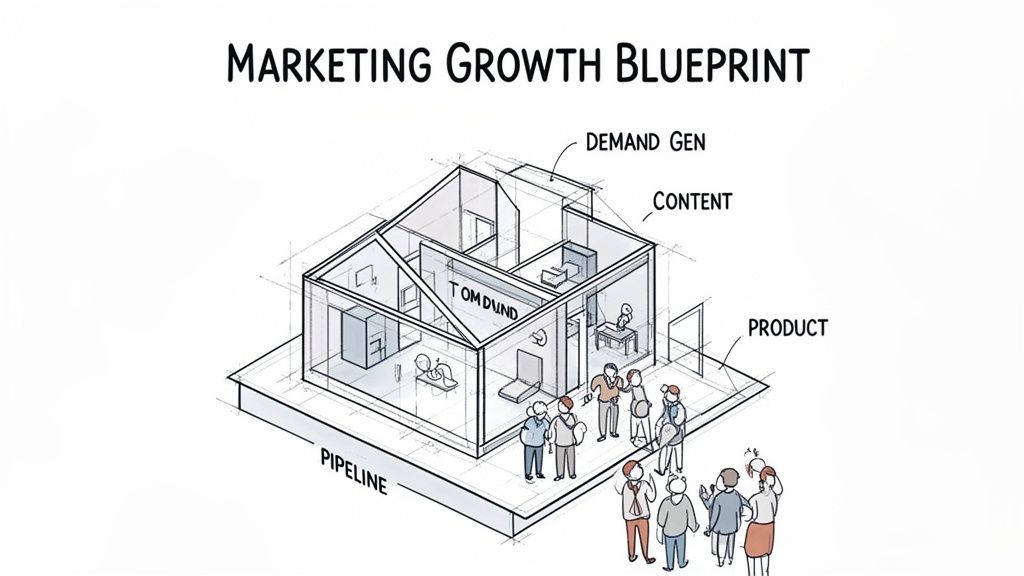
The House Blueprint Analogy
Imagine trying to build a house without a blueprint. The plumber installs pipes right where the electrician needs to run wires. The foundation gets poured for a two-story home, but you only planned for a bungalow. Everyone is working hard, but their efforts are disconnected. The result? A mess of expensive rework and painful delays.
Your marketing team works the same way. When the structure is fuzzy, you start seeing ugly symptoms.
A poorly designed structure creates very real, very painful problems. Here's a quick look at the symptoms you're likely seeing and what's really going on under the hood.
Symptoms of a Misaligned Marketing Org Structure
| Symptom | What It Looks Like | Likely Structural Cause |
|---|---|---|
| Flat Pipeline | Everyone is busy, but qualified leads just aren't materializing. | No clear ownership of demand generation vs. brand awareness. |
| Team Burnout | Talented marketers are stretched thin, juggling too many roles without clear focus. | Generalist roles haven't evolved into specialist functions. |
| Wasted Spend | Marketing dollars are spent on random acts of marketing that don't connect to a strategy. | Lack of a central leader to align budget with revenue goals. |
| Siloed Efforts | The content team writes blog posts the demand gen team can't use. Product marketing's messaging never makes it to the website. | No defined handoffs or collaboration points between specialized teams. |
Recognize any of these? They aren't just minor headaches—they're direct consequences of a structure that can't support your growth ambitions.
Aligning Your Team for Scalable Growth
A clear structure provides the alignment you need to stop these problems before they start. It defines who is responsible for what, how different functions collaborate, and how success is actually measured. This kind of clarity is absolutely critical for structures for high-volume operations, where even small inefficiencies can stall momentum fast.
The frustration with misaligned teams is everywhere. By 2023, one report found that over 80% of marketers at large firms were unhappy with their organization's effectiveness, blaming capability gaps and mismatched roles. Their old structures just couldn't keep up.
Your org structure is a direct reflection of your go-to-market strategy. If your strategy is to win, your team needs to be organized to execute that winning plan—anything less is just organized chaos.
The key takeaway is simple: your marketing team's design has to evolve with your company. The scrappy, do-it-all team that got you to your first $1M in ARR won't be the one that gets you to $10M. By getting the blueprint right for your current stage, you prevent massive headaches down the road and build a true growth engine, not just a collection of busy people.
Choosing Your Model Core Marketing Org Structures Explained
Think of your marketing org structure as the operating system for your team. Some setups are built for heavy-duty specialization, while others prioritize speed and flexibility.
Your choice isn’t just an HR checkbox—it shapes how work flows, how ideas spread, and how quickly you hit your growth targets. For B2B tech companies, a few core models tend to rise to the top. To see why, it helps to start with the basics of organizational design and how it underpins scale.
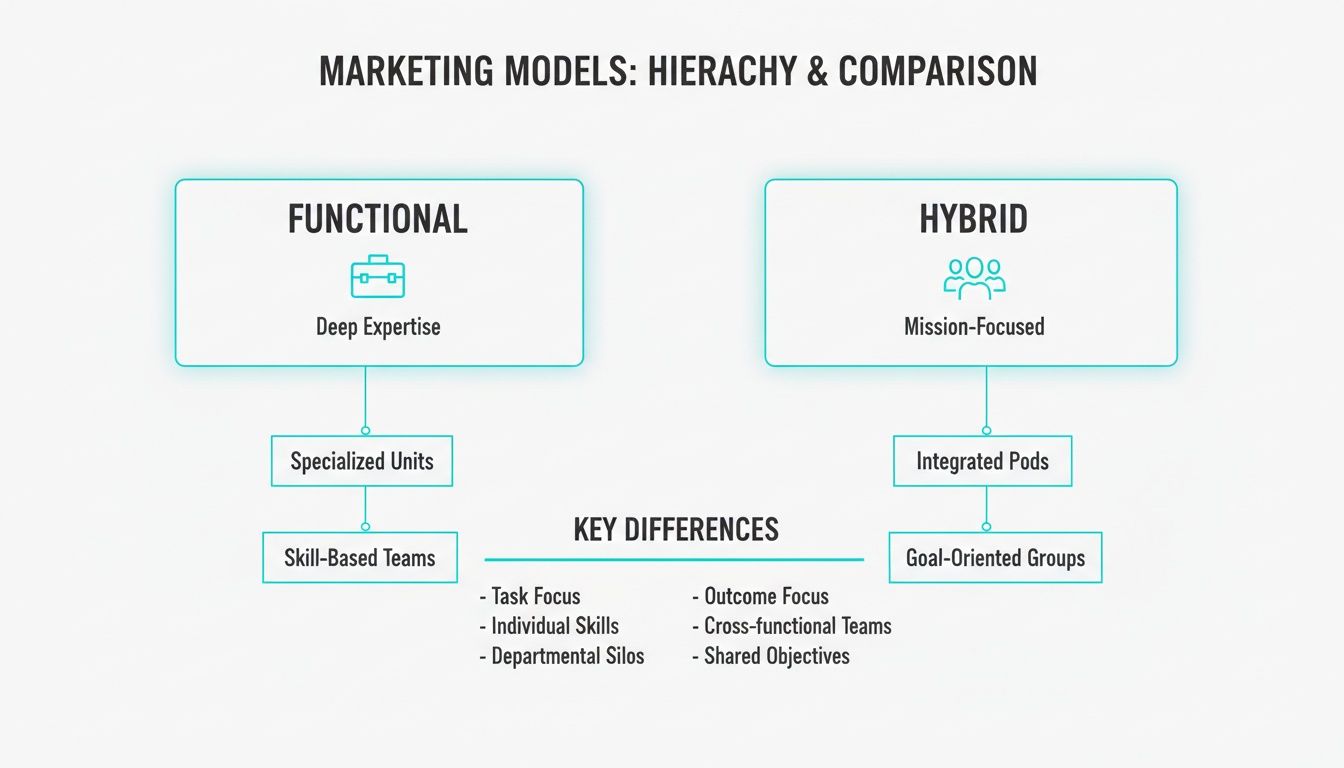
The Functional Model: The Specialist’s Workshop
The Functional model is the classic approach. Picture a workshop where each expert—content, demand gen, product marketing—has their own station.
In this model, marketers group by skill set, reporting up to a Head of Content or a Head of Demand Gen. This helps keep each discipline sharp.
Pros
- Deep domain expertise drives quality.
- Specialists get to refine their craft every day.
Cons
- Teams can easily slip into silos.
- Cross-functional projects often slow to a crawl.
This setup is a good fit for early-stage teams building core capabilities or for large firms that really value functional mastery.
The Hybrid Model: The Agile Mission Squad
On the flip side, the Hybrid model (sometimes called matrix or pod) builds teams around goals instead of roles. Think of it like forming a special ops squad for a new product launch or a push into a new market.
Each pod has a content lead, a demand gen pro, a product marketer, and a designer. The team owns the mission from start to finish, letting them make decisions and execute fast.
Pros
- Breaks down silos and speeds up delivery.
- Aligns everyone on a shared, concrete outcome.
Cons
- Reporting lines can get blurry and create confusion.
- It takes strong coordination to avoid mixed messages.
In the fast-moving world of B2B tech, these squads give you the ability to react nimbly to market shifts. A “New Product Launch” pod, for example, can craft messaging, build assets, and launch campaigns all together—without any handoff delays.
Ultimately, there’s no one-size-fits-all solution. The trick is to choose the model that cuts down on friction and powers your strategy right now. A workshop of experts or a fleet of agile squads—pick what matches your current needs.
Building Your Team: Stage-by-Stage Org Charts and Headcount
Talking about org models in the abstract is easy. Building a real-world team that doesn't fall apart under pressure is another story entirely.
The right marketing org structure isn't a static blueprint; it’s a living thing that has to evolve right alongside your company. What works for a scrappy three-person startup will absolutely cripple a 50-person scale-up.
So let's get practical. Here are the field-tested blueprints for B2B tech companies—who to hire, when to hire them, and most importantly, why.
Seed Stage: The Lean Founding Team (Under $1M ARR)
At this stage, your only real goal is to survive and find product-market fit. Marketing isn't about building a sophisticated growth engine yet. It's about testing, learning, and wrestling your first few customers through the door. The team is founder-led, and every dollar is precious.
Your first marketing hire is not a VP. It's not a hyper-specialist. You need a doer.
- Headcount: 1 (plus a founder who’s basically a part-time marketer)
- Key Hire: Marketing Generalist (or "Marketing Manager")
- Reporting Structure: Reports straight to a Founder/CEO.
Think of the Marketing Generalist as a versatile athlete. They can knock out a blog post in the morning, launch a simple email campaign by lunch, and manage your social channels in the afternoon. Their job is to throw a bunch of stuff at the wall and see what sticks.
This hire is about pure execution, not crafting a 10-page strategy deck. The goal is momentum. They provide the initial spark needed to validate your go-to-market ideas before you pour any real fuel on the fire.
You aren't building complex teams here. You’re just laying a foundation of activity and learning.
Series A: The Specialization Phase ($1-5M ARR)
Once you’ve hit that first million in ARR, you’ve proven something is working. The game shifts from pure survival to building a repeatable growth machine. The "do-everything" generalist model is already starting to show its cracks. It’s time to bring in specialists.
This stage is all about ditching random acts of marketing for predictable pipeline. Your marketing org structure has to reflect that. To see exactly how these pieces click together, you can learn more about building a modern marketing department structure.
- Headcount: 3-5
- Leadership: Head of Marketing (or Director of Marketing)
- Key Hires:
- Demand Generation Manager: This person owns pipeline, period. Their world revolves around MQLs and SQLs, and they're responsible for creating and capturing demand through paid channels, SEO, and email.
- Content Marketer: With a demand gen fire started, you need fuel. This person creates the blog posts, case studies, and whitepapers that attract and educate your audience.
- Reporting Structure: The specialists report to the Head of Marketing, who reports to the CEO.
This model establishes clear reporting lines and accountability for specific outcomes.
The structure is built for focused execution. It’s simple on purpose.
Series B and Beyond: The Scaling Engine ($5M+ ARR)
You have a proven go-to-market motion and a growing team. Now, the challenge is scale. The Head of Marketing who was once both a player and a coach needs to become a full-time leader. The org chart has to expand to handle more functions and way more complexity.
This is where you layer in operational discipline and deeper expertise. Your marketing org structure starts to resemble a mature organization with clear departments and leaders.
- Headcount: 8-15+
- Leadership: VP of Marketing
- Key Hires & Teams:
- Product Marketing Manager: As your product suite grows, you need someone to own messaging, positioning, and competitive intel. They are the critical link between product, marketing, and sales.
- Marketing Operations Specialist: You can't scale without solid systems and data. This role owns your martech stack (think HubSpot or Marketo), manages analytics, and keeps the whole engine running smoothly.
- Expanded Teams: Your demand gen and content functions will need more firepower. You’ll likely add an SEO specialist, a paid media manager, or a social media manager to go deeper in each channel.
At this point, you're big enough to choose a core operating model—usually Functional or Hybrid—to manage the increased complexity and cross-team projects. The diagram below breaks down how these two popular models work.
Remember, structure follows strategy. As your goals get bigger, your team’s design must evolve to meet them. Building your team isn't just about filling seats; it’s about intentionally designing an organization that can conquer the challenges of your next growth stage.
Defining Roles, Responsibilities, and Key Handoffs
An org chart is just a bunch of boxes and lines on a slide. Its real value comes to life when everyone knows exactly what they own, where their job ends, and where someone else’s begins. Without that clarity, you end up with duplicated work, missed opportunities, and a lot of frustrating “I thought you were handling that” conversations.
A solid marketing org structure isn’t just about who reports to whom; it's about defining clear lanes. Think of it like a highway—when the lanes are clearly marked, traffic moves smoothly. But when the lines are fuzzy, people swerve all over the road, causing bottlenecks and slowing everything down.
Core Roles and Their Lanes
While job titles can vary, the core functions in a growing B2B tech marketing team are pretty consistent. Nailing down who owns what is the first step toward building a high-performance engine.
- Head of Marketing/CMO: This person owns the "why" and the "what." They're on the hook for the overall marketing strategy, the budget, and hitting the team's revenue contribution targets. For a deeper look, check out our guide on the core roles of a Chief Marketing Officer.
- Product Marketing Manager: They are the voice of the customer and the market, living and breathing messaging, positioning, and competitive analysis. Their lane is also sales enablement—arming the sales team with the tools they need to win deals.
- Demand Generation Manager: This person owns the pipeline, period. Their world is measured in Marketing Qualified Leads (MQLs) and their direct contribution to sales. They run the channels that create and capture interest, like paid ads, SEO, and email campaigns.
- Content Marketer: They create the fuel for the demand gen engine. Their lane is writing blog posts, building ebooks, hosting webinars, and producing case studies that attract, educate, and convert your ideal customers.
- Marketing Operations: Think of this role as the team's mechanic. They own the martech stack, the data, the analytics, and process optimization. They make sure the whole department runs like a well-oiled machine and can prove its impact.
With these lanes defined, the next critical piece is figuring out how traffic moves between them.
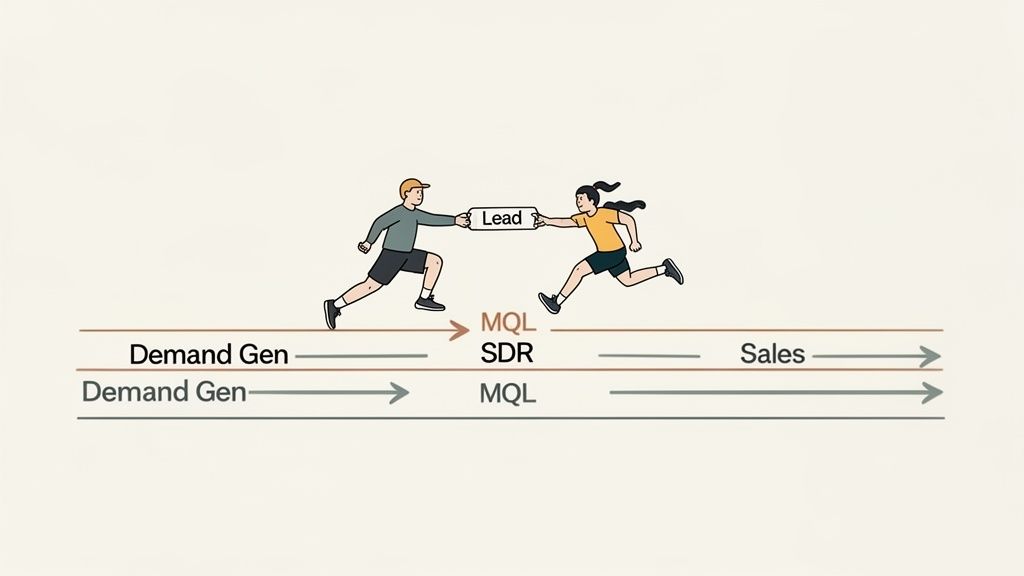
Mapping the Handoffs: The Relay Race
Your go-to-market process is a relay race. Each runner is a different team—Marketing, Sales, Product—and the baton is the customer. A dropped baton means a lost deal. Smooth handoffs are everything.
The most critical handoffs aren't just processes; they are agreements. They require clear definitions, shared goals, and mutual accountability between teams to function correctly.
This is where a Service Level Agreement (SLA) becomes so important. An SLA is a formal handshake between two teams that defines the rules of engagement.
Key Handoff Points to Define:
- Product Marketing to Content: How does a new product message become a real campaign? The handoff is the messaging and positioning guide, which the content team then uses to create blog posts, ad copy, and landing pages.
- Demand Generation to Sales (SDRs): This is the most famous—and often the most broken—handoff. When does a lead officially become an MQL? The SLA needs to spell out the exact criteria (e.g., company size, job title, a specific action taken on the website).
- Sales to Marketing: What happens to leads who aren't ready to buy yet? The handoff process should detail how sales sends these leads back to marketing for more nurturing, preventing valuable prospects from falling through the cracks.
This tight integration, especially between marketing and sales, is a massive competitive advantage. In fact, one study found that 65% of optimized B2B companies now have marketing and sales under unified leadership, a big jump from 45% in 2020. Companies making this shift reported a 35% improvement in pipeline velocity, crediting the structure's "adaptability based on metrics." To see how this alignment drives growth, you can read more about the marketing and sales org research.
Measuring Success: KPIs for Your Modern Marketing Team
A brilliant new marketing org structure is just a theory until you prove it drives results. The real test isn't how the chart looks on a slide, but whether the team’s work actually moves the needle on what matters most—revenue.
Without the right Key Performance Indicators (KPIs), you're flying blind. You won’t know if your demand gen team is just busy or actually building qualified pipeline. You won't know if your content is resonating or just adding to the noise online. Data is what turns your structure from a good idea into a predictable growth engine.
Connecting Functions to Outcomes
Different parts of your marketing machine have different jobs, so they need different scorecards. You wouldn't measure a sprinter and a marathon runner with the same stopwatch, right? The same logic applies here.
Your Demand Generation team, for instance, lives and breathes pipeline. Their success is tied directly to creating revenue opportunities, and their KPIs should reflect that with zero ambiguity.
- Marketing Qualified Leads (MQLs): The total volume of leads hitting the pre-agreed criteria for sales-readiness.
- Sales Qualified Leads (SQLs): The number of MQLs that sales accepts and agrees to work. This is a critical handoff point.
- Pipeline Velocity: How fast leads move from first touch to closed-won. A faster cycle means a more efficient engine.
- Customer Acquisition Cost (CAC): The total cost of marketing and sales to land one new customer.
These numbers are direct and unforgiving—they tell you exactly how well your lead engine is performing.
Measuring Brand and Content Impact
On the other hand, the Brand and Content team often plays a longer game. Their work absolutely contributes to revenue, but many of their most important KPIs are leading indicators of future success. Their job is to build an audience, earn trust, and establish authority.
The KPIs you choose signal what's important to the business. If you only measure bottom-funnel metrics, your team will neglect the top-funnel activities that build long-term demand and brand equity.
Success for this team can be tracked with metrics that show growing influence and engagement:
- Organic Traffic: An increase shows your content is ranking well and attracting your target audience through search.
- Share of Voice (SOV): How visible and talked-about your brand is in the market compared to your competitors.
- Engagement Rate: Likes, shares, comments, and time spent on a page prove your content is hitting the mark.
To give you a clearer picture, here’s how KPIs often evolve as a company grows and its marketing functions mature.
Marketing KPIs by Function and Growth Stage
This table breaks down the essential marketing KPIs for each function, showing how they shift from early-stage goals to more sophisticated metrics as the company scales.
| Marketing Function | Key KPIs (Seed/Series A) | Key KPIs (Series B+) |
|---|---|---|
| Demand Generation | MQLs, SQLs, CPL (Cost Per Lead) | Pipeline Value, Pipeline Velocity, CAC, LTV:CAC Ratio |
| Content Marketing | Organic Traffic, Blog Subscribers, Social Engagement | Keyword Rankings, MQLs from Content, Share of Voice |
| Product Marketing | Website Conversion Rate, Feature Adoption Rate | Win/Loss Rate, Competitive SOV, Sales Enablement Usage |
| Brand/Comms | Social Media Following, Media Mentions, Website Traffic | Brand Recall, Direct/Branded Traffic, Inbound Link Quality |
| Marketing Ops | Database Growth, Email Open/Click Rates | Lead-to-Close Conversion Rates, Data Integrity, Marketing ROI |
As you can see, the focus moves from top-of-funnel volume and activity in the early days to efficiency, revenue impact, and ROI as the business matures.
The Power of Shared KPIs
The single most powerful way to make your new structure click is to create shared accountability, especially between marketing and sales. When both teams are responsible for the same number—like revenue generated from marketing-sourced leads—the finger-pointing stops and real collaboration begins.
Shared KPIs force alignment. They ensure the marketing team isn't just tossing MQLs over the wall to hit a volume target, but is laser-focused on generating leads sales can actually close. This data-driven connection is essential. If you want to dive deeper, our guide offers more insight into how to measure marketing ROI effectively.
This alignment is what justifies your headcount, informs future investment, and ultimately, turns your marketing org into a powerful driver of business growth.
Making the Change: A Practical Checklist for Restructuring
Thinking about changing your marketing org structure is one thing; actually doing it without blowing things up is another. A clumsy reshuffle can kill morale, freeze projects in their tracks, and leave your best people wondering if they should update their LinkedIn profile. A thoughtful, transparent process isn't just nice to have—it's non-negotiable.
This isn't just about moving boxes on a chart. It’s a delicate change management exercise where the goal is to build a stronger, more effective team, not just a different-looking one.
Most companies are surprisingly bad at this. A Deloitte survey of over 1,000 executives found that only 17% felt their organizations were 'excellent' at being agile. That’s a huge gap between wanting to adapt and being able to pull it off. A structured approach is how you avoid becoming part of that dissatisfied majority.
Define Your North Star
Before you even think about touching a single role, get brutally honest about why you're doing this. What business goal is driving the change? Copying a structure you saw on a blog post is a recipe for disaster.
Your "why" has to be specific and measurable. For example:
- Are you trying to increase MQLs by 50% next year?
- Do you need to slash your pipeline velocity and get sales what they need, faster?
- Are you launching a new product and need a dedicated go-to-market squad to make it a success?
Your structure must directly serve that outcome. The "why" always dictates the "how."
A Step-by-Step Transition Plan
Once your goals are locked in, you can build a deliberate plan. This isn't something you can knock out over a weekend. Follow these steps to manage the transition smoothly and keep your team’s trust.
- Audit Your Current Team: Forget job titles for a minute. What are your people actually good at? Who’s a secret data whiz? Who loves getting on the phone with customers? Map out the skills and passions you already have—this inventory is way more valuable than any formal job description.
- Map People to New Roles: With your ideal future state in mind, start penciling in your current talent. Be realistic about who fits where and what skills you’ll need to hire for. This is where you spot the gaps before they become problems.
- Communicate Transparently: Get the whole team together and announce the changes all at once. Explain the why behind the new structure and connect it directly to the company’s big-picture goals. Show each person how their new role helps get you there.
- Establish New Cadences: Your old meeting rhythms probably won’t work anymore. From day one, set up new check-ins, team stand-ups, and cross-functional syncs that support the new workflows. This is how you make the new structure real.
Quick Answers to Common Questions
Even with the best org chart in hand, a few questions always pop up when you're making changes. Here are the straight-up answers I give B2B tech leaders when we're designing their modern marketing team.
When Should I Hire My First Marketing Leader?
The sweet spot is usually right around your Series A funding round. By then, you should have some early signs of product-market fit and need a real leader to build a repeatable engine for growth, not just run random campaigns.
Before that, a sharp marketing generalist or even founder-led marketing gets the job done. If you hire a senior leader too early, you end up with a strategy-execution mismatch—you’re paying for a strategist when what you really need is a doer.
Should Marketing Report to Sales or the CEO?
In almost every high-growth B2B tech company I've worked with, marketing should report directly to the CEO. This gives marketing a strategic seat at the table and keeps it tied to the big-picture business goals.
When marketing reports to sales, it almost always gets demoted to a sales support function. The focus shifts to short-term lead gen, and you lose the long-term brand building that drives sustainable growth.
Putting marketing on equal footing with sales creates a much healthier partnership where both teams are accountable for revenue.
How Do I Structure My Team for Different Industries?
If you're selling into multiple, distinct industries, a Hybrid or Segment-Based model is your best bet. This structure lets you build deep, specialized expertise for each market you’re trying to win.
The best way to do this is by creating small, dedicated pods or 'squads' for each key vertical.
- Dedicated Focus: Each pod gets its own mix of marketers (like content and demand gen) who live and breathe that specific industry.
- Deep Relevance: This team becomes fluent in the vertical’s unique pain points, language, and buying triggers. They sound like insiders, not outsiders.
- Targeted Campaigns: All your messaging and campaigns get tailored for maximum impact within that segment, instead of being one-size-fits-all.
This approach stops you from creating generic marketing that no one pays attention to.
Building the right marketing org chart is a huge step, but it takes serious leadership to bring it to life and make it work. Value CMO gives B2B tech companies the fractional CMO expertise needed to design and lead high-performing teams without the full-time cost. Get the senior marketing leadership you need to scale.