Let's be honest, "demand generation" sounds like a pretty corporate buzzword. But really, it’s all about making your ideal customers want to do business with you. It’s a bigger-picture strategy, focused on building awareness and trust in your company’s solutions long before anyone is even thinking about a purchase.
Think of it as creating a community of fans, not just a list of leads.
Unpacking What Demand Generation Marketing Really Is

Let's make this simple. Imagine you’re launching the best new restaurant in town.
You could stand on the corner handing out flyers for a 10% discount. That’s a classic lead generation play—you’re directly asking for someone to walk in and buy.
But with demand generation, you play a different game entirely. You host free cooking classes, publish recipes on a popular food blog, and get featured in local media for your unique culinary philosophy. You aren't asking for the sale. You're building a reputation.
When those people eventually get hungry, your restaurant is the first one they think of. That’s the heart of what demand generation marketing is: a long-game strategy that educates and builds trust to create a reliable pipeline of future customers who already know, like, and respect you.
How It Differs From Other Marketing Approaches
It’s easy to get demand gen mixed up with similar-sounding terms like lead generation or pipeline marketing. They're all related, sure, but they play different positions on the same team. Nailing the differences is the key to building a cohesive growth engine.
Many marketers use "demand generation" and "lead generation" interchangeably, but their goals are fundamentally different. While there's some overlap, we've broken down the key distinctions between demand generation vs. lead generation to help you focus your efforts where they count.
Here’s the simplest way to think about it: demand generation creates the market and educates potential buyers. Lead generation captures the interest that already exists. Pipeline marketing then takes that interest and guides it on its journey toward becoming revenue.
To make this crystal clear, let's look at how these three disciplines stack up side-by-side.
Demand Gen vs Lead Gen vs Pipeline Marketing
Here’s a quick comparison to help you distinguish between these crucial functions. Each has a specific job to do, and a truly effective marketing strategy needs all three working in sync.
| Discipline | Primary Goal | Key Activities | Core Metric |
|---|---|---|---|
| Demand Generation | Create awareness and educate the market on their problems and your solutions. | SEO, content marketing, webinars, podcasts, community building, social media. | Influenced Pipeline |
| Lead Generation | Capture contact information from prospects who have shown interest. | Gated content (e-books), demo requests, free trial sign-ups, contact forms. | Marketing Qualified Leads (MQLs) |
| Pipeline Marketing | Nurture qualified leads and accelerate their journey to becoming customers. | Email nurturing sequences, targeted ad campaigns, sales enablement content. | Sales Qualified Leads (SQLs) & Pipeline Velocity |
Ultimately, demand gen builds the audience, lead gen converts that audience into contacts, and pipeline marketing turns those contacts into paying customers. You can’t have one without the others.
The Core Components of a Demand Generation Engine
A powerful engine isn’t just one single part; it’s a whole system of components working in perfect harmony. The same goes for a strong demand generation program. It's not about a single campaign or channel but a collection of essential pillars that, when combined, create a predictable system for growth.
Think of these as the blueprints for your revenue machine. Each piece has a specific job, from identifying your destination to ensuring the machinery runs without a hitch. Getting them right is the difference between sputtering along and building unstoppable momentum.
Start with Your Ideal Customer Profile
Before you write a single blog post or launch an ad, you need to know exactly who you're talking to. The Ideal Customer Profile (ICP) is the North Star for your entire demand generation strategy. It’s a detailed, living document that defines the perfect-fit company for your product—not just any company, but the one that will get the most value and, in turn, provide the most value back to you.
Your ICP goes way beyond basic info like industry and company size. It digs into the specifics:
- Technographics: What technologies are they already using?
- Pain Points: What specific, urgent problems are they trying to solve right now?
- Goals: What business outcomes are they trying to achieve?
- Buying Triggers: What events or changes would force them to seek a solution like yours?
Without a crystal-clear ICP, your marketing is just guesswork. With one, every piece of content and every campaign has a clear purpose and audience.
Create Genuinely Valuable Content
Once you know who you’re targeting, you have to create content that genuinely helps them. This is the fuel for your demand generation engine. The goal isn’t to pitch your product constantly; it’s to educate, solve problems, and build trust. When you become the go-to resource for your ICP, you win their attention and loyalty.
This means focusing on quality over quantity. Instead of churning out generic articles, create pillar pieces of content that address your audience's deepest challenges.
Your content should be so valuable that your audience would be willing to pay for it—but you give it away for free to establish authority and build a relationship.
High-impact content includes insightful blog posts, original research reports, data-rich webinars, and expert-led podcasts. Each piece should be designed to move a potential customer from being unaware of their problem to being aware of your solution.
Choose the Right Distribution Channels
Creating amazing content is only half the battle. You have to get it in front of the right people. Distribution is how you ensure your valuable resources don't just sit on your website collecting dust. The key is to meet your audience where they already hang out.
Your ICP dictates your channel strategy. If your ideal buyers are active on LinkedIn, that’s where you should focus your social efforts. If they rely on industry publications for information, a PR or guest posting strategy makes more sense. The goal is a multi-channel approach that surrounds your ICP with helpful, relevant information.
Nurture Relationships with Automation
Very few buyers are ready to make a purchase the first time they interact with your brand. That's where nurturing comes in. It’s the art of building and maintaining relationships over time through personalized, automated communication.
This process guides potential customers through their buying journey, providing the right information at the right time. To scale this effectively, you need the best marketing automation software. These platforms allow you to create sophisticated email sequences, segment your audience based on behavior, and score leads to pinpoint who is ready for a sales conversation.
Tie It All Together with Technology
Finally, your martech stack is the chassis that holds your entire demand gen engine together. These are the platforms that let you execute, measure, and optimize your strategy. While the specific tools will vary, a solid foundation usually includes:
- Customer Relationship Management (CRM): The central hub for all customer and prospect data.
- Marketing Automation Platform: For nurturing leads and automating communication at scale.
- Analytics Tools: To track performance and measure ROI across all your channels.
These components work together to create a seamless system that attracts, engages, and converts your ideal customers into a predictable stream of revenue.
Why Account-Based Marketing Is a Demand Gen Powerhouse
Think about fishing for a second. You could cast a wide net and hope to pull in a few decent fish along with a bunch of seaweed and tiny ones. That's a lot like old-school marketing. Or, you could grab a spear and go directly after the biggest, most valuable fish in the water.
That’s Account-Based Marketing (ABM) in a nutshell.
ABM is such a powerful strategy because it flips the traditional marketing funnel completely on its head. Instead of chasing a high volume of individual leads, you focus all your marketing and sales firepower on a handpicked list of high-value accounts—the ones that are a perfect fit for you. It's the difference between a department store selling off the rack and a bespoke tailor crafting a suit for a single, important client.
For a B2B founder, this laser-focused approach means less wasted budget, less time chasing unqualified prospects, and bigger, faster deals with the exact customers you want.
Uniting Sales and Marketing for Precision Targeting
For ABM to actually work, tight alignment between your sales and marketing teams is non-negotiable. I'm not just talking about having a weekly meeting; I mean building a single, unified revenue team where both sides share goals, work from the same data, and agree on every single account to target.
When sales and marketing are truly in sync, that's when the magic happens:
- Shared Goals: Both teams are measured by the same metrics, like pipeline generated from target accounts and, ultimately, closed-won revenue.
- Co-Owned Strategy: Marketing doesn’t just toss leads over the fence. They work hand-in-glove with sales to build personalized campaigns and outreach that actually resonate with decision-makers.
- Unified Communication: The message a prospect sees in a marketing campaign is the exact same one they hear in a call from a sales rep. This creates a seamless, compelling experience for the buyer.
This deep collaboration ensures every marketing dollar and every sales hour is spent on opportunities with the highest possible return. It’s a true strategic partnership.
The diagram below shows how a powerful demand gen engine needs a clear ICP, valuable content, and the right channels—all of which are critical for a winning ABM strategy.
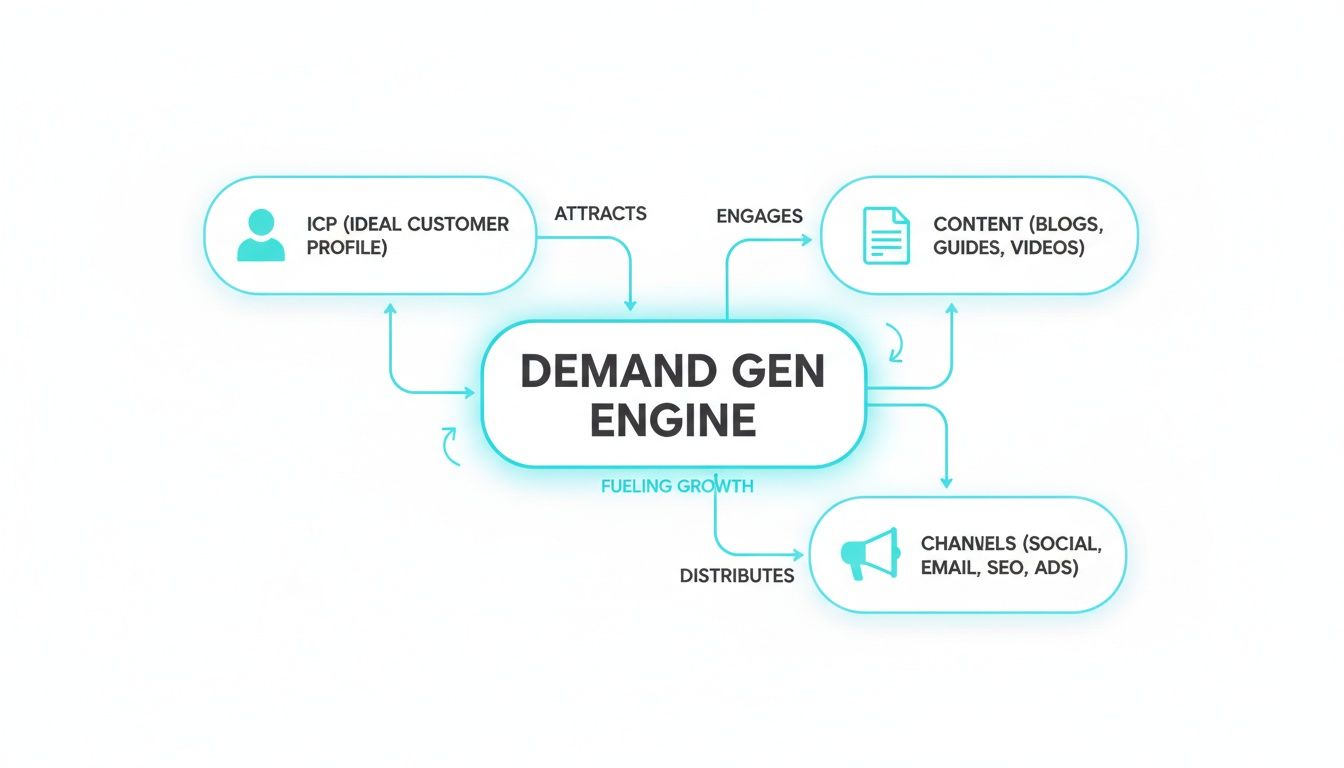
As you can see, a well-defined customer profile sits at the center, driving what content you create and which channels you use to engage those high-value accounts.
Using Intent Data as Your Secret Weapon
So, how do you know which of your target accounts are actually ready to talk? This is where intent data becomes your secret weapon. It gives you a peek into which companies are actively researching solutions like yours right now, even if they’ve never been to your website.
Intent data is like a flare in the dark. It signals which of your dream customers are in-market and ready to engage, letting you shift from cold outreach to perfectly timed, relevant conversations.
By tracking online activity—like content downloads, keyword searches, and topic research across the web—you can prioritize your outreach to accounts that are showing clear signs of purchase intent. This lets you show up with a message that speaks directly to their current needs, making your marketing feel less like an interruption and more like a helping hand.
The impact is huge. Research shows that 68% of B2B marketers say ABM delivers a higher ROI than any other marketing initiative, and over 70% use intent data to prioritize their accounts. We’ve seen this firsthand at Value CMO—after one of our Alignment Sprints, teams using ABM with intent data often see 20-30% faster deal cycles simply because their outreach is so much more relevant. To learn more, check out the latest demand generation marketing trends and benchmarks.
Fueling Your Strategy with AI and Predictive Analytics
Modern demand generation isn't about guesswork anymore. It's about making smart, data-driven decisions, and this is where AI and predictive analytics have become a marketer's best co-pilot. These aren't just buzzwords for the future; they're practical, powerful tools for B2B tech companies right now.
AI platforms are brilliant at digging through mountains of data—web traffic, content downloads, even third-party intent signals—to spot patterns a human team could never see. This completely changes how you find and prioritize your best-fit accounts.
Predicting Your Next Best Customer
Imagine knowing which prospects are getting ready to buy before they even hit your pricing page. That's the core idea behind predictive lead scoring. Instead of treating every inbound inquiry the same, AI builds a dynamic score based on hundreds of data points, showing your sales team exactly who to call first.
This data-first approach means your resources go where they'll have the biggest impact. Your team stops wasting time chasing low-fit leads and spends more time in meaningful conversations with accounts showing real, measurable interest. The result? A much faster and healthier sales pipeline.
AI acts as a powerful filter, separating the high-potential opportunities from the noise. It helps you move from a strategy of hope to a strategy of probability, focusing your marketing spend on quality and pipeline velocity, not just raw lead volume.
This intelligence also lets you personalize experiences at a scale that was once impossible. AI can dynamically adjust the content, messaging, and offers someone sees based on their behavior, creating tailored journeys that feel one-to-one. You can explore a variety of AI marketing automation tools that make this level of personalization achievable even for lean teams.
Personalizing Experiences at Scale
Personalization is the heart of effective demand gen, and AI is the engine that makes it run. We've moved way beyond just inserting a first name into an email. Today’s AI can analyze a buyer’s role, industry, and recent online behavior to serve them the perfect case study, blog post, or webinar invite at just the right time.
This creates a connected buyer journey where every touchpoint feels relevant and helpful, not intrusive. And this isn't just theory—it works. HubSpot's recent data shows 82% of US marketers are already using AI to create content faster, fueling personalized experiences that adapt to what buyers are signaling.
At Value CMO, our CMO Accelerator engagements put this into practice by building data-driven growth roadmaps with integrated CRM automation. Because of this, our clients often see 25-40% improvements in pipeline velocity just by focusing on this kind of behavior-based personalization.
By weaving AI and predictive analytics into your strategy, you’re not just finding your ideal customers—you’re engaging them in a way that builds trust and drives predictable growth. It’s all about working smarter, not just harder.
Orchestrating Channels for a Seamless Buyer Journey
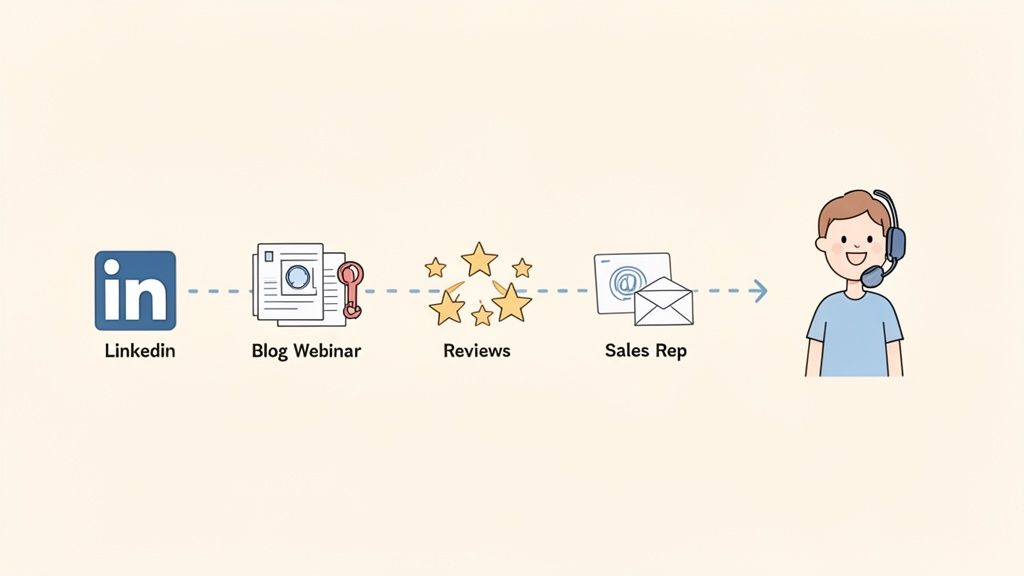
Today’s B2B buyers don't walk a straight line. They’re explorers, not shoppers following a grocery store aisle. Their path to buying is a winding journey that zig-zags across a dozen different channels and touchpoints.
They might first see your brand in a sharp LinkedIn post, then poke around your blog, watch a recorded webinar, and skim your G2 reviews—all before they ever think about talking to sales. This is the new reality, and it's exactly what demand generation marketing is built to handle.
The goal is to stop thinking in terms of one-off campaigns and start building a single, seamless journey. We need to tell a consistent story across every single touchpoint, making sure the message evolves as your buyer gets smarter.
Building a Cohesive Multi-Touch Experience
Picture this: a prospect from a target account sees a helpful ad on LinkedIn and clicks to download an insightful ebook.
That single action kicks off a short, educational email sequence. No hard sell, just a few messages that build on the ebook's topic. A week later, they get a retargeting ad for a live webinar that hits on the exact pain point from the content they already consumed.
By the time a sales rep finally calls, they know every step that prospect took. The conversation is warm, relevant, and genuinely helpful because it’s informed by the entire journey. That’s channel orchestration in action.
A successful demand generation strategy ensures that each interaction builds upon the last, creating a smooth, positive experience that guides the buyer from their first touch to the final sale.
This only works with tight alignment between marketing and sales. Both teams need to be reading from the same playbook. Marketing paves the road, and sales provides the personalized guidance at just the right moment.
A Tactical Multi-Touch Sequence for SaaS
Let's make this concrete. Here’s what a simple journey could look like for an early-stage SaaS company targeting a specific account:
- Touch 1 (Paid Social): An awareness-focused LinkedIn ad targets your ICP. It’s a short video that explains how to solve a common industry problem, subtly positioning your company as the expert.
- Touch 2 (Content Download): The prospect clicks the ad and lands on a blog post expanding on the video's topic. It offers a downloadable "Ultimate Guide" in exchange for an email.
- Touch 3 (Email Nurture): A three-part automated email sequence kicks off, delivering more value—a link to a related case study, an invite to a webinar, and a short checklist.
- Touch 4 (Retargeting): Now in a retargeting audience, the prospect sees display ads with customer testimonials and a clear call-to-action to request a demo.
- Touch 5 (Sales Outreach): The CRM flags this high-engagement account for an SDR. They send a personalized email that references the content the prospect engaged with and asks a relevant, timely question.
This kind of methodical, multi-step process is incredibly effective. In fact, well-designed 6-8 touch sequences frequently drive a 30-50% lift in qualified opportunities. By layering paid media, content, email, and smart sales outreach, you build real momentum and get pipelines unstuck. You can learn more about how modern B2B buyers respond to these kinds of demand generation marketing trends on dealfront.com.
Measuring What Matters in Demand Generation
How do you really know if your demand generation strategy is working? It's way too easy to get lost in a sea of vanity metrics—clicks, impressions, social media likes. These numbers might look good in a weekly report, but they don't pay the bills. They don’t tell you if you’re actually moving the needle on business growth.
To prove the real value of your demand gen efforts, you have to measure what truly matters. That means shifting your focus from fuzzy top-of-funnel activity to hard, bottom-line results.
Moving Beyond Vanity Metrics
The only real goal here is to draw a straight line from your marketing efforts directly to revenue. This requires a framework that tracks how all those awareness and education activities—the blog posts, the webinars, the LinkedIn ads—actually translate into a healthy sales pipeline and, ultimately, closed deals. Forget about just reporting on website traffic; it's time to have meaningful conversations about how marketing is driving the business forward.
When you measure the right things, marketing stops being seen as a cost center and starts being recognized as the revenue engine it is. The conversation shifts from "How many leads did we get?" to "How much pipeline did we create?"
This shift in conversation is critical for getting executive buy-in and securing the budget you need to scale. A huge piece of this is learning how to measure marketing ROI in a language your leadership team understands and respects.
Key Demand Generation KPIs by Funnel Stage
To build a clear, honest picture of your program's health, you need to track the right KPIs at each stage of the buyer's journey. Ditching vanity metrics for performance indicators gives you a true story of your impact, from initial touch to final sale.
Here's a breakdown of the most important metrics to track:
| Funnel Stage | Primary KPI | Supporting Metrics | What It Tells You |
|---|---|---|---|
| Top of Funnel (Awareness) | Marketing Qualified Leads (MQLs) | Website Traffic, Content Downloads, Webinar Registrations | Are we reaching our ICP and creating initial interest effectively? |
| Middle of Funnel (Consideration) | Sales Qualified Leads (SQLs) | MQL-to-SQL Conversion Rate, Demo Requests, Pipeline Velocity | Are we successfully nurturing interest and creating high-quality, sales-ready opportunities? |
| Bottom of Funnel (Decision) | Marketing-Sourced Revenue | Customer Acquisition Cost (CAC), Close Rate, LTV:CAC Ratio | Is marketing contributing directly to closed-won deals and driving profitable growth? |
Focusing on these KPIs gives you a dashboard that tells the full story—not just how much activity you're generating, but how much business you're creating.
KPIs That Signal Real Business Growth
While the table above gives you a stage-by-stage view, a few core metrics should always be on your main dashboard. These are the ones that tell the true story of your impact.
- Marketing-Sourced Revenue: This is the big one. It answers the most important question from your CEO: "How much new revenue did marketing directly bring into the business?"
- Pipeline Velocity: This tells you how fast deals move through your sales funnel, from the first touch to the final signature. A faster velocity means your marketing is creating better-educated, higher-quality opportunities that are ready to buy.
- Customer Acquisition Cost (CAC): This tracks exactly how much you're spending to land a new customer. A truly effective demand gen program should lower your CAC over time by creating more efficient, inbound interest that costs less to convert.
Understanding the Full Customer Journey
Let’s be honest: today’s B2B buyers interact with your brand across a dozen different channels before they even think about talking to sales. Relying on a single-touch attribution model—like giving all the credit to the last ad they clicked—gives you a dangerously incomplete picture of what’s actually working.
This is exactly why multi-touch attribution is non-negotiable. It assigns credit to all the touchpoints that influenced a buyer along their journey, from the first blog post they read six months ago to the final webinar they attended last week. By understanding what is multi-touch attribution, you get a true, 360-degree view of which channels and content are most effective at both creating and nurturing demand. No more guesswork.
How to Build or Fix Your Demand Generation Program
Putting the principles of demand generation into practice can feel overwhelming, but it really boils down to asking the right questions. Whether you're building a program from scratch or figuring out why an existing one is sputtering, a frank, systematic audit is always the first step.
Start with your foundation. Is every single decision you make grounded in a deep, shared understanding of your ideal customer? An unclear ICP is the #1 reason even the most creative campaigns fail to produce real pipeline. Full stop.
Once you’re sure about who you're talking to, you can start diagnosing the engine itself. This means taking an honest look at your content, your channel strategy, and—most importantly—how well your teams are working together.
A Practical Diagnostic Checklist
Use these questions to pinpoint weaknesses and find your highest-impact opportunities. Be brutally honest here. This isn't about checking boxes; it's about fixing what's broken.
1. Ideal Customer Profile (ICP) Clarity:
- Do sales and marketing agree on the exact definition of a perfect-fit account? Not a vague description, but a razor-sharp one.
- Is our ICP based on real data (best customers, fastest deals, highest LTV) or just a bunch of assumptions from a whiteboard session?
- Does every piece of content we create speak directly to this profile's specific, nagging pain points?
2. Content and Channel Effectiveness:
- Does our content genuinely educate and solve problems, or is it just a thinly veiled product pitch? Buyers can smell a sales pitch a mile away.
- Are we distributing our content where our ICP actually spends their time, or are we just shouting into the void on channels that feel easy?
- Do we have a clear system for nurturing interest over time, or are we letting warm prospects go cold right after the first touch?
3. Sales and Marketing Alignment:
- Do both teams share the exact same goals and KPIs? Think pipeline created and revenue sourced, not just MQLs or meetings booked.
- Is there a clear, agreed-upon handoff process for when marketing-sourced interest is ready for sales outreach?
- Do sales reps have the content and context they need to have relevant, valuable conversations from the first call?
When to Call for Reinforcements
If this audit reveals significant gaps, you probably don’t have the internal bandwidth or expertise to fix them all quickly. This is often the perfect time to bring in strategic leadership from the outside, especially when a full-time executive hire isn't yet feasible.
A fractional CMO can step in to bridge a leadership gap, mentor a junior team, or design a fast, focused growth plan. They provide the senior-level direction needed to fix a stalled pipeline, align your teams, and build a demand generation program that finally delivers predictable results.
Ready to stop guessing and start building a revenue engine that actually works? Value CMO provides the senior B2B marketing leadership you need without the full-time overhead. Learn how we build data-driven growth roadmaps for tech startups.