
A marketing department structure is simply the blueprint for how your marketing team is organized—who does what, who reports to whom, and how all the work gets done. For a B2B tech startup, this isn't about creating some stuffy corporate hierarchy. It's about building a predictable growth engine.
Your Marketing Structure Is Your Growth Engine
Let's be real. For most tech founders, "structure" sounds like a total drag. You're obsessed with building a killer product, and it's all too easy to fall for the myth that a great product will just sell itself. In the brutal B2B arena, that's a fast track to failure.
Sticking with an "all-hands-on-deck" marketing approach—where everyone pitches in on everything—is a recipe for chaos. What you get is burned-out people, random acts of marketing, and a pipeline that’s completely stalled out.
Think of your marketing team like a symphony orchestra. You wouldn't ask the violinists to play the drums or the conductor to sell tickets, right? Each musician has a specialized role, but they're all playing from the same sheet music to create something cohesive and powerful. A well-defined marketing department structure does the same thing. It gives every person clarity on their job while making sure the whole team is marching toward the same goal: predictable revenue.
Before we go deeper, let's do a quick check-up. Is your current marketing setup a growth blocker or a growth enabler?
Symptoms of a Broken vs. Healthy Marketing Structure
Use this quick diagnostic table to see if your current marketing approach is a growth blocker or a growth enabler.
| Symptom of a Broken Structure | Outcome of a Healthy Structure |
|---|---|
| Random acts of marketing with no clear goal. | Focused campaigns tied directly to revenue. |
| People are busy, but the pipeline is empty. | Activities are prioritized by their impact on sales. |
| Burnout from constant context-switching. | Roles are clear, and people own their swim lanes. |
| Finger-pointing between sales and marketing. | Shared goals and metrics create a unified team. |
| Inability to report on what's working (and why). | Clear dashboards show ROI and attribution. |
| Hiring feels like a shot in the dark. | The next hire fills a specific, strategic gap. |
If you're seeing more symptoms on the left, it's a clear sign that a lack of structure is holding you back.
From Chaos to Clarity
Without a deliberate structure, marketing becomes a series of frantic, disconnected tasks. One week it's a blog post, the next it's a last-minute scramble for a trade show. This kind of reactive work almost never builds the momentum you need to scale.
A clear structure flips the script, turning that chaos into a focused growth machine by:
- Defining Ownership: Everyone knows exactly what they’re on the hook for, whether it's generating leads or creating sales enablement content. No more confusion.
- Improving Efficiency: Clear workflows stop people from duplicating work and ensure the right person is handling the right task. The systems that drive this are covered in our guide to marketing operations.
- Enabling Scalability: As you grow, you can slot new roles into a pre-built framework without breaking everything. It’s plug-and-play, not start-from-scratch.
This shift—from marketing as a support function to a core driver of the business—is becoming the norm. The American Marketing Association found that 57% of Fortune 500 companies now have a marketing-focused role in their top leadership. To get there, you have to build a better marketing department organizational structure that’s wired for your specific business goals.
A thoughtful marketing department structure isn't about control; it's about empowerment. It provides the clarity and direction your team needs to stop fighting fires and start building a predictable pipeline that delivers the data-driven results investors want to see.
Matching Your Structure to Your Startup Stage
Trying to nail down the "perfect" marketing department structure is a fool's errand. It just doesn't exist. Why? Because the scrappy, do-whatever-it-takes approach that gets a seed-stage startup off the ground will absolutely cripple a Series B company trying to build a predictable growth machine.
The key is to think of your marketing function not as a static department, but as a growth engine. And like any engine, it needs the right parts bolted on at the right time. Your goal isn't just to increase headcount; it's to add specific capabilities precisely when the business demands them.
This isn't just theory. As companies get smarter with their data, the focus is shifting hard toward accelerating revenue and gaining real insights—goals that directly shape how you should build your team.
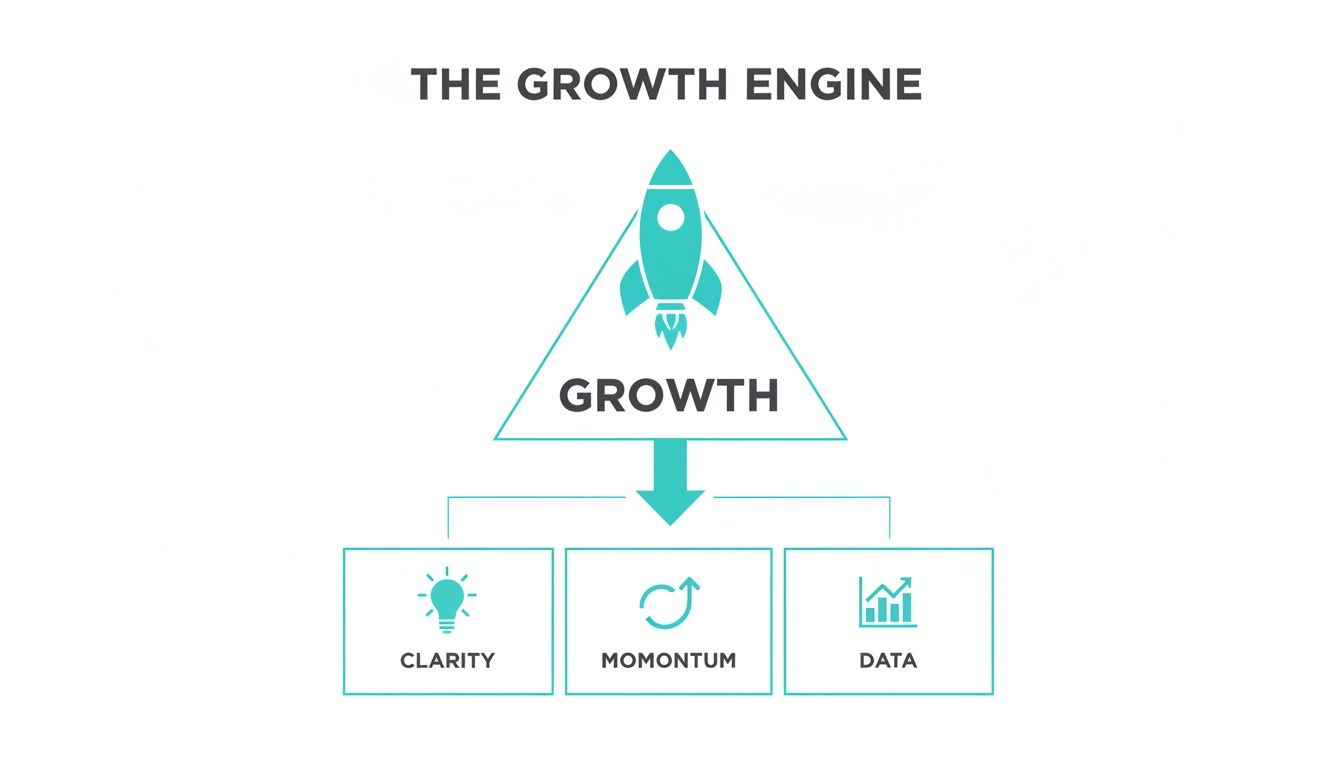
As the diagram shows, sustainable growth isn't just about raw speed. It's built on a foundation of clarity, momentum, and data—each one becoming a bigger deal as you scale.
The table below breaks down how your marketing focus, team composition, and key metrics should evolve as your company hits different funding milestones.
Marketing Structure Evolution by Funding Stage
| Funding Stage | Primary Marketing Goal | Core Roles | Key Metrics |
|---|---|---|---|
| Pre-Seed/Seed | Find Product-Market Fit & Land First 10 Customers | Founder or a T-shaped marketing generalist. | Website traffic, qualitative feedback, sales conversations. |
| Series A | Build a Repeatable Demand Generation Engine | Marketing Manager, Content Creator, Demand Gen Specialist. | MQLs, Cost per Lead (CPL), initial pipeline contribution. |
| Series B+ | Scale & Optimize the Go-to-Market Machine | VP of Marketing/CMO, specialized "pods" (Demand Gen, Content, Ops). | Pipeline velocity, CAC, LTV, marketing-sourced revenue. |
Each stage builds on the last, adding layers of specialization and sophistication as you prove out your model and pour fuel on the fire. Let's dig into what that looks like in practice.
The Founder-Led 'Doer' Model (Pre-Seed/Seed)
In the very beginning, "marketing" isn't about building a department. It's about raw execution. The goal is simple but brutally difficult: find product-market fit. You’re testing messages, figuring out your first viable channels, and desperately trying to land those first 10 paying customers.
At this point, the "marketing team" is usually just a founder who can sell or a single, jack-of-all-trades marketer.
- Main Goal: Validate the market and get early traction.
- Essential Role: A founder pounding the pavement or a “T-shaped” marketing generalist who can write decent copy, run a few simple ads, and manage a social account without setting anything on fire.
- Key Metrics: Forget MQLs or pipeline value. You’re focused on qualitative feedback, raw website traffic, and the number of sales conversations you can generate.
The structure is flat because it has to be. Speed and learning are everything.
The Foundational 'Generalist' Team (Series A)
Once you’ve closed that Series A round, the game changes. You’ve got product-market fit, and the new mandate is to build a repeatable demand generation engine. It’s time to move beyond founder-led hustle and into a more systematic approach. "Random acts of marketing" are officially banned.
Now you’re ready to build a small, foundational team of smart generalists who can cover the core bases of modern B2B marketing.
Your Series A structure is all about laying the groundwork for scale. You’re not hiring a niche specialist for everything; you’re hiring adaptable players who can stand up your core programs in content, demand gen, and product marketing.
This team usually involves a few key hires reporting to a Head of Marketing or directly to the CEO.
- Main Goal: Build a predictable lead funnel.
- Core Roles: Marketing Manager/Director, a Content Creator, and a Demand Generation Specialist.
- Key Metrics: The focus shifts to hard numbers like Marketing Qualified Leads (MQLs), cost per lead, and early signs of pipeline contribution.
The Specialized 'Pod' Structure (Series B and Beyond)
With a Series B check in the bank, your focus sharpens dramatically. It's all about scaling and optimizing your go-to-market motion. The engine is working, and it’s time to pour fuel on it. The generalists who got you here can no longer provide the depth of expertise required to win.
This is where specialization comes in. Many scale-ups adopt a "pod" or "squad" model, creating small, cross-functional teams aimed at specific goals like inbound, account-based marketing (ABM), or customer marketing. This model fosters tight collaboration and clear ownership, which is exactly what you need. After all, research shows 75% of employers rate teamwork as "very important," and this structure is built for it.
A specialized structure might break down like this:
- Leadership: A VP of Marketing or CMO who owns the strategy and the budget.
- Demand Generation Pod: Specialists in SEO, paid media, and marketing ops who are 100% focused on filling the top of the funnel.
- Content & Product Marketing Pod: A team of writers, product marketers, and designers who create all the assets needed to attract prospects and help sales convert them.
- Customer Marketing Pod: A dedicated team focused on retention, upsell, and advocacy to make sure you keep the customers you fought so hard to win.
At this stage, every function has its own sophisticated KPIs—like pipeline velocity, customer acquisition cost (CAC), and lifetime value (LTV)—all rolling up to the one metric that truly matters: revenue growth.
Your First Five Critical Marketing Hires
Making your first marketing hires is one of the highest-stakes decisions a founder can make. Get the sequence right, and you create momentum that pays for itself over and over. Get it wrong, and you can burn through cash and precious time with almost nothing to show for it.
This isn’t about just filling seats. It’s a strategic roadmap for building a real marketing engine, one smart hire at a time.
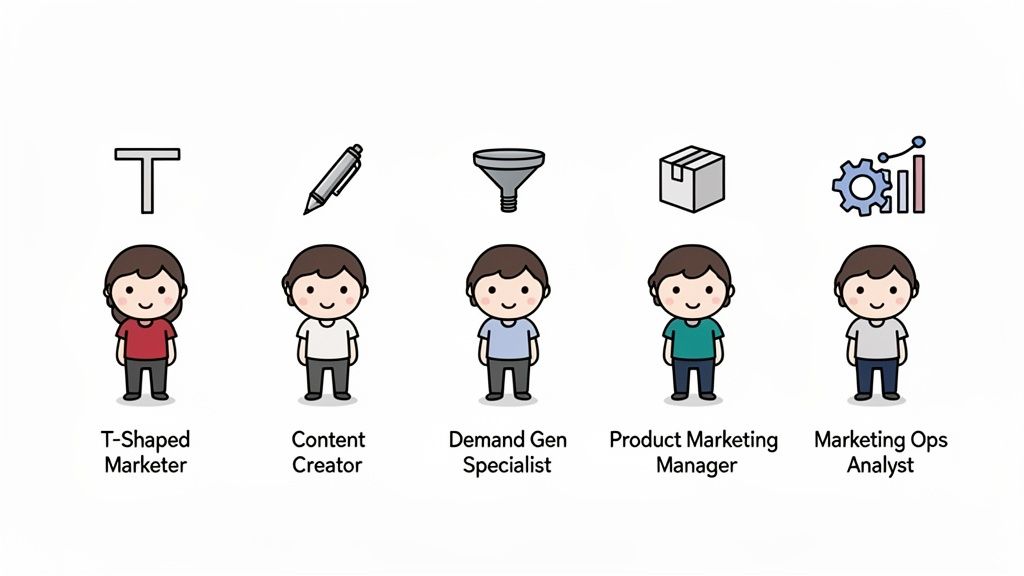
The goal is to assemble a small, mighty team where each new person solves a specific, urgent problem. Let's walk through the "who" and "why" behind your first five essential hires.
Hire 1: The T-Shaped Marketer
Your very first hire has to be a versatile generalist, what we call a T-shaped marketer. Picture the letter "T"—the wide horizontal bar is a broad knowledge of many marketing disciplines (SEO, social, email, ads), while the vertical stem represents deep skill in one or two critical areas, usually content and demand gen for a B2B startup.
This person is your marketing Swiss Army knife. They can write a blog post, rig up a simple email sequence, manage your social accounts, and make sense of basic campaign data. They need to be scrappy, adaptable, and totally comfortable with ambiguity—all non-negotiable traits in a chaotic early-stage environment.
- Problem They Solve: They get the engine started from a dead stop. They build your foundational content, establish an initial online presence, and start testing channels to see what works, moving you from pure founder-led selling to a true marketing function.
Hire 2: The Content Creator
Once your T-shaped marketer lays the groundwork, you'll quickly see that one person can't possibly create enough fuel to power the engine. Your second hire needs to be a dedicated Content Creator.
This person lives and breathes storytelling. They exist to turn your company's complex product into compelling blog posts, case studies, webinars, and website copy that actually connects with people. They don't just write; they are a strategic asset who gets inside the heads of your customers to create content that answers their questions. This hire directly supports both sales (with enablement materials) and demand gen (with top-of-funnel assets).
Hire 3: The Demand Generation Specialist
You now have someone creating high-quality content. Great. But you need another person whose entire job is getting that content in front of the right eyeballs. Enter the Demand Generation Specialist.
This role is all about building and managing the channels that create a predictable flow of leads for your sales team. Their world is metrics, channels, and conversion rates. They run your paid ad campaigns, manage SEO, optimize landing pages, and build out your marketing automation. They are the analytical counterweight to the creative Content Creator, focused like a laser on one question: "How do we turn all this effort into qualified pipeline?"
Key Insight: These first three hires create a powerful trifecta. The T-Shaped Marketer gives you breadth and leadership, the Content Creator produces the fuel (content), and the Demand Gen Specialist builds the engine (channels) to burn that fuel.
Hire 4: The Product Marketing Manager
As your product gets more complex and your sales team grows, a critical gap emerges: the bridge between what your product does and why your customers should care. The Product Marketing Manager (PMM) is that bridge. They are the voice of the customer inside the company and the voice of the product to the outside world.
This role owns:
- Positioning and Messaging: Crafting the core story of your product.
- Sales Enablement: Creating battle cards, pitch decks, and demos that help sales reps win.
- Go-to-Market Strategy: Planning and running product launches to maximize their impact.
- Competitive Intelligence: Knowing the market landscape so your team is never caught off guard.
Hiring a PMM ensures your entire go-to-market team is telling a single, powerful story. As you start building your team, exploring different strategies for hiring marketing talent can give you a real edge.
Hire 5: The Marketing Operations Analyst
Your fifth hire might not seem as exciting, but they are the absolute secret to scaling. A Marketing Operations Analyst is the mechanic who makes sure your growth engine runs without breaking down. They own your "martech stack"—your CRM, marketing automation, and analytics tools.
This person is obsessed with data, process, and efficiency. They build the dashboards that tell you what’s working, make sure lead data is clean and gets to sales correctly, and automate manual tasks that slow everyone down. Without this role, your marketing efforts will eventually drown in messy data and broken workflows.
This sequence builds your marketing function methodically. But if you need senior-level strategy before you’re ready for a full-time VP, you might want to learn more about how to hire a fractional CMO to guide these early hires and set the right foundation for growth.
What a Modern B2B Marketing Team Actually Does
When you're first starting out, "marketing" is usually just one person (maybe you) doing a bit of everything. But as your B2B tech startup grows, that jack-of-all-trades approach just doesn't scale. To hit your next revenue goal, you have to specialize.
This part can feel tricky. The titles sound vague and the roles seem to overlap. Let's cut through the noise.
Think of it less like a rigid corporate ladder and more like a high-performance pit crew. Every person has a specific, vital job, but they all work in lockstep to win the race. We’ll skip the generic job descriptions and get straight to what these people really do all day.
The Demand Generation Engine: Pipeline Builders
The Demand Generation team is the engine room. Their one and only mission is to fill the sales pipeline with high-quality leads. They're obsessed with metrics, channels, and conversion rates, constantly tweaking campaigns to deliver predictable growth.
These are the people who live and breathe your ad platforms, marketing automation tools, and analytics dashboards. A typical day might be launching a new LinkedIn ad campaign, A/B testing a landing page, or figuring out which channels give you the best cost-per-lead. They are the analytical heart of the team.
- Core Responsibilities: SEO, paid media (PPC), marketing automation, and lead nurturing.
- Key Metrics: Marketing Qualified Leads (MQLs), Sales Qualified Leads (SQLs), pipeline value, and customer acquisition cost (CAC).
- Who They Work With: They’re joined at the hip with sales to make sure the lead handoff is seamless. They also rely on the content team for the assets that fuel their campaigns.
The Content Marketing Crew: Storytellers
If Demand Gen builds the engine, Content Marketing provides the fuel. This crew creates valuable, relevant stuff that attracts, educates, and engages your target audience. They are your storytellers, turning complex technical jargon into compelling narratives that actual humans want to read.
A content marketer’s day is more than just writing blog posts. It’s interviewing engineers for a technical whitepaper, scripting a customer story video, or analyzing which topics are getting the most traction. They are the voice of your brand, building trust and authority long before anyone talks to sales.
The Product Marketing Team: Market Translators
Product Marketing is the critical bridge between your product and the market. Think of them as expert translators. They take dense product features and turn them into clear value propositions that both customers and your own sales team can actually understand.
Without a strong product marketer, even the best products can get lost in translation and fail to get any real traction.
Product marketers are constantly collaborating. They might spend their morning with the product team planning a go-to-market launch, their afternoon creating a sales battle card on a competitor, and their evening tweaking the messaging on the pricing page.
A great product marketer gets the entire company speaking the same language. They align product, marketing, and sales around a single, powerful story about who your customer is, what they need, and why you’re the only real choice.
The Marketing Operations Backbone: Engine Mechanics
Finally, there’s Marketing Operations (Ops)—the unsung heroes who make sure the entire marketing machine runs without a hitch. They're the mechanics of your growth engine, managing the technology, data, and processes that everything else depends on.
Your Marketing Ops pro is the master of your "martech stack." They manage the CRM, automate workflows, build the dashboards that track performance, and keep the data clean. When a lead gets stuck or a report looks funky, they’re the one who dives in to fix it.
Their work allows the rest of the team to move faster and make smarter, data-driven decisions. It’s no surprise that 75% of employers say the kind of collaboration they enable is "very important." They are the ones who make scale possible.
- Core Responsibilities: Martech stack management, data analysis and reporting, process optimization, and lead management.
- Key Metrics: Lead velocity, data accuracy, marketing ROI reporting, and system uptime.
- Who They Work With: They support every other marketing function and are the main link to the sales operations team.
The Smart Way to Scale: In-House vs. Outsourcing
You can't hire for every single marketing skill at once. Frankly, you shouldn't even try. The smartest founders I know understand that building a marketing team isn't just about collecting full-time hires. It’s about making sharp "make vs. buy" decisions.
Knowing when to build a capability in-house, bring on a specialized freelancer, or partner with an agency is a capital-efficient way to punch way above your weight. You get access to deep expertise exactly when you need it, without bloating your payroll and torching your runway.
When to Keep It In-House
Some functions are the heart and soul of your company. These are the areas where you need deep institutional knowledge and a consistent brand voice that never wavers.
As a rule of thumb, you should always prioritize in-house talent for:
- Brand & Content Strategy: Your core story, voice, and positioning need to come from people who live and breathe your culture every day.
- Product Marketing: This role is the connective tissue between your product, sales, and marketing teams. It demands an intimate grasp of your roadmap and customers that’s nearly impossible to outsource effectively.
- Team Leadership: The person setting the vision and mentoring your team has to be fully invested in your company's long-term success. Full stop.
These roles shape your identity. They're too central to your mission to hand over to a third party.
When to Outsource or Hire a Freelancer
On the flip side, some marketing functions are highly specialized, project-based, or require expensive tools that just don't make sense to own early on. This is where outsourcing really shines.
Consider bringing in outside help for things like:
- Technical SEO Audits: A one-time, deep-dive audit from a top-tier specialist can give your in-house team a clear, actionable roadmap for months.
- Public Relations (PR): Building real media relationships takes time and a specific network. A good agency can often land results much faster than you could on your own.
- Complex Paid Media Campaigns: Managing big budgets across platforms like Google Ads and LinkedIn requires niche expertise and constant, hands-on optimization.
- Graphic Design & Video Production: For high-impact creative, tapping a freelancer or agency for specific projects is almost always more efficient than hiring a full-time creative.
Outsourcing isn't a sign of weakness; it's a sign of strategic focus. It lets your core team concentrate on what they do best while you leverage world-class talent for specialized tasks.
To learn more about how to structure these partnerships, you can explore some of the best practices for outsourced marketing. This approach lets you plug in specialized skills on demand.
The Fractional CMO: A Powerful Hybrid Model
So, what do you do when you need senior-level strategic direction but aren't ready for a $250k+ full-time executive salary? This is a classic startup dilemma: you have a junior team that’s executing well but lacks a seasoned leader to guide the ship.
This is exactly where the Fractional CMO model comes in.
A Fractional CMO is a part-time, battle-tested marketing executive who provides the high-level strategy, team mentorship, and go-to-market planning you'd get from a full-time VP of Marketing, but on a flexible, contract basis. They aren't just advisors—they roll up their sleeves and help your team get the work done.
This model is a perfect fit when you need to:
- Bridge a leadership gap before you're ready to hire a full-time VP of Marketing.
- Mentor and level up a promising but still junior marketing team.
- Build a real strategic growth roadmap and get your foundational marketing engine running correctly.
- Get an unbiased, expert perspective to fix a stalled pipeline or a misaligned go-to-market strategy.
By blending in-house execution with outsourced strategic leadership, you get the best of both worlds. You build a strong internal team while ensuring their efforts are guided by proven expertise—helping you make smart, capital-efficient moves that accelerate growth without adding massive overhead.
Building Your Marketing Department Action Plan
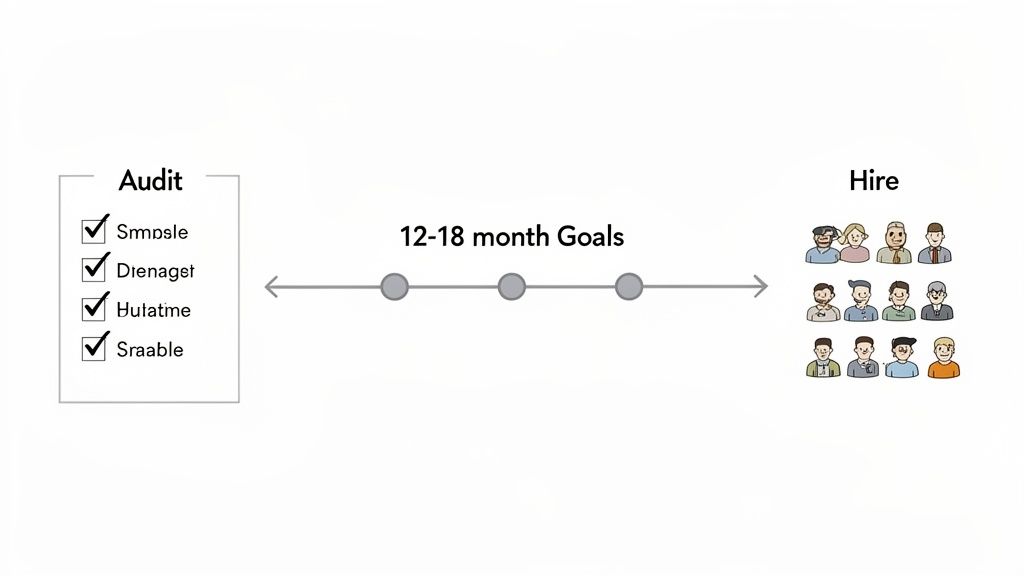
Models and theory are useful, but execution is what separates stalled startups from the ones that break through. It’s time to turn these concepts into a concrete action plan you can actually use. This is your toolkit for building a marketing function that drives real business results.
Structuring your marketing department isn’t a one-and-done task. It’s a constant cycle of assessing where you are and adapting for where you’re going. Let's walk through a simple, four-step process to get you there.
Step 1: Audit Your Current Capabilities
Before you build anything, you need a blueprint of your current reality. This is where you have to be brutally honest with yourself and your team. Where are the real gaps in your marketing engine?
- Skills Check: What can your current people actually do well? Maybe you’re great at writing blog posts but have no idea how to interpret analytics.
- Performance Deep-Dive: Get into the numbers. Which channels are legitimately driving pipeline, and which are just burning cash?
- Process Map: How does work actually get done? Chart out your key workflows, like how a lead gets passed to sales, and find the bottlenecks.
This audit gives you a clear, data-informed starting point. It stops you from hiring based on a gut feeling and forces you to focus on solving your biggest growth constraints first.
Step 2: Define Your 12- to 18-Month Goals
With a clear picture of today, you can look to tomorrow. Stop thinking in terms of job titles and start thinking in terms of business outcomes. What does marketing absolutely have to achieve in the next year and a half for the company to win?
Your goals dictate your structure, not the other way around. A goal to enter a new market requires a totally different team than a goal to double down on an existing one.
Get specific and make sure you can measure it. For example:
- Grow marketing-sourced pipeline from $2M to $5M.
- Slash customer acquisition cost (CAC) by 15%.
- Become the recognized leader in a new product category.
Step 3: Map Roles to Your Goals
Now you can finally connect your goals to the people you need. Look back at the stage-based models we covered and pick out the functions that will directly drive the outcomes you just defined.
For instance, if your main goal is to scale the pipeline, your first hire should probably be a Demand Generation Specialist or a Marketing Operations Analyst. If it's all about creating a new category, a sharp Product Marketing Manager and a versatile Content Creator are non-negotiable.
Step 4: Create a Prioritized Hiring Roadmap
Last but not least, sequence your hires. You can't bring everyone on at once, so you need a timeline. Your roadmap should clearly outline which role you’ll hire in Q1, Q2, and so on, based entirely on which person will unlock the most immediate value.
This step-by-step approach turns the messy task of team-building into a manageable, strategic process. It ensures every dollar you invest in headcount is tied directly to a specific, measurable business goal.
Common Questions, Answered
Here are a few questions I hear all the time from B2B tech founders trying to build their marketing team.
What's the Most Important First Marketing Hire for a Startup?
Nine times out of ten, your first hire should be a 'T-shaped' Marketing Generalist. This is someone with a broad understanding of the whole marketing landscape but deep, hands-on expertise in one or two critical areas—usually content and demand generation.
They’re the person who can roll up their sleeves and get campaigns running from a dead start. This hire is your foundation; they build the engine before you start adding specialized mechanics.
How Does AI Change My Marketing Department?
AI doesn't really blow up your org chart—it just makes the people in it more powerful. You don't need to add new roles; you need to upskill the ones you have.
Your Content Creator doesn't get replaced; they become an 'AI-assisted Content Strategist.' They use AI for the grunt work like research and first drafts, freeing them up to focus on originality, strategy, and hitting the right note with your audience. The core functions stay the same, they just get faster and smarter.
When Do I Hire a Full-Time VP of Marketing Instead of a Fractional CMO?
A Fractional CMO is your go-to when you need top-tier strategy and team leadership without the full-time executive price tag. This is a common move post-Series A when you need a proven leader to build your growth roadmap and fix what's broken.
You hire a full-time VP of Marketing when the machine is already built and humming. This usually happens around Series B, when you have a bigger team and budget that needs a dedicated, in-house leader to optimize and scale what’s already working. It’s a shift from building the engine to fine-tuning it for the racetrack.
Ready to build a marketing structure that drives predictable revenue? Value CMO provides the senior-level strategic leadership you need without the full-time cost. Get your custom growth roadmap.