If you're a B2B tech founder, mixing up sales and business development isn't just a simple mistake—it can be a costly one that puts the brakes on your growth. Think of Business Development as your architect, the one designing future opportunities through smart partnerships and new markets. On the other hand, Sales is your closer, focused on turning today's qualified leads into real, measurable revenue right now.
Understanding The Core Difference
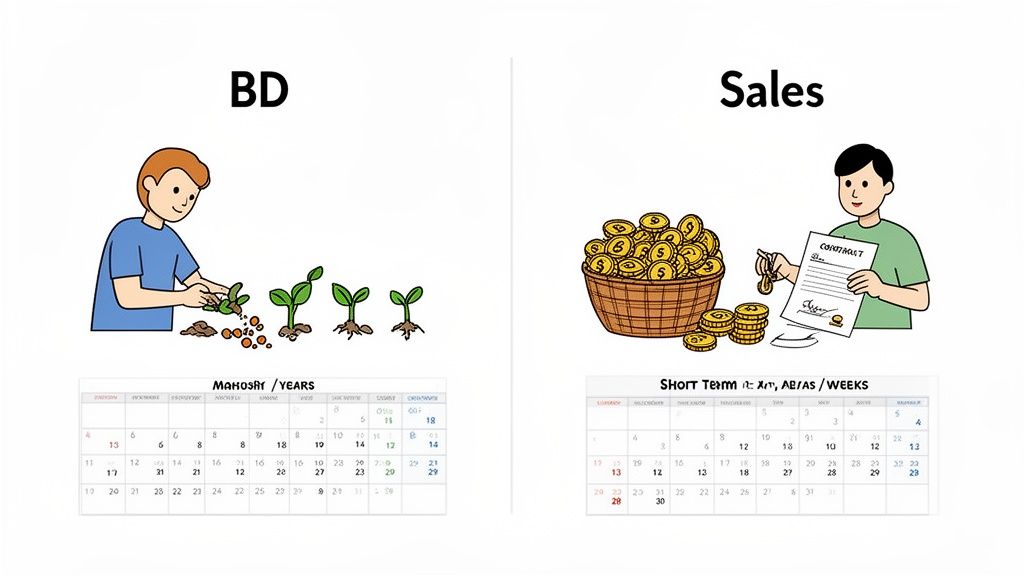
So many founders get tangled up in the whole sales versus business development debate. When you get right down to it, the difference is all about their timeline and what they’re trying to achieve. Business development (or BD) is playing the long game. Sales is all about winning today.
Put simply, BD is out there planting seeds for future harvests. The team's work involves building foundational relationships and exploring new channels that might not pay off for months or even years. Sales, on the other hand, is focused on bringing in the current crop—turning genuine interest into signed contracts and cash in the bank.
The Architect and The Closer
I find it helpful to think of it as an architect and a closer. The BD team is your architect, and their job is to create the blueprint for long-term growth. They’re out there identifying new markets to jump into, forging strategic alliances with other companies, and building brand awareness in places you've never been before. You don't measure their success in daily closes but in the strategic opportunities they tee up for the future.
The sales team is your closer. They take the opportunities and leads that come in—whether from marketing or BD—and guide them through a clear-cut sales process. Their world is all about the transaction and what's happening right now, centered on hitting a monthly or quarterly revenue number. You can see how this fits into a bigger go-to-market plan in our guide on demand generation vs lead generation.
Business Development creates future revenue streams by asking, "Where can we be a year from now?" Sales generates current revenue by asking, "How can we close this deal this quarter?"
Getting this distinction right is the first step toward building a growth engine that actually scales. When you understand their separate but symbiotic roles, you avoid misaligned expectations, bad hires, and a pipeline that grinds to a halt. But when both functions are crystal clear on their purpose? They create an unstoppable force.
| Aspect | Business Development (The Architect) | Sales (The Closer) |
|---|---|---|
| Primary Goal | Create long-term value and opportunities | Drive short-term revenue and close deals |
| Time Horizon | Quarters to years | Days to months |
| Key Activities | Strategic partnerships, market research, networking | Prospecting, product demos, negotiation, closing |
| Focus | Building relationships and the ecosystem | Transactional execution and hitting quota |
Comparing Objectives And Timelines
When you’re a founder with a million things on your plate, it’s tempting to lump sales and business development together. But their clocks are set to completely different times. Confusing the two is a recipe for frustration; understanding their distinct rhythms is how you set them both up to win.
Sales lives and breathes immediacy. The team’s focus is relentlessly short-term, marching to the beat of monthly and quarterly quotas. Their goals are direct, transactional, and easy to measure. Everything they do is about turning existing leads into closed deals and hitting revenue targets right now.
Business development, on the other hand, is playing the long game. Their horizon is strategic, measured in quarters or even years. They aren't chasing a number this month. They're building the infrastructure for future growth.
The Sprint Versus The Marathon
Think of sales as a series of sprints. Their goals are crystal clear and tied directly to the P&L:
- Hit the Quota: This is the big one. Meeting or beating the revenue target for the month or quarter is priority number one.
- Increase Deal Size: Sales reps are always looking for ways to grow the average contract value, whether it’s through an upsell or a cross-sell.
- Shorten the Sales Cycle: Efficiency is everything. The mission is to get qualified prospects from the first call to a signed contract as fast as humanly possible.
Business development is running a marathon. Its objectives are about forging entirely new paths to revenue, which demands patience and a strategic eye.
The primary goals here look very different:
- Mapping New Markets: Identifying and validating totally new customer segments or geographic territories where the company can expand.
- Nurturing Strategic Alliances: Building deep relationships with non-competing companies to co-market or co-sell into their customer base.
- Securing Channel Partnerships: Setting up agreements with other businesses (resellers, distributors) to sell your product for you, creating a brand-new sales motion.
This long-term focus has a massive upside. In fact, companies with a strong business development function have a 30% higher likelihood of successfully breaking into new markets compared to those just relying on sales. BD’s work is what turns future potential into real profit. You can dig deeper into the impact of these strategic partnerships on salesmotion.io.
A sales leader’s favorite question is, "What can we close by Friday?" A business development leader’s favorite question is, "Who should we be talking to now to win in the next fiscal year?"
A Real-World SaaS Startup Scenario
Let’s bring this down to earth with an example. Say you run a B2B SaaS startup that sells project management software.
Your sales team is completely dialed in on hitting its Q3 numbers. Their world revolves around leads generated from a recent webinar on "Improving Team Productivity." They’re running demos, firing off proposals, and negotiating contracts to lock in as many deals as they can before September ends. Success, for them, is a signature on a contract.
Meanwhile, your business development professional is working on something much bigger. She’s identified that an integration with a major enterprise CRM could open up a huge, untapped customer base. Her focus for the next 6 to 12 months will be on:
- Finding the right people to talk to at the CRM company.
- Building a relationship and proving the partnership would be a win-win.
- Hammering out the technical and commercial terms of an integration.
- Coordinating with the product team to actually build it.
- Finally, launching the partnership to the CRM's massive audience.
The sales team’s effort delivers predictable cash flow this quarter. The BD professional’s work is building a new, scalable revenue engine for the next three years. Both are absolutely critical, but they’re playing different games with different rules and timelines.
Measuring Success With The Right KPIs
So, you understand the different timelines and objectives. But how do you actually know if your teams are hitting their marks? It all comes down to tracking the right Key Performance Indicators (KPIs).
The metrics that define success for a business development pro are fundamentally different from those used to evaluate a sales executive. Confusing them is a fast track to mismanagement and killing team morale.
Sales KPIs are transactional and tied directly to closing deals right now. They measure how efficiently your team turns prospects into paying customers. It's a world of clean, quantifiable results where you can see success on a weekly, or even daily, basis.
In contrast, business development KPIs are about the long game. They measure progress in building the channels and relationships that will fuel future growth. These metrics are less about today's revenue and more about creating durable, long-term value.
Core Sales Performance Metrics
For a B2B tech startup, the sales team’s dashboard is all about velocity and conversion. Their day-to-day—running demos, sending proposals, negotiating contracts—is designed to move a qualified lead to a closed deal as fast as possible.
You'll typically see their success measured by a handful of critical, revenue-focused KPIs:
- Quota Attainment: The ultimate measure. It’s the percentage of the revenue target a salesperson or team hits in a set period, usually a month or quarter.
- Conversion Rate: This tracks the percentage of leads that move to the next stage of the funnel, especially the final jump from a qualified opportunity to a closed-won deal.
- Average Deal Size: A key metric for growth. Bumping up the average contract value means you’re squeezing more revenue from each customer, making the whole operation more efficient.
- Sales Cycle Length: This is the average time it takes to close a deal from the first touchpoint. A shorter cycle means cash comes in the door faster.
The most telling differentiator is the primary unit of measurement. For sales, it’s closed revenue. For business development, it’s qualified pipeline opportunities and signed strategic partnerships.
Key Business Development Indicators
Business development is more exploratory and relational. A BDR might spend their week networking at industry events, vetting potential integration partners, or hammering out the terms of a new channel agreement. These moves don't generate immediate cash but are absolutely vital for building a sustainable growth engine.
Because of that, their KPIs have to reflect this strategic focus:
- Number of New Strategic Partnerships Signed: This is a primary indicator of success, tracking formal agreements with other companies that unlock new markets or channels.
- Qualified Opportunities Generated: This measures the volume and quality of high-value leads the BD team tees up and hands off to sales.
- Pipeline Value from Partnerships: This KPI tracks the total potential revenue value of all the sales opportunities flowing from new channels or alliances.
- Time to First Revenue from New Channel: This metric tells you how long it takes for a new partnership to start generating actual revenue, giving you a real sense of how effective your BD strategy is.
Here’s a quick breakdown of how these metrics stack up against each other.
At-a-Glance Comparison of Sales vs Business Development KPIs
| Metric Category | Business Development (Long-Term Value) | Sales (Immediate Revenue) |
|---|---|---|
| Primary Goal | Generate qualified pipeline & new channels | Close deals & generate revenue |
| Core Metric | Number of new partnerships signed | Quota attainment percentage |
| Pipeline Focus | Value of opportunities from new channels | Conversion rate (Opportunity-to-Close) |
| Efficiency Metric | Time to first revenue from new channel | Average sales cycle length |
| Value Metric | Lifetime value of partner-sourced customers | Average deal size |
Ultimately, you need both functions firing on all cylinders to win.
In the fast-paced world of B2B tech, tight alignment between business development and sales can supercharge growth. We see companies achieve 15-20% higher growth rates just by getting this coordination right. While BD focuses on creating long-term pathways, sales executes on the wins, tracking KPIs like hitting 100% quota attainment and achieving 25-30% conversion rates from opportunity to close.
For a deeper dive into the metrics that feed the top of the funnel, check out this practical guide on Lead Generation KPIs. A well-oiled system can even slash sales cycles from over 90 days to under 60—a clear signal that your go-to-market engine is humming.
Knowing When And How To Hire
As a founder, one of the toughest calls you’ll make is who to hire and when. Get it right, you build momentum. Get it wrong, and you burn through precious cash and time. In the very early days, it's all hands on deck—you or your first sales hire are probably juggling both sales and business development out of sheer necessity.
But that scrappy, do-it-all approach has a shelf life. As you start to scale, specialization stops being a luxury and becomes the engine for predictable growth. A Business Development Representative (BDR) and an Account Executive (AE) do very different jobs, and knowing the trigger points for hiring each one is critical.
Deciding Your Next Strategic Hire
The hiring decision boils down to a single question: What is the biggest bottleneck to your growth right now? Are you struggling to find new ponds to fish in, or do you have plenty of fish on the line but no one to actually reel them in?
Hire for business development when your main problem is creating new opportunities. This is the move when you need to:
- Explore new verticals: You've tapped out your initial beachhead market and need to see if there's real demand in other industries.
- Build strategic channels: Your growth hinges on partnerships, integrations, or reseller programs that need time and focused effort to build.
- Generate top-of-funnel interest: Your lead flow is weak. You need a dedicated hunter to go out, find, and qualify potential customers before they’re even ready for a sales conversation.
On the other hand, hire a dedicated sales closer (Account Executive) when your bottleneck is turning existing interest into signed deals. This is your signal when:
- Lead flow is strong: Marketing or early BD work is bringing in more qualified opportunities than your current team can handle effectively.
- Founders can't close anymore: You (or your first hire) are so buried in demos and negotiations that prospecting has ground to a halt.
- Sales cycles need shortening: You have deals in the pipeline, but they’re stalling because no one has the dedicated time or skill to push them over the finish line.
This decision tree shows you the strategic path. Your immediate need—long-term growth channels or short-term revenue—points directly to the right hire.
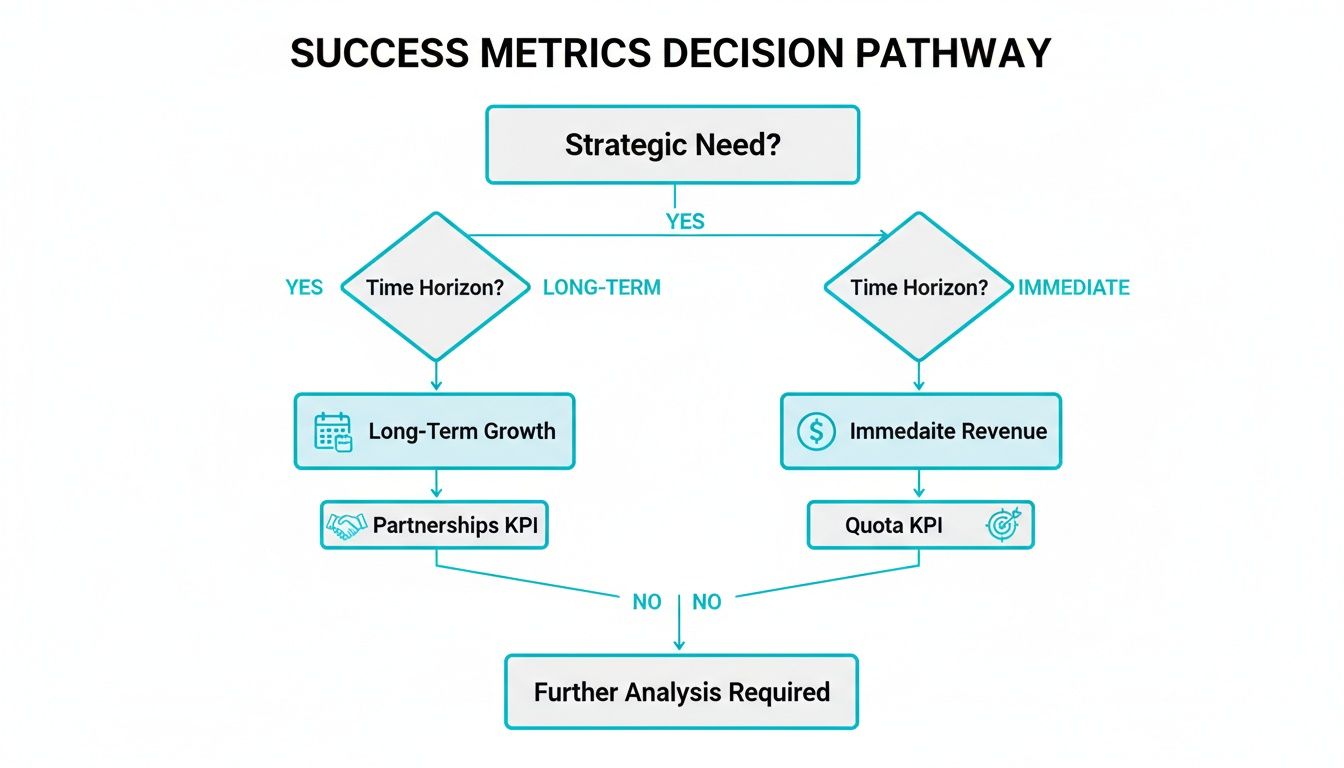
As the chart shows, if your strategic need is long-term growth, you should be measuring partnership KPIs. If it's immediate revenue, then quota attainment is what really matters.
Crafting The Right Job Descriptions
The skills you're hiring for are as different as the roles themselves. Your job descriptions have to reflect that reality if you want to attract the right people. A generic "salesperson" post will get you a mixed bag of candidates, and most won't be a fit for what you actually need.
A classic hiring mistake is looking for a unicorn—a "hunter" who can also "close." While those people exist, they’re rare. Most professionals excel at one or the other. Hire for the specific skill set your startup needs most at its current stage.
For a Business Development Representative, your job description should be all about strategic thinking and relationship building.
- Snippet Example (BD): "You will be responsible for identifying and qualifying new strategic opportunities in untapped markets. Success in this role requires a curious and strategic mindset, exceptional research skills, and the ability to initiate high-level conversations with potential partners and enterprise clients."
For an Account Executive, the focus has to be on persuasion and execution.
- Snippet Example (AE): "You will own the full sales cycle from qualified opportunity to close. Success in this role requires masterful presentation skills, a deep understanding of customer pain points, and a relentless drive to exceed revenue targets and manage a robust pipeline."
These differences bleed directly into compensation. BD roles are often heavier on the base salary (think a 70/30 or 80/20 split) with bonuses tied to qualified opportunities. AE roles are heavily leveraged with commission (a 50/50 split is common), directly rewarding them for closing revenue.
Knowing how to structure your team is a huge piece of this puzzle. You can find some great ideas on building a great B2B marketing team structure that works alongside your sales function. And as you scale, practical advice on hiring remote sales representatives can be a game-changer. Getting these nuances right ensures you hire the right person, for the right job, with the right incentives.
Designing Your Team And Handoff Process
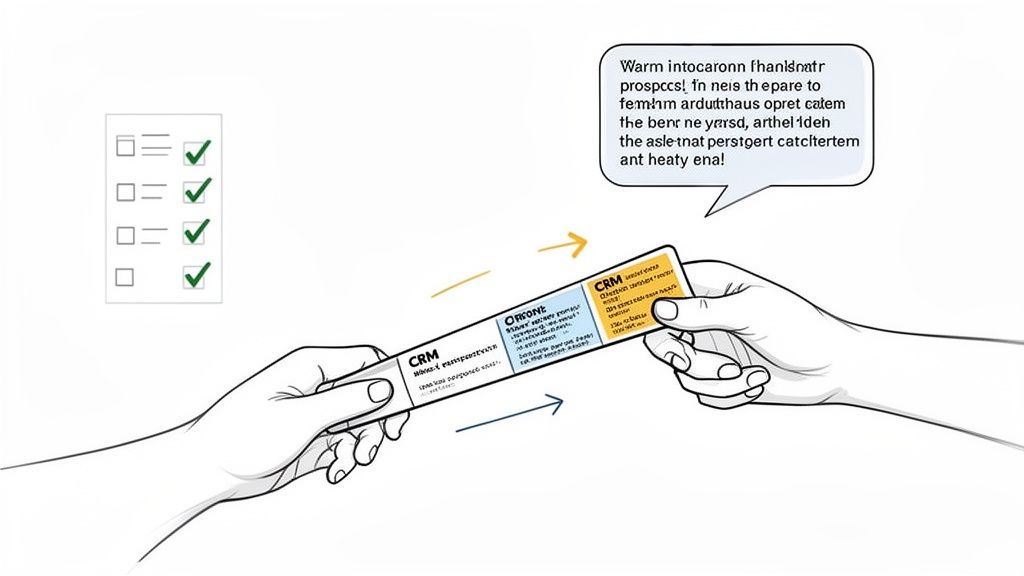
Having both a sales and a business development function is a great start, but it’s just that—a start. Real growth happens when these two teams work as one. This isn't just about playing nice; it's about deliberately designing an org structure and a handoff process so airtight that no opportunity ever falls through the cracks.
The heart of this collaboration is the handoff: the moment a Business Development Representative (BDR) passes a qualified prospect to an Account Executive (AE). Get this wrong, and all the BD team's hard work goes to waste. But get it right, and your sales team walks into a warm, well-briefed conversation, dramatically increasing their odds of closing the deal.
Structuring Your Growth Teams
One of the first big decisions you'll face is where the BDRs report. There are two common models, and the best fit depends entirely on your go-to-market motion.
Model 1: The BDRs Report to Sales
This is the classic structure, especially for sales-led companies.
- Pros: It creates a super-tight feedback loop. AEs can directly coach BDRs on what a truly qualified lead looks like, making sure the opportunities they receive are primed for a sales conversation.
- Cons: The risk here is a myopic focus on hitting short-term quotas. BDRs might get pulled away from strategic, long-term prospecting to chase immediate wins.
Model 2: The BDRs Report to Marketing
This model is becoming more popular, particularly for startups with a strong inbound engine.
- Pros: It aligns your entire top-of-funnel strategy. Marketing generates leads, and BDRs qualify them, creating one unified demand-gen machine. This kind of harmony is a huge advantage and a key theme when you're figuring out how to align sales and marketing.
- Cons: You have to watch out for a potential disconnect with the sales team. If the handoff isn't perfectly managed, AEs can start to feel like the leads landing in their pipeline aren't actually ready for them.
A great handoff isn't a calendar invite. It's a transfer of trust and intelligence, ensuring the prospect feels understood and the Account Executive feels prepared. The goal is one continuous conversation, not two separate ones.
The Playbook For A Perfect Handoff
A seamless handoff is a process, not an accident. It needs a clear, documented playbook that both teams buy into and follow religiously. It’s about so much more than firing off an email; it's about arming the AE with everything they need to win. A well-configured CRM is the backbone of this entire operation, making the transfer of knowledge transparent and efficient.
Here’s what a best-practice handoff playbook should cover:
- Standardized Qualification Framework: Both teams must agree on what defines a Sales-Qualified Lead (SQL). Use a framework like BANT (Budget, Authority, Need, Timeline) or MEDDIC to ensure every lead passes a minimum threshold before it moves over.
- Detailed Prospect Notes in the CRM: The BDR needs to capture more than just contact info. The CRM notes should tell a story: the prospect’s strategic goals, their biggest pain points, other stakeholders involved, and any potential objections that have already surfaced.
- The Warm Introduction: The BDR should facilitate a warm, three-way intro via email. This simple step validates the entire process for the prospect and transfers the trust the BDR has built directly over to the AE.
This disciplined approach ensures the prospect never has to repeat themselves and the AE can start their first conversation by adding immediate value. It’s the difference between a clumsy cold transfer and a strategic baton pass in a high-stakes relay.
Building A Unified Growth Engine
Throughout this guide, we've picked apart the differences between sales and business development. But as a founder, your job isn't just to know the theory—it's to weave these two critical functions into a single, powerful growth engine.
The most common mistake I see is treating them as opposing forces. They're not. They are two sequential parts of a unified revenue strategy. Real acceleration happens when sales, BD, and marketing are locked in tight, each function amplifying the others' work.
From Strategy To Revenue
The ideal setup is a seamless flow of value. Business development acts as the strategic scout, venturing into new territories to find and cultivate high-potential, long-term partnerships. Their job is to fill the top of the funnel not just with leads, but with the right kind of opportunities that align with where your company is headed.
Sales then steps in as the efficient conversion machine. Armed with the context and trust built by the BD team, they can focus entirely on what they do best: guiding qualified prospects through the buying journey and turning strategic potential into predictable, measurable revenue.
The ultimate goal is a system so well-integrated that the prospect feels one continuous, value-driven conversation. They shouldn't feel the "handoff"; they should only feel understood and expertly guided from the first exploratory chat to the final signed contract.
Your Role As The Founder
Your job is to be the architect of this collaboration. It will not happen by accident.
You have to intentionally design the processes, communication channels, and shared goals that bind these teams together. This means defining the exact point of the handoff, making sure the CRM is the single source of truth, and fostering a culture of mutual respect where wins are shared.
When you successfully bridge the gap between long-term strategy and short-term execution, something powerful happens. You unlock a growth model that is both scalable and predictable. This unified engine is what separates startups that merely survive from those that truly dominate their market. It's the foundation for sustainable success.
Common Questions from Founders
When you're trying to nail down your growth strategy, the line between sales and business development can get blurry. Here are the straight-up answers to the questions I hear most from B2B tech founders.
Can One Person Do Both Sales and Business Development?
In the very beginning? Yes, absolutely. It's often the founder or the first commercial hire wearing both hats out of pure necessity. You're just doing whatever it takes to get the company moving.
But that’s not a model that scales. The roles require fundamentally different mindsets. Business development is a long game built on strategic patience. Sales is all about the urgency of closing deals this quarter. As you grow, you have to split the roles to execute well and avoid burning out your best people.
How Should I Structure Compensation For Each Role?
Your comp plans have to mirror what you're asking them to do. If the incentives are wrong, you're guaranteed to get the wrong results. It's that simple.
- Sales Roles (Account Executives): Pay here is heavily tied to performance. A 50/50 split between base salary and commission is standard. Their job is to close revenue, and their paycheck should reflect that direct, transactional success.
- Business Development Roles: These folks are playing a longer, more strategic game, so the feedback loop is slower. Compensation should be weighted more heavily toward base salary—think an 80/20 or 70/30 split. Bonuses are tied to hitting targets like qualified opportunities generated or new strategic partnerships signed, not the final revenue number the sales team closes.
Paying a BDR based on closed revenue is a classic mistake. It forces them to hunt for easy, short-term wins instead of sourcing the bigger, more strategic deals that will actually fuel your long-term growth.
What is Marketing's Role in This Process?
Marketing is the third leg of the stool—the "air cover" that makes both sales and BD exponentially more effective. It's the engine that warms up the entire market.
Marketing is responsible for creating the content and tools both teams depend on, from case studies and whitepapers to the pitch decks and battle cards they use every day. They also own the inbound channels that feed new leads directly into the pipeline.
When marketing, biz dev, and sales are all pulling in the same direction, you get a powerful, seamless go-to-market motion. That synergy is how you build real, sustainable momentum.
Ready to build a unified growth engine for your B2B tech startup? Value CMO provides the fractional CMO leadership to align your go-to-market strategy, build a data-driven roadmap, and drive measurable results. Get the senior marketing expertise you need without the full-time overhead at https://valuecmo.com.