For B2B tech startups, the line between a great lead and a total waste of time is razor-thin. We've all been there: marketing celebrates a wave of new marketing-qualified leads (MQLs), but sales can't seem to close any of them. This creates friction, burns through your budget, and stalls growth. The problem isn't a lack of leads; it's a lack of clarity. A generic, set-it-and-forget-it lead scoring model floods your pipeline with high-fit, low-intent prospects or, even worse, low-fit, high-engagement contacts that completely exhaust your sales team. This isn't just inefficient—it's expensive. Every hour a sales rep spends chasing a poorly qualified lead is an hour they're not spending on a deal that could actually close.
This outdated approach leads to a predictable, frustrating cycle: marketing generates volume, sales questions the quality, and you miss your revenue targets. It’s time to move beyond vanity metrics and build a scoring system that truly acts as a revenue engine. This guide breaks down the essential lead scoring best practices that separate the high-growth startups from everyone else.
Inside, you'll find a human-centric, data-driven framework to get your teams on the same page and focused exclusively on the leads that matter most. We'll cover everything from tying your scoring to your Ideal Customer Profile (ICP) and bringing in predictive models to setting up score decay rules and creating feedback loops for constant improvement. By the end, you'll have a clear, actionable playbook to transform your lead scoring from a source of conflict into a powerful driver of predictable pipeline and revenue growth.
1. Define Your Ideal Customer Profile (ICP) Before You Score a Single Lead
The most fundamental of all lead scoring best practices is to build your model on a rock-solid foundation: your Ideal Customer Profile (ICP). Trying to score leads without a crystal-clear, agreed-upon ICP is like trying to navigate without a map. Sure, you'll assign points, but they won't guide your sales team toward the deals most likely to close and stick around for the long haul. Before you even think about behavioral scores, you have to nail down the specific firmographic and demographic traits of your best-fit customers.
This alignment ensures that marketing and sales are chasing the same targets, which puts a stop to the friction and wasted effort spent on leads that will never convert. Before you dive into scoring, it's crucial to understand what an Ideal Customer Profile (ICP) is and how to define it for your business. For B2B tech startups, this means getting specific about criteria like company size, industry, revenue, geography, and even the technology stack they use.
Why is this so crucial?
An ICP-driven scoring model helps you look beyond simple engagement metrics. It prioritizes prospects that look just like your most successful, profitable, and loyal customers. For example, HubSpot initially scored leads primarily on company size. They later refined their ICP to include marketing maturity and growth rate, realizing these were much stronger signs of a successful partnership. That small shift allowed them to focus their resources on companies that were truly ready for their solution.
Actionable tips to get started:
- Analyze Your Best Customers: Base your ICP on the top 20% of your current customer base. Look for the common threads among these high-performing accounts rather than guessing at a hypothetical ideal.
- Host an Alignment Workshop: Get your founders, sales leaders, and marketing heads in the same room. The goal is to walk out with a single, documented ICP scorecard that everyone agrees on.
- Document and Share It: Create a shared document detailing the ICP criteria. This should be a living document, accessible to both sales and marketing, serving as the single source of truth for all your go-to-market efforts. You can learn more about defining a comprehensive ICP from Value CMO's guide on the topic.
- Revisit It Quarterly: Your ICP isn't set in stone. Review and refine it every quarter based on new win/loss data and what you're hearing from the market. As your product evolves, so will your ideal customer.
2. Use a Dual-Model Approach: Score for Fit + Behavior
Once you've locked in your Ideal Customer Profile, the next step is to build your scoring system around two distinct but complementary dimensions: fit and interest. This dual-model approach is one of the most effective lead scoring best practices because it separates who a lead is from what they do. Explicit scoring evaluates fit by assigning points based on who they are (firmographics), while behavioral scoring measures interest through what they're doing (engagement).
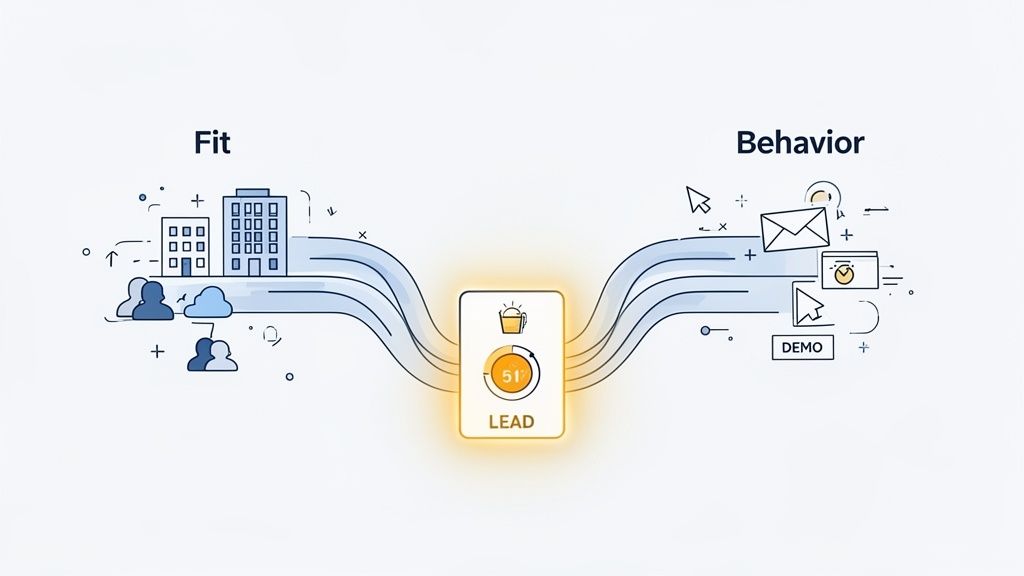
This method stops sales from wasting time on highly engaged leads who are a terrible fit for your product (like a student downloading every whitepaper) and from ignoring perfect-fit leads who are just starting their research. By combining these two scores, you can create a matrix that prioritizes leads who are both a strong fit and highly engaged, making sure your sales team focuses its energy on prospects with the highest chance of closing.
Why is a dual model so important?
Relying on just one type of score gives you an incomplete picture. A lead from a Fortune 500 company might seem valuable (high explicit score), but if they have zero engagement, they're not ready for a sales call. On the flip side, a lead who attends every webinar (high behavioral score) but works at a two-person agency probably doesn't have the budget or need for your enterprise solution. A platform like Marketo, for instance, allows for sophisticated models that combine account-level firmographic data with individual behavioral signals. This means that when a lead from a target account requests a demo, their score skyrockets, immediately flagging them for sales outreach.
Actionable tips to get started:
- Start Simple: You don't need to track every possible action. Begin by assigning points to your top 3 to 5 highest-intent behaviors, like "Demo Request," "Pricing Page Visit," and "Trial Signup."
- Use Your Automation Platform: Lean on the native scoring capabilities within your marketing automation system (like HubSpot, Pardot, or Marketo). This automates the process and cuts down on the risk of manual errors.
- Let Scores Decay: Set behavioral scores to decrease or "decay" over time, usually after 30 to 90 days of inactivity. This ensures a lead's score reflects their current interest level, not something they did six months ago.
- Test Your Weighting: Don't just guess. A/B test the balance between your explicit and behavioral models. You might find that for your business, a high-fit score is a better predictor of a win than high engagement, or vice-versa.
3. Get Sales and Marketing on the Same Page About the Hand-Off
A mathematically perfect lead scoring model is totally useless if your sales team doesn't trust it. One of the most critical lead scoring best practices is to build a bridge between marketing and sales by co-creating the rules of engagement. This means sitting down together and defining what a Marketing Qualified Lead (MQL) and a Sales Qualified Lead (SQL) actually are, and agreeing on exactly when and how a lead gets passed from one team to the other. Without this shared agreement, marketing will be celebrating MQL volume while sales complains about lead quality—a classic recipe for friction that kills your pipeline.
This alignment needs to be more than a verbal agreement; it requires a documented, system-enforced playbook. The goal is to create a seamless handoff where every lead passed to sales meets a minimum, agreed-upon threshold for both fit (ICP alignment) and interest (behavioral signals). Before you even think about setting up scoring rules, it's essential to understand how to align sales and marketing teams around a common goal: revenue. This shared understanding turns the hand-off from a simple data transfer into a strategic play.
Why is this alignment so critical?
When qualification criteria are clear and consistent, sales starts to trust the leads they receive. This confidence is everything because it ensures reps invest their valuable time following up promptly and thoroughly. For instance, Calendly makes sure its sales team gets leads that meet specific firmographic criteria (like company size of 50–2,000 employees) and also show real engagement (a behavioral score over 30). This two-part check guarantees that AEs aren't wasting cycles on prospects who are a poor fit or not yet ready to talk, which dramatically improves their lead-to-opportunity conversion rates.
Actionable tips for a unified hand-off:
- Host an Alignment Sprint: Get sales and marketing leaders in a room to collaboratively define the hand-off criteria. The output should be a single, documented scorecard or decision tree that spells out the exact requirements for an MQL.
- Document Everything: Write down the hand-off rules in a shared, living document. This "Service Level Agreement" (SLA) should be your single source of truth, not a forgotten Slack message.
- Create a Feedback Loop: Set up a mandatory weekly or bi-weekly meeting where sales gives specific feedback on lead quality. Use this time to review and tweak the scoring model based on what's happening in the real world.
- Measure What Matters: Track metrics that both teams care about, like lead-to-opportunity rate, opportunity win rate, and average deal size. Use this data to validate and improve your scoring model's accuracy.
4. Let Predictive Scoring and Machine Learning Do the Heavy Lifting
While rule-based scoring is a great place to start, it has its limits. Predictive lead scoring is the next step up, using machine learning to dig into your historical data and automatically figure out which attributes and behaviors most accurately predict a conversion. This approach moves beyond human assumptions, uncovering powerful, non-obvious signals that traditional models often miss. It also adapts on the fly as new data comes in, keeping your scoring relevant and effective.

This method ensures you’re not just scoring leads, but scoring them with intelligent, data-backed precision that gets smarter over time. To make things even more accurate and efficient, leaning on AI in lead scoring can give you powerful predictive capabilities. Platforms like Salesforce Einstein and HubSpot use AI to analyze your won and lost deals, assigning scores based on how likely a lead is to become a paying customer. For anyone looking to implement this, a detailed HubSpot AI lead scoring guide can show you the way.
Why is predictive scoring a game-changer?
A predictive model can weigh dozens of signals at once, far more than anyone could manage with manual rules. For example, a rule-based model might assign 10 points for a CFO title. A predictive model, however, might discover that a CFO from a mid-market tech company who downloaded a pricing guide and visited the integrations page is 5x more likely to close than a CFO from another segment who only downloaded a whitepaper. That level of nuance is a massive boost for sales efficiency.
Actionable tips to get started:
- Earn the Right to Predict: Don't jump into predictive modeling too early. You need enough historical data to make it work, typically at least 50-100 closed-won deals and a similar number of closed-lost opportunities over 6-12 months.
- Clean Up Your Data: Predictive models are only as good as the data you feed them. Before you start, do a thorough audit of your CRM data to get rid of duplicates, standardize fields, and fill in missing info. Remember: garbage in, garbage out.
- Start Lean and Validate: You don’t need to invest in an expensive, all-in-one platform right away. Start with a built-in tool from your marketing automation platform or CRM and check its accuracy by tracking predicted scores against actual conversion rates each quarter.
- Complement, Don't Replace: Use predictive scores as a powerful guide for sales, not a replacement for their gut instincts. Encourage reps to give feedback on high-scoring leads to help refine the model and keep a human in the loop.
5. Let Old Scores Fade with Behavioral Decay Rules
A high lead score can be really misleading if it’s based on old engagement. One of the most important lead scoring best practices is to implement "score decay," which ensures that a lead’s score accurately reflects how interested they are right now. A prospect who downloaded a whitepaper six months ago is far less engaged than one who visited your pricing page yesterday. Decay rules stop old, irrelevant activities from artificially inflating a score and keep your sales team focused on leads with active, recent buying signals.
This process systematically lowers a lead’s behavioral score over time if they don't show any new activity. It keeps your lead prioritization dynamic and relevant, preventing sales from wasting time on leads who have gone cold. By valuing recent interactions more highly, you make sure that the hottest leads always rise to the top.
Why is score decay so important?
Without decay, a lead who was super engaged a year ago could still show up as an MQL today, even with zero recent activity. This creates false positives and erodes your sales team's trust in the whole system. For instance, Marketo users often set up a 90-day decay rule for general email engagement but a much longer 180-day window for high-intent actions like a demo request. This recognizes that different signals have different shelf lives. This smart approach ensures that scores remain a reliable indicator of where a lead is in their buyer's journey.
Actionable tips for setting up score decay:
- Match Decay to Your Sales Cycle: A good starting point is to set a standard decay window of 90 days. If your average sales cycle is shorter, adjust the window to match and stay relevant.
- Create Tiered Decay Rules: Not all behaviors are created equal. Use a shorter, more aggressive decay window (e.g., 30 days) for high-velocity signals like pricing page visits, and a longer one (e.g., 180 days) for top-of-funnel content downloads.
- Decay Behavior, Not Demographics: Apply decay rules only to behavioral scores. Firmographic and demographic data like company size or industry are pretty static and shouldn't decay.
- Test Your Windows: Don't just set it and forget it. Compare the conversion rates of leads with fresh scores against those whose scores are about to decay. Use this data to fine-tune your decay periods for maximum accuracy.
- Explain the Rules to Sales: Make sure your sales team understands how and why scores decay. This transparency builds trust and helps them interpret lead scores correctly, knowing that a high score truly means recent engagement.
6. Use Account-Based Scoring for Your ABM Programs
For B2B tech companies running Account-Based Marketing (ABM), traditional lead-centric scoring just doesn't cut it. Account-based lead scoring shifts the focus from individual contacts to the collective engagement and fit of the entire target account. This approach looks at leads within the context of their company, making sure that your marketing and sales resources are focused on high-value accounts most likely to become major customers. Instead of just asking "Is this lead interested?" it asks, "Is this target account showing buying signals?".
This model is a key part of modern lead scoring best practices because it directly supports a coordinated ABM strategy. It stops sales from chasing low-level contacts at non-target companies, even if those people are highly engaged. Instead, it directs attention to the key accounts that match your go-to-market strategy, aligning marketing efforts with sales territories and strategic plans.
Why is account-based scoring so crucial?
Account-based scoring gives you a complete picture of an account's journey, recognizing that B2B buying decisions are made by committees, not just one person. For example, Slack successfully used this model to target engineering teams at specific high-growth companies. By scoring the account as a whole based on everyone's engagement, they could see when an entire department was showing interest, which was a much stronger signal of a "land and expand" opportunity. This is way more effective than just scoring one interested engineer.
Actionable tips for account-based scoring:
- Define Your Target Account List (TAL): Before you start scoring, create a clear TAL of 50-500 accounts based on ICP criteria like market size, revenue, growth rate, and strategic fit. This list is the foundation of your scoring model.
- Roll Up Engagement Signals: Combine behavioral data from all the contacts you know within a target account. One person downloading a whitepaper is interesting; five people from the same account attending a webinar is a high-priority buying signal.
- Prioritize Fit Over Individual Activity: Give a higher score to any new lead that comes from a top-tier target account, even if their individual engagement score is low. Being part of a key account automatically makes them more valuable.
- Sync Account Scores with Your CRM: Make sure that account-level scores are regularly updated and synced between your marketing automation platform and CRM. This gives your sales team a clear, unified view of which accounts are heating up and need attention right away.
7. Regularly Check Your Scoring Model with A/B Tests and Win/Loss Analysis
One of the most common mistakes in lead scoring is treating your model like a one-and-done project. A scoring model that isn’t regularly checked will eventually become inaccurate, leading to poor lead prioritization and a loss of trust from the sales team. Setting up a systematic validation process using A/B testing and win/loss analysis is one of the most critical lead scoring best practices for maintaining a high-performing revenue engine. This practice ensures your scoring stays predictive and aligned with what's actually happening in sales.
This validation process involves comparing your model's predictions against real results, like conversion rates, deal sizes, and sales cycle lengths. By looking at this hard data, you can spot when your scoring is drifting off course and make evidence-based tweaks to your scoring weights, keeping the system precise and effective. It transforms your lead scoring from a theoretical exercise into a dynamic, data-driven tool.
Why is validation so important?
Without validation, your scoring model is just running on assumptions. Markets change, ideal customer profiles evolve, and buyer behavior shifts. A model that was accurate last quarter might be misleading your sales team today. For example, Gong uses its own conversation intelligence platform to analyze call transcripts and deal data from closed-won and closed-lost opportunities. This helps them identify which behavioral signals most strongly predict a deal will close, allowing them to constantly refine their scoring model based on real-world data.
Actionable tips for model validation:
- Run Quarterly Accuracy Audits: Group your leads by score range (e.g., A-Leads: 100+, B-Leads: 70-99, C-Leads: 40-69). Then, measure and compare the lead-to-opportunity and opportunity-to-close conversion rates for each group. If your lower-scored leads are converting at higher rates, it's a clear sign your model needs a tune-up.
- Set Up a Win/Loss Review Process: Regularly analyze your closed-won and closed-lost deals. Look for the common firmographic, demographic, and behavioral signals in each category. This analysis will show you which attributes truly correlate with success versus those that are just noise.
- Track Lead Quality by Source: Use your CRM reports to see how leads from different sources (e.g., organic search, paid ads, events) perform after being scored. If a high-scoring source consistently brings in low-quality deals, you might need to adjust the initial points you give to that channel.
- Share Metrics Transparently: Build trust with the sales team by sharing monthly accuracy reports. Show them the data behind why certain leads are prioritized. Transparency is key to keeping everyone aligned and ensuring the system gets used.
- Keep a Changelog: Maintain a "scoring changelog" that documents every adjustment you make to the model, the date, the data-backed reason for the change, and what you expect to happen. This creates institutional knowledge and helps you avoid repeating past mistakes.
8. Segment Your Scoring Models for Different Sales Cycles
A one-size-fits-all lead scoring model is a common trap that treats every lead as if they follow the exact same buying journey. The truth is, an enterprise buyer evaluating a six-figure deal behaves very differently from a small business owner signing up for a self-serve product. One of the most impactful lead scoring best practices is to segment your models to reflect these different sales cycles and complexities. By creating separate scoring rules for different segments, you'll dramatically improve your qualification accuracy.
This approach acknowledges that a high-value action for an SMB lead (like starting a free trial) might be an early, low-commitment step for an enterprise prospect. Segmented models stop your sales team from jumping on long-cycle enterprise leads too early, while making sure they don't miss out on fast-moving SMB opportunities that need immediate attention. It aligns your scoring logic with how each specific market segment you serve actually behaves.
Why is segmented scoring so crucial?
Segmenting your scoring makes sure that lead scores are relevant and make sense in context. For example, Intercom cleverly segments its scoring by company stage: pre-product fit, growth, and enterprise. A lead from a pre-product fit startup might become sales-qualified with a lower score threshold, reflecting a faster, more transactional sales process. On the other hand, an enterprise lead needs more consensus-building and will have a longer, more deliberate buying journey, which justifies a higher score threshold and a more patient follow-up approach. This stops sales from treating all leads the same and helps them tailor their approach to the prospect's unique situation.
Actionable tips for segmented scoring:
- Start with 2-3 Core Segments: Don't overcomplicate things at first. Begin by creating separate models for your main segments, such as SMB vs. Enterprise, or by product line. You can always add more complexity later if the data shows you need it.
- Define Segment-Specific Thresholds: Set different Marketing Qualified Lead (MQL) score thresholds for each segment. For example, an SMB MQL might be 50 points, while an Enterprise MQL might be 75 points because of the longer, more complex evaluation.
- Use Different Score Decay Windows: Enterprise leads often have buying cycles lasting six months or more. Their engagement scores should decay slowly (e.g., over 180 days). SMB leads, however, might have a 30-day cycle, so their scores should decay much faster (e.g., over 60 days) to reflect that urgency.
- Automate Segment Classification: Use firmographic enrichment tools and CRM workflows to automatically assign new leads to the right segment based on criteria like company size, industry, or employee count. This ensures they get funneled into the right scoring model from day one.
9. Use Intent Data to See Beyond Your Own Website
Relying only on your own first-party data, like website visits or email clicks, just shows you how leads interact with your brand. To really level up your lead scoring best practices, you have to look beyond your own digital backyard and tap into third-party intent data. This approach shows you which accounts are actively researching solutions like yours across the wider web, giving you a powerful, early-warning system for buying intent. By layering these external signals over your internal data, you can spot in-market buyers before they ever fill out a form on your site.
Intent data providers like 6sense, Demandbase, and ZoomInfo track digital footprints across thousands of publisher sites, forums, and review platforms. They watch for content consumption, keyword searches, and competitor comparisons to build a detailed picture of an account's research journey. This lets you score and prioritize accounts that fit your ICP and are showing active buying behavior—a massive advantage in competitive markets.
Why is intent data so crucial?
Intent data transforms your lead scoring from reactive to proactive. Instead of waiting for a lead to raise their hand with a demo request, you can identify their needs as they're just starting to form. For example, you might see that an ideal-fit account is suddenly binge-reading content about "data integration platforms" and visiting G2 for competitor reviews. This strong intent signal, combined with their ICP fit, deserves a high score and immediate, personalized outreach from the sales team, long before the competition even knows they're in the market.
Actionable tips for using intent data:
- Start with One Main Vendor: Don't try to juggle multiple, conflicting data sources at the beginning. Choose a single, reputable provider like Demandbase or 6sense to build your initial framework and keep your data consistent.
- Combine Intent with ICP Fit: An intent signal by itself is just noise. The real power comes from filtering these signals through your ICP criteria. Prioritize high-intent signals coming from accounts that perfectly match your target profile.
- Weight Intent Signals Heavily: Don't be shy about assigning big point values to strong intent signals. Active research on a high-value keyword topic can be just as telling as a direct demo request.
- Fuel Proactive Outreach: Use intent data for more than just scoring; use it to power your Account-Based Marketing (ABM) campaigns and sales sequences. Arm your BDRs with insights like, "We saw your company was researching solutions for X," to make their outreach super relevant and timely.
- Validate and Calibrate: Constantly check if your intent data is accurate. Compare the accounts your model flags as "in-market" with the accounts that actually enter your sales pipeline and close. Use this feedback loop to refine your scoring and the keyword topics you're tracking.
10. Automate Your Scoring and Create a Feedback Loop
A lead scoring model is only valuable when it runs efficiently and adapts over time. This is where automation and feedback loops become absolutely essential. Automating the scoring process ensures real-time evaluation and immediate routing of qualified leads to your sales team. At the same time, a structured feedback process makes sure the model stays accurate, relevant, and trusted by both sales and marketing. This two-part system transforms lead scoring from a static project into a dynamic, self-improving engine for revenue growth.
This is a must-do because manual scoring is slow, full of errors, and just doesn't scale. Automation removes the guesswork and delays, letting your sales team engage with hot leads the moment they show intent. The feedback loop then closes the circuit, using real-world outcomes to refine the very definition of a "hot lead."
Why are automation and feedback so crucial?
Without automation, even the best lead scoring model will fail because of poor execution. Leads will go cold while they wait for a manual review and handoff. Without feedback, the model will quickly become outdated as your market, product, or ideal customer profile changes. For example, a company might start by scoring a "demo request" as its highest-value action. But feedback from sales, maybe through a platform like Gong, might reveal that leads who first download a specific technical whitepaper actually convert to closed-won deals at a higher rate. That insight, captured through a feedback loop, allows for an immediate tweak to the model.
Actionable tips for automation and feedback:
- Start with Your Native Tools: Begin by setting up scoring within your existing marketing automation platform (e.g., HubSpot, Pardot, Marketo). These tools have robust built-in capabilities and integrate seamlessly with your CRM. Master what you already have before you go looking for third-party solutions.
- Document and Test Your Logic: Clearly document the rules, triggers, and routing logic in a shared wiki or document. Before you go live, test your automation on a small, controlled group of leads to find and fix any workflow issues. For a deeper dive, check out this guide on how to implement marketing automation.
- Establish a Rhythm for Feedback: Schedule a recurring monthly "Lead Quality Review" meeting between marketing and sales leaders. Use this time to review conversion rates by score, talk about trends, and gather real-world feedback from the reps on the front lines.
- Use Closed-Loop Reporting: Build reports in your CRM or analytics tool that track leads from their initial score all the way to a closed-won or closed-lost deal. This data is the ultimate source of truth for checking and improving your scoring model's accuracy.
10-Point Lead Scoring Best Practices Comparison
| Approach | 🔄 Implementation Complexity | ⚡ Resource Requirements | 📊 Expected Outcomes | 💡 Ideal Use Cases | ⭐ Key Advantages |
|---|---|---|---|---|---|
| Define Clear Ideal Customer Profile (ICP) Alignment Before Scoring | Moderate — cross-functional discovery and documented criteria | Low–Medium — stakeholder time, customer data | Higher lead fit; scalable, repeatable scoring foundation | Early-stage and growth B2B tech establishing PMF and alignment | Eliminates wrong-lead scoring; faster sales productivity ⭐ |
| Implement a Dual-Model Approach: Explicit + Behavioral Scoring | Moderate — build weighting and decay rules for two streams | Medium — marketing automation + tuning effort | Balanced fit + intent; fewer false positives | Startups optimizing ROI with limited budgets | Captures intent and fit together; automatable ⭐⭐ |
| Align Sales and Marketing on Lead Qualification and Hand-Off Criteria | Moderate — define SLAs, thresholds, and feedback loops | Low–Medium — meetings, documentation, CRM routing | Consistent hand-offs; improved pipeline velocity and predictability | Organizations with sales/marketing friction over lead quality | Reduces disputes; creates shared ownership and accountability ⭐ |
| Use Predictive Scoring and Machine Learning for Signal Weightings | High — modeling, data pipelines, vendor or data science support | High — historical data, tools, expert resources | More accurate, adaptive scoring after sufficient data (6+ months) | Scale-ups / Series A+ with >50 closed deals and clean data | Discovers hidden signals; auto-adjusts weights for accuracy ⭐⭐⭐ |
| Establish Behavioral Decay and Score Recency Rules | Low — define decay windows and recency multipliers; tune over time | Low — config in MAP/CRM and monitoring | Prevents stale scores; focuses on actively engaged prospects | Teams with multi-touch engagement and stale-scoring issues | Keeps scores current; easy to implement and explain ⭐ |
| Implement Account-Based Lead Scoring for ABM Programs | High — account roll-ups, TAL, multi-lead aggregation and integrations | High — ABM tooling, account research, data maintenance | Prioritized high-value accounts; improved win rates in target accounts | Mid-market/enterprise-focused companies running ABM | Aligns spend to high-value accounts; supports multi-thread selling ⭐⭐⭐ |
| Validate Scoring Model Accuracy with A/B Testing and Win/Loss Analysis | Moderate — design holdouts, run tests, analyze results quarterly | Medium — data analysis, interviews, reporting effort | Continuous model improvement; reduced drift and evidence-based tuning | Teams with sufficient lead volume and CRM hygiene | Data-driven adjustments; measurable model reliability ⭐⭐ |
| Segment Scoring Models by Sales Cycle Length and Deal Complexity | Moderate — create multiple models, thresholds, and routing logic | Medium — segment definitions, maintenance, enrichment | Better segment-level prediction and messaging; fewer misqualifications | Companies with distinct SMB vs enterprise behaviors | Tailored thresholds per segment; optimizes resource allocation ⭐⭐ |
| Use Intent Data and Third-Party Signals for Enhanced Accuracy | Medium — vendor integration and signal validation | High — vendor subscriptions, data ops, integration work | Earlier identification of in-market accounts; better outbound targeting | Mid-market/enterprise with budget for intent vendors | Detects research activity early; boosts ABM/outbound effectiveness ⭐⭐ |
| Automate Lead Scoring and Establish Clear Feedback Loops for Continuous Optimization | Moderate — build automation, integrations, dashboards and feedback cadence | Medium–High — integrations, reporting, training | Real-time scoring, scalable routing, continuous optimization | Growing teams needing scale, transparency, and closed-loop reporting | Reduces manual work; real-time handoffs; maintains trust and auditability ⭐⭐⭐ |
From Theory to Revenue: Making Your Lead Scoring a Competitive Advantage
Navigating the world of lead scoring can feel like piecing together a complex puzzle. We've walked through the key pieces, from anchoring your model in a crystal-clear Ideal Customer Profile (ICP) to the dynamic dance between explicit and behavioral data. We've seen how getting sales and marketing on the same page isn't just a nice-to-have but the bedrock of any successful scoring system. The journey from a basic points system to a sophisticated, revenue-driving engine is one of constant evolution.
Putting these lead scoring best practices into action is more than just a box-ticking exercise; it's a strategic imperative. It transforms your go-to-market motion from a reactive, volume-based approach to a proactive, precision-guided operation. By embracing ideas like predictive modeling, score decay, and account-based scoring, you empower your sales team to focus their energy where it truly counts: on engaged buyers at high-fit accounts who are ready to have a conversation. This focus is the ultimate competitive advantage, especially for startups and scale-ups where every resource has to be maximized.
Your Path to a High-Performance Scoring Model
Let's boil it all down into actionable takeaways. The most effective lead scoring systems are not static "set it and forget it" projects. They are living, breathing mechanisms that adapt to your market, your product, and the feedback from your revenue teams.
Key pillars to build on:
- Alignment Over Automation: Technology is the enabler, but human alignment is the foundation. Your scoring model will only work if sales and marketing agree on the definition of a "qualified lead" and the handoff process. Regular check-ins and shared KPIs are non-negotiable.
- Data is Your North Star: Don't just collect data; be intentional about it. Combine firmographic and demographic data (the who) with rich behavioral and intent signals (the what and why). This multi-faceted view is what separates a good scoring model from a great one.
- Iteration is the Engine of Improvement: Perfection is the enemy of progress. Start with a simple, rules-based model grounded in your ICP and historical win data. Then, commit to a cycle of checking in and optimizing. Use A/B tests, analyze your wins and losses, and create feedback loops to consistently refine your criteria and thresholds.
Remember the Goal: The objective isn't to get a perfect score for every lead. The true goal is to build a predictable pipeline. An effective scoring model gives you a reliable forecast of which leads will convert, helping you manage resources, set realistic targets, and scale your growth with confidence.
Ultimately, mastering these lead scoring best practices is about shifting from guesswork to a data-driven science. It’s about building a revenue machine that minimizes wasted effort and maximizes conversion rates at every stage of the funnel. For founders and leaders, this isn't just a marketing tactic; it’s a core component of building a scalable, efficient, and dominant business. You're not just scoring leads; you're engineering your company's growth.
Feeling overwhelmed by the complexity of building a world-class GTM engine? The team at Value CMO specializes in implementing sophisticated systems like these for ambitious B2B tech companies, providing the senior-level expertise needed to build a revenue machine without the full-time overhead. Visit Value CMO to learn how our fractional CMOs can accelerate your path to a predictable pipeline.