Let's be real. When you hear "sales and marketing alignment," it probably sounds like corporate jargon—something you stick on a slide deck for the board.
But what it really means is building a single, unified revenue engine. It’s where your marketing team generates leads that sales actually wants, and sales gives feedback that makes marketing smarter. This isn't just a "nice-to-have"; it's how you stop burning cash and start growing your business, for real.
The True Cost of Sales and Marketing Misalignment
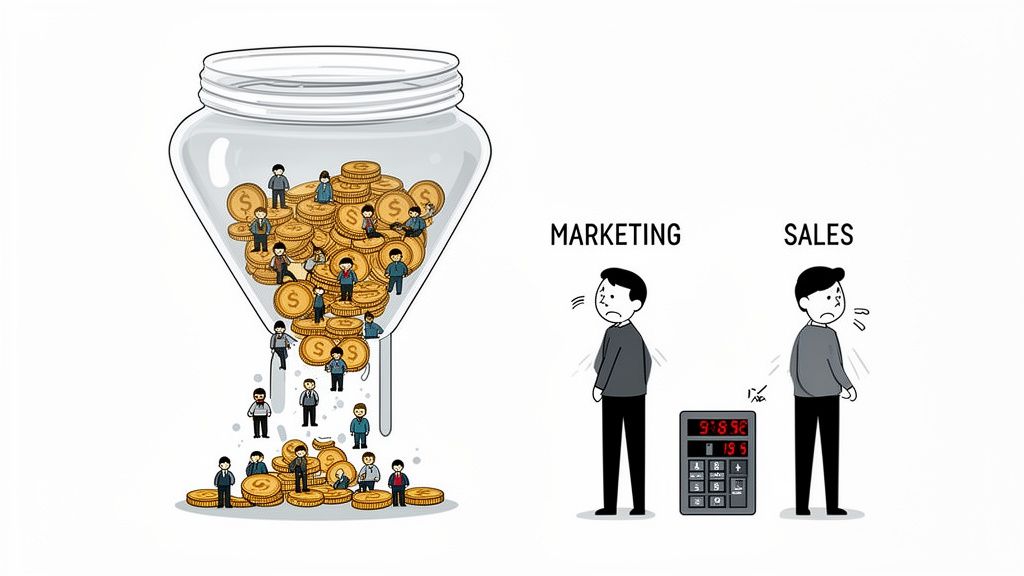
Before we jump into the "how," let’s talk about the pain of getting this wrong. For so many B2B tech founders, aligning these teams feels like a problem for "later." That’s a huge mistake. Misalignment is a silent revenue killer. It's not just about a little friction between departments; it's a direct drain on your bottom line.
You see this disconnect in painful ways every single day. Marketing hits a record for new leads, but the sales team complains they’re all junk. Sales reps, in turn, feel like they're spinning their wheels on prospects who are never, ever going to buy.
The result? A leaky funnel that bleeds potential deals at every stage.
The Financial Drain of Disconnected Teams
Think about the actual dollars. Your marketing team invests thousands in ad spend, but if sales ignores those leads because they don’t trust where they came from, that budget is just gone. Every lead that gets dropped is a sunk cost with zero chance of return.
This isn't a small leak; it's a financial black hole. The hit from misaligned teams is one of the biggest hidden costs in B2B tech. Research shows that businesses lose an estimated $1 trillion every year from these disjointed efforts. That staggering number is exactly why this is now a C-suite priority. You can dig into more sales and marketing alignment statistics to see the full picture.
Misalignment isn't just an operational headache; it's a strategic failure. It means your go-to-market engine is firing on half its cylinders, slowing your growth and giving competitors an easy win.
More Than Just Wasted Money
The damage goes way beyond the budget. When your teams aren't rowing in the same direction, the negative effects ripple through your entire company.
- Employee Morale: Constant conflict creates a toxic "us vs. them" culture. You end up with burned-out sales reps and frustrated marketers who are far more likely to check out or just quit.
- Customer Experience: Prospects get confusing, mixed messages. A marketing email might be talking about one feature while a salesperson is pitching a completely different value prop. This creates confusion and erodes trust in a heartbeat.
- Brand Reputation: A disjointed customer journey makes your brand look disorganized and amateur. In a competitive market, that's a credibility killer.
Fixing this isn't just another project to add to the backlog. For a B2B tech startup or scale-up, it’s one of the most powerful growth levers you can pull. It’s about transforming two separate functions into one cohesive revenue machine.
Defining Your Ideal Customer with Both Teams
True alignment starts when everyone agrees on who you're actually selling to.
Forget that theoretical Ideal Customer Profile (ICP) that was built once and is now collecting dust in a forgotten Google Drive folder. This isn't a one-and-done marketing exercise. It’s the foundational agreement for your entire revenue engine.
This is about getting sales and marketing leaders—and their key players—in the same room to build a practical, actionable definition of your customer. One that everyone actually believes in and uses. When both teams are aiming at the same target, everything that follows gets a whole lot easier.
Moving from Theory to Reality
Too often, the ICP is built in a silo. Marketing looks at analytics and industry reports, creates a persona, and lobs it over the fence. Meanwhile, sales operates on gut feel and frontline experience, often ignoring the "official" document because it doesn't match the reality they see in their calls every day.
This is where the first crack in alignment appears.
To fix it, you need to turn the process from a theoretical exercise into a collaborative workshop rooted in your own data. The goal is simple: analyze your best customers—the ones you wish you could clone. These are the clients who "get it" fast, stick around, and become your biggest fans.
Your best customers hold the blueprint for your future growth. By reverse-engineering their success, you stop guessing who you think you should sell to and start focusing on who you know you should sell to.
This isn't just about demographics. It's about spotting the specific company details and behavioral triggers that signal a perfect fit.
Running a Collaborative ICP Workshop
Get the right people from both teams in a room for a dedicated session. The agenda is straightforward: dissect your most successful accounts and find the common threads.
Here are the key areas to dig into together:
- Firmographics: What are the non-negotiables? Look at company size (revenue or employee count), industry, geography, and even the tech stack they use. Is there a sweet spot where you consistently win deals?
- Behavioral Triggers: What happened right before they bought? Did they just hire a key role (like a VP of Operations)? Announce a new round of funding? These are powerful buying signals that marketing can use for targeting.
- Pain Points and Goals: Get specific. What exact problems were they trying to solve? Sales has a goldmine of insights here from their discovery calls. Document the literal language customers use to describe their challenges.
- Watering Holes: Where do these people hang out online? What publications do they read, which influencers do they follow, and what communities are they active in? Marketing needs this to find them.
A simple persona card can help turn all this data into something tangible and easy to reference.
This visual tool transforms abstract data into a real, relatable profile that keeps both teams focused on the human you're trying to help.
Making Your ICP a Living Document
The output of this workshop can't be another static PDF. It has to be a living document that guides daily work and gets refined over time. For a deeper look at how to structure this, our team developed a practical ideal customer profile template that works as a great starting point for your session.
This shared ICP becomes the single source of truth for everything. Marketing uses it to sharpen ad copy, create content that hits home, and dial in their targeting. Sales uses it to build better lead lists, tailor outreach, and ask smarter discovery questions.
Ultimately, a shared definition ensures both teams are speaking the same language to the same people. It’s the first, and most important, step. And to make sure the handoff is seamless, you need a clear marketing qualified leads definition that both sides agree on. This way, marketing knows what a "good lead" looks like, and sales knows exactly what to expect.
2. Forge a Shared Playbook with Joint KPIs
Once you've nailed down your shared Ideal Customer Profile, it's time to translate that agreement into action. Good intentions are great, but they don't close deals. Without clear rules of engagement, you're setting everyone up for finger-pointing when a quarter goes south.
This is where you build the playbook. At its core is a Service Level Agreement (SLA)—a document that turns a handshake deal into a concrete, measurable commitment. This isn't about micromanagement; it's about creating a system of mutual accountability where everyone knows the game plan and how to win.
From Vanity Metrics to Shared Goals
The biggest mistake I see is teams tracking separate, often conflicting, metrics. Marketing celebrates a record month for website traffic while sales complains about a lack of quality conversations. Sound familiar? That’s a classic symptom of misalignment.
The fix is to shift focus from departmental vanity metrics to shared Key Performance Indicators (KPIs) that directly impact revenue. Both teams need to be measured against the same finish line.
These are the KPIs that actually matter for a unified revenue team:
- Pipeline Velocity: How fast are leads moving from first touch to closed-won? This forces both teams to work together to remove friction from the buyer’s journey.
- Customer Acquisition Cost (CAC): What's the total sales and marketing cost to land one new customer? When this is a shared KPI, marketing gets smarter about spend, and sales is motivated to improve close rates.
- Lead-to-Close Rate: What percentage of marketing-generated leads ultimately become paying customers? This is the ultimate test of lead quality and sales effectiveness.
Tracking these numbers creates a shared language of success. The conversation shifts from "my leads vs. your follow-up" to "our pipeline and our revenue." If you need more guidance, there are plenty of great resources on choosing the right metrics that matter for your B2B startup.
Defining Your Lead Handoff Process
A solid SLA is built on crystal-clear definitions. You absolutely must get alignment on Marketing Qualified Lead (MQL) and Sales Qualified Lead (SQL).
- MQL: This is a lead marketing has vetted against specific criteria—demographic, firmographic, and behavioral signals. For example, a Director of Engineering from a 500-person tech company who downloaded a pricing guide is an MQL. The rules are agreed upon beforehand.
- SQL: This is an MQL that sales has accepted and qualified as a legitimate opportunity. This usually happens after an initial discovery call confirms there’s a real need, budget, and authority to buy (think BANT or MEDDIC).
Getting these definitions right is everything. They become the contractual basis for the lead handoff, eliminating those painful, subjective debates about lead quality. To put this into practice, you can use a tool like this Success Criteria and KPI Framework Builder to codify your definitions.
An SLA isn't just a document; it's a peace treaty. It forces uncomfortable but necessary conversations upfront, preventing much bigger conflicts down the road. It codifies respect and accountability between two critical teams.
This simple flowchart shows how defining your ICP—the essential first step—feeds directly into building your SLA and KPIs.
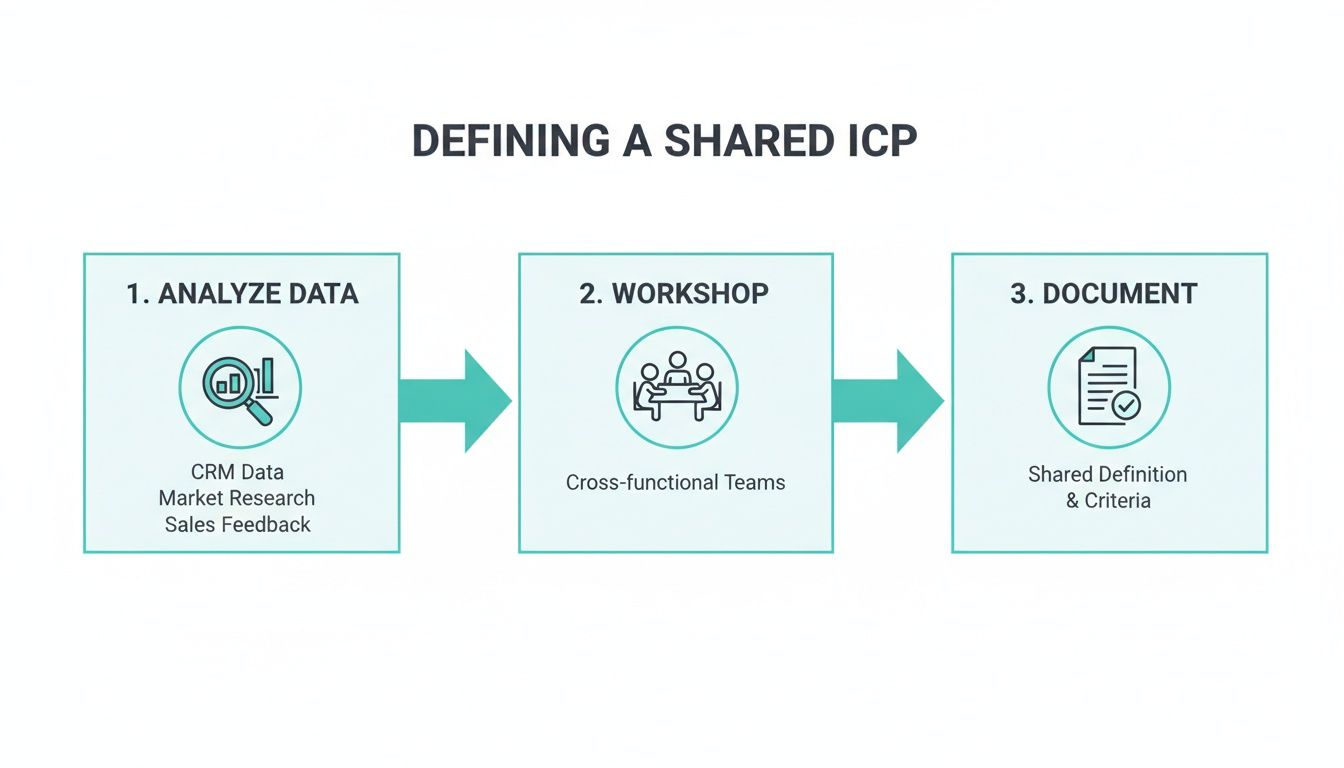
This process—data analysis, collaborative workshops, and clear documentation—is the bedrock of any successful alignment strategy.
Your Sample SLA Marketing and Sales Agreement
Here’s a simplified look at what a basic SLA can cover. The goal is to set clear expectations for what each team will deliver, how it will be measured, and how often you'll review performance together.
| Team Commitment | Metric/KPI | Target/Goal | Reporting Frequency |
|---|---|---|---|
| Marketing delivers qualified leads | Number of MQLs per month | 150 MQLs | Monthly |
| Marketing ensures lead quality | MQL to SQL conversion rate | ≥ 25% | Monthly |
| Sales acts on leads promptly | Time to first follow-up on an MQL | < 4 business hours | Weekly |
| Sales works leads thoroughly | Number of follow-up attempts per MQL | 6 attempts over 14 days | Weekly |
| Sales provides feedback on lead quality | % of MQLs accepted/rejected with reasons | 100% of rejected MQLs documented | Weekly |
This table isn't just a set of rules; it's a framework for collaboration. When both teams know the targets and see the data, the focus shifts from placing blame to solving problems. It builds a predictable system that everyone can trust.
Integrating Your Tech Stack for a Seamless Handoff
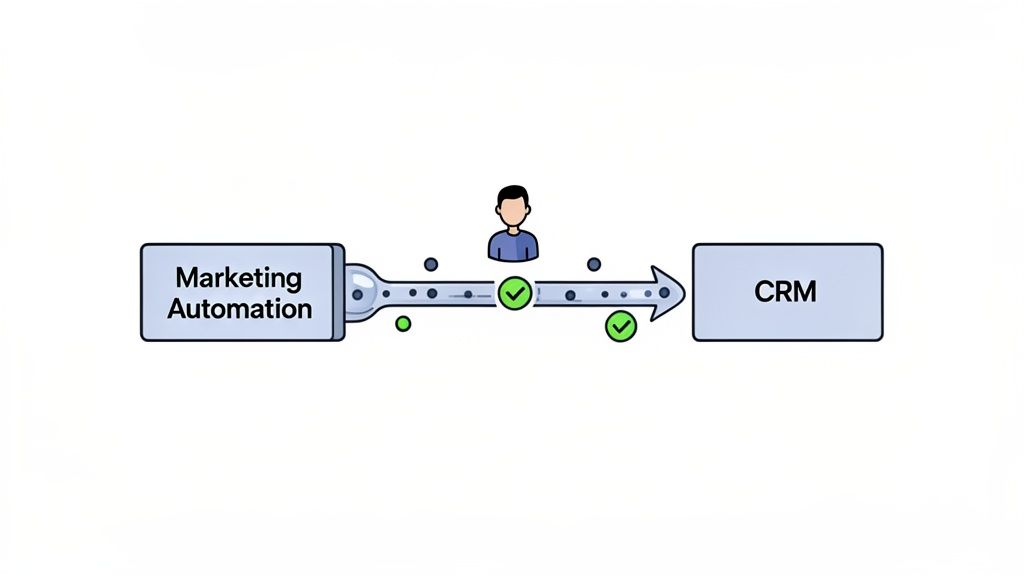
A brilliant strategy and a rock-solid SLA can fall apart in an instant if your technology doesn’t cooperate. I’ve seen it happen dozens of times: the digital handoff between the marketing automation platform and the CRM is where promising leads simply vanish into a black hole. This isn't a minor glitch; it’s a critical failure that torpedoes all your hard work.
Think about it from your lead's perspective. They fill out a high-intent form, expecting a quick response. But if they have to wait two days because your systems aren't talking to each other, you’ve already lost them to a competitor. A broken tech stack creates a clunky, disjointed experience that makes your company look disorganized and absolutely kills momentum.
The goal is simple: create a single source of truth. You need a unified view of the entire customer journey where both marketing and sales can see every single touchpoint in one place—from the first ad click to the closed deal. That requires a thoughtful and deliberate integration of your core technologies.
The HubSpot and Salesforce Bridge
For most B2B tech companies I work with, the most critical connection is between a marketing platform like HubSpot and a CRM like Salesforce. When this sync works, it’s magic. When it doesn’t, it’s a constant source of friction and finger-pointing.
Making this connection seamless isn't just about flipping a switch. You have to get the details right to ensure information flows correctly and everyone gets the context they need.
- Field Mapping: This is the absolute foundation. You have to make sure that data fields in HubSpot (like
Job TitleorLead Source) correctly map to their corresponding fields in Salesforce. Mismatched fields lead to lost information and frustrated sales reps who don’t have the context they need for a call. - Automated Lead Routing: Speed is everything. Once a lead hits your MQL threshold, that handoff needs to be instant and automatic. Set up rules that route leads to the right salesperson based on territory, industry, or company size. This cuts out the manual work and ensures follow-up happens well within the window defined by your SLA.
This level of integration transforms your tech from a simple record-keeping system into an active part of your revenue engine. It’s the operational backbone of a truly aligned sales and marketing function.
Creating a Single Source of Truth
The ultimate aim of tech integration is giving both teams a complete, 360-degree view of the prospect. A sales rep should never have to ask a prospect which webinar they attended; that information should be visible directly in the CRM contact record.
This means syncing all the relevant marketing activities. Did the prospect visit the pricing page three times this week? Did they open a specific marketing email? This behavioral data is pure gold for a salesperson, helping them tailor their conversation and understand what a prospect actually cares about.
Your tech stack should empower your teams, not get in their way. A well-integrated system removes excuses and provides the context needed for intelligent, timely conversations that actually move deals forward.
To get this right, you need to conduct regular audits of your tools. For a comprehensive overview of how to build and maintain an effective toolkit, you can learn more about structuring your marketing tech stacks. This will help you spot and fix the common integration mistakes that create data silos and kill productivity.
A tech audit isn't a one-time event. As your business grows and your strategies evolve, you'll add new tools and change processes. A quarterly check-in to review your integrations, clean up data, and confirm workflows are still running smoothly is a non-negotiable part of maintaining alignment. It’s how you keep the handoff frictionless for good.
Building a Rhythm of Communication and Feedback
Defining your ICP and locking in an SLA are huge milestones. But alignment isn't a one-and-done project. It’s a living thing that needs consistent, deliberate communication to stay healthy. Without a regular cadence for collaboration, even the best plans fall apart as old habits and silos creep back in.
This is where you build a real rhythm. It’s not about jamming more meetings onto the calendar; it’s about creating dedicated forums where both teams can review performance, hash out roadblocks, and share intel from the front lines.
The goal is a genuine closed-loop feedback system. Sales needs to share raw, on-the-ground truth about lead quality and prospect conversations. Marketing then takes that feedback and uses it to sharpen campaigns and messaging almost in real-time. This is the loop that turns a good go-to-market strategy into an unbeatable one.
The Weekly Smarketing Tactical Huddle
The most frequent—and arguably most important—meeting is the weekly "Smarketing" huddle. This is a fast-paced, tactical session meant to keep the engine running smoothly day-to-day. Think of it as a pit stop to check the tires and refuel before the next lap.
Keep the agenda tight and data-driven, focusing on last week and the week ahead.
- Lead Flow Review: Did marketing hit its MQL target? How fast did sales follow up, and did we meet the SLA?
- Lead Quality Feedback: This is the heart of the meeting. Sales reps must come prepared to talk about specific leads—the good, the bad, and the ugly. Why was a certain MQL amazing? What patterns are you seeing in the leads getting disqualified?
- Campaign Snapshot: What's new from marketing? How are the early results looking? This keeps sales in the loop on what’s driving demand so they can tailor their conversations.
This meeting should be 30-45 minutes, tops. The point is to solve immediate problems and maintain momentum before small issues blow up into major friction.
The Monthly Strategic Pipeline Review
While the weekly huddle is all about tactics, the monthly meeting is about strategy. Here, you zoom out to look at the bigger picture and analyze the health of the entire pipeline. This is where leadership from both teams connects the dots between activity and results.
A common language is critical. When teams measure different things, they can't have a productive conversation. Shared metrics force a shared perspective on what's working and what isn't.
Key topics for this monthly deep dive include:
- SLA Performance: How are we tracking against the core metrics in our Service Level Agreement? Are we hitting our MQL-to-SQL conversion rate? Is the lead-to-close rate trending up or down?
- Pipeline Analysis: Let's look at the pipeline by source. Which marketing channels are generating the most valuable opportunities? Are deals getting stuck at a specific stage in the funnel?
- Win/Loss Analysis: Dig into the deals that closed—and the ones that slipped away. What are the common themes from the wins? Why did we lose those key deals? This is a goldmine for refining your ICP and value prop.
This is the meeting where you spot the trends. Maybe a specific webinar is consistently producing demo-ready leads, or perhaps leads from a certain ad campaign have a terrible close rate. These insights tell you where to double down and what to fix.
The Quarterly Business Review
The quarterly business review (QBR) is your highest-level sync, tying all your sales and marketing efforts directly back to the company's revenue goals. This is where you and the sales leader stand shoulder-to-shoulder and present your joint performance to the executive team.
The focus here is bottom-line impact and planning for the next quarter. You’re not just reporting on MQLs; you’re talking about revenue influenced, customer acquisition cost (CAC), and the overall return on your go-to-market investment. The QBR is your chance to prove the power of an aligned revenue engine.
Here’s a simple meeting cadence that brings all of this together.
Effective 'Smarketing' Meeting Cadence
A structured meeting plan ensures continuous alignment and feedback between sales and marketing teams. This isn't just about talking; it's about solving problems and winning together.
| Meeting Type | Frequency | Attendees | Primary Goal |
|---|---|---|---|
| Smarketing Tactical Huddle | Weekly | Key reps from sales and marketing | Review lead flow, share immediate feedback, and fix tactical issues. |
| Strategic Pipeline Review | Monthly | Sales and marketing leadership | Analyze pipeline health, review SLA metrics, and identify trends. |
| Quarterly Business Review | Quarterly | Sales/marketing leaders and executive team | Connect joint efforts to revenue goals and plan for the next quarter. |
This structured rhythm turns "alignment" from a buzzword into a consistent, daily practice. It builds accountability, fosters empathy, and makes sure both teams are constantly learning and getting better, together. It’s the operational heartbeat of a high-growth company.
Your Top Sales and Marketing Alignment Questions, Answered
Even with the best-laid plans, you're going to hit a few bumps. When you're bringing two historically siloed teams together, questions are going to come up. It’s all part of the process.
Here are some of the most common questions I get from B2B tech leaders, with straight answers to help you navigate the tricky spots.
Where Do We Even Start?
Before touching any tech or drafting a single KPI, get the heads of sales and marketing in a room for a joint Ideal Customer Profile (ICP) workshop. This is non-negotiable. You have to agree on exactly who you're selling to before anything else can happen.
Pull the data on your best existing customers. Who’s happiest? Who’s most profitable? Let that data guide the conversation. This shared understanding of your target becomes the bedrock for everything else, from ad campaigns to sales scripts.
How Do We Settle Arguments Over Lead Quality?
Ah, the classic friction point. The only way to solve it is to swap subjective complaints for objective data, and your Service Level Agreement (SLA) is where you make this happen.
When a salesperson disqualifies a lead in the CRM, don't just let them close it out. Make them pick from a dropdown list of reasons.
- Not a decision-maker
- Budget doesn't match
- Timeline too long
- Chose a competitor
- Unresponsive after multiple touches
Marketing then reviews this data weekly. If a pattern pops up—say, a ton of leads are getting tossed for "budget doesn't match"—marketing knows they need to adjust their targeting or messaging. This simple feedback loop turns arguments into actionable insights.
Disagreements over lead quality are a symptom of a process problem, not a people problem. Fix the process by introducing objective data, and you'll eliminate 90% of the conflict.
Who Should Own the Shared Metrics?
While sales and marketing leads are on the hook for their teams' contributions, a senior executive needs to own the ultimate alignment goals.
In most B2B tech companies, this falls to a Chief Revenue Officer (CRO). If you're an early-stage startup, that person is probably the CEO.
This executive ownership is critical for two reasons. First, it signals that alignment is a core business priority, not just a side project. Second, it provides a clear tie-breaker when conflicts arise, ensuring decisions serve overall revenue growth, not just one team’s agenda.
Is a Formal SLA Overkill for a Small Startup?
Not at all. In fact, it's the perfect time to put one in place. It's way easier to build good habits when your team is small than it is to fix bad habits and deep-seated cultural divides later.
An SLA for a startup doesn't need to be a 20-page legal document. A simple one-pager will do.
Just outline the essentials:
- The clear, agreed-upon definition of a Marketing Qualified Lead (MQL).
- The sales team's commitment for follow-up time (e.g., within 8 business hours).
- One or two shared goals, like MQL-to-SQL conversion rate.
This simple document builds a culture of mutual accountability from day one and creates a framework that can easily scale as you grow.
Building a truly unified revenue engine is a journey, but it's one of the most powerful investments you can make in your company's growth. If you need senior marketing leadership to guide this process and build a focused, data-driven roadmap, Value CMO can help. We provide fractional CMO services that deliver strategic clarity and hands-on execution without the full-time overhead. Learn more about how we align sales and marketing to accelerate revenue.