So, what exactly is a fractional CMO for startups? Think of it like this: you get a seasoned, part-time marketing executive who steps in to lead your strategy and your team. This brilliant model gives early-stage companies access to top-tier strategic leadership without the eye-watering price tag and long-term commitment of a full-time executive. It's a game-changer for ambitious founders on a lean budget.
Why Smart Startups Are Bringing a Fractional CMO Onboard

Have you ever tried to build a skyscraper without an architect? You might have the best builders and the finest materials, but without a master blueprint, the whole project is just a shot in the dark. The foundation could be shaky, the structure unstable, and the final result will almost certainly fall short.
This is exactly what happens in way too many startups. Founders hire junior marketers or agencies to handle the day-to-day stuff, but there’s no high-level strategic vision holding it all together. The result? Disconnected campaigns, wasted ad spend, and growth that's stalled out.
A fractional CMO is your marketing architect. They don’t just lay bricks; they design the entire blueprint for scalable, predictable revenue growth.
The Rise of Fractional Leadership
The fractional executive model isn’t just some passing trend. It’s a real shift in how modern companies build their leadership teams. We've seen a massive spike in these roles, with some reports showing a 57% increase in fractional positions since 2020. This is all happening for one simple reason: it just makes sense financially.
Let's look at the numbers. A full-time CMO in a major tech hub can easily demand a salary between $250,000–$400,000 per year, plus equity. An experienced fractional CMO for startups, on the other hand, typically costs between $10,000–$15,000 per month. That's a 40–65% cost reduction for the same caliber of strategic brainpower.
That kind of savings frees up precious cash that you can pour right back into your product, your sales team, and other critical parts of your business.
A fractional CMO offers a powerful balance of expertise and affordability, letting startups punch way above their weight in competitive markets. They bring the wisdom of a seasoned executive without the crushing financial burden.
More Than Just a Consultant
It’s really important to get this: a fractional CMO isn't just another consultant. A consultant usually pops in, delivers a one-time audit or a project plan, and then waves goodbye. A fractional CMO, however, actually plugs into your leadership team.
They take real ownership of your marketing results. They manage the budget, mentor your junior team members, and are on the hook for hitting actual numbers. This deep involvement means the strategy doesn’t just get created—it gets executed, measured, and fine-tuned. If you want to dig a bit deeper, you can explore the core fractional CMO meaning and see how different it is from other marketing roles.
For a lot of founders, the marketing world is a complex beast. Having a fractional CMO on your team is a huge relief. They translate your big business goals into a clear, actionable marketing roadmap, turning confusion into momentum. They can help you build out a comprehensive startup marketing strategy guide that actually works.
What a Fractional CMO Actually Delivers
So, what do you really get when you bring a fractional CMO on board? It’s not just another face on your Zoom calls. Think of it as installing a new, high-performance operating system for your entire marketing department.
This isn’t about ticking tasks off a list; it’s about a fundamental shift in how you think about growth. A great fractional CMO’s impact boils down to three key things: building the strategy, leading the team, and driving the execution.
Let's break down what that looks like in the real world.
Strategic Planning and Roadmap Development
Most early-stage startups don’t have a marketing strategy. They have a collection of random tactics. A fractional CMO’s first job is to swap that chaos for clarity. They take a step back, dig into your business goals, and build a strategic roadmap that ties every single marketing move back to revenue.
This process usually involves a few key steps:
- Defining Your North Star: They work with you to set clear, measurable goals that actually matter. You'll move beyond vanity metrics like social media likes to focus on things like lead generation, customer acquisition cost (CAC), and the value of your pipeline.
- Building the Growth Model: They map out your entire customer journey, figuring out the best channels and messages to attract, engage, and convert your ideal customers.
- Allocating Resources Wisely: They create a realistic budget that puts your limited funds toward the activities that will have the biggest impact. This stops you from making the all-too-common mistake of burning cash on channels that don’t deliver.
For a B2B SaaS startup aiming for its first 100 enterprise leads, this means creating a target account list, designing an account-based marketing (ABM) plan, and setting up the tech to prove it's all working.
Team Leadership and Mentorship
Many startups have talented but junior marketing teams who are eager to make an impact but lack senior guidance. A fractional CMO steps in as their player-coach, leveling up their skills and turning a group of individuals into a high-performing engine.
Instead of just handing out tasks, they mentor your team on the "why" behind the "what." This might mean teaching a content marketer how to write for SEO and demand generation, or coaching a digital specialist on how to cut ad spend while improving ROI.
A fractional CMO doesn’t just manage your team; they build its capabilities. The goal is to create a self-sufficient, confident marketing function that keeps delivering value long after their engagement is over.
This is the kind of leadership that turns your marketing department from a cost center into a strategic growth driver.
Hands-On Execution and Optimization
Finally, a fractional CMO for startups actually rolls up their sleeves. They aren't just strategists who drop off a slide deck and disappear. They're on the hook for getting the marketing engine running and tuning it for better performance.
This hands-on work often includes things like:
- Overseeing the launch of a new demand generation campaign.
- Negotiating with vendors and picking the right marketing technology.
- Digging into performance data and making adjustments to get better results.
This tangible impact is exactly why the fractional leadership market is blowing up. One estimate puts the fractional CMO market at about $1.27 billion in 2024, driven by startups that are seeing real results. Case studies often show measurable wins like lead generation jumping by around 40% and much better ROI from smarter budget allocation. Discover more insights about this growing market and its impact on harlemworldmagazine.com.
One of the most critical things a B2B startup needs is a solid lead generation strategy, especially on key platforms. For many, that means mastering LinkedIn. Learning how to generate leads on LinkedIn for real results is a perfect example of the practical, revenue-focused expertise a fractional CMO brings to the table.
Choosing Your Marketing Leadership Model
As a founder, one of your biggest decisions is figuring out who steers the marketing ship. This isn’t just about filling a role; it’s about picking the right leadership model for your exact stage. You have to answer one question first: Do I need an architect to design the blueprint, or do I just need more hands on deck to build what’s already planned?
Every option—from a full-time executive to a freelance specialist—solves a completely different problem. Get this wrong, and you’ll burn through cash and lose momentum. No startup can afford that. Let's break down the common paths so you can get this right.
Comparing Your Options
The choice between a fractional CMO for startups, a full-time hire, an agency, or a freelancer is really a balancing act between strategy, cost, and execution. Each one brings a different mix to the table. Nailing the trade-offs is how you win.
This flowchart lays out the core deliverables a fractional CMO brings to the table, showing how they blend high-level strategy with leadership and hands-on execution.
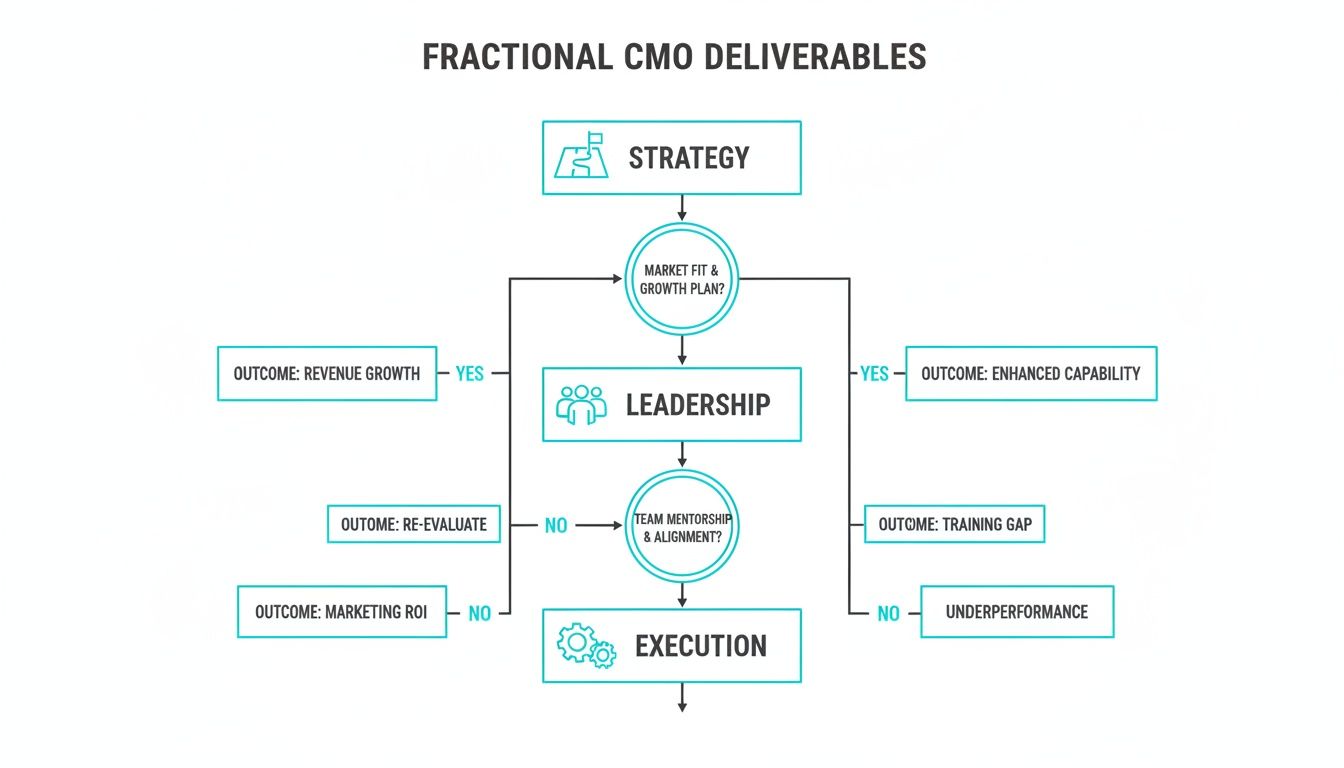
This model is built to fill the exact leadership gap that trips up most growing startups.
To make the differences even clearer, here's a side-by-side look at your main options.
Comparing Marketing Leadership Models for Startups
| Factor | Fractional CMO | Full-Time CMO | Marketing Agency | Freelance Consultant |
|---|---|---|---|---|
| Primary Role | Strategic leadership & team building | Executive ownership & management | Channel-specific execution | Task-based execution |
| Cost | Mid-range (retainer) | High (salary + equity + benefits) | Varies (retainer or project) | Low (hourly or project) |
| Strategic Input | High (core function) | High (core function) | Low (expects strategy from you) | Low (focused on one task) |
| Commitment | Part-time, flexible | Full-time, long-term | Contract-based | Project-based, short-term |
| Best For… | Startups needing strategy before scale | Mature companies with large teams | Executing a known, defined plan | Filling a specific skill gap |
This table shows there’s no single "best" choice—only the right choice for where your company is right now.
Strategist or Specialist
A marketing agency, for instance, is brilliant at execution in a specific channel. Need a team of pros to run your Google Ads or manage social media? An agency brings that specialized firepower. Think of them as master craftspeople who can build one part of the house perfectly.
But an agency almost never designs the architectural plan. They expect you to hand them the blueprint. If you don't know which channels to target, who your ideal customer is, or what your message should be, an agency is just executing in the dark.
A fractional CMO is the architect who designs the entire blueprint. They figure out what to build and why before bringing in specialists to handle the construction. They answer the big strategic questions first, ensuring every dollar you spend is effective.
This is a critical distinction. Hiring a specialist when you desperately need a strategist is one of the most common—and most expensive—mistakes a startup can make.
The Right Time for a Full-Time CMO
A full-time CMO becomes a non-negotiable asset once your company hits a certain scale and complexity. This is usually when you have proven product-market fit, a multi-million dollar marketing budget to manage, and a large internal team that needs constant, dedicated leadership.
The commitment is huge. A top-tier CMO comes with a hefty salary, benefits, and equity. For most early-stage startups, that kind of investment is just too early. Locking in a full-time executive before your strategy is even validated can tie up precious capital that should be going toward growth experiments.
A fractional CMO acts as the perfect bridge. They give you the executive-level guidance you need to get to the stage where a full-time hire isn’t just affordable, but absolutely essential.
For founders weighing these models, it’s helpful to get familiar with the nuances of outsourced marketing solutions and how they fit into a startup's journey. By matching your leadership choice with your immediate needs, you put your company on the path to smart, sustainable growth.
Knowing When to Hire a Fractional CMO
Timing is everything in a startup. Make the right move at the wrong time, and you're just burning cash. But make it at the right moment, and you unlock your next stage of growth. Hiring your first real marketing leader is one of those moments.
So, how do you know when it’s time to bring in a fractional CMO? It's almost never a single event. It’s usually a series of familiar growing pains telling you that what got you here won't get you there.
Spotting these signals early is the key. Let's walk through the clear signs that it’s time to make the call.
Green Lights: When You Should Hire a Fractional CMO
If any of these sound painfully familiar, you're probably in the sweet spot. These aren't just bumps in the road; they're systemic problems that demand senior strategic leadership.
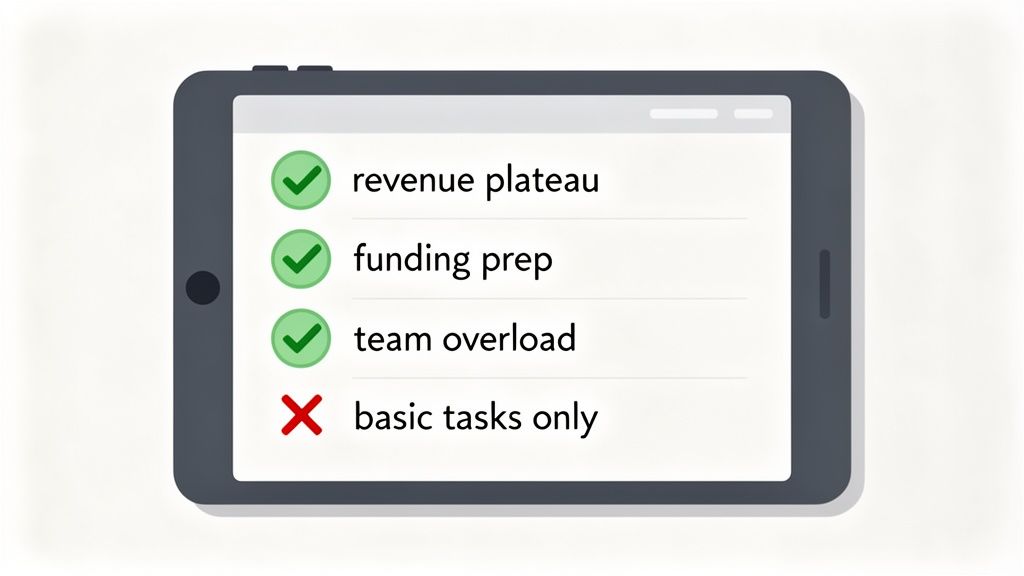
- Your Growth Has Plateaued: The early wins from founder-led sales and hustle have fizzled out. Revenue is flat, and you’re not sure which levers to pull to get the engine humming again.
- You're Drowning in Marketing Choices: SEO, PPC, ABM, content, social—the options are overwhelming. You're throwing money at different channels hoping something sticks, but there’s no real plan or reliable way to measure what’s actually working.
- Your Junior Team is Spinning its Wheels: You've got talented, hardworking marketers, but they lack the senior guidance to prioritize what really matters. They need a mentor and a strategist, not just a manager to assign tasks.
- You're Gearing Up for a Funding Round: Investors don't just back a great product; they back a predictable growth machine. You need a clear go-to-market strategy, solid numbers, and a scalable plan to win customers. A fractional CMO builds that story and the data to back it up.
A fractional CMO is the perfect fit when your strategic problems have outgrown the hours you have to solve them. They bring clarity and direction right when you, the founder, can no longer be the sole marketing strategist.
This transition from founder-led hustle to a structured, strategic function is a natural—and necessary—part of scaling up.
Red Lights: When a Fractional CMO Is Not the Right Fit
Just as important as knowing when to hire is knowing when not to. A fractional CMO is a strategic weapon, not a Swiss Army knife. Bringing one in for the wrong reasons leads to frustration and a wasted budget.
Here are the red flags that mean you need something else:
- You Just Need More Hands for Execution: If you already have a solid strategy and just need someone to write blog posts or run Google Ads campaigns, hire a freelance specialist. It’s a much smarter—and more cost-effective—use of your money.
- You Haven't Nailed Product-Market Fit: A fractional CMO can't create demand for a product nobody wants. Their job is to scale something the market has already given a thumbs-up. Focus on your product first.
- You Have No Budget for Marketing Execution: A strategist needs resources to bring their plan to life. If you can’t afford to invest in the channels, tools, or content they recommend, their strategic roadmap will just sit on a shelf.
Understanding the difference is crucial. A fractional CMO is an investment in high-level strategy and leadership. When your startup is facing the right challenges, it’s an investment that pays for itself by unlocking your next phase of growth.
How to Hire the Right Fractional CMO
So you've decided a fractional CMO for startups is the right move. Great. Now for the hard part: finding the right one. This isn’t just about filling a role; it’s about bringing in a strategic partner who’s as invested in your success as you are.
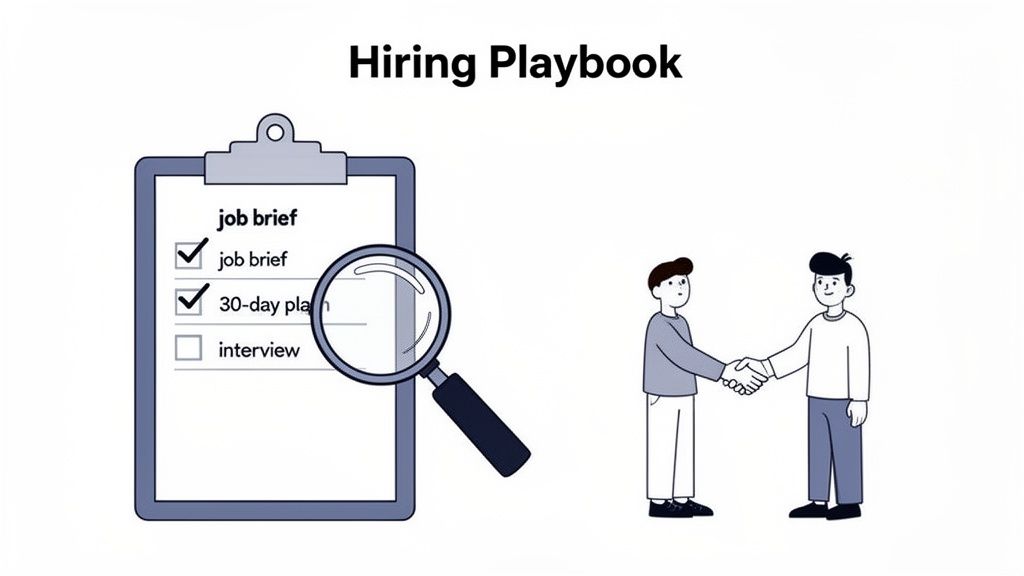
The process is totally different from hiring a full-timer or a task-based freelancer. You’re looking for a rare mix of high-level strategy, in-the-weeds experience, and a personality that clicks with your leadership team. Here’s the playbook to get it right.
Start with a Clear Job Description
Before you even think about posting a job, you need to define what success looks like. A generic job description brings in generic candidates. You need to create a "Success Profile" that pinpoints the exact business problems this person is coming in to solve.
Be painfully honest about your challenges. Is your pipeline drying up? Is your brand message a confusing mess? Does your junior team need a mentor, like, yesterday? A sharp problem statement attracts senior leaders who have already solved your exact problems.
Your description should cover:
- The Mission: One sentence that nails the core challenge (e.g., "Build a predictable lead gen engine to take us from $1M to $5M ARR.").
- Key Responsibilities: Forget tasks; focus on outcomes. Use phrases like "Own the go-to-market strategy from day one" or "Mentor and level-up our two-person marketing team."
- Required Experience: Get specific. Mention your industry (e.g., B2B SaaS), company stage (e.g., Seed or Series A), and the results you need to see (e.g., "Proven track record of scaling organic traffic past 100K visitors/month").
This clarity works like a powerful filter, making sure you only talk to people who are a genuine fit.
Ask the Right Interview Questions
Interviewing a fractional CMO isn’t about brain teasers or hypothetical questions. It’s about digging into their strategic thinking and seeing how they operate in the real world. You need to get past the slide decks and understand how they actually solve problems.
The best candidates won't just tell you what they'd do; they'll explain the why behind their thinking. They'll ask you more questions than you ask them, showing a real curiosity to understand your business before they start prescribing solutions.
Here are a few questions that cut right to the chase:
- "Walk me through building a marketing engine from scratch for a company our size." This forces them to show you their playbook—from research and strategy to execution and measurement. Listen for how they sequence their moves.
- "What’s your 30-day plan to make an impact here?" This reveals their ability to diagnose issues fast and go after high-impact activities. A great answer starts with listening and learning, then targets a few quick wins to build momentum.
- "Tell me about a time a marketing strategy you owned failed. What did you learn?" This is a test for self-awareness. Marketing is all about experimenting, and you want a leader who learns from misses, not one who pretends they don't happen.
Understand Engagement Models and Pricing
Fractional CMOs don't fit into a one-size-fits-all box. Most engagements are built around a monthly retainer, which buys you a set amount of their time and focus. Pricing varies based on experience, your industry, and how deep they need to go, but the models are pretty standard.
- Retainer Model: This is the most common setup. You pay a flat monthly fee for a set number of hours or days per week. It gives you consistent access to strategic leadership.
- Project-Based Model: This works best for a specific, time-bound goal, like a product launch or a full GTM strategy build-out. It has a clear start and finish line.
- Advisory Model: A lighter-touch option. Here, the fractional CMO is more of a strategic sounding board, joining leadership meetings and offering high-level guidance with less hands-on execution.
When you talk money, focus on the value and the outcomes you're buying, not just the hourly rate. A seasoned—and pricier—fractional CMO can often deliver results much faster, giving you a better ROI. To see how this works in practice, it helps to understand how specialized firms hire a fractional CMO matched to your specific needs.
Common Questions About Fractional CMOs
Even when the model makes perfect sense on paper, founders still have questions before they pull the trigger. And they should—it’s a big decision. This is where we get into the practical, nuts-and-bolts concerns about cost, time, and what success really looks like.
Think of this as your final gut-check. Let's tackle the most common questions we hear so you can make a confident choice.
How Much Does a Fractional CMO for Startups Cost?
Let’s get right to it—the money question. A typical engagement for a fractional CMO for startups lands somewhere between $5,000 and $15,000 per month. This is almost always a retainer, which secures you a dedicated slice of their strategic focus.
But the real story isn't the price tag; it's the value. Compare that retainer to the fully loaded cost of a full-time CMO—salary, benefits, bonuses, equity—and the savings are huge. You're often looking at a 40-65% cost reduction while getting the same caliber of senior-level talent.
That’s cash you can pour back into executing the marketing plan, preserving your precious runway while still getting top-tier strategic leadership.
What Is the Typical Time Commitment?
The "fraction" in fractional CMO is beautifully flexible. The time commitment is dialed in to your startup's needs and can scale up or down as you hit new milestones. Most engagements range from one to three days per week, or about 8 to 24 hours.
An early-stage startup might only need one day a week for high-level strategy and team mentorship. A scale-up getting ready for a major launch might need three days for more hands-on leadership. This adaptability is the model’s core strength.
The goal isn't to buy hours; it's to buy outcomes. A great fractional CMO makes a real impact on your business, whether they're working 10 hours a week or 20. The focus is on moving the needle, not just filling a timesheet.
This setup ensures you’re never overpaying for leadership you don't need, but you always have the strategic firepower you need for your current growth stage.
How Do You Measure the Success of a Fractional CMO?
Success isn't some vague idea. It's measured against the clear, agreed-upon goals you set at the very beginning. While the specific KPIs will depend on your business, they almost always tie directly back to revenue growth and marketing efficiency.
Common ways to measure success usually include:
- Pipeline Growth: A measurable jump in the number and quality of Marketing Qualified Leads (MQLs) and Sales Qualified Leads (SQLs).
- Improved Conversion Rates: Better performance at key stages in your funnel, from website visitor to paying customer.
- Lower Customer Acquisition Cost (CAC): Making your marketing spend more efficient by doubling down on what works.
- Increased Organic Visibility: Growth in organic traffic and keyword rankings that builds a long-term, sustainable asset for your business.
But the numbers only tell part of the story. True success also includes strategic wins that are harder to measure but just as critical.
Strategic success markers often involve:
- Creating a Scalable Marketing Roadmap: A clear, documented plan the entire company can get excited about and rally behind.
- Upskilling Your Internal Team: Mentoring your junior marketers into a more confident and capable unit.
- Building Repeatable Processes: Establishing the systems and workflows needed to sustain growth long after they're gone.
Ultimately, a successful fractional CMO leaves your marketing function stronger, smarter, and more effective than they found it.
Is a Fractional CMO Different from a Consultant?
Yes, and this is one of the most important distinctions to understand. A marketing consultant is typically brought in for a specific, project-based task. They might run an audit, deliver a strategic plan, or advise on a particular challenge—and then they’re gone.
A fractional CMO for startups, on the other hand, becomes a real, integrated member of your leadership team. They operate as a part-time executive, not an external advisor.
This means they don't just create the strategy; they own its execution. They manage the budget, lead the team, report to the CEO and the board, and are held accountable for hitting business-level targets. The commitment is deeper, the involvement is more hands-on, and the focus is on driving long-term, sustainable growth from the inside.
Ready to stop guessing and start growing? At Value CMO, we provide B2B tech startups with the senior marketing leadership needed to build a predictable revenue engine. Our fractional CMOs step in to clarify your strategy, mentor your team, and execute a plan that delivers real results. Learn how we can help you scale.