So, you know your startup needs that C-suite marketing brainpower, but a six-figure salary feels like a galaxy away. We get it. This is exactly where fractional CMO services come into play. Think of it like calling in a seasoned special forces commander for your marketing squad, but only when you need their elite strategy and leadership the most.
Your Secret Weapon for Scalable Startup Growth

For ambitious B2B tech companies, the road from early traction to scalable growth is littered with marketing landmines. You might have a killer product and a small, hungry team, but without experienced leadership, your efforts can feel scattered and ineffective. A fractional Chief Marketing Officer is precision-engineered to fill this exact gap.
A fractional CMO isn't a consultant who drops off a strategy deck and then vanishes. They're a part-time executive who actually embeds with your company, taking full ownership of the marketing function from high-level strategy right down to execution. You get the strategic thinking of a seasoned pro without the massive cost and long-term commitment of a full-time hire.
Bridging the Leadership Gap
A lot of startups get stuck in this awkward middle ground. They’ve outgrown what a junior marketer or a generalist can do, but they’re just not ready to drop a quarter-million dollars on a full-time VP of Marketing. A fractional CMO is the perfect bridge, delivering an immediate impact while building the foundation for future growth.
This isn't some fringe idea, either. The model is catching on, and fast. The fractional CMO market is seeing explosive growth, with a projected 50% increase in these roles. This wave is being driven by scale-ups who need flexible, high-caliber marketing leadership without the permanent overhead.
To kickstart that growth, a fractional CMO will dig into things like refining your go-to-market plan, optimizing your demand gen engine, or mentoring your current team to level up their skills. They'll pull from a playbook of actionable SaaS marketing ideas to drive growth that are proven to work.
A fractional CMO is more than a temporary leader; they're a strategic growth partner. Their main goal is to build a marketing engine that not only gets you quick wins but keeps running efficiently long after they're gone.
Before we dive into the nuts and bolts, let's do a quick side-by-side to see how this role stacks up against a traditional full-time hire.
Here’s a quick rundown of what you’re looking at when comparing a fractional CMO to bringing on a full-time executive.
Fractional CMO Services At a Glance
| Aspect | Fractional CMO | Full-Time CMO |
|---|---|---|
| Cost | Flexible retainer, significantly lower than a full-time salary | Full executive salary, bonuses, equity, and benefits |
| Commitment | Part-time, project-based, or monthly retainer | Full-time employment with a long-term contract |
| Speed to Impact | Immediate, often making an impact within weeks | Slower ramp-up time due to longer hiring and onboarding |
| Expertise | Broad experience across various industries and growth stages | Deep expertise in one company but potentially narrower perspective |
| Flexibility | Scales up or down based on your business needs and budget | A fixed resource regardless of fluctuating requirements |
The table makes it pretty clear: for startups needing agility and top-tier expertise without the massive financial burden, the fractional model is a pretty compelling advantage.
What a Fractional CMO Actually Does for You
So, what does a fractional CMO do once they’re on board? It’s one thing to know the definition, but it’s another to see how their expertise translates into real-world impact for your business.
Think of them less as a temporary manager and more as a multi-talented "player-coach" who operates across three critical functions. They don’t just hand you a playbook and wish you luck; they get on the field with your team to help run the plays. Their work is a blend of high-level thinking and practical, in-the-weeds action, designed to build a marketing engine that drives real results.
Architecting Your Marketing Strategy
Before anything else, a great fractional CMO acts as the chief architect of your marketing strategy. Many startups have a collection of marketing tactics—some blog posts here, a few paid ads there—but no cohesive plan tying it all together. The fractional CMO’s first job is to build that blueprint.
This starts by getting deep into your business goals. Are you trying to crack a new market, boost customer lifetime value, or just generate more qualified leads? They'll translate these objectives into a clear, documented marketing roadmap.
This involves:
- Defining your Ideal Customer Profile (ICP): Getting laser-focused on who you serve, what their pain points are, and how your solution helps.
- Crafting your core messaging: Making sure your value proposition is sharp, consistent, and actually resonates with your target audience.
- Building a channel strategy: Picking the most effective channels to reach your ICP, whether it's content, SEO, paid media, or partnerships.
For example, let's say a B2B SaaS company has a flat pipeline. A fractional CMO would come in, analyze the market, and realize the current messaging is too broad. They’d lead a workshop to redefine the ICP around a specific industry vertical, rewrite the website copy to address that vertical's unique challenges, and launch a targeted LinkedIn campaign—all within the first 60 days.
Mentoring and Leading Your Team
One of the most valuable roles a fractional CMO plays is that of a mentor. Your junior marketing team is likely full of talent and energy, but they often lack the senior-level guidance needed to truly excel. A fractional CMO provides that direction.
They don’t just delegate tasks; they actively coach your team, elevating their skills and building their confidence. This creates a stronger, more capable marketing function that can sustain momentum long after their engagement ends.
A fractional CMO is a force multiplier for your existing team. They provide the strategic oversight that turns a group of individual contributors into a high-performing, goal-oriented marketing department.
This leadership shows up in practical ways. They'll run productive weekly meetings, help team members set and track meaningful goals (OKRs), and give direct feedback on everything from campaign briefs to ad copy. They become the person who connects the team’s daily work to the company’s bigger vision.
Overseeing Hands-On Execution
Finally, a fractional CMO rolls up their sleeves and makes sure the strategy gets executed flawlessly. They aren't just advisors who operate from a distance; they're deeply involved in the day-to-day operations to drive progress.
This hands-on oversight means they are accountable for results. They’ll manage the marketing budget, select and manage vendors or agencies, and oversee the implementation of key marketing technology like your CRM and automation platforms.
Imagine you're preparing for a major product launch. The fractional CMO would:
- Develop the go-to-market plan, coordinating with product, sales, and customer success.
- Oversee the creation of all launch assets, from sales decks to website landing pages.
- Manage the demand generation campaign to build a pipeline of early adopters.
This blend of strategy, mentorship, and execution is what makes fractional CMO services so powerful. You get a leader who can design the game plan, coach the players, and help score the winning goal.
Choosing Your Marketing Leadership Model
Once you know you need senior marketing leadership, you hit a fork in the road. This isn't just about hiring someone; it's about picking the right leadership model for your company's stage, budget, and growth goals. Get this right, and it will shape your marketing—and your company's trajectory—for years to come.
You've got three main plays: bring on a fractional CMO, hire a full-time executive, or partner with a marketing agency. Each path comes with its own set of wins and trade-offs. Let's cut through the noise and look at what really matters—cost, speed, expertise, and how well they'll mesh with your team—so you can make a smart, clear-eyed decision.
The Full-Time CMO Commitment
Hiring a full-time Chief Marketing Officer is the classic move. This gets you a dedicated, deeply embedded leader who lives and breathes your company culture every day. They are 100% focused on your success, building long-term institutional knowledge and forging deep relationships across the whole organization.
But that level of dedication comes with a hefty price tag. The hunt for a top-tier CMO can easily take 6-9 months, which feels like an eternity in the startup world. Then there's the financial commitment. A full-time CMO's total compensation package will run you anywhere from $250,000 to $570,000 annually once you factor in salary, bonuses, benefits, and equity. A fractional approach, by contrast, can slash executive hiring costs by up to 75%. You can get more details on CMO compensation and fractional models at Maven Marketing Solutions.
The Marketing Agency Partnership
A marketing agency brings something different to the table: an entire team of specialists on call. For a single monthly fee, you get access to experts in SEO, content, paid ads, and design. This can be a great way to execute specific campaigns or fill tactical gaps when your internal team is still small.
The big downside? A lack of deep business integration. An agency is an external vendor, and they’re often juggling multiple clients. They probably won't get the nuances of your internal politics, product roadmap, or unique company culture. This can lead to campaigns that are tactically solid but strategically disconnected from your real business goals.
The Fractional CMO Hybrid
This is where fractional CMO services come in, offering a powerful hybrid of the other two models. A fractional CMO gives you the C-suite strategic brain of a full-time hire but with the flexibility and cost-efficiency of an agency. They actually embed within your leadership team, taking real ownership of your marketing function without the massive long-term overhead.
A fractional CMO acts as a strategic partner who is both in the business and on the business. They provide the high-level guidance of an executive while remaining agile enough to adapt to the fast-changing needs of a growing company.
This model is a game-changer for startups hitting a growth inflection point—those who have outgrown junior marketing but aren't quite ready for a full-time executive salary. It lets you plug in elite talent immediately, hit the accelerator on growth, and build a rock-solid marketing foundation for whatever comes next.
This simple decision tree helps visualize the core question you need to answer.
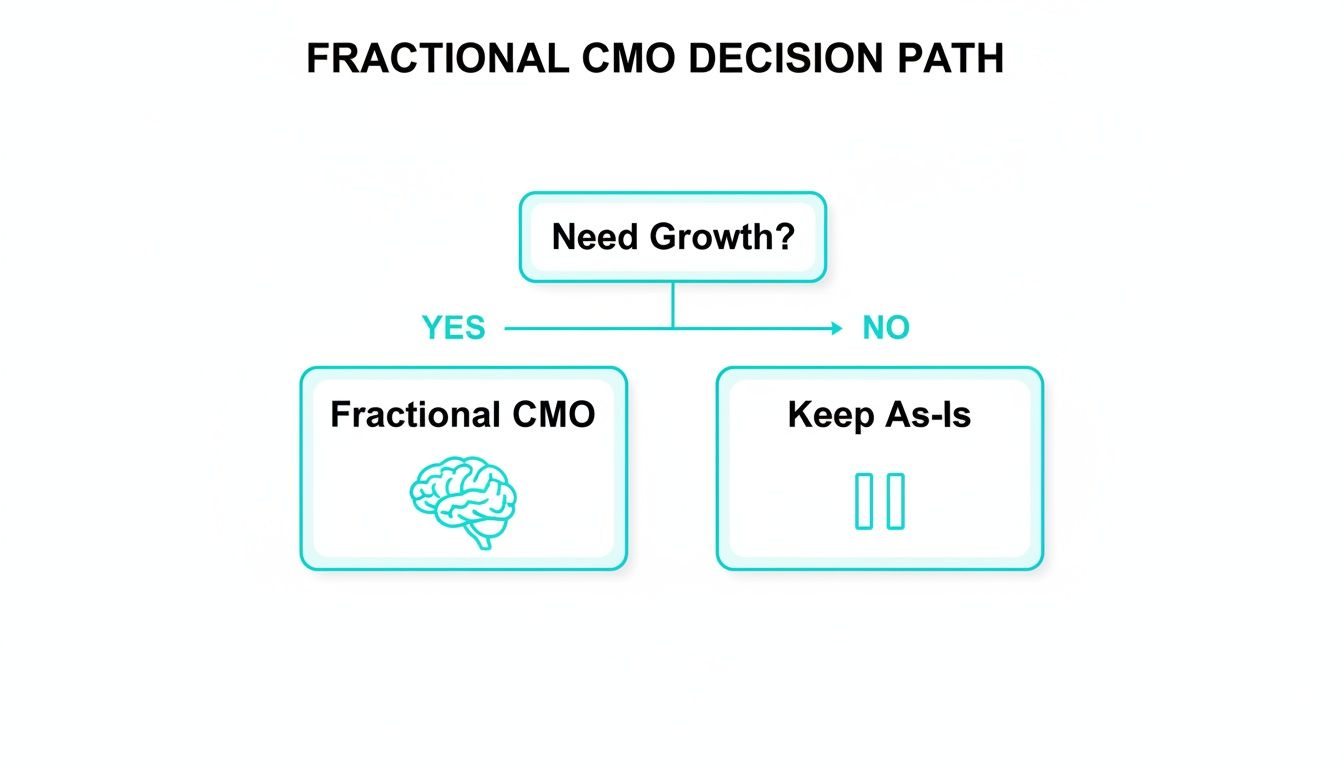
The path forward becomes pretty clear when you define your main objective. If growth is the goal, a fractional CMO is a direct route to getting it done.
Leadership Model Comparison: Fractional CMO vs Full-Time vs Agency
To help you weigh these options head-to-head, here’s a direct comparison of the three models across the factors that matter most to a growing B2B tech company.
| Criteria | Fractional CMO | Full-Time CMO | Marketing Agency |
|---|---|---|---|
| Cost Structure | Flexible monthly retainer | High fixed salary + benefits + equity | Project or retainer-based fee |
| Speed to Impact | High (impact within weeks) | Low (long hiring and onboarding) | Medium (depends on scope) |
| Strategic Depth | High (embedded executive) | Highest (fully dedicated) | Low to Medium (external vendor) |
| Team Integration | High (part of leadership) | Highest (full-time employee) | Low (client-vendor relationship) |
| Flexibility | High (scales with needs) | Low (fixed resource) | Medium (contract-dependent) |
| Ideal For | Scaling startups needing strategic leadership and flexibility. | Mature companies needing a permanent, dedicated leader. | Businesses needing tactical execution for specific campaigns. |
Ultimately, the right choice depends entirely on your unique situation. But for B2B tech startups that need to make smart, capital-efficient moves to drive growth, the fractional CMO model often strikes the perfect balance of expertise, speed, and cost.
How Fractional CMOs Get Paid (And How You’ll Work Together)
When you're thinking about bringing on a senior marketer, the first questions are always, "How does this actually work?" and "What's it going to cost?"
Unlike a straightforward salary, fractional CMO services are built for flexibility. The price and the plan are shaped around your specific needs, so you only pay for the strategic horsepower you actually require. You're not just buying a block of hours; you’re buying outcomes—a clear go-to-market plan, a repeatable demand gen engine, or a marketing team that finally has direction.
Let's break down the common ways these engagements are structured so you can see what fits your budget and goals.
The Project Sprint Model
Think of this as hiring a specialist for a single, high-stakes mission. It’s a focused, short-term engagement designed to solve one big problem, fast. This is perfect when you have a specific, time-sensitive goal and need an expert to come in, own it, and get you across the finish line.
The sprint model is your go-to for situations like:
- A critical product launch: You need a seasoned pro to build and run the go-to-market playbook from scratch.
- A website or brand overhaul: You need senior leadership to guide the messaging, design, and execution to make sure it actually works.
- An urgent pipeline fix: Your lead flow has tanked, and you need an expert to diagnose the issue and plug the leak, now.
These projects typically last 1-3 months, and the deliverable is simple: a completed, successful project. It’s a surgical strike for when you need a specific win.
The 90-Day Foundation Model
This model is for startups with a bunch of random marketing tactics but no real strategy holding them together. If that sounds familiar, this is your starting point. Over 90 days, the fractional CMO acts as an embedded leader to build the essential foundation for sustainable growth.
The goal here isn't just to run a few campaigns. It’s to build the systems, processes, and strategy that will fuel your marketing for years to come.
This foundational sprint is all about building the marketing infrastructure—the strategy, messaging, team alignment, and tech stack—that turns sporadic efforts into a predictable growth machine.
Outcomes usually include a documented marketing strategy, a crystal-clear Ideal Customer Profile (ICP), a messaging framework everyone can use, and a 12-month roadmap. It sets the stage for everything that comes next. For a deeper dive, our guide to outsourced marketing service models can give you more context on how these foundational sprints are structured.
The Ongoing Growth Retainer
The growth retainer is the most common setup for a reason. It’s an ongoing, part-time engagement where the CMO becomes your dedicated marketing leader, typically for 10-20 hours per week. This gives you the continuous strategic oversight needed to execute a long-term plan, mentor your junior marketers, and pivot when the market shifts.
This model is the best fit for companies that need consistent, C-suite leadership but aren't ready for a full-time, six-figure hire. Demand for these retainers is especially high in tech and healthcare. In the US and Europe, monthly fees usually land between $7,000–$20,000. The ROI is clear, with some startups seeing a 40% increase in qualified leads after bringing in fractional leadership to overhaul their digital presence. You can see more data behind these fractional CMO trends on CNVCMO.com.
This kind of ongoing partnership ensures your marketing doesn't just launch strong—it keeps getting smarter and more effective over time.
Your Guide to Hiring the Right Fractional CMO
You’re sold on the idea and ready to find a strategic partner to help steer your marketing ship. But finding the right fractional CMO isn't like hiring for other roles. You're looking for a unique blend of strategic acumen, hands-on execution, and cultural fit—all in a part-time package.
This is your playbook for navigating the hiring process. It's designed to help you move beyond résumés and identify a true growth leader who can make an immediate impact. Let's walk through the steps to find, vet, and onboard your ideal marketing executive.
Start with a Clear Job Scorecard
Before you even think about looking at candidates, you need to define what success looks like. Don't just write a generic job description. Create a "job scorecard" that outlines the specific outcomes you expect this person to achieve in the first 90-180 days.
Your scorecard should answer critical questions like:
- What are the top 3-5 business objectives we need this role to influence? (e.g., increase marketing-sourced pipeline by 40%, reduce customer acquisition cost).
- What specific marketing functions need the most attention? (e.g., demand generation, product marketing, team mentorship).
- What core competencies are non-negotiable? (e.g., deep B2B SaaS experience, proven team leadership).
This scorecard becomes your North Star, ensuring you evaluate every candidate against the same objective criteria. For more guidance, our full article on how to hire a fractional CMO offers more detailed frameworks for defining your needs.
Find Talent in the Right Places
Top-tier fractional CMOs aren't typically browsing standard job boards. They're often experienced executives who have built their own consultancies or work with specialized firms. So, your search needs to be more targeted.
Consider these high-value channels:
- Peer and Investor Networks: Ask other founders, CEOs, and your investors for recommendations. A warm introduction is always the strongest starting point.
- Specialized Fractional Marketplaces: Platforms that specifically connect companies with fractional executives are a goldmine for pre-vetted talent.
- LinkedIn: Search for profiles with terms like "Fractional CMO," "Interim CMO," or "Marketing Advisor" and look for individuals with a track record in companies similar to yours.
Ask Questions That Reveal True Strategic Thinking
During the interview process, it's easy to get bogged down in tactical questions. But you're hiring a leader, not just a doer. Your goal should be to uncover their strategic thought process.
A great fractional CMO won't just tell you what they did; they'll explain why they did it and how it connected to the business's bottom line. Their answers should demonstrate a clear link between marketing activities and revenue outcomes.
Here are some powerful questions to ask:
- "Walk me through a time you inherited a marketing function that was underperforming. What were the first three things you did, and why?"
- "Describe your process for building a marketing strategy from the ground up. How do you ensure it aligns with sales and product?"
- "Tell me about a significant marketing failure. What did you learn from it, and how did it change your approach?"
These questions force candidates to move beyond buzzwords and reveal how they actually think and operate under pressure.
What a Sample 90-Day Roadmap Looks Like
A true strategic partner will come to the final interview stages with a preliminary plan. While it won't be fully fleshed out, seeing a sample roadmap shows they've done their homework and are thinking proactively about your business. It's a massive green flag.
Here’s a snapshot of what an effective 90-day plan might include:
Month 1: Discovery & Foundation (Days 1-30)
- Week 1-2: Full immersion. Meet with key stakeholders across sales, product, and leadership. Review all existing data, marketing assets, and tech stack.
- Week 3-4: Initial Audit. Present a clear diagnosis of current strengths, weaknesses, opportunities, and threats (SWOT). Define a baseline for key metrics.
Month 2: Strategy & Quick Wins (Days 31-60)
- Week 5-6: Finalize the strategic roadmap. Gain alignment on Ideal Customer Profile (ICP), core messaging, and channel priorities.
- Week 7-8: Launch a "quick win" initiative. This could be a campaign to fix a leaky funnel or optimize a high-intent channel to build immediate momentum.
Month 3: Execution & Optimization (Days 61-90)
- Week 9-12: Begin executing the long-term strategy. Establish a marketing dashboard and a regular reporting cadence to track progress against goals. Mentor the team on new processes.
This structured approach shows you're not just hiring a consultant; you're onboarding a leader with a clear plan for driving results from day one.
How to Measure Your Fractional CMO ROI

Bringing on a fractional CMO is a serious investment in your company’s future, not just another line on a spreadsheet. So how do you know if it's actually paying off?
The trick is to look past the easy-to-track vanity metrics like social media likes and website traffic. To get a real sense of their impact, you need to measure performance through two distinct but connected lenses: the financial outcomes and the operational improvements that get you there.
Strategic and Financial Metrics
This is where you connect marketing efforts directly to money in the bank. These are the big-picture numbers your board, your investors, and your CFO care about. They prove that marketing is a revenue driver, not a cost center.
To get a clear view, you have to track the right key performance indicators for lead generation. This ensures every metric you watch is tied to building the sales pipeline.
Here are the heavy hitters:
- Marketing-Sourced Pipeline: How much new sales pipeline came directly from marketing activities? This is your best forward-looking indicator of future revenue.
- Customer Acquisition Cost (CAC): A great fractional CMO is obsessed with driving this number down. Lowering your CAC means your growth engine is becoming more efficient.
- Marketing Contribution to Revenue: Of all the deals you closed this quarter, what percentage did marketing significantly influence? This shows direct impact on the bottom line.
A fractional CMO’s real value is measured by their ability to draw a straight line from marketing spend to revenue. If you can't see that connection, something isn't working.
These metrics tell the most important story. For a deeper dive, our guide on how to measure marketing ROI gives you more frameworks for proving the financial impact of your marketing.
Operational and Team Metrics
While the financial metrics are the ultimate goal, operational improvements are the leading indicators that you're on the right track. A fractional CMO’s job is to build a well-oiled marketing machine, and these numbers show you how well that machine is running.
Think of it this way: better operations today create better financial results tomorrow. You’re looking for evidence of increased efficiency, a more productive team, and smarter, repeatable processes.
Here’s what to keep on your dashboard:
- Lead-to-Opportunity Conversion Rate: Are the leads marketing is generating actually turning into qualified sales opportunities? If this rate goes up, your lead quality is improving.
- Sales Cycle Length: Is it taking less time to close a deal? Effective marketing educates prospects and warms them up, which should help shorten the sales cycle.
- Team Performance and Velocity: Is the marketing team shipping more high-quality work, faster? Track project completion rates and the successful launch of new campaigns to measure this.
By tracking a balanced scorecard of financial and operational metrics, you can have objective, data-driven conversations about what's working and know with confidence that your investment is paying off.
Common Questions About Fractional CMOs
Even when the benefits seem clear, founders and CEOs usually have a few practical questions before bringing a fractional CMO on board. Let's tackle the most common ones so you have the full picture.
When Is the Right Time to Hire a Fractional CMO?
The sweet spot is usually right after you've hit product-market fit. You’ve got some early customer traction and you know your solution works, but you don't have a repeatable strategy to scale it.
Many B2B tech companies make the call after their Seed or Series A round. If your founding team is drowning in marketing tasks they're not experts in, or if your current marketing feels scattered and disconnected from actual revenue, that’s a huge signal it’s time for senior leadership.
How Much Time Does a Fractional CMO Actually Spend With Us?
Engagements are flexible, but most fall between 10 to 20 hours per week. This is typically set up as a monthly retainer for a certain number of hours or days.
The beauty of the model is that they focus only on high-impact work. They’re there to lead team meetings, drive key growth initiatives, and report back to the executive team—without getting pulled into the day-to-day admin that bogs down a full-time role. The goal is always maximum impact, not maximum hours.
A fractional CMO’s value isn’t measured in hours logged, but in strategic progress made. They are brought in to solve specific growth problems and build momentum, making every hour count.
Can They Manage My Existing Marketing Team?
Absolutely—in fact, that's one of their most important jobs. A great fractional CMO doesn't just hand down a strategy; they act as a mentor and leader for your in-house specialists, giving them the direction they need to execute effectively.
They also take over managing any agencies or freelancers you work with. This gets all your external partners rowing in the same direction, aligned with your business goals and accountable for a clear return on your investment.
How Do I Make Sure They'll Fit Our Company Culture?
That’s a fair question, and it’s why the interview and vetting process is so critical. The best fractional CMOs are chameleons—they’re experts at embedding themselves quickly into new teams and adapting to how you work.
During your calls, ask direct questions about their onboarding process and how they've handled different company cultures in the past. A successful partnership is just as much about a strong personality fit as it is about strategic know-how.
Ready to see how senior marketing leadership can accelerate your growth without the full-time cost? Value CMO provides the strategic expertise B2B tech startups need to build a predictable revenue engine. Get in touch to see how our fractional CMO services can work for you.