Think of your B2B tech startup as a high-performance race car. As the founder, you’re the driver, with your eyes locked on the finish line—product, sales, investor relations. But who's in your pit crew? Trying to be the driver, mechanic, and chief engineer all at once is a surefire way to burn out and make some costly mistakes.
This is exactly where outsourced marketing services come into the picture. It’s not about just hiring a few freelancers to check off a to-do list. It's about bringing in a world-class pit crew that already knows how to change the tires, refuel the engine, and analyze performance data in real time.
This approach gives you access to specialized, high-performance talent in areas like SEO, content, and paid ads, all without the fixed cost and long-term commitment of a full-time in-house team. A partnership like this lets you stay in the driver's seat while a dedicated team makes sure your marketing engine is firing on all cylinders, helping you navigate the competitive track with speed and precision.
Unlocking Growth With Outsourced Marketing Services
So what does an outsourced marketing team actually do? Well, they don't just take orders; they become a strategic extension of your company. It's their job to translate your business goals into a real marketing roadmap and then bring it to life, day in and day out.
For a deeper dive into the gears and levers they manage, it's worth getting your head around the core components of B2B Marketing Operations.
A real partnership blends both strategy and execution. Here’s what that looks like in practice:
- Strategic Planning: They help you nail your ideal customer profile, sharpen your messaging, and build a go-to-market plan that’s directly tied to your revenue goals.
- Multi-Channel Execution: This is the day-to-day work. Think SEO-driven blog posts, social media management, and running targeted ad campaigns that actually bring in leads.
- Tech Stack Management: They bring expertise in marketing automation, analytics, and CRM tools, making sure your technology is helping, not hurting.
- Performance Reporting: They deliver clear, data-backed reports that show what’s working, what isn’t, and how marketing is directly contributing to sales.
By outsourcing, you're not giving up responsibility for marketing. You're gaining a focused, accountable partner dedicated to driving measurable results, which frees you up to focus on building a great product and company.
Ultimately, this model is built for ambitious startups that are gunning for rapid, sustainable growth. It provides the expertise and bandwidth you need to compete without the massive overhead, making it a powerful way to scale efficiently.
Choosing Your Marketing Engagement Model
Picking how you'll tackle marketing is just as important as deciding to tackle it. This isn’t about just finding a vendor; it's about choosing a partnership structure that fits your startup’s stage, your immediate needs, and where you want to go. Get it right, and you'll accelerate growth. Get it wrong, and you're in for a world of friction and wasted money.
For B2B tech founders, it usually boils down to three paths. Each offers a different mix of strategic leadership, hands-on execution, and cost. Knowing the difference helps you figure out what you actually need and pick the right co-pilot for your journey.
This decision tree shows that first big fork in the road every founder faces.
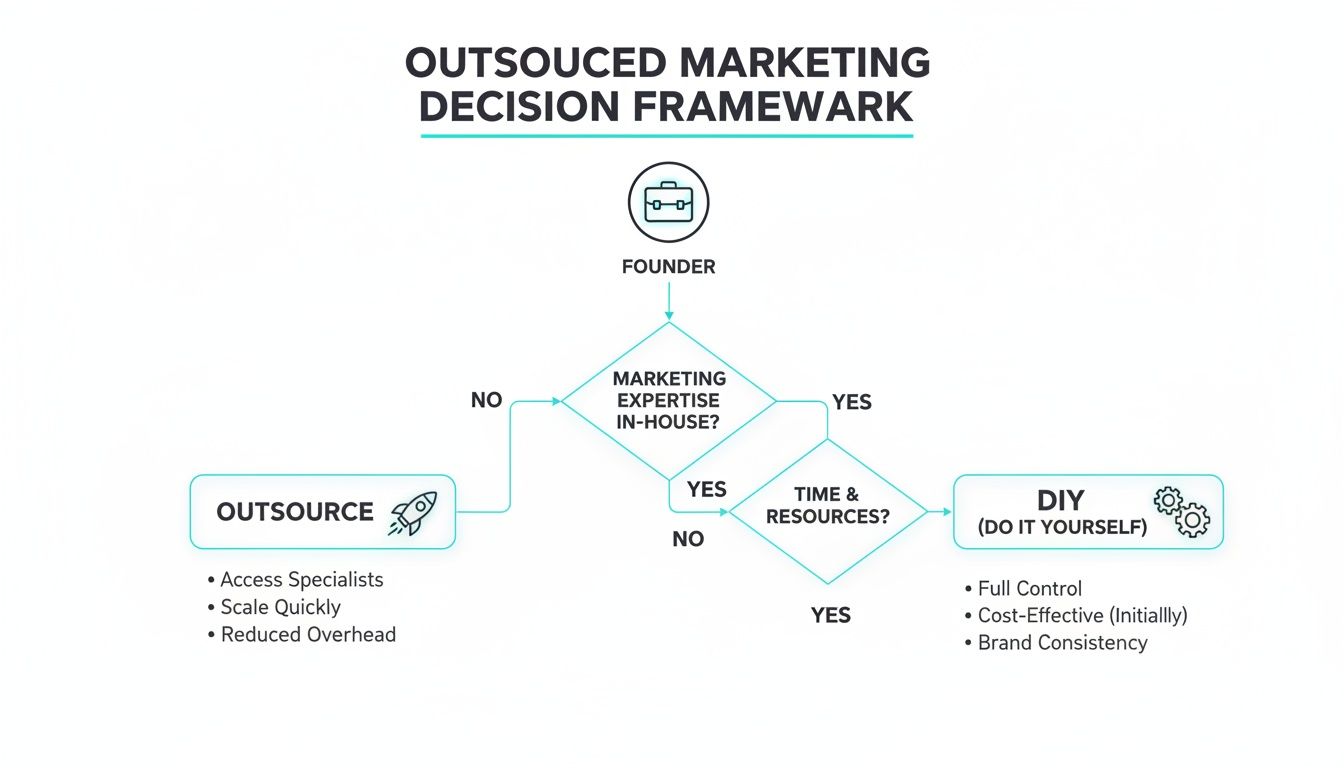
As the flowchart shows, this isn't just about saving time. Choosing to outsource is a smart move to tap into specialized expertise and hit your growth targets faster.
Let’s break down the three main ways you can structure that marketing horsepower.
Comparing Marketing Engagement Models For B2B Startups
To make a quick decision, this table breaks down the core differences between bringing on a Fractional CMO, hiring an agency, or building your own in-house team. Use it as a quick-glance guide to match your startup's needs with the right model.
| Model | Best For | Key Strengths | Typical Cost Structure |
|---|---|---|---|
| Fractional CMO | Startups needing senior-level strategy without the full-time cost. | High-level strategy, leadership, budget management, roadmap development. | Monthly Retainer |
| Marketing Agency | Companies with a defined strategy but needing execution power. | Specialized execution (SEO, PPC, Content), scalability, access to a team of experts. | Monthly Retainer or Project-Based Fees |
| In-house Team | Well-funded scale-ups with product-market fit. | Deep brand knowledge, cultural alignment, full control over operations. | Full-time Salaries + Benefits + Overhead |
Each path has its place. A Fractional CMO sets the direction, an agency provides the tactical muscle, and an in-house team offers deep integration. Now, let's dig into the details of each.
The Fractional CMO: Your Strategic Co-Pilot
Think of a Fractional CMO as your part-time, on-demand marketing executive. This is your move when you desperately need high-level strategic direction but can’t justify the $200k+ annual salary for a full-time VP of Marketing.
They don’t just run campaigns; they build your entire marketing engine from the ground up. A Fractional CMO plugs into your leadership team, hammers out the go-to-market strategy, figures out who you’re selling to, and manages the budget. Often, they’ll even help you hire junior marketers or find the right agency to execute the plan. If your pipeline is flat and you have no idea why, you need this kind of leadership.
A Fractional CMO doesn't ask, "What campaigns should we run?" They start by asking, "Who are we selling to, why should they care, and how will we measure success?"
This model gives you seasoned expertise without the full-time headcount, making it perfect for early-stage startups that need a solid foundation. To get a better feel for the role, check out this guide on how to hire a Fractional CMO.
The Marketing Agency: Your Tactical Special Forces
Already have a solid strategy but lack the team or specific skills to execute it? A marketing agency is your tactical strike team. Agencies are built to execute at scale, bringing deep expertise in areas like SEO, paid ads, content creation, or social media.
You bring in an agency when you have a marketing manager who can direct traffic but needs a team to write blog posts, manage Google Ads, or build out landing pages. This works best when the tasks are clear and you just need a crew that can get it done, and get it done fast.
The key difference here is the scope. An agency delivers on a specific set of services. A Fractional CMO owns the entire marketing function—strategy, performance, and all.
The In-House Team: Your Dedicated Internal Unit
Building an in-house team is the classic approach, and it gives you the deepest possible integration and cultural fit. This model offers total control and brand knowledge because your team lives and breathes your company every single day.
But this path also comes with the highest fixed costs and takes the longest to get going. A single marketing manager can easily cost over $100,000 a year once you add in benefits, software licenses, and training. Plus, finding one person who’s an expert in everything is a unicorn hunt—you’ll likely need to hire several specialists over time.
Going in-house is a serious commitment. It’s the right call for well-funded companies that have found product-market fit and need a dedicated, long-term team to scale what’s already working. The decision comes down to whether you need immediate, specialized impact or you’re ready to invest the time and money to build that capability from scratch.
The True Benefits And Hidden Risks Of Outsourcing
Bringing in an outsourced marketing partner can feel like a massive shortcut—a way to bolt a V8 engine onto your startup overnight. But like any powerful tool, it's just as important to understand the risks as it is to chase the rewards. A clear-eyed view of both sides is what separates a smart move from a reactive mistake.
This shift to outsourcing is more than a fad; it’s a fundamental change in how companies scale. The market for external services, including marketing, is on track to hit a massive $525 billion by 2030. That number tells a story: companies are getting smarter about offloading work so they can double down on what they do best.
Let’s get past the surface-level talk and dig into the real advantages and the risks people don’t discuss enough.

Unlocking Deeper Strategic Advantages
Sure, outsourcing can be cheaper than hiring a full-time team, but that’s just the beginning. The real value is in the strategic leverage you gain—the kind that’s almost impossible to build from scratch when you’re moving fast.
- Instant Access to a Pro-Grade Martech Stack: Enterprise-level tools for automation, analytics, and SEO come with five-figure price tags. A good partner walks in the door with a fully-loaded tech stack, giving you access to serious firepower without the hefty annual contracts.
- An Unbiased, Objective Perspective: Your team lives and breathes your product, which is great, but it also creates blind spots. An outside partner brings fresh eyes, challenges sacred cows, and questions the "we've always done it this way" mentality that can stall growth.
- Built-In Scalability and Flexibility: Need to go all-in for a product launch or pull back after a big push? An outsourced model lets you dial your marketing spend and resources up or down on demand, skipping the painful process of hiring and firing.
The win isn't just getting tasks done for less. It's about plugging into a ready-made system of people, processes, and tech that’s built to perform from day one. This lets you punch way above your weight class and run sophisticated campaigns that your bigger competitors take months to build.
Navigating The Potential Pitfalls Proactively
Of course, no model is perfect. Handing over a piece of your company to an external team requires a huge amount of trust and smart management. Most partnerships that go sideways fail because these risks were ignored right from the start.
The trick isn't to fear these pitfalls but to get ahead of them. When you know the common challenges of an outsourced marketing partnership, you can build a relationship designed to withstand them.
- Risk 1: Loss of Direct Control: Founders are used to having their hands on every lever. Outsourcing means you have to let go, at least a little.
- Risk 2: Misaligned Brand Voice: A partner who doesn’t truly “get” your brand will produce content that feels bland or, worse, completely off-key. This can kill your credibility.
- How to fix it: Spend real time on brand immersion during onboarding. Give them a detailed brand guide, but also have them interview your key leaders and best customers. They need to absorb your company’s DNA, not just read a style guide.
- Risk 3: Finding a True Niche Expert: B2B tech is a different beast. A generalist agency might not grasp your long sales cycle, technical buyers, or the specific pain points your product solves.
- How to fix it: Be relentless when vetting partners for industry-specific experience. Ask for case studies from companies that look just like yours—same industry, same business model, same stage of growth. Don't settle for "close enough."
Thinking about these risks proactively turns them from potential deal-breakers into manageable challenges. It lays the groundwork for a partnership built on transparency and shared goals—which is the only kind that drives real, lasting growth for a startup.
How To Select The Right Marketing Partner
Picking an outsourced marketing partner is one of the biggest bets you'll make as a founder. This isn't like buying software; you're choosing a co-pilot for your growth. Get it right, and they’ll feel like an extension of your leadership team. Get it wrong, and you'll burn cash, time, and morale. This is your playbook for getting it right.
There's a reason why so many companies are making this shift. The market for outsourced sales and marketing shot past $28.65 billion in 2022 and is on track to nearly double to $57.46 billion by 2030. This isn't just a trend; it's a strategic pivot. Companies are deliberately choosing specialized outside partners to hit their numbers faster.
This boom gives you more options than ever, but it also means you have to be ruthless in your vetting process.
Go Beyond The Polished Case Studies
Every potential partner will show you their highlight reel—the slick case studies and glowing logos. Your job is to look behind the curtain. You need to understand their process, their real expertise, and how they act when things inevitably go wrong. A great partner has nothing to hide and welcomes the tough questions.
Start by filtering for specific industry experience. A generalist agency might be great at running Facebook ads for e-commerce, but they’ll probably get crushed by the long sales cycles and technical buyers in B2B tech.
Here are the first-pass filters to apply:
- Niche Specialization: Do they have a clear, proven track record with B2B tech or SaaS companies at your exact stage? Ask for at least three relevant examples.
- Service Alignment: Do their core services—whether it's demand gen, SEO, or product marketing—line up with your most urgent needs right now?
- Cultural Fit: After the first call, do they feel like genuine partners you could actually work with every week? Or do they just feel like another vendor?
When you’re looking at outsourced marketing services, especially for a B2B tech startup, your partner has to be fluent in the latest B2B content marketing best practices. This is non-negotiable.
Vetting Questions That Reveal The Truth
Once you have a shortlist, it's time to dig in. Use these questions to get past the pitch and see how they really operate. Their answers will tell you everything you need to know.
1. "Walk me through a time a campaign for a client failed. What happened, what did you learn, and what did you do next?"
This question is a test of honesty and accountability. A great partner isn't afraid to talk about failure. They frame it as a learning moment and can tell you exactly what they changed to fix it.
2. "How do you document and transfer knowledge to your clients?"
You want a partner, not a black box. The best ones use shared project management tools, keep clear documentation, and make sure you own all your assets and data. This is critical—it prevents you from being held hostage if you ever decide to move on.
3. "What will the first 30 days of our engagement look like? What specific information will you need from us to be successful?"
This reveals their onboarding process. A vague answer is a major red flag. A strong partner will lay out a structured discovery phase, name the stakeholders they need to interview, and give you a clear timeline for the initial strategy.
Your goal isn't just to hire a team that can execute tasks. It's to find a strategic partner who can think critically, challenge your assumptions, and take genuine ownership of your growth targets.
By asking pointed questions like these, you change the dynamic from a sales pitch to a working session. You get to see how they think on their feet and decide if they’re truly the growth engine your startup needs.
Your First 90 Days: An Implementation Roadmap
You’ve signed the contract. The partnership is official. Now what?
This is where the real work begins. The first 90 days of any outsourced marketing engagement are make-or-break. They set the tone, build momentum, and lay the foundation for a long-term win. A strong start isn’t just about flipping the switch on a few campaigns—it’s about deep alignment and building trust.
Think of this initial period as a structured sprint designed to get everyone on the same page, integrate your systems, and start banking some early wins. You’re building the engine before you hit the racetrack.

Phase 1: The First 30 Days Of Deep Discovery
Month one is all about immersion and planning. Your new partner should act like a sponge, absorbing everything they can about your business, your customers, and your goals. Rushing this step is a classic mistake that leads to off-key messaging and wasted ad spend later on.
Here’s what this phase looks like:
- Stakeholder Interviews: Your partner sits down with your leadership, sales, and product teams to see the business from every angle. No assumptions allowed.
- Customer and Market Research: This means digging deep into your ideal customer profile (ICP), running a fine-toothed comb through the competition, and spotting market gaps.
- Tech Stack Audit and Integration: The team gets access to your CRM, analytics platforms, and marketing automation tools, making sure data flows cleanly from day one.
- Setting the Communication Cadence: You’ll lock in weekly check-ins, a shared project management board (like Asana or Trello), and the reporting dashboards you’ll live in.
Phase 2: The Next 30 Days Of Strategy And Foundation Building
With a solid grasp of your business, month two is for turning all those insights into a concrete action plan. This is when the strategic roadmap takes shape and the core assets get built.
A well-defined B2B marketing team structure, even an outsourced one, is critical here. It ensures everyone knows their role and what they’re accountable for.
During this 30-day block, your partner will:
- Develop the 90-Day Marketing Plan: This is a detailed playbook outlining specific campaigns, channels, KPIs, and timelines. No fluff, just action.
- Define Core KPIs: You’ll agree on the numbers that actually matter—forget vanity metrics. We're talking Marketing Qualified Leads (MQLs), Sales Qualified Leads (SQLs), and pipeline velocity.
- Create Foundational Content: This could mean rewriting core website copy, building a high-value lead magnet, or crafting key sales enablement docs that your team will actually use.
Your partner shouldn't just present a plan; they should co-create it with you. This ensures the strategy is not only smart but also realistic and fully synced with your sales team's capacity and business goals.
Phase 3: The Final 30 Days Of Execution And Optimization
In month three, the engine finally starts running. The first campaigns go live, and the focus immediately shifts to execution, measurement, and learning. This is where you see tangible outputs and start gathering the first real data on what’s connecting with your audience.
The move toward external partners is accelerating for a reason. Projections show that by 2025, over 50% of U.S. companies will have outsourced key digital marketing tasks, driven by the need for specialized skills without the overhead of a full-time hire.
By the end of your first 90 days, you should have a fully operational marketing program, a clear reporting rhythm, and a data-backed plan for what comes next.
Got Questions? Let's Clear a Few Things Up
Even after you've mapped everything out, bringing on an outsourced marketing partner can feel like a big leap. A few nagging questions almost always pop up right before you sign. That's a good thing. It's smart to tackle these concerns head-on.
Getting straight answers isn't just about vetting a vendor; it's about making sure you're truly ready to plug a new growth engine into your company. Let’s walk through the questions B2B founders ask most often.
How Much Control Am I Really Giving Up?
This is the big one, and it's a valid fear. But a good partnership isn't about losing control—it's about gaining leverage. You still set the strategic direction and the business goals. Your partner brings the specialized expertise and execution muscle to get you there.
The best relationships are built on total transparency and collaboration. Expect regular reports, strategy sessions, and full access to your performance data. The goal is to feel like you've extended your team, not handed over a core part of your business to a stranger.
Isn't Outsourcing Just for Startups That Can't Afford a Full-Time Team?
Not anymore. While it’s definitely a cost-effective way to get started, plenty of well-funded scale-ups and even large enterprises use outsourced marketing services as a strategic weapon. They bring in partners to tap specialized skills for a specific project, break into new markets fast, or get an objective outside view to shake up stale internal thinking.
Outsourcing is a strategic lever for agility and expertise, not just a budget fix. It’s about getting the right skills at exactly the right time to hit your growth targets without adding fixed overhead.
This model lets established companies stay nimble and access specific, high-level talent on demand. That's a powerful advantage, whether you're at the seed stage or Series C.
What’s the Single Most Important Factor for a Successful Partnership?
Expertise and a solid track record are table stakes. But the one thing that makes or breaks these relationships is cultural and communicative alignment. Seriously. Your outsourced partner has to get you.
They need to operate like an extension of your own team, deeply understanding your vision, your customer's real-world problems, and your appetite for risk. This kind of alignment is built on proactive communication, radical transparency, and a shared definition of what a "win" looks like. A great relationship amplifies results; a poor one will sink even the most brilliant strategy.
If your B2B tech startup needs senior marketing leadership to build a focused, data-driven growth roadmap without the full-time cost, Value CMO can help. We deliver practical, no-fluff plans to scale customer acquisition and revenue. Learn more at https://valuecmo.com.