Let's be honest, an "outsourced marketing service" is just a fancy way of saying you're hiring an outside team of pros to plan and run your marketing. For a B2B tech startup, this means getting instant access to strategists, writers, and demand gen experts without the crippling burn rate of a full-time staff. It’s how you pour gas on growth while you stay laser-focused on your product.
Is an Outsourced Marketing Service Right for Your Startup?
As a founder, you're already wearing a dozen hats. "Marketing expert" doesn't need to be one of them. You’re busy building an amazing product, talking to customers, and, you know, keeping the lights on. The thought of also mastering SEO, content strategy, and paid ads can feel like a distraction at best, and an impossibility at worst.
This is where the conversation about outsourcing usually starts. Think of it like bringing in a specialized architect to design your office expansion. You know the goal—more space, better workflow—but they bring the blueprint, the tools, and the crew to get it done right and on time. You provide the vision for growth; they build the engine to make it happen.
Why Founders Turn to Outsourcing
For most B2B tech startups, this isn't just about offloading tasks. It’s a strategic move to solve some very common, very painful problems that can kill growth before it starts. You’re probably wrestling with at least one of these right now:
- Limited Budget: Hiring a senior-level, in-house marketing team is wildly expensive. An outsourced partner gives you a full squad of experts for what you’d typically pay one or two full-time employees.
- Critical Skill Gaps: Your team might be brilliant engineers, but do you have someone who's a true pro at marketing automation or demand generation? Outsourcing instantly plugs those holes with people who have done it before.
- The Need for Speed: The pressure to scale and hit milestones is intense. An external team is built to hit the ground running, launching campaigns and generating leads much faster than you ever could by building a team from scratch.
This isn’t a niche strategy anymore; it’s becoming the norm. Over 50% of U.S. companies now outsource key digital marketing functions like content and SEO. The trend isn't just about saving money—it's about tapping into deep industry knowledge that's almost impossible to build internally overnight. You can read more about the latest outsourcing statistics to see just how common this has become.
An outsourced marketing service isn't just a vendor; it's a growth partner. The goal is to find an extension of your team that brings the strategic firepower needed to hit your next big milestone, freeing you to focus on innovation.
Ultimately, outsourcing your marketing is a calculated investment in growth. It’s for founders who know that while they can do anything, they can't do everything—at least not all at once, and not without burning out.
Comparing Outsourced Marketing Models
Okay, you’ve decided to bring in outside help. That’s the first big step. But the next question is just as critical: what kind of help does your startup actually need? An outsourced marketing service isn't a one-size-fits-all deal. It’s a spectrum of different engagement models, each built to solve a specific type of growth problem.
Picking the wrong one is like hiring a master architect to fix a leaky faucet—a total waste of talent, time, and money. To avoid that misstep, let's break down the three main models you'll run into. Think of them not as dry definitions, but as distinct roles on your mission to scale.
This decision tree shows how a startup's needs and budget often dictate the choice between building an in-house team versus bringing in an outsourced marketing service.
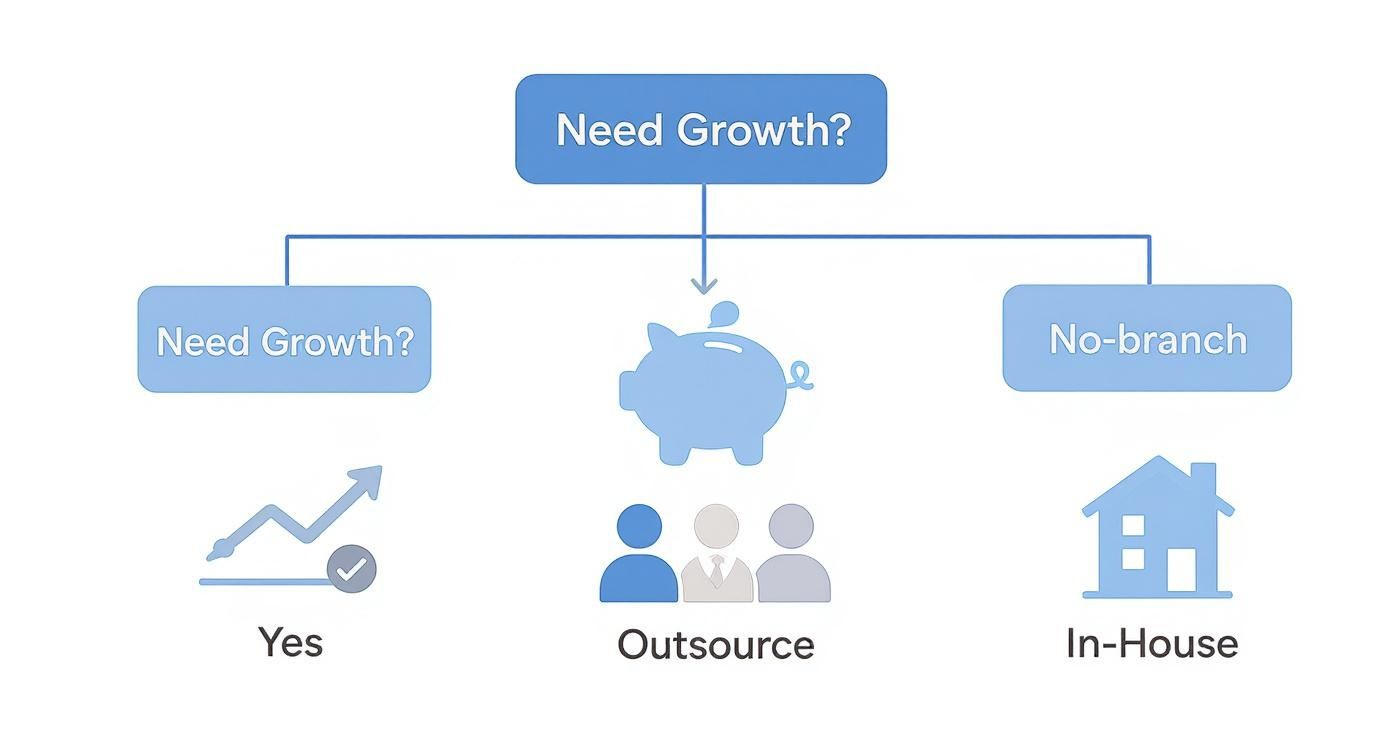
As you can see, for startups that need to grow on a tight budget, outsourcing quickly becomes the most logical and efficient path forward.
The Fractional CMO: Your Strategic Co-Pilot
Think of a Fractional CMO as your strategic co-pilot. This isn't the person who will be in the weeds writing blog posts or managing social media accounts day-to-day. Instead, they are a seasoned, executive-level marketer who joins your leadership team on a part-time—or "fractional"—basis.
Their job is to build the map. They help you nail your go-to-market strategy, identify your ideal customer, set high-level goals, and build a cohesive marketing plan that actually works. They provide the "why" behind every action and make sure every marketing dollar is spent effectively.
A Fractional CMO is a perfect fit for founders who have a small, junior team needing direction or for those who need to build a marketing function from the ground up but aren't ready for a full-time executive salary.
The Full-Service Agency: Your Execution Crew
If the Fractional CMO is the co-pilot, the full-service agency is the entire flight crew. This is the hands-on team that takes a strategic plan and makes it a reality. An agency brings a whole squad of specialists to the table—content writers, SEO experts, paid media managers, designers, and web developers.
This model is built for execution at scale. You get access to a complete marketing department without the headache and cost of hiring, training, and managing each person individually. They run the day-to-day operations, from launching ad campaigns and producing case studies to optimizing your website for conversions.
A full-service agency is your best bet when you have a clear strategy but lack the internal bandwidth or specialized skills to execute it consistently. They provide the horsepower to run the engine.
The Freelance Contractor: Your Specialist Operator
Finally, you have the freelance contractor. This is your specialist operator—the expert you bring in for a very specific, well-defined mission. Think of them as the technician you hire to install a critical piece of equipment on your ship, like the navigation system or the comms array.
You wouldn’t hire a freelancer to define your entire marketing strategy, but you absolutely would hire one to:
- Write a series of technical white papers
- Redesign your company logo
- Manage a short-term Google Ads campaign
- Fix your website's technical SEO issues
This model is perfect for filling a specific, temporary skill gap or knocking out a one-off project. It offers maximum flexibility and is often the most budget-friendly option for targeted needs.
To make the choice even clearer, here’s a quick side-by-side comparison of the three models.
Comparing Outsourced Marketing Models
| Model Type | Best For | Typical Cost Structure | Key Advantage | Potential Limitation |
|---|---|---|---|---|
| Fractional CMO | Startups needing high-level strategy and leadership. | Monthly Retainer | Executive-level guidance without the full-time cost. | Not responsible for day-to-day execution. |
| Full-Service Agency | Companies with a strategy that need execution power. | Monthly Retainer or Project Fees | Access to a complete team of diverse specialists. | Can be less agile; may lack deep product immersion. |
| Freelance Contractor | Businesses needing a specific skill for a defined project. | Hourly or Project-Based | Cost-effective for targeted, short-term tasks. | Lacks strategic oversight and team integration. |
Ultimately, the right outsourced marketing service comes down to your startup's current stage, budget, and most pressing challenges. By understanding the distinct roles these models play, you can confidently pick the partner that will actually help you navigate your journey to growth.
The Real Benefits of Outsourcing Your Marketing
Handing over your marketing can feel like a big leap of faith, especially when you've built your company from the ground up. But the wins of using an outsourced marketing service are bigger than just saving a few bucks. It’s about changing how you compete.
Think of it this way: instead of spending months trying to hire one marketing generalist who knows a little about everything, you instantly plug in an entire team of specialists. SEO experts, ad managers, content strategists—they're all masters of their craft. This isn't just an upgrade; it's a total reboot of your capabilities.

This isn't just a hunch; it's part of a huge industry shift. The global market for external services, marketing included, is on track to hit an estimated $525 billion by 2030. That explosive growth tells you one thing: smart companies are doubling down on their core product and letting experts run functions like marketing.
Access Specialized Skills Instantly
Let's be real. Most B2B tech startups can't afford to hire a full-time SEO pro, a paid ads manager, a content strategist, and a marketing automation specialist. Even if you had the cash, finding and vetting all that talent would eat up months you just don't have.
An outsourced partner brings that entire skillset to the table on day one.
Suddenly, you've got a team that has already launched dozens of campaigns, navigated the latest algorithm changes, and knows exactly which channels deliver for a company just like yours. This immediate access to deep expertise lets you run sophisticated plays that would otherwise be completely out of reach.
A key advantage here is their mastery of advanced tools and processes. To get a sense of how agencies drive efficiency, look at the role of powerful marketing automation for agencies.
Scale Your Efforts with Market Changes
The startup world is anything but predictable. One quarter, you might be gunning for a product launch and need an all-out marketing blitz. The next, you might need to pull back to refine your product based on early user feedback.
An in-house team gives you a fixed capacity at a fixed cost. Outsourcing, on the other hand, is built for flexibility.
- Scale Up: Need to crack a new market or launch a major feature? Your partner can instantly pour more resources into content, ads, and outreach.
- Scale Down: Hitting a slow season or making a strategic pivot? You can dial back your engagement without going through the pain of layoffs.
This agility means your marketing spend is always tied directly to your immediate business goals. No more wasted resources, just maximum return.
Outsourcing isn't just a cost-saving measure; it's a strategic investment in flexibility. It allows your startup to operate with the marketing power of a much larger company while maintaining the agility of a small one.
Free Yourself to Focus on Your Product
Finally, and this might be the most important part, outsourcing your marketing buys back your most valuable asset: your time and focus.
Every hour you spend trying to write a blog post or decode Google Ads is an hour you're not spending talking to customers, improving your product, or leading your team. That's a bad trade.
By handing the marketing reins to a partner you trust, you get out of the tactical weeds. You can step back into your role as a founder and visionary, confident that a team of pros is executing a data-driven plan to grow the business. That mental space is often the secret ingredient that fuels real, lasting innovation.
How to Choose the Right Marketing Partner
This is the most important decision you'll make in your outsourcing journey. Picking the right outsourced marketing service is like adding a true partner to your leadership team—someone who just gets your vision and is genuinely invested in your success.
The wrong one? It quickly becomes a frustrating cycle of missed deadlines, wasted budget, and misaligned goals. You don't have time for that.
To avoid the headache, you need a practical game plan for vetting potential partners. It’s about looking past the slick sales pitch and digging into what really matters. You need the right questions and a keen eye for red flags.

Evaluate Their B2B Tech Experience
First things first: do they speak your language? Marketing a B2B tech startup is a completely different beast than marketing an e-commerce brand or a local dentist's office. Your sales cycles are longer, your buyers are technical, and the path to a signed deal is rarely a straight line.
A partner with deep B2B tech experience already gets this. They won't need a crash course on MQLs, SQLs, or product-led growth. They’ll have proven playbooks from other SaaS or tech companies that they can tailor to your unique situation.
When you're talking to a potential partner, get right to the point:
- "Can you share examples of your work with B2B tech companies similar to us in size and stage?"
- "How do you approach marketing for a product with a complex, multi-touch sales cycle?"
- "What's your experience in our specific niche, like FinTech or HealthTech?"
Their answers will tell you everything. If they're vague or try to pivot, that’s a major red flag. You need someone who has already solved the problems you're facing.
Dig Into Their Case Studies and Results
Every agency on the planet will tell you they can deliver growth. The best ones will show you. Don't just glance at the logos on their website; ask for detailed case studies that lay out the actual results they’ve achieved.
A strong case study isn't a fluffy testimonial. It should give you a clear "before and after" picture, outlining the specific actions they took and the measurable outcomes.
Look for metrics that matter to a founder. Vague claims like "increased brand awareness" are nice, but what you really need to see are hard numbers on lead generation, customer acquisition cost (CAC), and pipeline growth.
This is your chance to verify that their definition of success lines up with yours. If they can’t provide concrete data, it’s a sign they may not be as results-driven as you need them to be. For founders considering strategic leadership, knowing how a partner measures performance is non-negotiable. You can learn more about what to look for when you hire a fractional CMO and see how top-tier partners approach results.
Assess Communication Style and Cultural Fit
This is the part that often gets overlooked, but it's absolutely critical for a healthy, long-term partnership. How does this team communicate? Are they proactive and transparent, or will you have to constantly chase them for updates?
Pay close attention to their responsiveness and clarity during the vetting process. A partner who is slow to respond or gives you confusing answers before you’ve even signed a contract is not going to magically improve once they have your business.
Think about the practical, day-to-day reality of working together:
- Who will be your main point of contact? You need a dedicated person who knows your account inside and out, not a junior rep who cycles out every six months.
- What is their meeting cadence? A weekly check-in is pretty standard and essential for keeping everyone aligned and moving forward.
- What tools do they use for project management? This isn’t a trivial question—it’s about ensuring transparency and keeping the work on track.
Ultimately, you’re looking for a partner who feels like an extension of your own team. They should be collaborative, open to feedback, and genuinely motivated to help you win. That cultural alignment is the foundation of a successful and stress-free outsourcing relationship.
Understanding Pricing and Measuring Performance
Let's get straight to what every founder wants to know: what's this going to cost, and what results can I actually expect? Talking about money can feel tricky, but we need to pull back the curtain on the financial side of an outsourced marketing service. Getting this right is the key to building a partnership that delivers real value, not just a bunch of busywork.
The conversation shouldn't just be about cost; it has to be about investment and return. To get there, you first need to understand how partners structure their fees and, more importantly, how you'll measure the results of that spending. This framework will help you set realistic goals and hold your partner accountable for meaningful growth.
Common Pricing Models Explained
When you start getting proposals, you'll probably see a few common pricing structures. Each one is built for a different kind of engagement, so knowing the difference helps you pick the right fit for your startup's stage and budget.
- Monthly Retainer: This is the go-to model for most ongoing partnerships. You pay a fixed fee each month for an agreed-upon scope of work. It gives you predictable costs and keeps the marketing engine running consistently.
- Project-Based Fee: Perfect for a one-off, clearly defined project like a website overhaul or a new product launch campaign. You pay a flat fee for a specific deliverable with a clear beginning and end.
- Performance-Based Pricing: This one is less common for broad strategy work, but some agencies will tie a portion of their fee to hitting specific targets, like generating a set number of qualified leads. It directly aligns their paycheck with your success.
Your partner must be transparent about their process and pricing. Vague proposals are a major red flag. You want a clear breakdown of what you're paying for and what activities that fee covers.
Shifting the conversation from "How much does it cost?" to "What business outcomes will this investment produce?" is the first step toward a successful partnership. The best outsourced marketing service focuses on value, not just billable hours.
Key Performance Indicators That Actually Matter
Once you've sorted out the pricing, the next move is to define what success looks like. For a B2B tech startup, vanity metrics like social media likes or impressions don't pay the bills. You have to focus on Key Performance Indicators (KPIs) that tie marketing efforts directly to revenue.
Your partner should help you build a dashboard that tracks the numbers that truly move the needle. When you’re measuring performance, it’s critical to define how your outsourced team will track progress, often through detailed reports on search visibility. A helpful guide like the Keyword Rankings and Visibility Report can offer a deeper look into this process.
Here are the KPIs you should be talking about from day one:
- Marketing-Qualified Leads (MQLs): The raw number of leads your marketing generates that fit your ideal customer profile and are ready for a sales conversation.
- Cost Per Acquisition (CPA or CAC): This is the bottom line on efficiency. It’s the total cost of your marketing divided by the number of new customers you won.
- Pipeline Value: The total potential revenue from all the leads marketing has generated. This shows marketing's direct contribution to future sales.
- Lead-to-Customer Conversion Rate: The percentage of leads that actually become paying customers. This KPI is a great way to gauge lead quality.
Tracking these numbers gives you a clear, data-driven view of what’s working and what isn’t. For an even deeper dive, our guide on how to measure marketing ROI provides a solid framework for connecting your spend to real results. A great partner won't just report these numbers—they’ll use them to constantly refine the strategy, making sure your investment is always driving measurable growth.
Navigating Your First 90 Days Together
You’ve signed the contract with your chosen outsourced marketing service. Now the real work begins. Those first three months are critical—they lay the foundation for the entire partnership. Getting it right sets the tone, builds momentum, and makes sure everyone is locked in on the same goals for the long haul.
Think of this 90-day period as a three-act play. Act one is all about deep discovery. Act two is focused on building and launching. And act three is where you start learning and optimizing. A clear roadmap like this gets rid of surprises and gives you confidence that things are moving from day one.
Month 1: The Deep Dive and Discovery Phase
The first 30 days are a full-immersion deep dive into your business. Your new partner’s only job right now is to become an extension of your team. That means they need to absorb everything they can about your product, your customers, and your market. This isn’t just a few casual chats; it's a structured information transfer.
You should expect a flurry of kickoff meetings, interviews with key stakeholders, and a thorough audit of all your existing marketing assets. Get ready to share your brand guidelines, customer personas, competitor research, and grant access to your analytics platforms. The more you give them, the faster they’ll get up to speed.
The success of the entire engagement often hangs on how good this initial onboarding is. Don't hold back. Treat your new partner like an insider and give them everything they need to win for you.
Month 2: Building the Strategy and Launching Campaigns
With a solid grip on your business, month two is all about action. Your partner will take everything they learned in discovery and turn it into a concrete marketing strategy and an execution plan. This is where you finally start to see tangible work product.
Key moves during this phase usually include:
- Finalizing the strategic plan: This is the master document. It should clearly spell out your goals, target channels, core messaging, and the KPIs you’ll be tracking.
- Creating foundational assets: This could mean anything from writing new website copy and designing ad creative to producing a new lead magnet to capture interest.
- Launching initial campaigns: By the end of this month, the first marketing initiatives should be live. Whether it's a paid search campaign, an email nurture sequence, or a new content series, the engine is officially running.
This is a highly collaborative time. Your job is to provide fast, clear feedback and approvals to keep the momentum going. Solid communication prevents bottlenecks and ensures the output stays true to your vision.
Month 3: Reviewing Data and Optimizing for Results
In the last 30 days of this kick-off period, the focus pivots to data. Your first campaigns are out in the wild, generating performance metrics. This is the moment of truth where you start seeing what’s working—and, just as importantly, what isn’t.
Your partner should be analyzing those early results and coming to you with data-backed ideas for optimization. That could mean tweaking ad copy, adjusting audience targeting, or shifting budget to a channel that’s punching above its weight. These initial lessons are priceless for sharpening the long-term strategy.
This cycle of review and refinement is fundamental to ongoing success, much like what you'd see in a formal quarterly business review format. It establishes a rhythm of continuous improvement, making sure your marketing efforts get smarter and more effective over time.
Got Questions About Outsourcing Your Marketing?
Even with the best game plan, bringing on an outsourced marketing partner can feel like a big leap. It's totally normal to have a few last-minute questions—you're trusting someone else with your startup's growth, after all.
Let's walk through the most common concerns I hear from founders. Think of it as a final pre-flight check to clear up any "what ifs" before you take off.
Will I Lose Control Over My Marketing?
This is probably the number one fear founders have, and it’s a total myth. A good partnership isn’t about surrendering control; it's about collaboration. You're not hiring a vendor to take over. You're gaining a strategic partner who executes your vision.
You'll still own the high-level strategy, sign off on core messaging, and review every result. Your outsourced team handles the day-to-day execution, bringing specialized skills to the table that you don't have time to build in-house. It’s like being the director of a movie: you set the vision and make the final calls, while your expert crew handles the lighting, sound, and camerawork.
Outsourcing marketing isn’t about losing control; it’s about gaining leverage. You delegate the tactical work to free yourself up for the high-impact, strategic decisions that only a founder can make.
When Is the Right Time for My Startup to Outsource?
There's no magic revenue number, but the signs are usually pretty clear. The sweet spot is often right after you've nailed product-market fit and you're ready to build a repeatable engine for bringing in customers.
Other common triggers include:
- Founder Burnout: You and your co-founders are spending more time tinkering with marketing tasks than focusing on product and sales.
- Hitting a Wall: The growth channels that got you here have started to slow down, and you need fresh expertise to find new ones.
- Skill Gaps: You know you need to launch a sophisticated SEO or paid ads program but have no idea where to even start.
Ultimately, the decision is less about your company's size and more about your readiness to invest in structured, scalable growth.
Is This Better Than Just Hiring a Marketing Manager?
This really comes down to breadth versus depth. When you hire one marketing manager, you get the skills and bandwidth of exactly one person, who is almost always a generalist. An outsourced partner, on the other hand, gives you access to an entire team of specialists.
For what you'd pay one senior marketing hire, you can often get a team that includes:
- A content strategist and writer
- An SEO expert
- A paid ads manager
- A graphic designer
It’s the difference between hiring one person to build your entire house versus hiring a general contractor. The contractor brings in the expert plumbers, electricians, and carpenters exactly when they’re needed, ensuring every part of the job is done right. For most startups, that specialized, on-demand expertise is far more valuable.
Ready to build a marketing engine that drives real results? At Value CMO, we provide the strategic leadership and execution power B2B tech startups need to scale, without the cost of a full-time hire. Let's build your growth roadmap together.