For B2B tech founders, the pressure to scale with a lean team is a familiar battle. Outsourced marketing is the strategic answer: you bring in an external team to plan and run your marketing, essentially plugging a high-performance engine into your startup. This guide breaks down everything from the different ways to do it to setting a budget and tracking what actually matters.
Why Outsourced Marketing Is on Every Founder's Radar
As a founder, you're stretched thin—pulled between product, sales, fundraising, and, yes, marketing. The heat is on. You need to hit growth milestones fast, but building an entire marketing department from scratch is slow, costly, and riddled with risk. This is exactly where outsourced marketing becomes a game-changer.
Think of it less as just "hiring help" and more like leasing a specialized, high-performance engine for your startup. You get all the horsepower and expertise needed to accelerate, but without the heavy overhead and long-term commitment of buying the engine outright. This lets you pour your limited cash into your core product while a dedicated team builds your pipeline.
The Growing Appeal of External Expertise
This isn't some fringe trend; it’s a fundamental shift in how companies build for growth. The demand for specialized, cost-effective talent is blowing up the market. Projections show the global sales and marketing BPO market, valued at $28.65 billion in 2022, is on track to nearly double to $57.46 billion by 2030. You can dig into more insights about this global growth on ActivatedScale.com. That surge makes one thing clear: companies are leaning heavily on outside partners to get scalable and efficient, fast.
For a B2B tech startup, this means you can tap into a level of talent and a range of skills—from SEO and content to paid ads and automation—that would be impossible to recruit and pay for in-house at an early stage.
As you figure out if outsourced marketing is the right play, understanding the 10 B2B inbound marketing best practices can set clear expectations for what a good partner should deliver. This guide will give you the framework to decide if it's the right path to kick your growth into a higher gear.
Decoding the Three Core Outsourced Marketing Models
Trying to figure out outsourced marketing can feel complicated, but it really boils down to three main options. Think of it like getting around town: you can call a full-service car service (an agency), hire an expert driver for your own car (a fractional CMO), or book a specialist for a single trip (a freelancer). Each gets you where you're going, but the right one depends on your destination, your budget, and how much you want to be in the driver's seat.
This isn't just a niche trend; it's a massive economic shift. The global market for business process outsourcing, which includes marketing, is on track to hit nearly USD 347.95 billion by 2025. And with 63% of companies increasing their outsourcing budgets last year, it’s clear that founders and CEOs are voting with their wallets for specialized, on-demand help. You can dig into more data on these extensive outsourcing trends to see what’s driving the shift.
Let's break down the three models you'll encounter.
The Full-Service Marketing Agency
A full-service marketing agency is essentially an entire marketing department in a box. You get a whole crew of specialists—SEO analysts, content writers, paid media buyers, designers—all coordinated by a single account manager. This model is built for one thing: comprehensive execution.
For a B2B tech startup, an agency makes the most sense when your product is validated and you're ready to hit the gas on multiple channels at once. If you need to build brand awareness, run lead gen campaigns, and overhaul your website all at the same time, an agency brings the coordinated firepower. The catch? It's usually the most expensive route, working on a monthly retainer, and can sometimes feel a step removed from your day-to-day operations.
The Fractional CMO
A fractional CMO (fCMO) isn't there to do the daily grunt work; they're there for high-level leadership and strategy. This is a seasoned marketing executive you bring onto your leadership team part-time—maybe 10 to 20 hours a week. Their job is to draw the map, not pave the road.
This model is a perfect fit for an early-stage startup that has a small, junior team but is missing senior strategic direction. An fCMO helps you define your ideal customer, set your budget, pick the right channels, and manage other vendors or freelancers. They provide the "why" and the "what," freeing up your team or contractors to handle the "how." Think of them as your on-demand strategic guide.
Independent Contractors and Freelancers
Independent contractors and freelancers are your special ops team. These are individual experts you hire for specific, project-based tasks. Need a killer blog post, a landing page that actually converts, or someone to run your LinkedIn ads? You find a specialist for just that job.
This is the most flexible and budget-friendly model, ideal for startups watching every dollar and with very specific needs. If you know exactly what needs doing, you can assemble a lean, "à la carte" team of freelancers. The downside is that you become the general contractor, responsible for coordinating everyone and making sure their work fits into the bigger picture.
The diagram below shows how these three paths branch out from a startup, each serving a different purpose.
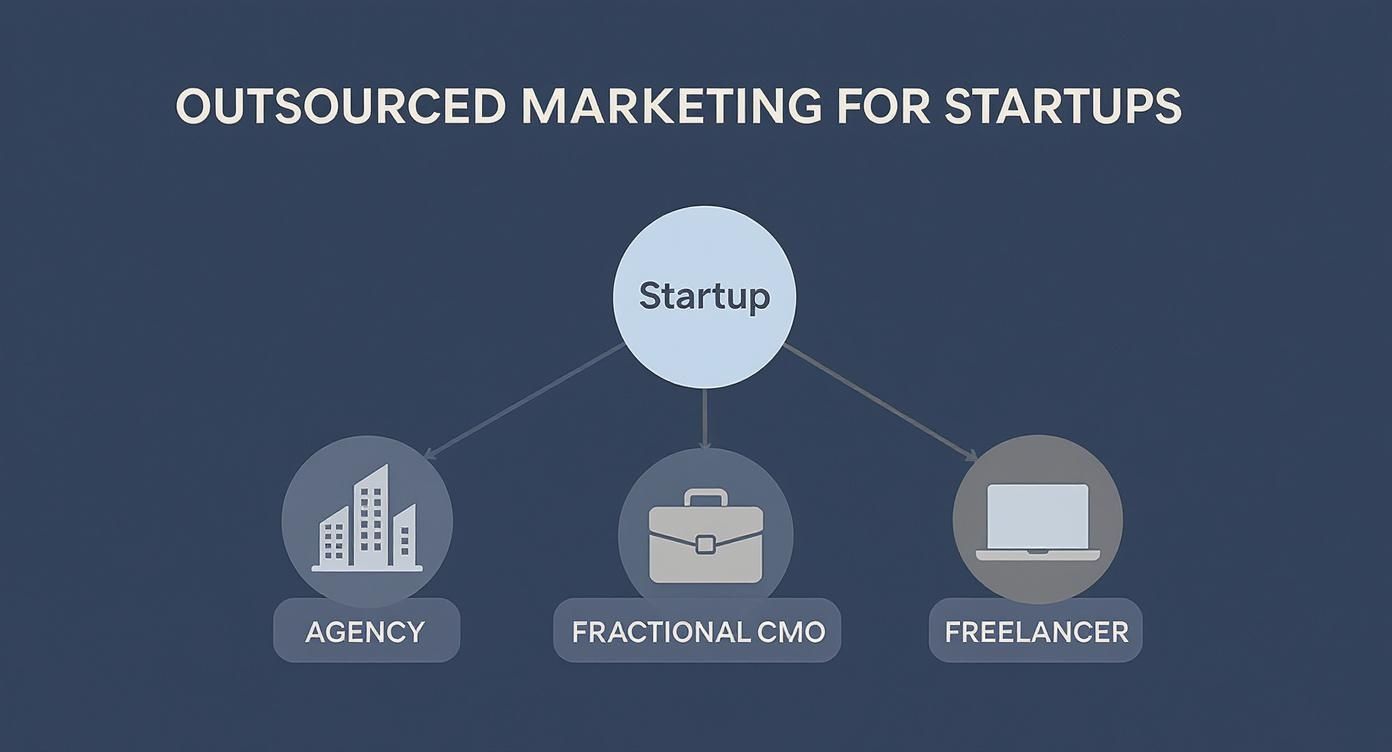
As you can see, all three options fuel growth, but they offer different mixes of strategic leadership versus tactical execution. It’s all about matching the right kind of support to your most pressing needs.
Key Takeaway: There is no single "best" model. The right choice hinges on your startup's stage, your internal team's skills, your budget, and whether your biggest gap is high-level strategy, broad-based execution, or a specific, specialized task.
Comparing Outsourced Marketing Models for B2B Tech Startups
To make the decision clearer, it helps to see how these models stack up side-by-side. Each has its strengths, but they solve very different problems for a founder.
| Criteria | Marketing Agency | Fractional CMO (fCMO) | Independent Contractors |
|---|---|---|---|
| Primary Focus | Comprehensive execution across multiple channels. | High-level strategy, planning, and leadership. | Specialized, task-based project completion. |
| Best For | Scaling multiple marketing functions at once. | Startups needing senior leadership without a full-time hire. | Specific, well-defined projects with clear deliverables. |
| Cost Structure | Monthly retainer (typically higher cost). | Monthly retainer or project fee (mid-range cost). | Hourly or per-project (most cost-effective). |
| Management | Low (managed by an account lead). | Low (the fCMO often manages others). | High (you are the project manager). |
Ultimately, this table highlights the core trade-offs: cost versus control, and strategy versus execution. Knowing which of these you need to solve for right now is the key to making the right choice.
The Upsides and Downsides of Outsourcing
Let’s have a frank conversation about what happens when you hand over the keys to your marketing. Deciding to outsource marketing isn’t just about getting tasks off your plate; it’s a strategic bet with huge upsides and some very real, manageable risks. You need to see both sides clearly to make a call with confidence.
The pull to outsource is strong for a reason. For a fast-moving B2B tech startup, the benefits are obvious. You’re not just hiring help—you’re plugging directly into a source of momentum.
The Clear Advantages of Outsourcing Your Marketing
When you bring on an external partner, you instantly upgrade your company’s capabilities. Think of it like getting an entire workshop of specialized tools delivered overnight, instead of having to build each one from scratch. This gives you a serious edge that's tough to build in-house, especially when you're just starting out.
Here are the main benefits you can bank on:
- Instant Access to Specialized Talent: Building an in-house team with real depth in SEO, paid media, content strategy, and marketing automation takes years and a ton of cash. Outsourcing gives you a full bench of specialists from day one, letting you punch way above your weight class.
- Faster Speed to Market: A good external team already has proven workflows. They ship faster. Campaigns that might take your team months to plan and execute can often be launched in weeks, getting you critical market feedback that much sooner.
- Serious Cost Savings: A full-time team comes with heavy overhead beyond salary—benefits, payroll taxes, software licenses, training. An outsourced partner rolls all of that into a single, predictable fee, often delivering more firepower for a fraction of what it would cost to build a comparable team internally.
- On-Demand Scalability: Your growth won't be a straight line, so your marketing shouldn't be rigid. Outsourcing lets you crank up the investment for a product launch or a big growth push, then dial it back down as needed without the pain of hiring and firing.
For a founder, the biggest benefit is focus. By handing off the marketing function, you get your time and your team's energy back to pour into what you do best: building an incredible product and taking care of your customers.
Navigating the Potential Downsides
Of course, it’s not all smooth sailing. Handing over a core business function to an outsider brings up some valid concerns. The trick isn't to ignore these risks, but to get ahead of them from the start.
Here are the most common fears founders have, and how to deal with them:
-
Losing Your Brand Voice: Your brand is everything. The fear is that an outside team just won't "get" your voice, your culture, or what makes you unique.
- How to Fix It: A deep, thorough onboarding is non-negotiable. Give your partner detailed brand guidelines, customer personas, and clear examples of what’s on-brand (and what’s not). Set up regular check-ins specifically to review messaging and keep it sharp.
-
Communication Gaps and Misalignment: Without clear lines of communication, it’s easy for an external team to drift away from your actual business goals.
- How to Fix It: Set a clear communication rhythm from day one. That means one point of contact, weekly stand-ups, and a shared project management tool like Asana or Monday.com. A good partner will insist on this kind of structure themselves.
-
Becoming Too Dependent on One Partner: What happens if the partnership sours, or they move on? Putting all your eggs in one basket can feel risky.
- How to Fix It: Make sure you own all your assets and accounts—your website, your Google Analytics, your ad accounts, your content. Document the key processes and strategies so that knowledge doesn’t walk out the door if the relationship ends.
By tackling these potential issues head-on, you turn risks into strengths. You end up with a partnership built on trust, transparency, and a shared obsession with hitting your goals.
A Framework for Making the Right Outsourcing Decision

Knowing you need help is easy. Figuring out what kind of help to get is the hard part.
The right call on outsourced marketing isn’t about finding the single “best” option—it’s about diagnosing your startup’s specific growing pains and matching them to the right cure. This framework is built for founders to cut through the noise and focus on what actually matters.
Think of it like a trip to the doctor. You don’t just walk in and ask for random medicine. You describe your symptoms so the doctor can make an accurate diagnosis. We’ll do the same for your marketing by looking at three core pillars. These will point you straight to the right model, whether that’s an agency, a fractional leader, or a team of specialized contractors.
Pillar 1: Your Startup's Current Stage
Where your company is right now is the single biggest factor. The marketing needs of a pre-seed startup hunting for product-market fit are completely different from a Series A company trying to build a scalable pipeline.
Be brutally honest about where you are.
- Pre-Seed/Seed Stage: Your whole world is about validation. You need high-level strategy to nail down who your customer is, what message clicks, and which one or two channels are worth testing. A full agency is almost always overkill here.
- Series A and Beyond: You’ve got a product that works and some early traction. Now the name of the game is repeatable, scalable growth. You need to expand your marketing footprint, which usually demands a broader execution team.
Pillar 2: Your Internal Resources
Next, take a hard look at the team you already have. Your existing people and budget will either open doors or limit your options. The goal of outsourcing is to fill gaps, not duplicate what you’re already good at.
It's interesting to see how outsourcing priorities shift. Between 2019 and 2020, the share of marketers outsourcing content creation dropped from 40% to 30%, showing a trend toward bringing that function in-house. But specialized work like design and video production remains heavily outsourced, which underscores the need to match external help to your specific internal weaknesses.
Key Question: What is the single biggest marketing bottleneck on your team today? Is it a lack of senior-level strategy? Not enough hands to get campaigns out the door? Or a missing specialty like technical SEO?
Your budget is a huge part of this. A $5,000 monthly marketing budget points you toward freelancers or a tightly scoped project. A budget of $25,000+ per month, however, opens the door to a full agency retainer or a high-impact fractional CMO.
Pillar 3: Your Primary Growth Goals
Finally, what are you trying to accomplish in the next six to twelve months? Vague goals like “more growth” are useless. Get specific, because your objective dictates the expertise you need.
- Goal: Strategy and Leadership: If your main problem is you don't know what to do, your biggest need is a strategist. A fractional CMO provides this C-level direction without the full-time executive cost. Our guide on how to hire a fractional CMO digs deep into this model.
- Goal: Execution and Scale: If you have a solid plan but lack the people to run it across multiple channels, an agency is built for this. They bring a ready-made team to manage everything from paid ads to content.
- Goal: Specific Task Completion: If you have a clear, defined project—like building a new website or running a single LinkedIn ad campaign—hiring an independent contractor is the smartest, most direct route.
By walking through these three pillars—stage, resources, and goals—you create a clear diagnosis. This turns an overwhelming choice into a simple, logical next step and makes sure your investment in outsourced marketing is set up to win from day one.
Setting Your Budget and Realistic Expectations
Let's talk about the two things every founder lives by: money and results. Jumping into outsourced marketing without a clear budget and timeline is like setting sail without a map. You’ll burn a lot of fuel but have no idea if you’re actually getting closer to shore. This section is about demystifying the numbers and setting a practical roadmap.
Figuring out what to spend isn't guesswork. There are clear benchmarks depending on the model you choose, and each one solves a different problem at a different price point. The first step is always matching your budget to your most pressing goals.
What Outsourced Marketing Costs
Your investment can range from a few thousand dollars for a specific project to well over $25,000 for a comprehensive program. It all comes down to the scope and expertise you need to plug into your company.
Here’s a realistic look at typical monthly investment levels:
- Under $5,000 per month: This budget works best for hiring independent contractors to handle specific, well-defined tasks. Think writing a series of blog posts, managing a single social media channel, or executing a small-scale SEO project. It’s all about targeted execution, not broad strategy.
- $5,000 – $15,000 per month: In this range, you can afford a more strategic partnership. This could mean a high-impact fractional CMO to steer your strategy and manage other freelancers. Or, it could get you a smaller, specialized marketing agency focused on one or two key channels, like paid ads or content.
- $15,000 – $25,000+ per month: This is where you bring in a full-service agency or a deeply involved fractional CMO. At this level, you should expect a multi-channel strategy, a dedicated team, and comprehensive execution covering everything from demand generation to brand building.
For a deeper dive into structuring your spending, our guide on creating a lean CEO marketing budget for 2025 provides a framework that ties your costs directly to your growth targets.
Setting a Realistic Results Timeline
The single biggest mistake I see founders make is expecting instant, hockey-stick growth from day one. Some tactics deliver quick feedback, sure, but real marketing momentum is built over time. You have to align your expectations with the channels you’ve chosen.
Paid advertising can generate leads within days or weeks, giving you fast data on messaging and targeting. However, organic channels like SEO and content marketing are long-term investments; they can take 4-6 months to show significant traction but build a sustainable, compounding asset for your business.
A great partnership isn't about overnight miracles; it's about hitting progressive milestones. Here’s what a strong first 90 days should look like:
- First 30 Days (Discovery and Planning): This phase is all about deep learning. Your new partner should be a sponge, absorbing everything about your product, customers, and market. Expect them to run audits, interview key people, and deliver a clear strategic plan with defined KPIs.
- Next 30 Days (Foundation and Quick Wins): With a plan locked in, the focus shifts to building foundational assets and launching initial campaigns. This could mean setting up analytics, launching a pilot paid ad campaign, or publishing the first pieces of cornerstone content. The goal here is to establish momentum and gather early data.
- Final 30 Days (Optimization and Reporting): By now, you should see the first tangible results and a clear reporting rhythm. Your partner should be analyzing initial campaign data, optimizing what’s working, and giving you a clear picture of progress against the goals set in month one.
This 90-day ramp-up period sets the stage for a successful long-term relationship built on transparency and measurable results, turning your budget into a predictable growth engine.
How to Manage and Measure Your New Marketing Partner
Choosing a partner is a huge step, but the real work starts on day one. A great outsourced marketing relationship doesn't just happen. It’s built on clear communication, smooth integration, and a shared definition of what winning actually looks like.
Those first few weeks are critical. They set the tone for the entire partnership. Think of onboarding less like a handover and more like a deep knowledge transfer. Your new partner needs to become a true extension of your team, and a rushed start almost always leads to off-key messaging and wasted effort down the road.
Your Onboarding Checklist for a Strong Start
A seamless integration process is non-negotiable. It’s what allows your partner to hit the ground running instead of tripping over basic access issues. Treat them like a new C-suite hire and give them everything they need to operate effectively from the get-go.
Your onboarding should cover these bases:
- A Brain Dump on Your Business: Set aside dedicated time to walk them through your product, your ideal customer profile (ICP), and the competitive landscape. Don’t hold back—share the good, the bad, and the ugly.
- Defining Your Brand Voice: Hand over your brand guidelines, key messaging docs, and even examples of content you love (and stuff you hate). This is how you stop them from sounding like an outsider.
- Granting System Access: Nothing kills momentum faster than waiting for a login. Give them immediate access to the essentials: Google Analytics, your CRM, your content management system (CMS), and any ad accounts.
Measuring What Actually Moves the Needle
Vanity metrics like social media impressions are nice, but they don't pay the bills. For a B2B tech startup, success is measured by one thing: impact on the sales pipeline and revenue. You have to align on the key performance indicators (KPIs) that truly matter from day one.
Your marketing dashboard should tell a story about business growth, not just activity. If a metric doesn't connect directly to acquiring customers or generating revenue, it's likely a distraction.
Focus every report and conversation around these core business metrics:
- Marketing Qualified Leads (MQLs): This is the raw number of high-intent leads your marketing efforts are generating. It’s the primary handoff to sales and a direct measure of pipeline creation.
- Customer Acquisition Cost (CAC): This tells you exactly how much you're spending to land each new customer. A falling CAC means your marketing is getting more efficient. Simple as that.
- Lifetime Value (LTV) to CAC Ratio: This is the power ratio. It compares a customer's total value over time to what it cost to acquire them. A healthy ratio (usually 3:1 or higher) proves your marketing investment is delivering a strong, sustainable return.
When you establish a clear communication rhythm—like weekly check-ins and monthly strategy reviews—you build accountability into the system. And when you know exactly how to measure marketing ROI, you turn your outsourced partner from a cost center into a predictable engine for growth.
Alright, you've seen the models, the benefits, and the frameworks. Now, let's get down to the brass tacks.
Founders always have a few practical questions at this point—the kind that bridge the gap between understanding outsourced marketing and actually pulling the trigger. Let's tackle them head-on so you can move forward without any lingering doubts.
How Fast Will I See Results?
This is always the first question, and the only honest answer is: it depends entirely on the play you're running.
If your partner spins up a paid ad campaign, you can see leads and data flowing in within a few weeks. That’s fantastic for getting quick feedback from the market.
But if you're building a real, sustainable engine with SEO and content, that’s a long game. You should expect to see meaningful traction in 4 to 6 months, not days. A great partner will do both—blend short-term wins with long-term asset building—and give you a clear timeline for each.
Do I Lose Control of My Brand?
This is a totally valid fear, but the answer should be a hard no. You are the final word on your brand. A solid partnership is built on collaboration, not handing over the keys and hoping for the best.
You stay in the driver's seat through:
- Deep Onboarding: You’ll arm them with brand guidelines, ideal customer profiles, and clear examples of your voice and tone.
- Clear Approval Workflows: No major campaign or piece of content should ever see the light of day without your sign-off.
- Constant Communication: Regular check-ins ensure the messaging stays locked in with your vision and business goals.
What If I Pick the Wrong Partner?
Making a switch is a lot less painful than you might think, as long as you set things up right from day one. The absolute key is to own all your core assets.
That means your website domain, your Google Analytics account, your ad accounts, and every piece of content created should belong to you, not the agency.
Retaining ownership of your digital properties and data is non-negotiable. It ensures that if you need to switch partners, you can do it without losing years of performance history or rebuilding your entire marketing foundation from scratch.
This one simple move protects your investment and gives you the freedom to find the right long-term fit, without getting stuck in a bad relationship. With these questions answered, you’re ready to make a confident, smart decision.
Ready to stop guessing and start building a predictable growth engine? Value CMO provides the senior marketing leadership B2B tech startups need to clarify strategy and execute with focus. Learn how our fractional CMO service can build your roadmap to revenue.