Staring at some aggressive growth targets and wondering how your small team will ever keep up? You’re not alone. The simple truth is that you outsource marketing services when your team's bandwidth, budget, or skills just can't fuel your growth ambitions anymore. Think of it as a strategic play to inject immediate expertise, speed, and specialized tools right into your marketing engine.
Deciding to Outsource Your Startup's Marketing
For most B2B tech startups, the decision to outsource isn’t about throwing in the towel—it’s about delegating smartly.
Think of it like building a house. You and your co-founder might be great at framing the walls and managing the project, but you bring in specialist contractors for the electrical and plumbing. Why? Because you don’t have the time or the deep expertise to do it all, and let's be honest, mistakes in those areas are incredibly costly.
An outsourced marketing partner is that specialist contractor for your growth. They bring the tools, blueprints, and skilled labor to build a critical part of your business, which frees up your core team to focus on what they do best: building a great product.
Common Triggers for Outsourcing
So, how do you know it’s time to make the call? There are a few common triggers that tend to push founders toward outsourcing. Spotting them early can be the difference between stalled growth and a breakout quarter.
These triggers often look like this:
- Rapid Scaling Pains: Your lead generation has gone flat, but your sales targets just doubled. An in-house team of two can't suddenly produce five times the output without quality taking a nosedive.
- The Niche Skills Gap: You desperately need a technical SEO audit or a complex HubSpot automation sequence, but hiring a full-time expert for that one function is total overkill. Outsourcing gives you that specific skill on demand.
- Running Out of Hours: Your team is spending more time on routine tasks like scheduling social media posts than on high-impact strategy. This is a flashing red light that you need to offload execution to free up strategic brainpower.
A key benefit of outsourcing is getting immediate access to a team that has already climbed the learning curve. They've tested the strategies, implemented the tools, and know what works for B2B tech—saving you months of painful trial and error.
This is especially true for foundational marketing work. For instance, a good external partner can quickly help you nail down your ideal customer and market segments. Having a crystal-clear picture of who you're selling to is non-negotiable, and you can learn more about how to create buyer personas from our detailed guide.
Ultimately, deciding to outsource is a proactive choice. It’s about recognizing you can’t DIY your way to scalable, predictable revenue. By bringing in specialists, you’re not just buying services; you're buying speed, expertise, and focus.
Exploring Different Marketing Outsourcing Models
Once you’ve decided to bring in outside help for marketing, the next question is: what does that actually look like? Outsourcing isn't a one-size-fits-all solution. It’s more like a menu of options, and picking the right one is critical for getting the results you need without paying for things you don’t.
Think of it like building a house again. You could hire a general contractor to manage the entire project from foundation to finishings. You could bring in an architect to just draw up the blueprints. Or you could just hire a plumber to fix a specific leak. Each gets a job done, but the cost, control, and outcome are completely different. The same logic applies to building your marketing function.
This visual below highlights the key triggers that often push startups to explore these models as they chase growth.
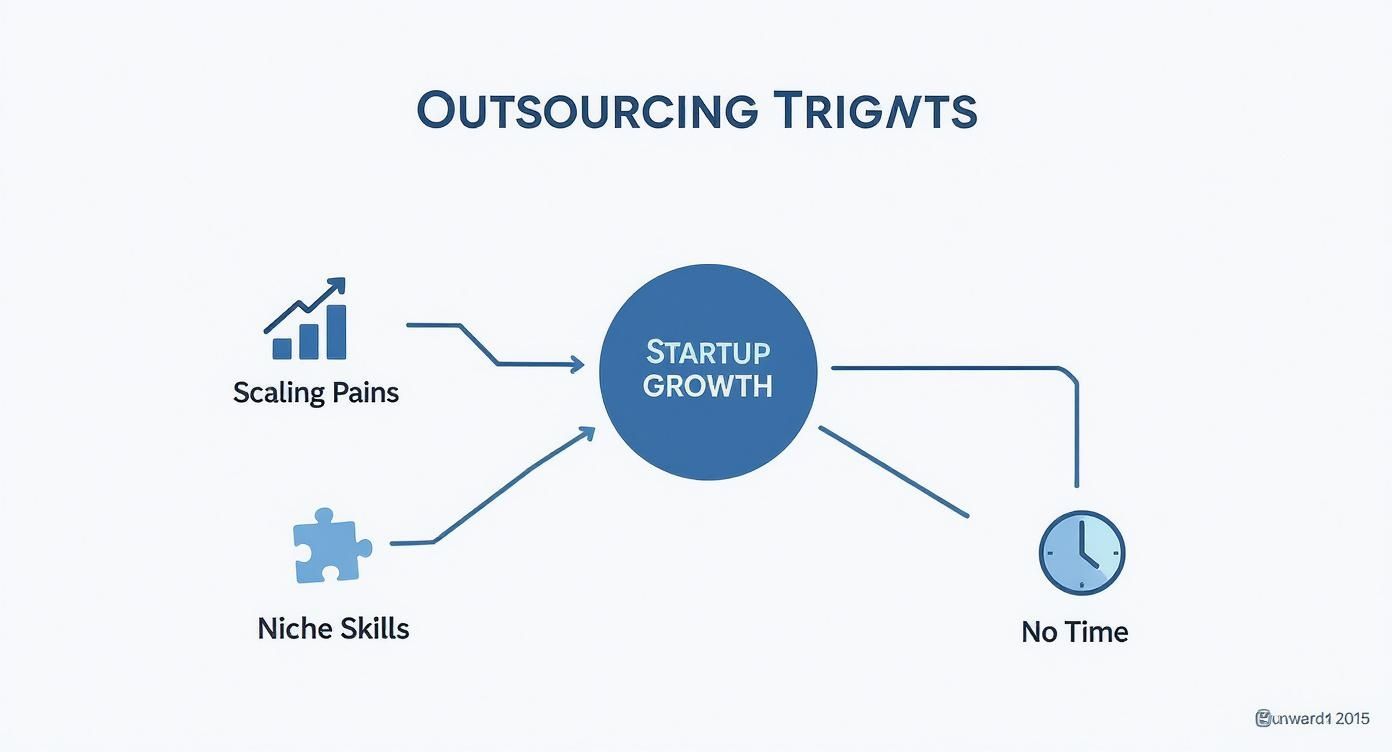
As the flowchart shows, pressures like scaling pains and the need for niche skills often leave teams feeling like they have no time. This makes outsourcing an essential lever for continued startup growth.
Choosing the right partner starts with understanding the core models available. Each has its own strengths, weaknesses, and ideal use case, so let’s break them down.
Comparing Marketing Outsourcing Models
The table below gives you a side-by-side look at the most common outsourcing models. Use it to quickly compare which approach might be the best fit for your startup's stage, budget, and strategic needs.
| Model | Best For | Typical Cost Structure | Pros | Cons |
|---|---|---|---|---|
| Full-Service Agency | Well-funded startups needing an all-in-one, hands-off solution. | Monthly Retainer ($10k – $50k+) | Integrated strategy, access to a diverse team of specialists, single point of contact. | Most expensive option, can be slow to pivot, often requires long-term contracts. |
| Fractional CMO | Startups with an execution team that lacks senior-level strategic direction. | Monthly Retainer ($5k – $15k) | C-level strategy without the executive salary, GTM planning, board-level reporting. | Not built for hands-on execution; you still need a team to do the work. |
| Managed Services | Companies wanting to offload a specific, ongoing function like PPC or email marketing. | Fixed Fee or Retainer ($2k – $10k / channel) | Deep expertise in one area, predictable costs, clear accountability for a single function. | Can create channel silos; less focus on integrated, cross-channel strategy. |
| Freelancers | Teams needing to fill specific skill gaps or execute well-defined, short-term projects. | Hourly or Project-Based ($75 – $250+/hr) | High flexibility, cost-effective for specific tasks, access to specialized talent on demand. | Requires internal management, can be inconsistent, no overarching strategic oversight. |
| Hybrid Model | Growth-stage startups that need both strategy and flexible execution. | Blended (e.g., Fractional CMO retainer + freelancer project fees) | Combines strategic leadership with cost-effective execution; highly scalable and adaptable. | Requires careful coordination between the strategic lead and tactical implementers. |
Ultimately, the right model depends entirely on where your biggest gaps are. Do you need a brain, a pair of hands, or both? Answering that question will point you in the right direction.
The Full-Service Agency
A full-service agency is the all-inclusive resort of marketing. They handle everything from high-level strategy to the day-to-day work of running campaigns across SEO, paid ads, content, and social media.
This model is a solid fit for established startups or well-funded companies that need a comprehensive solution and prefer a single point of contact to manage it all.
The Fractional CMO
A Fractional Chief Marketing Officer (CMO) is your strategic architect. They bring senior-level marketing leadership and planning to the table without the full-time executive salary.
This is perfect for startups that have a junior team ready to execute but lack high-level direction on go-to-market strategy, positioning, and budget oversight. A fractional CMO builds the roadmap; they don’t necessarily pave every inch of the road themselves.
A Fractional CMO acts as a part-time member of your leadership team. Their primary role is to set the 'why' and the 'what,' empowering your internal team or freelancers to handle the 'how.'
Freelancers and Specialized Consultants
Hiring individual freelancers is the à la carte approach. Need a technical SEO audit, a set of Google Ads campaigns, or a series of blog posts? You can hire a specialist for just that task.
This model offers maximum flexibility and cost control. It’s ideal for startups with specific, well-defined needs and the internal bandwidth to manage multiple contributors. It’s a highly effective way to fill skill gaps without a long-term commitment.
Managed Services and Hybrid Models
Finally, there's the middle ground. A managed services provider might take over one specific function end-to-end, like your entire paid advertising program or your email marketing automation.
The hybrid model, however, is where many B2B tech companies are finding their sweet spot. This involves blending different approaches—for example, pairing a Fractional CMO for strategy with a few key freelancers for execution. This gives a startup the best of both worlds: senior-level guidance and flexible, cost-effective implementation. It's a balanced approach that provides the expertise and agility needed to scale efficiently.
The Real Benefits and Hidden Risks of Outsourcing
Deciding to outsource your marketing feels a lot like handing over the keys to your car. You trust you’ll get where you’re going faster, but there’s always that little voice in the back of your head. Before you commit, you need a clear, balanced view of the road ahead—both the smooth stretches and the potential potholes.

Let's get real about what to expect. On one hand, the advantages can be powerful enough to completely change your growth trajectory. On the other, the risks are just as real and can burn through your budget if you aren't prepared for them.
The Clear Advantages of Outsourcing
The most obvious win is plugging directly into specialized expertise. Your startup probably doesn't need a full-time MarTech automation wizard or a technical SEO guru on payroll, but you absolutely need their skills for a specific project. Outsourcing gets you that A-level talent on demand, without the hefty full-time salary and benefits package.
This leads directly to serious cost-efficiency. A full-time marketing hire comes with a loaded cost that goes far beyond their salary. Outsourcing turns a fixed personnel expense into a flexible operating expense you can dial up or down. Need to go all-in on a product launch? Ramp up your team. Hitting a quiet quarter? You can pull back without getting tangled in complicated HR issues.
Outsourcing isn't about cutting corners; it's about buying speed and focus. It frees up your core team to concentrate on product and innovation while experts handle the complex, time-consuming work of building your pipeline.
The numbers back this up. The global outsourcing industry was valued at around $577 billion in 2025, with over 50% of U.S. companies now outsourcing digital marketing functions. They're doing it for the creative flexibility and efficiency it unlocks. You can dig into more of the data on the growth of marketing outsourcing from industry stats.
The Hidden Risks You Must Manage
But the path isn't always smooth. The biggest risk is a potential loss of direct control. An external team, no matter how good, will never be as immersed in your company’s daily culture and conversations as an in-house employee. If you don't manage it proactively, this can lead to a real disconnect.
Another major hurdle is keeping a consistent brand voice. Your brand is more than a logo; it's the personality that shines through in every email, ad, and blog post. It takes a deliberate effort to make sure an external partner truly gets your voice and applies it everywhere, every time.
Finally, communication gaps can quietly sabotage the entire partnership. Different time zones, communication styles, or project management tools can create friction. Without a clear, agreed-upon communication rhythm, simple misunderstandings can snowball into missed deadlines and disappointing results. Acknowledging these risks upfront is the first step to building an outsourcing relationship that actually works.
How to Choose the Right Marketing Partner
Picking a marketing partner is one of the most critical decisions you'll make as a founder. Get it right, and you've found a growth accelerator that pumps expertise and momentum straight into your business.
Get it wrong, and you’ll burn through your budget with little to show for it, leaving you more frustrated than when you started.

The goal isn't just to hire a vendor; it’s to find a true extension of your team—someone as invested in your success as you are. This requires a structured evaluation that looks past the slick sales deck.
Define Your Goals and Scope
Before you even think about talking to anyone, you need to get crystal clear on what you want to achieve. "We need more leads" isn't a goal; it's a wish.
You have to get specific.
- Are you trying to generate 50 Marketing Qualified Leads (MQLs) per month?
- Do you need to slash your Customer Acquisition Cost (CAC) by 20%?
- Is the real objective to build a content engine that drives reliable organic traffic?
Sharp, defined goals act as a filter. They instantly help you weed out partners who don't specialize in the areas that matter most right now. Once your objectives are locked in, you can build a scope of work that spells out exactly what you expect them to deliver.
Vet Their Track Record and Expertise
With a shortlist in hand, it’s time to dig into their actual experience, especially with companies that look like yours. Don’t get distracted by a flashy portfolio of B2C brands if you're a B2B tech startup. The playbooks are completely different.
Ask for case studies directly relevant to your industry, business model, and goals. You're looking for proof they understand the unique challenges of a startup, like the need for agile decision-making and a relentless focus on measurable ROI. It's also smart to see how modern companies structure these relationships—checking out something like Cometly's Agency Partners program can give you a feel for what effective collaboration looks like.
A partner’s past performance is the best predictor of your future success with them. If they can’t show you concrete results they've achieved for a business similar to yours, that’s a major red flag.
Prioritize Cultural Fit and Communication
This is the step most founders skip, and it's often the one that makes or breaks the relationship. Skills are table stakes. A genuine cultural fit is the real differentiator. You're looking for a team that feels like they belong in your Slack channels.
Pay close attention to their communication style during your calls. Do they ask sharp, insightful questions and actually listen to your answers? Or do they just talk about themselves and their process? A great partner is curious, collaborative, and radically transparent.
If you’re hiring for a high-level strategic role, understanding their leadership qualities is even more vital. You can learn more about how to hire a fractional CMO to see what to look for in a true strategic partner.
Finally, always check their references. Talk to current or former clients to get an unfiltered view of what it’s like to work with them day-to-day. This due diligence is the final piece of the puzzle, ensuring you choose a partner who will truly help you grow.
Managing and Measuring Your Outsourced Strategy
Alright, you’ve signed the contract and picked your partner. Now the real work starts.
The success of any outsourced marketing partnership hinges less on the initial handshake and more on how you manage the relationship day-to-day. A great partnership isn’t luck; it’s built on a foundation of clear communication, shared goals, and relentless measurement.
The first step is a structured onboarding process. This is way more than just a kickoff call. It's a deep knowledge transfer where you arm your new partner with brand guidelines, buyer personas, market research, and access to your tech stack. Think of it as giving them the blueprints and the keys to the construction site—they can't build anything without them.
Once they’re up to speed, you need to lock in a communication rhythm. Set up shared Slack channels, schedule weekly check-in calls, and use a project management tool like Asana or Trello. This keeps everyone aligned and prevents the small communication gaps that can quietly kill progress.
Setting Up Your Performance Dashboard
You can't manage what you don't measure. A vague feeling that "things are going well" is a recipe for wasted money. You need hard data. For B2B tech startups, tracking the right Key Performance Indicators (KPIs) is everything. Your focus should be squarely on metrics that tie marketing efforts directly to revenue.
Your dashboard isn't a "nice-to-have." It's your single source of truth. Make sure it includes:
- Marketing Qualified Leads (MQLs): How many high-intent leads is your new partner actually generating each month?
- Cost Per Acquisition (CPA): When you boil it all down, what’s the total cost to land a new customer through these marketing efforts?
- Pipeline Contribution: How much new sales pipeline is marketing sourcing or directly influencing?
- Lead-to-Customer Conversion Rate: Of all the leads coming in, what percentage are turning into paying customers?
Measurement isn't just about holding your partner accountable. It’s about creating a feedback loop for continuous improvement. The data tells both teams where to double down and what to cut—fast.
It's also smart to know what your partners are using to track their work. Familiarize yourself with the best SEO reporting tools for agencies so you can have more informed conversations about performance.
Establishing a Cadence for Reviews
Finally, get a recurring schedule on the calendar for strategy reviews. A weekly call is perfect for tactical updates and quick adjustments. A monthly meeting should zoom out to review performance against your core KPIs. Then, use a quarterly business review (QBR) for the big-picture conversations about strategy, budget, and long-term planning.
This structured approach transforms your outsourced team from a simple vendor into a true extension of your company—one that delivers a measurable return on your investment. There's a reason the BPO market is projected to hit $57.46 billion by 2030. Companies are realizing that with the right management, outsourcing is a powerful lever for growth.
Success really comes down to a simple formula: clear goals plus transparent reporting. If you want to dig deeper, check out our guide on how to measure marketing ROI for more practical frameworks.
Common Questions About Outsourcing Marketing
Even with a clear plan, pulling the trigger on outsourced marketing brings up a lot of "what ifs." That’s completely normal. It’s a big decision.
Let's tackle the questions I hear most often from B2B tech founders so you can move forward feeling confident, not uncertain.
How Much Should I Expect to Pay?
This is the big one, and the honest answer is: it’s all over the map. A single freelancer might charge you $100 an hour, while a full-service agency could run $15,000 a month or more. The cost depends entirely on the model you choose and what you need them to do.
But here’s a better way to think about it: frame the conversation around value, not just cost. Instead of asking "How much does it cost?" ask, "What business outcome am I buying?" A great partner won’t just send you an invoice; they'll connect their fees directly to the results you care about, like hitting a certain number of MQLs or bringing down your customer acquisition cost.
The goal isn’t to find the cheapest option. It’s to find the partner who delivers the highest return on your investment. Sometimes, spending more upfront is actually the most profitable move in the long run.
Can an Outsourced Team Really Understand My Niche?
This is a totally valid concern, especially if you’re a deep-tech B2B startup. The last thing you want is to spend weeks teaching a marketing team the basics of your industry.
The key is to vet partners ruthlessly for their industry experience. Don't be shy about asking for case studies and references from companies that look a lot like yours. A partner who’s already navigated your market knows the language, the buyer pain points, and the ridiculously long sales cycles.
Real expertise means they skip the hand-holding. They’ll show up on day one asking smart, pointed questions and start adding value right away.
How Do I Maintain Control and Brand Consistency?
Handing over the keys to your marketing can feel like you're losing control. You don't have to. Success here is all about building a solid operational framework from the get-go.
Here’s how you stay in the driver's seat:
- Create a Robust Brand Guide: This is your rulebook. It should spell out your mission, voice, tone, visual identity, and core messaging. Your partner doesn't just read it; they live by it.
- Establish Clear Approval Workflows: No ad goes live, no blog gets published, no email gets sent without your team’s final sign-off. Use a simple project management tool to make this process airtight and painless.
- Set Up a Communication Cadence: Weekly check-ins, shared Slack channels, and real-time dashboards mean you always know what’s happening. You can step in and steer the ship whenever you need to.
The shift toward outsourcing is only getting bigger. The Business Process Outsourcing (BPO) market is on track to hit nearly $525 billion by 2030. A huge part of that growth comes from companies tapping into global talent pools in places like India and the Philippines, where skilled specialists can average $5 to $25 per hour. You can discover more insights about these global outsourcing statistics to see how others are leveraging worldwide expertise.
At the end of the day, choosing to outsource marketing services isn’t about giving up responsibility—it’s about adding serious firepower. With the right partner and a tight management process, you keep full control while gaining the expertise you need to scale.
Ready to accelerate your growth with expert marketing leadership? Value CMO provides B2B tech startups with fractional CMO services that deliver a clear go-to-market strategy and a data-driven plan for execution. Learn how we can build your growth engine.