So, what does it really mean to outsource marketing? It's simply about bringing in an outside partner—whether that’s a fractional CMO, an agency, or a specialist—to run your marketing instead of trying to build a full-time team from scratch.
Think of it like adding a flexible, on-demand marketing brain to your company. The whole point is to tap into specialized skills you don't have, work more efficiently, and grow your business without the massive overhead of hiring more people.
Knowing When It's Time to Outsource Your Marketing
As a founder, you're already wearing a dozen hats. Marketing often feels like one more puzzle you just don’t have the time or energy to solve. And while everyone says outsourcing is about "saving time," the real reasons you should consider it are much more specific. They usually feel like major roadblocks holding you back.
This isn't just about handing off tasks you don't feel like doing. It’s a smart, strategic move you make when you realize that what got you here won't get you to the next level.
Putting off this decision has a real cost. You end up burning cash on scattered tactics that go nowhere, losing ground to your competitors, and frustrating a team that’s looking for a clear direction. Let’s cut through the noise and talk about the real-world signs that it’s time to call in a pro.
Your Lead Flow Is a Rollercoaster
You’ve got a fantastic product and customers who love you, but your pipeline is all over the place. One month you’re swamped with leads, and the next, it’s crickets. That kind of up-and-down is a classic sign that you're relying on "random acts of marketing" instead of a repeatable system for growth.
An outsourced partner is built to diagnose this exact problem and build that system for you. They’ll start by asking tough questions like:
- Are you a one-trick pony? Are all your leads coming from just one place, like founder-led sales or word-of-mouth?
- Is there a real process? Do you have a clear system to capture, nurture, and convert leads, or is it all just happening by chance?
- Is your message actually connecting? Are you talking about your value in a way that’s clear and consistent everywhere a customer might find you?
Your Team Is Tactical, Not Strategic
Maybe you have a small, hardworking team—a social media manager who’s great with your community or a writer who produces solid blog posts. They’re fantastic at getting things done, but no one is actually steering the ship.
They’re waiting for a plan. A strategy that connects their day-to-day work to the company’s big-picture goals.
"The number one mistake I see founders make is trying to outsource their strategy before they truly own it. A great partner can amplify your strategy, but they can't create it out of thin air. You have to bring the vision."
This gap in strategic leadership is exactly where an outsourced marketing partner, especially a fractional CMO, can be a game-changer. They don't just hand out tasks; they build the roadmap that gives your team the purpose and confidence they need to do their best work.
You're Launching a New Product or Entering a New Market
Breaking into a new country or launching a major new product requires specialized know-how you probably don’t have in-house. You need someone who gets the local market, understands the competition, and has a playbook for reaching that specific audience.
Trying to figure all that out on the fly is a recipe for burning through a ton of time and money. Bringing in an outside expert who has a proven playbook for this stuff lets you move faster and with a lot more confidence. It's a shortcut to getting it right the first time around.
Choosing Your Marketing Outsource Model
So, you’ve decided to bring in some outside help. Awesome. But now comes the real question: what kind of help do you actually need?
A huge mistake I see founders make is thinking all marketing outsource partners are the same. They’re not. Picking the right model is just as important as the decision to outsource in the first place, because it directly impacts the results you'll get.
Think of it like building your product team. You wouldn’t hire a junior developer to design your entire technical architecture, and you wouldn't ask your CTO to fix a typo on the homepage. The same logic applies here. The trick is to match the partner to your startup's stage, your most pressing needs, and what your budget can realistically handle.
To help you figure this out, I'm going to share a simple comparison table that breaks down the four most common models you'll come across.
Comparing Marketing Outsource Models for Tech Founders
| Outsource Model | Best For | Typical Cost | Key Benefit |
|---|---|---|---|
| Fractional CMO | Founders who need a solid go-to-market strategy, team leadership, or a clear marketing roadmap. | $5,000 – $15,000/mo | Strategic leadership without the full-time C-suite salary. |
| Marketing Agency | Companies that have a strategy but no internal team to execute it across different channels. | $7,000 – $25,000+/mo | A full, ready-to-go execution team under one roof. |
| Specialized Freelancer | Startups needing top-tier expertise for a very specific, high-impact project (like a technical SEO audit). | $100 – $300+/hr | Deep, niche expertise you just can't find in a generalist. |
| Contractor / Consultant | Businesses that need someone to reliably handle ongoing, well-defined tasks (like writing blog posts). | $50 – $150/hr | Flexible, task-oriented help without the strategic overhead. |
As you can see, each of these models solves a very different problem. Let's dig into what that means for you in the real world.
The Four Core Outsourcing Models
Let's break down the main players in the outsourcing world. Each one is a tool for a different job. Getting these distinctions right is the first step toward making a smart investment.
-
The Fractional CMO: This is your part-time strategic leader. A good fractional CMO doesn’t just run campaigns; they build your entire marketing engine, from your go-to-market strategy to your team structure and budget. They’re perfect when you have a junior team that needs direction or when you, the founder, can no longer be the only marketing brain in the room.
-
The Marketing Agency: This is your all-in-one execution team. Agencies are a great fit when you already have a strategy but lack the people or the diverse skills to run it across SEO, paid ads, and content. You hand them the plan, and they bring a full team to the table to make it happen.
-
The Specialized Freelancer: This is your deep-dive expert. Think of a technical SEO wizard, a LinkedIn Ads guru, or a conversion copywriter who knows your industry inside and out. You hire them for a specific, high-stakes project where their unique expertise is the only thing that matters.
-
The Contractor or Consultant: This is your flexible, task-oriented resource. A contractor is perfect for steady, ongoing needs like writing two blog posts a week or managing social media. They reliably get a defined task done without needing a lot of strategic oversight from you.
This decision tree can help you visualize which path to take based on what's really keeping you up at night.
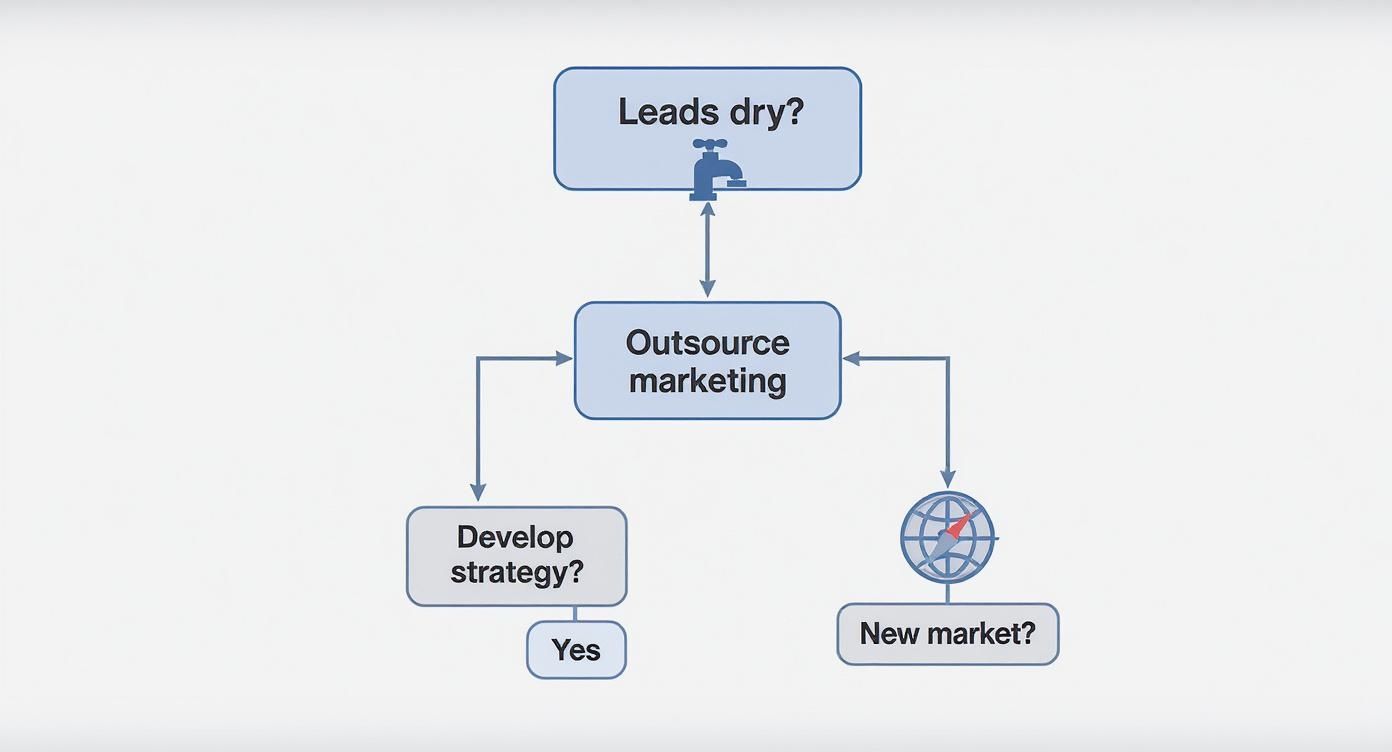
The flowchart makes it pretty clear: your main problem—whether it’s a strategy gap or an execution bottleneck—should point you directly to the right kind of partner.
Real-World Scenarios for B2B Tech Founders
Abstract definitions only get you so far. Let's ground this in situations you're probably facing right now.
Scenario 1: You need a go-to-market strategy for a new product.
Your team built an incredible feature, but you have no playbook to launch it. Who do you call?
In this case, a Fractional CMO is your best bet. An agency will ask you for the strategy, but a Fractional CMO will help you build it. They’ll work with you to define the ideal customer, nail the messaging, and map out the entire launch plan.
Scenario 2: You have a clear plan but no one to run it.
You know you need to be running LinkedIn ads, producing case studies, and fixing your website's SEO. The strategy is solid, but your two-person team is completely swamped.
This is a classic use case for a full-service marketing agency. You can hand them the brief, and they’ll have the specialists ready to execute across all those channels at once. If you want to see what this looks like, you can explore the full range of outsourced marketing services to see how they package these solutions.
Niche Expertise vs. Broad Execution
Sometimes, you don't need a whole team; you just need one specific skill, executed at an elite level.
Imagine your website traffic has flatlined, and you suspect deep technical issues are the culprit. An agency might have a general SEO person, but you need someone who lives and breathes schema markup and international SEO. This is exactly when you bring in a specialized freelancer.
On the flip side, if you just need a steady stream of content—blog posts, social updates, email newsletters—a contractor is often the most cost-effective path. They are built for consistent, quality output on a predictable schedule.
Ultimately, choosing the right marketing outsource model comes down to being honest with yourself. What's your biggest gap right now? Is it strategy, execution bandwidth, or a very specific skill? Your answer will point you directly to the right partner. And for highly technical needs, don't forget that a specialized marketing automation consultancy can also be a fantastic option for streamlining complex workflows.
Alright, you've figured out what you need and which outsourcing model makes sense. Now for the tough part: finding the right partner without burning through your cash and calendar. This isn't about scrolling through Upwork. It's a methodical search for a true extension of your team.
There's a reason the outsourced sales and marketing market is exploding. It was valued at USD 28.65 billion in 2022 and is rocketing toward USD 57.46 billion by 2030. That growth is fueled by founders just like you who need expert help to generate leads and run smart digital campaigns.
https://www.youtube.com/embed/kNaPbKn4hvw
Sourcing Top-Tier Talent
Forget the crowded, noisy marketplaces. The best partners are rarely found there. Your search needs to be targeted and strategic. Think quality over quantity.
- Trusted Industry Referrals: This is your best starting point. Ask other B2B tech founders, your investors, or mentors who they’ve had success with. A warm referral is worth its weight in gold.
- Curated Networks and Communities: Look into specialized networks that do the vetting for you. For high-level strategic help, platforms that connect you with fractional CMOs are invaluable. You can learn more about how to hire a fractional CMO through these dedicated services.
- Niche-Specific Groups: Go where the experts hang out online. This could be a niche Slack channel for SaaS marketers or a LinkedIn group focused on your specific industry.
Moving Beyond the Portfolio Review
Once you have a shortlist, the real work begins. A slick portfolio or a fancy website is just the beginning. Your job is to dig deeper and ask the tough questions that reveal their actual skills and, just as importantly, how they like to work.
A great partner won't just show you what they did; they'll explain why they did it and what the tangible business impact was. Look for strategic thinking, not just pretty deliverables.
I always recommend creating a simple scorecard to evaluate each potential partner. It helps you move beyond a "gut feeling" and forces a more objective, data-informed decision.
The Ultimate Vetting Checklist
Don't just let them walk you through their greatest hits. Use this checklist to really dig into their experience and make sure they're the right fit for your B2B tech startup. Knowing how to choose a PPC agency effectively is a great skill, and that same rigorous thinking applies here, no matter what kind of partner you're hiring.
1. Probe Their Niche Understanding
Ask them to describe your ideal customer in their own words. Then, ask how they would position your product against your top two competitors. Their answer will instantly tell you if they've done their homework or are just giving you a generic pitch.
2. Dissect Case Studies for Real ROI
Don't let them get away with vanity metrics. If they say they "increased engagement by 300%," you need to push back with real business questions.
- "That's interesting, but what did that do for marketing-qualified leads (MQLs)?"
- "How did your work actually impact the sales pipeline or customer acquisition cost (CAC)?"
- "Can you walk me through the dashboard you used to track these results?"
3. Conduct "Real" Reference Checks
When you talk to their past clients, don't just ask "Were you happy with them?" Ask pointed questions that get to the heart of what it's like to work with them.
- "Describe their communication style. How often did you hear from them, and how?"
- "Tell me about a time a campaign wasn't working. How did they handle that conversation, and what did they do next?"
- "What's one thing they could have done better?"
4. Test Their Communication Rhythm
Pay close attention to how they communicate during the vetting process itself. If they take a week to respond to an email now, imagine what it will be like when they have your money. This is a live preview of your future working relationship.
By following this methodical process, you shift the power dynamic. You’re not just being sold to; you're conducting a thorough evaluation to find a partner who can genuinely help you scale.
Crafting a Scope of Work That Prevents Problems
A vague scope of work is the #1 reason outsourced marketing partnerships fail. It’s where good intentions meet reality and everything falls apart because everyone had different expectations.
A well-crafted Statement of Work (SOW) isn't just some boring legal document; it's the constitution for your partnership.
Think of it this way: without a detailed SOW, you’re basically handing over your money and hoping for the best. With one, you’re providing a clear, actionable blueprint that defines what success looks like for everyone involved. It’s the single most important document you’ll create when you decide to marketing outsource.

Defining Concrete Deliverables
The heart of any SOW is the deliverables section. This is where you get rid of all the fuzzy language and get painfully specific. "Blog content" is not a deliverable. "SEO services" is a recipe for disaster.
You need to define what you're getting with numbers, frequencies, and clear parameters. This leaves zero room for misunderstandings.
- Vague: "Create blog posts and improve SEO."
- Concrete: "Deliver four (4) 1,500-word blog posts per month on pre-approved topics, fully optimized with a target keyword, meta description, and internal links."
This level of detail forces a strategic conversation upfront. It makes it crystal clear what you're paying for and what your partner is committing to produce.
Setting Up Communication and Reporting
How will you know if things are working? An SOW must outline how you'll communicate and what reporting will look like. This saves you from having to chase down your partner for updates and ensures you're both tracking the right things.
A great SOW doesn't just list tasks; it defines the operating rhythm of the partnership. It answers who, what, when, and how for communication and accountability before the work even starts.
Define these elements clearly:
- Meetings: Specify how often you'll meet (e.g., one 30-minute weekly check-in via Google Meet) and what the purpose of each meeting is.
- Reporting: Detail what metrics will be tracked and how they'll be presented. Will you get a monthly PDF report or access to a live dashboard? Be specific. A clear reporting framework is essential for understanding your progress, and you can learn more about how to connect activities to outcomes by exploring how to measure marketing ROI.
Mapping Timelines and Milestones
Every project needs a timeline with key milestones. For an ongoing partnership, this might mean outlining the focus for the first 30, 60, and 90 days. This creates momentum and gives both of you clear goals to hit early in the relationship.
For example, a 90-day plan might look something like this:
- Month 1: Technical SEO audit, competitive analysis, and creation of a 3-month content calendar.
- Month 2: Begin publishing two blog posts per week and launch the first LinkedIn ad campaign.
- Month 3: Deliver the first MQL report from ad campaigns and present a performance review of the initial content.
The Clauses Everyone Forgets
Finally, a rock-solid SOW includes the "what if" clauses that protect your business. These are easy to overlook but are critical if things go wrong or the partnership needs to end.
- Intellectual Property (IP): Who owns the work—the content, the designs, the campaign data—once it’s paid for? The SOW must state that all final work created for you becomes your company's property.
- Confidentiality: Your partner will have access to sensitive business information. A confidentiality clause is non-negotiable.
- Termination Clause: How can either of you end the agreement? This clause should define the notice period (e.g., 30 days written notice) and the process for wrapping things up and handling the final payment.
Managing Your Partner for Long-Term Success
Signing the contract isn’t the finish line; it’s the starting gun. The real work in any successful marketing outsource relationship begins now, as you shift from negotiation to true collaboration. A signed SOW doesn't guarantee results—a strong partnership does.
The biggest mistake I see founders make at this stage is slipping into a "set it and forget it" mindset. They hand off the keys and just expect magic to happen. But real growth comes from building an integrated relationship grounded in transparency, accountability, and shared goals. It’s about turning a vendor into a genuine extension of your team.
This isn't a niche strategy anymore. Over 50% of U.S. companies now outsource key marketing functions like SEO, content, and paid ads to get specialized skills without the overhead. You can find more outsourcing statistics on connectmkd.com. With so many companies doing it, the bar for managing these partnerships is higher than ever.

The First 30 Days: Your Onboarding Blueprint
A chaotic start can kill a partnership before it even gets off the ground. You need a structured onboarding plan to get your new partner up to speed on your brand, product, and culture—fast. A smooth first month sets the tone for everything that follows.
Your goal is to help them start contributing from day one. Here’s a proven plan for the first 30 days:
- Week 1: Kickoff & Deep Dive. Schedule a formal kickoff with all the key players. This is more than a meet-and-greet. The agenda needs a founder-led vision presentation, a product demo, and a deep dive into your ideal customer profile (ICP) and existing marketing assets.
- Week 2: Get Them Plugged In. Grant access to everything they need: your CRM, analytics platforms like Google Analytics, project management tools, and internal comms channels like Slack. Set up a dedicated shared channel for daily communication.
- Week 3: Strategy & Goal Alignment. This is where they start to earn their keep. Your partner should present their initial audit and a proposed 90-day strategic roadmap. Use this session to refine goals, lock in KPIs, and agree on the first set of deliverables.
- Week 4: Lock In the Operating Rhythm. By the end of the month, your communication and reporting routine should be set in stone. Confirm the weekly check-in agenda, the monthly performance report format, and the date for your first quarterly business review.
Moving Beyond Vanity Metrics to KPIs That Matter
Impressions and follower counts feel nice, but they don't pay the bills. If you want real value from your investment, you have to anchor your partnership to metrics that directly impact revenue. Your KPIs need to tell a story about how marketing is actually helping the business grow.
A great outsourced partner will push you to track what truly matters. They'll connect their activities to the sales pipeline and revenue, not just clicks and likes. If your partner is only reporting on vanity metrics, it’s a major red flag.
Zero in on these three core areas for your reporting dashboard:
- Lead Generation and Quality: Track things like Marketing Qualified Leads (MQLs), Sales Qualified Leads (SQLs), and the MQL-to-SQL conversion rate. This tells you if you're attracting the right kind of attention.
- Pipeline Velocity: How quickly are leads moving through your sales funnel? Metrics like the average sales cycle length and stage-by-stage conversion rates are vital for measuring momentum.
- Customer Acquisition Cost (CAC): This is the ultimate bottom-line metric. Your CAC shows exactly how much you're spending to land each new customer. A successful marketing program should steadily drive this number down over time.
Establishing a Rhythm for Communication and Review
Consistent communication is the bedrock of a healthy partnership. Without a clear structure for check-ins, crucial details get missed and small misalignments can grow into major problems.
I recommend a two-tiered system for keeping things on track.
The Weekly Tactical Check-In
This needs to be a tight, 30-minute meeting focused purely on what's happening now. Don't let it become a rambling conversation. A shared agenda keeps everyone on track:
- Review last week’s performance against KPIs.
- Get updates on current projects.
- Flag any immediate roadblocks or challenges.
- Confirm priorities for the week ahead.
The Quarterly Business Review (QBR)
This is your high-level strategy session. It's your chance to step back from the day-to-day work and look at the big picture. Your QBR should cover:
- A full review of performance against quarterly goals.
- An honest look at what worked, what didn't, and why.
- A strategic discussion about upcoming business priorities.
- Planning and goal-setting for the next quarter.
This structured approach keeps you both aligned on the daily grind and the long-term vision, turning your outsourcing arrangement from a simple service into a powerful engine for growth.
Common Questions Founders Ask Before Outsourcing Marketing
Even with a solid plan, founders always have a few last-minute questions before they pull the trigger on a marketing partner. It's a huge decision, and you should be asking them. I've pulled together the most common ones I hear to give you some straight answers.
What’s a Realistic Marketing Budget for an Outside Partner?
There’s no magic number here. Asking "how much does outsourced marketing cost?" is a lot like asking "how much does a car cost?" The real answer is: it depends on what you need it to do.
Your budget is tied directly to the type of partner you choose and the scope of work.
- A specialized freelancer for a single function, like technical SEO or LinkedIn ads, might run you $2,000 to $5,000 a month.
- A Fractional CMO who brings part-time strategic leadership typically lands between $6,000 and $15,000 a month.
- A full-service agency retainer often starts around $10,000 and can easily clear $30,000 a month for more complex, multi-channel campaigns.
Your funding stage also plays a huge role. A seed-stage startup will likely get the most bang for their buck with project-based specialists for quick wins. A Series A company, on the other hand, is probably ready to invest in a Fractional CMO or a small agency to build a proper growth engine.
What's the Single Biggest Mistake Founders Make When Outsourcing?
Easy. They try to outsource their strategy before they truly own it themselves.
Too many founders look for an agency to magically figure out their core messaging, ideal customer profile, and market positioning from scratch. That’s not what agencies are for.
Your marketing partner is a strategy amplifier, not a strategy creator. You have to bring the vision, the deep customer insights, and the business goals. Their job is to build a high-performance marketing machine around that core truth.
Another classic mistake is treating your partner like a vending machine for tasks. If you're just firing off instructions in Slack and waiting for deliverables, you're wasting their real value. The best results always come from deep integration and treating them like a true extension of your team, not just another vendor.
How Fast Should We Expect to See Real Results?
Patience is key here, but your expectations should be based on the marketing channels you’ve chosen. Marketing isn't a light switch; it’s about building momentum over time.
Here’s a realistic look at timelines for different efforts:
- Long-Term Plays (SEO & Content): These are the channels that build value over time. Expect to see meaningful, measurable results in about six to nine months. You'll see early positive signs before then, but the real business impact takes time.
- Paid Advertising (LinkedIn, Google Ads): You should see initial lead and traffic data within the first 30-60 days. The first 90 days are almost always about testing, learning, and optimizing campaigns to find what works before you scale up the budget.
- High-Level Strategy (Fractional CMO): When you bring in a strategic leader, you should have a crystal-clear roadmap, aligned goals, and tangible process improvements locked in within the first quarter.
The key is to define both short-term leading indicators (like website traffic or demo requests) and long-term lagging indicators (like MQLs and marketing-sourced revenue) in your Statement of Work from day one. That way, everyone knows what success looks like and when to expect it.
Ready to build a marketing engine that drives real growth? Value CMO provides the senior strategic leadership B2B tech startups need to clarify their strategy, build a focused roadmap, and execute with precision. Learn more at valuecmo.com.