Let's be real: outsourced marketing services is just a fancy way of saying you’re handing your company's marketing work over to an outside expert, team, or agency. Think of it as a way to get specialized skills and resources without the hefty price tag and commitment of hiring a full-time, in-house team. For any business trying to scale without breaking the bank, it’s a seriously smart move that lets you focus on what you do best.
Why Businesses Outsource Their Marketing

Think of your business as a high-performance race car. You’re the driver, completely focused on the vision and where you're headed. But you can't win the race all by yourself. You need a top-notch pit crew—the team with the slick tools and coordinated expertise to tune the engine, nail the fuel strategy, and change tires in seconds flat. They handle the critical stuff you simply can’t while you’re steering the car.
That’s exactly what outsourced marketing services are: your elite pit crew. They're the outside partners who bring the specialized knowledge, tools, and talent to run your marketing far more effectively than a founder or a small internal team ever could on their own.
Gaining an Instant Competitive Edge
Instead of burning through months and a ton of cash trying to build a marketing department from scratch, outsourcing gives you instant access to a team that's already been there and done that. This is a total game-changer for B2B tech startups, where getting to market fast is everything.
By outsourcing, you can tap into a pool of pros who are already experts in their fields—from SEO and content creation to paid advertising and automation—without the drawn-out hiring and training process.
This lets you launch sophisticated campaigns right out of the gate, putting you on a much more even footing with the bigger, more established players in your industry. You get all the perks of experience without the crushing overhead.
The Core Drivers for Outsourcing
So, what really pushes a company to start looking for outside help? The decision usually boils down to a few key things that directly impact growth, efficiency, and the bottom line. This isn't just about saving a few bucks; it's about making a strategic choice on where to put your time and money.
The main reasons companies turn to outsourced marketing partners often include:
- Access to Specialized Skills: You get instant expertise in tricky areas like SEO, marketing automation, or paid media that would be way too expensive or difficult to hire for directly.
- Cost Management: You turn the fixed costs of salaries and benefits into a predictable, variable expense. You pay for what you need, right when you need it.
- Rapid Scalability: You can quickly ramp marketing efforts up or down depending on market opportunities, without all the drama of hiring or firing.
- Enhanced Focus: Your internal leaders and teams are freed up to concentrate on what they do best—like product development, customer service, and sales.
Many outsourced teams specialize in critical growth areas like outbound lead generation, helping companies find and connect with potential customers proactively. For a deeper look, check out A Modern Outbound Lead Generation Playbook for some seriously valuable insights.
This strategic shift is all about trading fixed overhead for flexible expertise. The table below breaks down the main drivers and how they actually impact your business.
Why Companies Outsource Their Marketing
| Core Driver | Business Impact |
|---|---|
| Specialized Skills | Immediately levels up your marketing game and campaign results. |
| Cost Management | Reduces overhead and makes your budget more predictable, improving ROI. |
| Rapid Scalability | Lets you react quickly to market changes and growth opportunities. |
| Enhanced Focus | Boosts your team's productivity on core revenue-generating activities. |
Ultimately, outsourcing your marketing is about gaining leverage—getting more done, with better results, faster than you ever could on your own.
Decoding the Different Outsourcing Models

Deciding to outsource your marketing isn't a one-size-fits-all kind of deal. The world of outsourced marketing services is packed with different models, each designed to solve a specific problem. Picking the right one really comes down to your company's size, your budget, what you need right now, and where you want to go in the long run.
To make it simple, think of it like a construction project. You're trying to build something great, but you know you can’t do it all alone. The kind of expert you hire—and when you hire them—is going to shape the entire project, from the cost to the final quality.
The Full-Service Agency: The General Contractor
Imagine you’re building a new headquarters from the ground up. You need a crew that can handle everything: laying the foundation, framing the walls, running the electrical, and installing the plumbing. A full-service agency is your general contractor. They manage the whole project, from start to finish.
These agencies offer a complete, end-to-end solution with dedicated teams for SEO, content, paid ads, social media, and more, all under one roof. You get a single point of contact who coordinates all the moving parts, which is fantastic for simplifying management and keeping your brand consistent.
- Best for: Larger companies or well-funded startups that need a wide range of marketing activities managed at once, like for a major product launch or a big brand overhaul.
- Drawback: This all-in-one approach comes with the highest price tag. The retainers and management fees can be a total non-starter for early-stage companies.
The Specialist Freelancer: The Master Electrician
Now, let's say your headquarters is mostly built, but you need an expert for one critical job—wiring the whole building. You wouldn't hire a general contractor just for that. You’d bring in a master electrician, a real pro in one specific trade.
A specialist freelancer or contractor is that master electrician. This is the SEO guru who lives and breathes Google rankings, the PPC expert who can squeeze every last drop of ROI from your ad spend, or the writer who knows your niche inside and out. They are true masters of a single craft.
You hire them for a specific, well-defined task. It’s an incredibly efficient way to plug a skill gap in your existing team. Got a great strategist but no one to actually write the content? A freelance writer is a perfect fit.
This targeted approach lets you tap into elite talent for a specific job without the cost or long-term commitment of a full-time hire or a big agency retainer.
The main challenge here is coordination. If you hire a freelancer for SEO, another for ads, and a third for social media, you suddenly become the general contractor. It's on you to make sure they all work together toward a unified strategy.
The Fractional CMO: The Architect and Project Manager
What if you have a vision for a building but no blueprint? You need an architect to design the structure, create the strategic plan, and oversee the project to make sure it’s built to code and actually meets your goals. This is exactly what a Fractional Chief Marketing Officer (CMO) does.
A Fractional CMO brings high-level strategic leadership to the table without the eye-watering salary of a full-time executive. They don't just execute tasks; they build your entire marketing roadmap, define your go-to-market strategy, and manage the budget. They’re the brain of the operation, making sure every marketing dollar gets spent wisely.
This model is a game-changer for B2B tech startups that need senior marketing direction but just aren't ready for a full-time C-suite hire. A Fractional CMO builds the strategy and then helps you hire the right specialists or a small agency to execute it, providing the oversight to make sure you get results. If this sounds like the guidance you need, you can learn more about how a Fractional CMO can guide your startup’s growth and build a marketing function that scales. They’re the perfect bridge between having no marketing leadership and hiring a costly executive.
The True Cost of Outsourcing Your Marketing
When you start digging into outsourced marketing services, the first question is almost always about money. But just looking at a price tag is like judging a car by its paint job—it tells you nothing about the engine, performance, or the real value you’re getting for your money.
Understanding the true cost means looking past the monthly invoice to see the whole financial picture. This is more crucial than ever, especially with the global outsourcing market exploding. It was valued at a whopping $302.62 billion in 2024 and is projected to clear $500 billion by 2030.
More than half of U.S. companies now hand off key functions like digital marketing and content creation. It’s a massive shift in how businesses get growth done.
So, how do the different models stack up when it comes to what you pay versus what you actually get? Let’s break it down.
Unpacking Different Pricing Models
Every outsourcing model has its own way of billing, and each one is tied directly to the kind of value it delivers. Figuring this out is the first step toward making a smart investment.
-
Agency Retainers: Full-service agencies usually work on a monthly retainer. You pay a fixed fee for access to their whole team of specialists and a wide range of work. It’s predictable, but it’s often the most expensive option.
-
Project-Based Fees: Specialist contractors and freelancers often charge by the project or by the hour. This is perfect for specific, one-off jobs like a website redesign or an SEO audit. You’re paying for a clear outcome, which makes it super efficient for targeted needs.
-
Monthly Retainers for Fractional CMOs: A Fractional CMO also works on a monthly retainer, but this fee covers strategic leadership, planning, and management. While it’s a real investment, it’s just a fraction of the cost of a full-time executive salary with benefits, giving you C-suite guidance at a much more accessible price point.
The goal isn’t just to find the cheapest option. It's to find the model that gives you the highest return on your investment by directly tackling your biggest growth obstacles.
Hidden Costs and How to Budget
The sticker price rarely tells the whole story. As you budget for outsourced marketing, you have to be ready for potential hidden costs that can sneak up on you.
For instance, some agencies or freelancers might tack on extra charges for things like specialized software licenses, ad spend management fees, or revisions that fall outside the original scope. Those can add up fast. A good partner will be totally transparent about all potential costs from the very beginning, including platform fees and third-party tool subscriptions.
When you're trying to figure out the true cost, it's also super important to analyze the expenses and potential returns of specific channels. A good example is digging into LinkedIn costs and ROI. Having a firm grip on your Customer Acquisition Cost (CAC) is also non-negotiable for making smart budget decisions. You can get a clearer picture of your spending by using our customer acquisition cost calculator.
Comparing Cost Versus Real Value
A lower price doesn't always mean a better deal. A cheap freelancer might get tasks done, but they won’t give you the strategic direction your business needs to actually grow. On the other hand, a high-priced agency might be selling you a bundle of services you don’t even need yet.
The key is to match the cost to the strategic value it unlocks.
Here’s a quick look at how the costs and value propositions stack up across the most common models.
Comparing Outsourced Marketing Models Cost vs Value
| Outsourcing Model | Typical Cost Structure | Primary Value Proposition |
|---|---|---|
| Full-Service Agency | High Monthly Retainer ($10k-$50k+) | Comprehensive execution across all channels with a single point of contact. |
| Specialist Contractor | Project-Based or Hourly ($75-$250+/hr) | Deep expertise in one specific area to solve a tactical problem. |
| Fractional CMO | Mid-Tier Monthly Retainer ($5k-$15k+) | C-suite strategic leadership and roadmap development without the executive salary. |
In the end, the "true cost" of outsourced marketing isn't what's on the invoice; it's the impact it has on your bottom line. A partner that costs more but doubles your pipeline is a far better investment than a cheaper option that delivers flat results.
The right choice will align with your budget, plug your specific gaps, and give you a clear, measurable path to hitting your business goals.
How to Choose the Right Marketing Partner
Picking the right marketing partner can feel like trying to find your way through a maze in the dark. There are endless agencies, freelancers, and consultants out there, and it's ridiculously easy to get lost. The goal isn't just to find someone with a slick website; it's to find a true partner who feels like an extension of your own team.
Getting this right demands a clear process. It starts with an honest look at what your business actually needs and ends with asking the tough questions that separate the pros from the pretenders. If you rush this decision, you're pretty much setting yourself up for wasted money and lost opportunities.
Define Your Needs Before You Start Your Search
Before you even think about looking for a partner, you have to look inward. What problem are you really trying to solve here? If you skip this step, you’ll end up judging potential partners on all the wrong criteria.
Start by auditing your current situation. Are you struggling with high-level strategy and have no clue where to put your budget? Or is your plan solid, but you just don’t have the people to handle specific tasks like SEO or paid ads?
Be brutally honest about where your gaps are:
- Strategic Gaps: Do you have a clear go-to-market plan? Do you know your ideal customer profile (ICP) and how to actually reach them?
- Execution Gaps: Do you need someone to write blog posts, manage social media campaigns, or run your Google Ads?
- Leadership Gaps: Is there no one driving the marketing ship—guiding the team, managing vendors, and owning the results?
The answers to these questions will point you in the right direction. You'll know right away if you need an architect (like a Fractional CMO), a general contractor (a full-service agency), or a master plumber (a specialist contractor).
Go Beyond a Simple Google Search
Once you know what you’re looking for, it’s time to build your shortlist. Sure, search engines are a decent starting point, but the absolute best partners almost always come from trusted recommendations.
A referral from someone you trust in your network is the single best indicator of a quality partner. It’s real-world proof that they can actually deliver on their promises.
Here are a few ways to find top-tier candidates:
- Ask Your Network: Ping other founders, your mentors, or investors in your space. Who have they worked with? Who got them real results?
- Look at Complementary Companies: Who’s running marketing for non-competing companies you admire? Their partners could be a great fit for you, too.
- Industry Communities: Jump into relevant Slack channels, LinkedIn groups, or online forums. These are absolute goldmines for recommendations from people who have already vetted the experts.
Ask the Right Questions During the Vetting Process
With a shortlist ready, the interview process begins. This is your chance to dig deep and verify their expertise, process, and cultural fit. Don't let them just run through a generic slide deck. Come prepared with specific questions that make them prove their value.
A great outsourced partner feels less like a vendor and more like a key team member who’s just as invested in your success as you are. In fact, one survey found that the best outsourcing relationships are built on strong communication and a shared mission, not just a stuffy contract.
Here’s a checklist of questions you absolutely have to ask:
About Their Experience and Results
- Can you share a few case studies from B2B tech companies similar to ours?
- What specific results did you get for them? Walk me through the actual numbers.
- Who on your team would actually be working on our account, and what’s their background?
About Their Process and Communication
- What does your onboarding process look like for a new client?
- How do you structure communication? What’s the schedule for meetings and reports?
- How do you handle it when a campaign isn't working or we disagree on the strategy?
About Cultural and Strategic Fit
- How do you define success for a company like ours?
- What will you need from my team to make this relationship successful?
- Based on what you know so far, what would be your top 3 priorities in the first 90 days?
And one last thing: always check their references. A case study is just marketing material. A real conversation with a former client gives you the unvarnished truth about their strengths and, just as importantly, their weaknesses. This is the due diligence that ensures the partner you pick is the one who will actually help you grow.
Managing Your Outsourced Team for Success
Signing the contract isn’t the finish line; it’s the starting gun. A truly great partnership with an outsourced marketing services provider is built on what comes next. It’s a relationship, not a transaction, and it thrives on clear communication and shared goals that turn a vendor into a true extension of your team.
The work you put in upfront to build a solid foundation will pay off for months to come. A structured onboarding process and clear rules of engagement are the bedrock of a high-performing partnership, making sure everyone is aligned and pulling in the same direction from day one.
And this is more important than ever. The sales and marketing outsourcing market hit $28.65 billion in 2022 and is on track to reach $57.46 billion by 2030. What does that tell us? More and more companies are realizing that external experts are often better equipped to manage complex campaigns. You can read more about these global outsourcing trends to see just how fast the market is shifting.
Creating a Powerful Onboarding Experience
A great onboarding process isn’t about just sending over a few logins and a brand guide. It’s about total immersion. You need to arm your new partner with the deep, inside knowledge they need to represent your brand authentically and make smart decisions on your behalf.
Your goal is to get them up to speed quickly and efficiently. Put together a comprehensive onboarding kit—a shared folder works great—that includes:
- Deep Customer Insights: Don't hold back. Share your ideal customer profiles (ICPs), buyer personas, and customer journey maps.
- Brand and Voice Guidelines: Your mission, values, core messaging, and specific tone of voice. How do you want to sound?
- Product and Market Knowledge: Give them access to product demos, sales decks, and your latest competitive analysis.
- Existing Tools and Processes: A clear map of your current martech stack and internal workflows. No black boxes.
A thorough onboarding transforms your outsourced team from task-doers into strategic partners. When they understand the why behind the what, they can contribute ideas and solutions you never would have thought of on your own.
This initial effort dramatically shortens their ramp-up time and empowers your partner to start delivering real value almost immediately.
This simple three-step framework is a good gut check for your initial selection process.
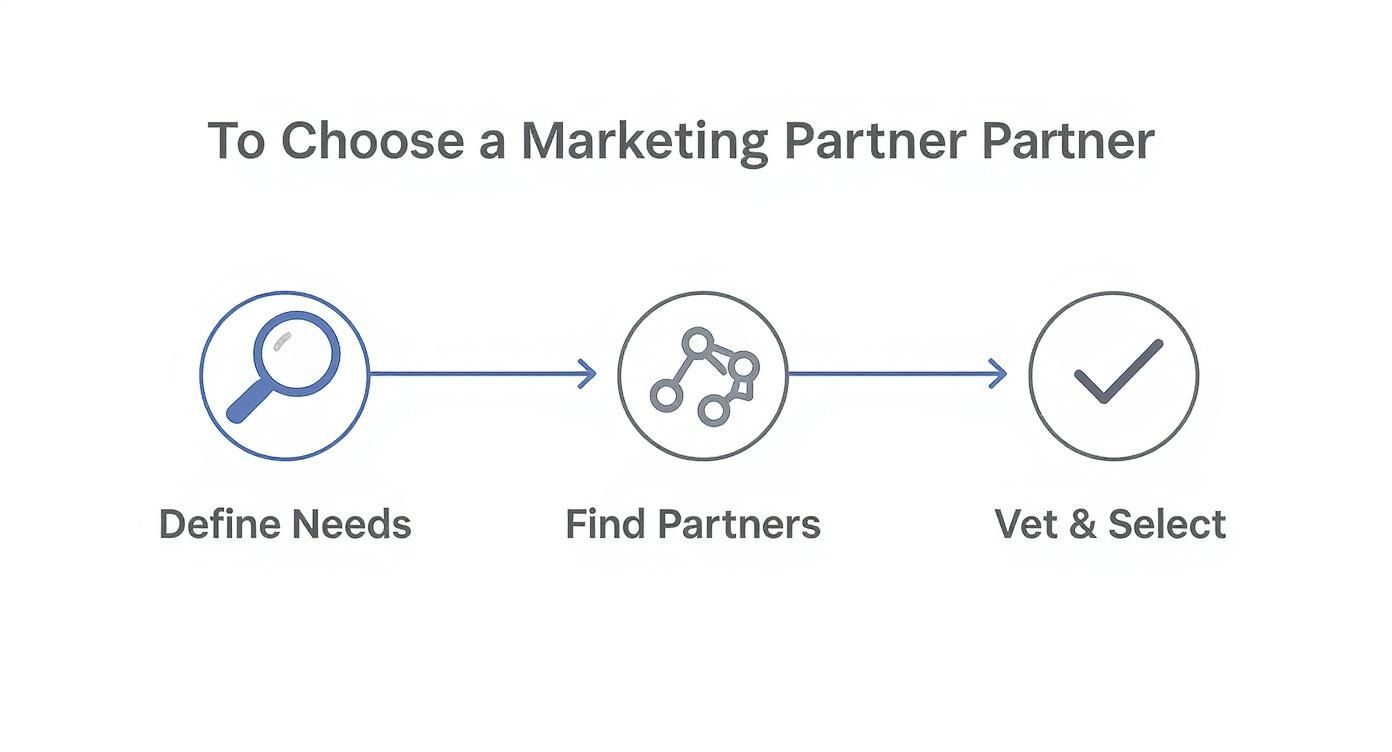
This visual just hammers home a key point: successful management starts way back with a methodical approach to defining your needs and vetting partners.
Establishing Clear Governance and Communication
Once your team is onboarded, the focus shifts to day-to-day management. This isn’t about micromanagement. It’s about creating a system of accountability and transparent communication that keeps everyone aligned and focused on results.
First, lock in a predictable communication rhythm. A well-defined meeting schedule kills the endless email chains and keeps everyone on the same page.
- Weekly Check-Ins: A quick tactical meeting (30 minutes max) to review progress, clear roadblocks, and plan the week ahead.
- Monthly Performance Reviews: A deeper strategic session to review KPIs, analyze campaign results against goals, and make data-driven decisions for the next month.
- Quarterly Business Reviews (QBRs): A high-level meeting to assess overall progress toward business objectives, review the budget, and plan major initiatives for the next quarter.
Second, define what success looks like from the very beginning using the SMART framework (Specific, Measurable, Achievable, Relevant, Time-bound). Vague goals like "increase brand awareness" are useless. Get specific. A much better goal is: "Increase organic search traffic by 15% in Q3 by publishing eight SEO-optimized blog posts."
That kind of clarity means both you and your outsourced partner know exactly what you’re shooting for. It also helps in structuring the team and responsibilities correctly. For more on this, check out our guide on creating a modern B2B marketing team structure, which has insights that apply to both internal and hybrid teams. Ultimately, a well-managed, collaborative environment is what turns an outsourcing arrangement into a powerful engine for growth.
Common Questions About Outsourcing Marketing
Even after you've weighed all the pros and cons, the idea of outsourcing your marketing can still feel like a big leap. It’s totally natural to have a few nagging questions. So let’s tackle the most common ones head-on so you can move forward with confidence.
Think of it like this: you know your destination, you’ve picked your aircraft, and you’ve met the flight crew. This is just the final pre-flight check to ensure a smooth journey.
Will I Lose Control Over My Marketing?
This is easily the biggest fear I hear from founders, and it’s a totally fair one. Handing over your brand’s voice—and your budget—to an outside team sounds pretty unnerving. But a good outsourcing partnership isn't about losing control; it's about gaining leverage.
You’re still the pilot. The best partners, whether it's a fractional CMO or a specialist agency, don't take over—they work with you. They bring strategic recommendations and the horsepower to get things done, but you always have the final say on direction, budget, and messaging.
A strong partnership is built on collaboration, not abdication. The goal is to create a system where your partner brings expert recommendations to the table, and you make the final strategic decisions with more confidence and better data.
Clear communication, regular reporting, and defined approval processes are standard practice. These are the guardrails that keep you in the loop and firmly in command of your brand’s destiny.
Is Outsourcing Just for Big Companies with Huge Budgets?
Not at all. This is a myth that holds back way too many startups. In reality, outsourced marketing services are often more critical for smaller companies that can’t possibly stomach the massive overhead of a fully-loaded in-house team.
The beauty of modern outsourcing is its flexibility. You can hire a specialist freelancer for a one-off project, like an SEO audit, for a few thousand dollars. Or, you can bring in a Fractional CMO for C-suite strategy at a fraction of a full-time executive salary.
- Startups can tap into senior-level strategy and professional execution from day one, leveling the playing field against bigger competitors.
- Scale-ups can use outsourcing to quickly plug skill gaps or scale a specific channel without the long, painful hiring process.
Outsourcing really democratizes access to elite marketing talent. You pay for the expertise you need, when you need it. It’s a highly efficient model for companies at pretty much any stage.
How Quickly Can I Expect to See Results?
Ah, the "how long 'til we get there?" question of marketing. The honest answer? It totally depends on what you're doing. Some tactics are built for speed, others for endurance. Setting realistic expectations from the get-go is crucial.
Here’s a rough timeline for some common marketing plays:
- Paid Advertising (PPC): You can see initial traffic and leads within the first 1-2 weeks. But getting to a strong, predictable ROI usually takes 1-3 months of testing and tweaking.
- Content Marketing and SEO: This is the long game. You might see some early flickers of life, but it typically takes 6-12 months to build real organic traffic and authority. The payoff is huge and sustainable, but it requires patience.
- Marketing Automation and Lead Nurturing: Once you get your email workflows and lead scoring set up, you can start seeing better lead quality and conversion rates within 2-3 months as the system starts working its magic.
A trustworthy partner will give you a clear roadmap with milestones. They'll be upfront and honest about what's realistic. If anyone ever promises you page-one Google rankings in a month, run the other way. Real growth comes from a smart strategy and consistent execution over time.
If you're a B2B tech founder looking for senior marketing leadership to build your growth engine without the full-time executive cost, Value CMO can help. We provide the strategic clarity and hands-on guidance to turn your vision into a measurable, data-driven marketing plan.
Explore how our Fractional CMO services can accelerate your growth