Think of a fractional CMO service as plugging a strategic brain directly into your leadership team. You get on-demand marketing leadership from a seasoned executive without the cost and commitment of hiring someone full-time.
They’re there to drive growth, mentor your staff, and build a scalable marketing engine—all on a part-time basis.
Your Smart Alternative to a Full-Time CMO
For a growing B2B tech company, hiring a full-time Chief Marketing Officer often feels like a catch-22. You desperately need senior-level strategic direction to scale, but a $200,000+ annual salary plus benefits is a total budget-breaker.
This is exactly where a fractional CMO steps in.
It’s about embedding leadership, not just outsourcing tasks. A fractional CMO becomes a real member of your executive team, accountable for high-level outcomes. They don't just hand you a plan and walk away—they own the marketing strategy, build the roadmap, and guide your team to get it done.
This model is all about balancing high-level strategy with team leadership to drive real business growth.
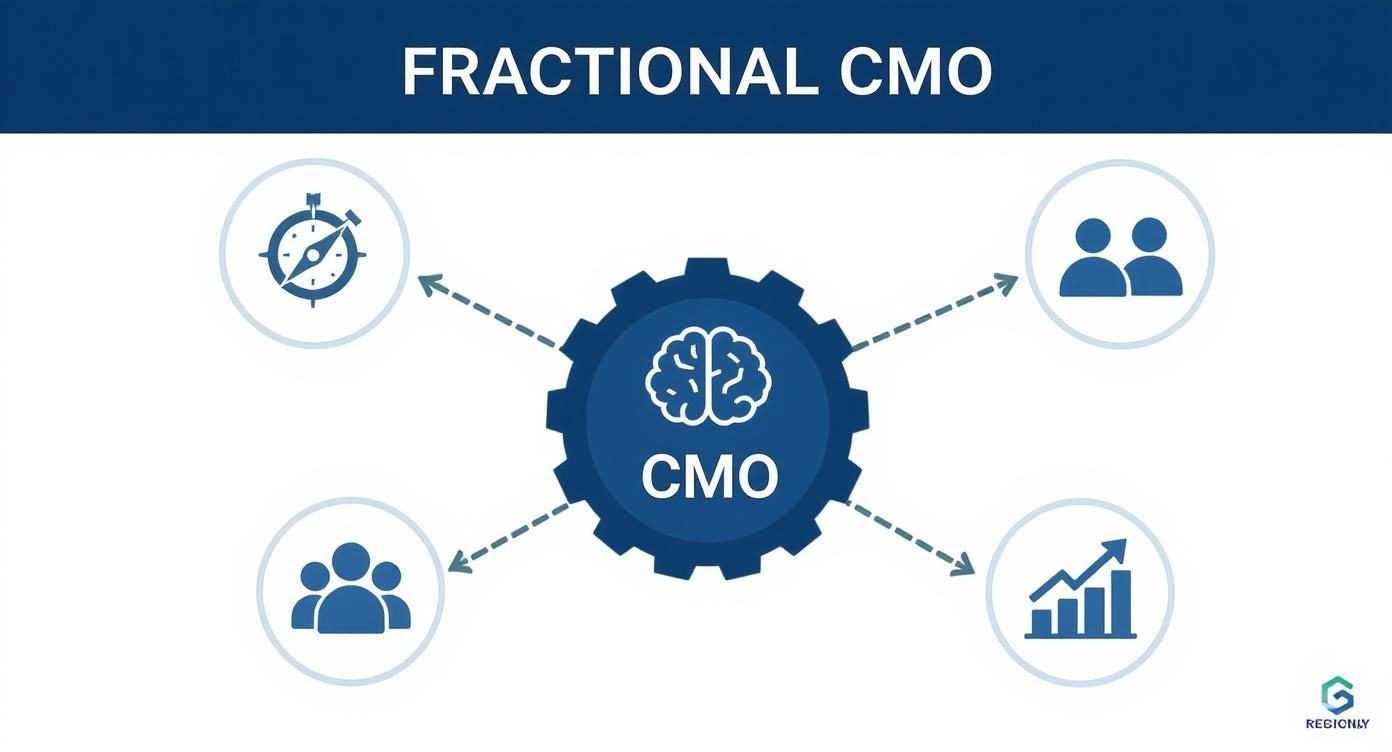
As you can see, their value comes from knitting these critical areas into a cohesive and effective marketing operation.
A Strategist, Not Just a Consultant
Here’s a good way to think about it: a fractional CMO is like a seasoned architect you hire to design and oversee the construction of your dream house. You wouldn't ask the architect to hammer every nail or paint every wall, right? Their job is to create the blueprint, make sure the foundation is solid, and manage the specialist crews (your marketing team) to bring the vision to life.
A fractional CMO focuses on that big picture.
- Building the Marketing Engine: They design the whole system, from brand positioning and messaging to your lead generation funnels and analytics.
- Setting High-Level Strategy: They define the go-to-market plan, nail down your ideal customer profile (ICP), and pick the right channels to reach them.
- Mentoring Your Team: They level up your existing marketing staff, giving them the guidance and structure they need to really shine.
A fractional CMO doesn't just rent you their expertise; they invest it in your company's long-term success, taking real accountability for measurable growth.
Driving Growth and Aligning Teams
A great fractional CMO acts as the connecting tissue between your sales and marketing teams, fixing those broken handoffs and making sure everyone is pulling toward the same revenue goals. They bring a fresh outside perspective that cuts through internal politics and gets the entire organization focused on growth.
For a deeper look into how this kind of leadership can unify your efforts, check out our complete outsourced marketing guide for 2025.
This model is also incredibly cost-efficient. With typical retainers ranging from $5,000 to $15,000 a month, you get top-tier talent for a fraction of what a full-time executive’s total compensation package would set you back.
Fractional CMO vs. Full-Time CMO vs. Marketing Agency
So, how does a fractional CMO stack up against your other options? Each model has its place, depending on your company’s stage, budget, and what you need right now. This table breaks down the key differences to help you decide which path feels right for you.
| Attribute | Fractional CMO Service | Full-Time CMO | Marketing Agency |
|---|---|---|---|
| Cost | $5K – $15K / month (retainer) | $200K+ / year (plus equity, benefits) | $3K – $20K+ / month (project or channel-based) |
| Engagement | Part-time strategic leadership; embedded in your team. | Full-time executive leadership and management. | Task-based execution; functions as an external vendor. |
| Expertise | Broad strategic and leadership experience. | Deep company and industry knowledge over time. | Specialized in specific channels (e.g., SEO, PPC). |
| Best For | Startups & scale-ups needing strategy without the full-time cost. | Mature companies needing dedicated, in-house leadership. | Companies needing to outsource specific marketing tasks. |
Choosing the right partner comes down to what you need most. If it's high-level strategy and team leadership on a flexible basis, the fractional model is often the perfect fit.
Why Fractional Marketing Leadership Is Gaining Momentum
The idea of a fractional CMO service isn't just another trend; it’s a direct answer to the pressures B2B tech founders and CEOs like you are facing. You’re expected to do more with less, all while navigating a marketing world where yesterday's winning tactics are already old news.
This pressure cooker environment has made the old way of doing things—hiring a rigid, expensive full-time executive—feel incredibly risky. Instead, companies are moving toward a more agile and capital-efficient model for strategic leadership.
The New Realities Driving the Shift
Today’s market is defined by tight budgets, fierce competition, and a constant demand for highly specialized skills. Founders simply can't afford to make a six-figure hiring mistake or burn months waiting for a new leader to get up to speed.
Several factors are making fractional leadership the go-to move:
- Economic Pressure and Budget Constraints: When things get tight, the marketing budget is usually the first one on the chopping block. Companies need every dollar to drive revenue, making the high overhead of a full-time CMO a tough sell.
- The Demand for Specialized Skills: Marketing isn't just one job anymore. Expertise in AI-driven analytics, complex MarTech, and data-backed strategy isn't a "nice-to-have"—it's essential. A fractional CMO often brings a wider, more current set of battle-tested skills than any single hire could.
- The Need for Speed and Agility: Markets pivot on a dime. You can bring a fractional executive on board in weeks, not months. That means you can shift your strategy, launch a new product, or optimize customer acquisition funnels without getting bogged down in a traditional hiring process.
Access C-Suite Expertise Without the C-Suite Price Tag
Honestly, the biggest reason for this shift is simple economics. You get the strategic brain of a top-tier executive for a piece of the cost. This isn’t about finding "cheap" help; it's about making a smarter, more efficient investment in high-level leadership.
The market data backs this up. The fractional CMO role has exploded, with a projected 50% increase in positions by 2025. This wave is being led by scale-ups and mid-sized companies that see the average full-time CMO salary—over $250,000 annually—as a non-starter.
A fractional CMO service, typically costing between $6,000 and $20,000 per month, gives them a path to executive-level guidance they can actually afford. This model evens the playing field, letting growing companies compete on strategy, not just the size of their war chest.
By bringing on a fractional CMO, a company isn't just cutting costs—it's reallocating capital from a fixed salary into flexible, high-impact growth initiatives that can be scaled up or down as needed.
A Broader Perspective Solves Problems Faster
Finally, a fractional CMO brings something a full-time hire simply can't: a diverse portfolio of experience from solving the exact same growth challenges at multiple companies, often at the same time. They spot patterns and connect dots across different industries and business models.
This cross-pollination of ideas means they solve your problems faster. They’ve already seen what works (and what bombs) in a dozen similar situations, letting them apply proven frameworks to your business without a long, expensive learning curve. It’s this blend of affordability, deep expertise, and broad perspective that makes fractional leadership such a powerful move.
When Is the Right Time to Hire a Fractional CMO?
Timing is everything. Hire a fractional CMO too early, and you won’t have the team or budget to execute their plan. Wait too long, and you’ll miss a critical growth window while burning cash on tactics that go nowhere.
So, when is that sweet spot? It’s less about your company's age or revenue and more about recognizing specific growing pains. These are the signals that you need high-level strategic direction, not just more activity.
Your Growth Has Stalled or Flatlined
This is the classic trigger. You had a great run with founder-led sales and some early marketing wins, but now the pipeline feels thin and unpredictable. The hustle that got you here just isn't working anymore.
It's a clear sign you've outgrown your initial approach. You're probably caught in a cycle of "random acts of marketing"—a blog post here, a social campaign there—with no real strategy connecting it all. A fractional cmo service is built to fix exactly this by installing a data-driven marketing engine designed for repeatable growth.
Your Marketing Team Lacks Senior Direction
You might have a talented, hardworking marketing team. They’re busy creating content, running ads, and managing social media. The problem? They’re flying without a clear strategic vision, like an orchestra without a conductor.
This usually looks like a team of specialists executing tasks in silos, with no one steering the ship. They need a leader who can connect their daily efforts to the company's financial goals, prioritize what actually matters, and mentor them. A fractional CMO provides that crucial layer of leadership, turning a busy team into an effective one.
Ask yourself this: "Do we need a strategist to build the marketing engine, or just more hands to run the one we already have?"
If the engine is missing, no amount of activity will move the company forward. The fractional CMO is the architect who designs that engine, ensuring every part works together to generate revenue.
The Founder Is the Overwhelmed De Facto CMO
In most B2B tech startups, the founder wears the marketing hat by default. You know the product and market better than anyone, but your time is split a dozen different ways. As the company grows, you become the bottleneck, unable to give marketing the focused attention it demands.
If you find yourself personally approving every social media post or agonizing over ad copy, it’s time to delegate. Handing the strategic reins to a fractional CMO frees you up to focus on product, vision, and fundraising—the high-leverage activities only a founder can do.
Here’s a quick checklist to see if you're there.
- Growth Stagnation: Are your lead and revenue numbers flat month-over-month?
- Strategic Void: Does your team lack a clear, documented marketing plan for the next 6-12 months?
- Founder Burnout: Are you spending more than 25% of your time on marketing tasks instead of core CEO duties?
- Inefficient Spend: Is your marketing budget being spent on disconnected tactics with no clear ROI?
- Team Frustration: Is your marketing team asking for direction or clarity on priorities?
If you answered "yes" to two or more of these, it's a strong sign you're ready for a fractional CMO. This isn't just about offloading work; it's about investing in the strategic foundation your company needs to scale. For a full walkthrough of the process, our guide on how to hire a fractional CMO breaks down every step.
How to Calculate the ROI of a Fractional CMO Service
Let's talk numbers. When you bring on a fractional CMO, you're making a serious investment, and you need to know it’s going to pay off. The immediate cost savings are easy to spot—especially when you compare it to a full-time C-suite salary—but the real win is in the tangible, measurable growth they can spark.
Thinking about return on investment (ROI) isn't just about what you save; it's about what you gain. To make a real business case, we need to get past the simple math and zero in on the metrics that dictate the health and scalability of a B2B tech company.

What Goes Into the Cost?
First, it’s good to know what you’re paying for. Fractional CMO pricing isn’t a one-size-fits-all deal; it typically reflects the depth and intensity of the work needed.
The fractional CMO market is growing fast, and rates vary. Here in the U.S., you'll often see retainers between $10,000 to $20,000 per month. We're also seeing more hybrid models pop up, blending a base retainer with performance bonuses tied directly to your goals—think hitting MQL targets or growing annual recurring revenue (ARR). This approach puts skin in the game and ties their pay to your success.
Look Beyond the Obvious Cost Savings
The simplest ROI calculation compares the fractional cost to a full-time CMO's salary. A fractional leader might cost you $120,000 per year, while a full-time hire with a total compensation package easily tops $300,000+. On paper, you’re saving $180,000. That’s a nice start, but it's just scratching the surface.
A sharp fractional CMO should be a profit center, not a line item on your expense sheet. Their real value comes from driving efficiency, moving faster, and firing up your revenue engine.
The true ROI of a fractional CMO isn't measured by the salary you avoid paying, but by the new revenue you start generating. It's an investment in building a predictable growth engine.
To get the full picture, you have to track their impact on the key performance indicators (KPIs) that really move the needle on your bottom line.
Key Metrics for Measuring the Real ROI
Let's get specific. A fractional CMO’s strategy should directly boost the numbers that your investors and board actually care about.
Here's where to focus:
- Lower Customer Acquisition Cost (CAC): A good strategist finds and cuts wasteful ad spend, funneling your budget into channels that deliver high-value leads. If they slice your CAC by 20%, that’s money you can pour right back into growth.
- Higher Lead Velocity Rate (LVR): Are you getting more qualified leads this month than last? A fractional CMO puts the systems in place to make sure that number climbs month after month, creating a far more predictable sales pipeline.
- Shorter Sales Cycles: By sharpening your messaging, nailing your ideal customer profile (ICP), and optimizing the nurture process, they help your sales team close deals faster. Knocking even a few weeks off the average sales cycle can have a massive impact on your cash flow.
- Growth in Annual Recurring Revenue (ARR): This is the ultimate scorecard. Every marketing effort—better leads, lower CAC, faster closes—should roll up to a clear, measurable lift in ARR.
Sample ROI Calculation for a Fractional CMO
To make this tangible, here's a simplified look at how a B2B tech company might track the impact of a 6- to 12-month fractional CMO engagement. The goal is to connect marketing activities directly to financial outcomes.
| Metric | Baseline (Before fCMO) | Target (After fCMO) | Potential Revenue Impact |
|---|---|---|---|
| Customer Acquisition Cost (CAC) | $8,000 | $6,400 (20% reduction) | $1,600 saved per customer |
| Marketing Qualified Leads (MQLs) | 50/month | 80/month (60% increase) | More pipeline opportunities |
| MQL-to-SQL Conversion Rate | 20% | 25% | Higher quality leads for sales |
| Average Sales Cycle Length | 90 days | 75 days (17% shorter) | Faster cash flow, quicker revenue |
| Annual Recurring Revenue (ARR) | $2M | $2.5M+ (25% increase) | +$500,000 in new ARR |
This example shows that an investment of, say, $120,000 for a year could realistically generate $500,000 or more in new ARR, delivering a clear and compelling return.
By tracking these KPIs, you create a data-backed story of your investment's performance. For a closer look at the formulas and frameworks, check out our guide on how to measure marketing ROI.
Your Guide to Hiring the Right Strategic Partner
Choosing the right fractional CMO can make or break your growth. This isn't just about finding someone with a polished resume; it's about bringing on a true strategic partner who plugs into your leadership team and owns your marketing outcomes.
A smart hire means looking beyond the surface. You need a partner who gets your world, has a proven history of scaling companies just like yours, and actually fits your culture.
What to Look For Beyond the Resume
A great fractional CMO is way more than a list of past jobs. They’re strategic thinkers who become an extension of your team—someone who thinks like a business owner, not just a consultant collecting a retainer.
Here are the non-negotiables you should be screening for:
- Deep Industry Experience: Do they have specific, hands-on experience in B2B tech or SaaS? A leader who has already navigated the exact challenges you're facing can deliver results so much faster.
- A Proven Scaling Track Record: Ask for concrete examples. How did they take companies from one growth stage to the next? Look for evidence of building marketing engines from scratch, not just managing existing ones.
- Cultural and Personality Fit: This person will be working shoulder-to-shoulder with you and your leadership team. Make sure their communication style, work ethic, and personality click with your company’s values. A smooth partnership is a productive one.
Hiring a fractional CMO is not about finding a temporary consultant to deliver a report. It’s about securing a strategic partner who will take ownership of your marketing function and drive it toward measurable, long-term success.
Essential Interview Questions to Ask
Once you've got a shortlist, the interview is your chance to dig into their strategic mind and see how they solve real problems. Your questions should force them to move past theory and show you how they’d handle actual scenarios in your business.
A huge part of a fractional CMO's job is often to spearhead and sharpen the go-to-market plan. It's a key area where the right partner adds massive value. For a deeper dive, exploring resources on Go-To-Market (GTM) strategy consulting can be incredibly helpful.
Use these questions to separate the real strategists from the talkers:
- "Walk me through your first 90 days." This reveals their process. A strong candidate will outline a clear plan focused on discovery, strategy, and quick wins—not just vague promises.
- "How do you define and measure marketing success?" Look for answers tied to business outcomes like pipeline growth, customer acquisition cost (CAC), and annual recurring revenue (ARR). If they lead with vanity metrics like website traffic, that’s a red flag.
- "Describe a time you built a marketing strategy for a company with a limited budget. What were the results?" This tests their resourcefulness and ability to prioritize high-impact moves when every dollar has to count.
- "How would you work with our sales leader to align marketing and sales?" A great fractional CMO service will hammer this point home. They should talk about creating one seamless revenue team, focused on shared goals and metrics.
Finding the right partner is the most important step you’ll take. Take your time, ask the tough questions, and prioritize finding a leader who is genuinely invested in helping you build something great.
A Few Final Questions Founders Ask
Even after seeing the benefits, bringing a fractional CMO into your leadership team is a big decision. Let's walk through the common questions that pop up right before founders and CEOs decide to pull the trigger.
Getting these practical details straight will help you move forward with confidence.
How Much of Their Time Do We Actually Get?
This is a great question because it gets right to the heart of the model's efficiency. While every engagement is different, a typical fractional CMO service lands somewhere between 10-20 hours per week.
But don't get hung up on the clock. This time is laser-focused on high-leverage activities: weekly leadership meetings, one-on-ones with your marketing team, and workshops to push key initiatives forward. The goal isn't to fill a timesheet; it's to deliver strategic leadership that creates momentum for your business.
The real value of a fractional CMO isn't measured in hours. It's measured in the clarity, direction, and momentum they create for your entire marketing function.
Will They Do the Hands-On Execution Work?
It depends, but a true fractional CMO’s main job is strategy, planning, and leadership. Think of them as the architect designing your marketing engine, not the mechanic turning every wrench.
While some are happy to roll up their sleeves for critical, high-level tasks, they aren't there to replace your content writer or digital ads specialist. In fact, a huge part of their role is helping you hire, train, and manage the right team to handle the day-to-day execution.
What’s the Difference Between a Fractional CMO and a Marketing Consultant?
This is a critical distinction. You hire a consultant for a specific, fire-and-forget project—like a market research report or a competitive analysis. Once they deliver the goods, the engagement is over.
A fractional CMO, on the other hand, becomes a real, integrated member of your leadership team for the long haul. They take ownership and accountability for your company's marketing performance. They're your part-time head of marketing, fully invested in seeing you win.
Ready to see how strategic, on-demand leadership can transform your growth? Value CMO provides B2B tech startups with the senior marketing expertise needed to build a scalable revenue engine.