Let’s be honest: a marketing team structure isn’t some rigid org chart you download and fill in. It's a living, breathing blueprint for growth. For B2B tech companies like yours, it’s the operating system that connects your talented people directly to revenue, making sure every single role is pushing the business forward.
Your Blueprint for a High-Growth Marketing Team
Forget the dusty, static hierarchies from old business textbooks. Building a marketing team in B2B tech today is all about putting together a growth engine. The right structure isn't just a list of job titles; it's a huge strategic decision that determines how fast you can move, how well you connect with customers, and how you scale from that first brave marketing hire to a full-blown department.
This playbook cuts through the fluff and gets right to the practical reality of building a team that generates real demand and gives sales the fuel they crave. We’ll get into the nitty-gritty of the core models and help you find the one that actually fits where your business is right now.
Why Your Team's Design Matters More Than Ever
In the old days, marketing departments were often siloed by function—the content people were over here, the ads people were way over there. Today, that’s a recipe for stalled growth. The demands of complex digital channels and long, multi-stakeholder sales cycles require a much more integrated, collaborative design.
How you organize your marketing team is a direct reflection of your company's stage and maturity.
An enterprise, for instance, might have super-specialized teams for SEO, paid media, and product marketing, all reporting up to a VP. But an early-stage startup is far better off with a small, scrappy team of 1–3 versatile marketers who can wear multiple hats. You can get a great feel for these tiered approaches in this breakdown from MarketerHire.com. This shift is all driven by one simple need: the ability to manage intricate channels and make smart, data-backed decisions on the fly.
The goal is to create a structure that's agile enough to adapt to market shifts but stable enough to execute a long-term strategy. It’s a balancing act between specialization and flexibility.
Think of your team structure as a living document—one you should revisit and tweak as your company hits new milestones. The right blueprint ensures your team isn't just another cost center but becomes the primary engine for customer acquisition and revenue.
Choosing the Right Organizational Model
Figuring out your marketing team structure is a lot like picking an operating system for your company. It sets the rules for how information flows, how decisions get made, and ultimately, how fast you can actually grow. This isn't about finding some perfect, one-size-fits-all org chart. It's about picking a model that fits where you are right now.
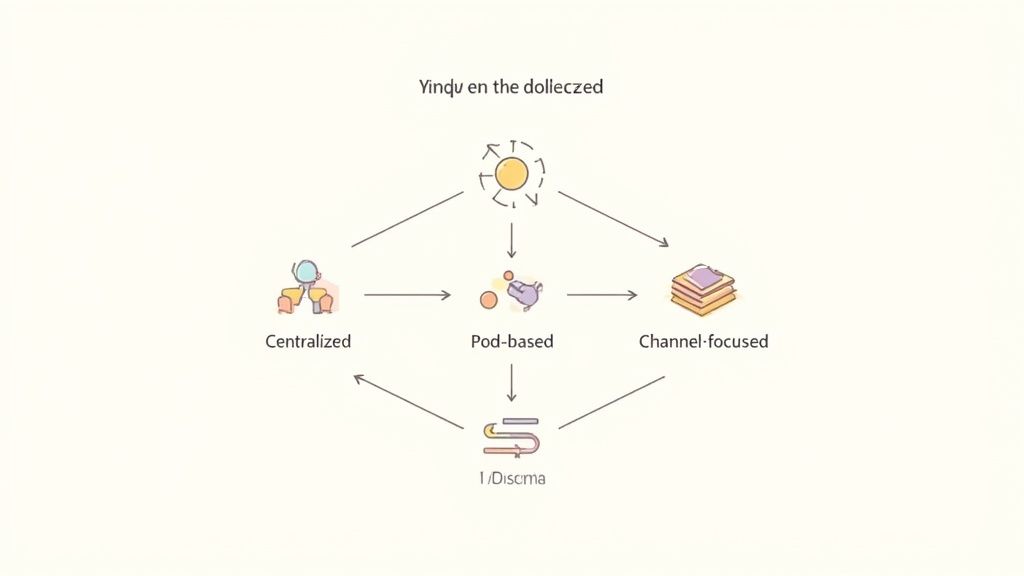
Forget the textbook definitions for a minute. Let's look at the three models that pop up most often in the real world of B2B tech. To make a smart call, it helps to have a baseline understanding of various organizational structure models, from classic hierarchies to more modern, agile setups. This gives you the bigger picture of where these marketing-specific structures fit.
The Centralized Model: Your Command Center
This is the classic starting point for a reason. In a centralized model, every marketing function—demand gen, content, product marketing, you name it—reports up to a single leader, like a CMO or VP of Marketing. Think of it as a central command.
This setup is fantastic for creating a unified brand voice and a consistent customer experience. Everyone is playing from the same sheet of music, which is absolutely critical when you're an early-stage startup trying to carve out an identity. It's also incredibly efficient. Resources can be quickly pointed at the biggest fire or opportunity without getting tangled up in complex reporting lines.
The downside? As you scale, the centralized model can become a serious bottleneck. When every campaign, blog post, and ad creative has to go through one person for approval, things grind to a halt. And if your company starts selling to different customer segments or product lines, this one-size-fits-all approach just won't have the specialized focus you need to win.
The Channel-Focused Model: The Specialist Squad
As a company gets bigger and figures out what works, it often shifts to a channel-focused structure. This is where you organize your team around specific marketing channels. You might have a Head of SEO, a Head of Paid Media, and a Head of Content, each running their own small team of deep specialists.
This model is built for expertise. You let your teams go deep, and they become masters of their domain. Your SEO team isn't getting pulled into social media strategy, and your paid media folks can obsess over ROAS day in and day out. It’s a great fit when you know a few key channels are driving the lion's share of your growth.
The biggest risk here is creating silos. When teams are only judged on channel-specific metrics (like search rankings or click-through rates), they can completely lose sight of the bigger picture—the customer's journey and the company's revenue goals. Without strong leadership forcing them to work together, you can end up with a disjointed customer experience and teams fighting each other for budget.
The best structure is rarely a pure model. Most successful scale-ups use a hybrid approach, blending elements of centralization for brand consistency with the agility of more specialized teams.
The Pod-Based Model: The Agile Task Force
The pod model—sometimes called a squad model—is really taking hold, especially in product-led SaaS companies. The idea is to create small, cross-functional teams (pods) that are 100% dedicated to a specific goal, product line, or customer segment.
A pod isn't just marketers. It might have a marketer, a product manager, an engineer, and a designer all working together. For example, a "New User Activation" pod has all the skills it needs to run experiments, ship features, and hit its number without waiting for permission slips from five different departments. This autonomy makes them incredibly fast and accountable.
Imagine a B2B SaaS company selling two different products: one for huge enterprise clients and another for small businesses. A single, centralized marketing team would struggle to do both well. But if you create two pods, each with its own marketers, you can tailor your messaging and strategy perfectly for each audience.
Of course, this model has its own challenges. It demands strong, autonomous leaders for each pod and can definitely be more expensive to run. Keeping the brand consistent across a bunch of independent pods also takes real, deliberate effort. But for companies that need to move fast and stay laser-focused on the customer, pods are a powerful way to organize for growth.
Defining The Core Roles On Your Team
A brilliant marketing team structure is just a drawing on a whiteboard until you have the right people to bring it to life. Once you’ve landed on your organizational model, the next step is finding the right talent. This is about way more than just filling seats—it's about defining roles so precisely that every single person knows exactly how their work drives revenue.
Let's get past the generic job titles and dive into what success actually looks like for the key players on a modern B2B tech marketing team.
This chart breaks down the marketing models we've discussed, highlighting where each structure puts its focus.
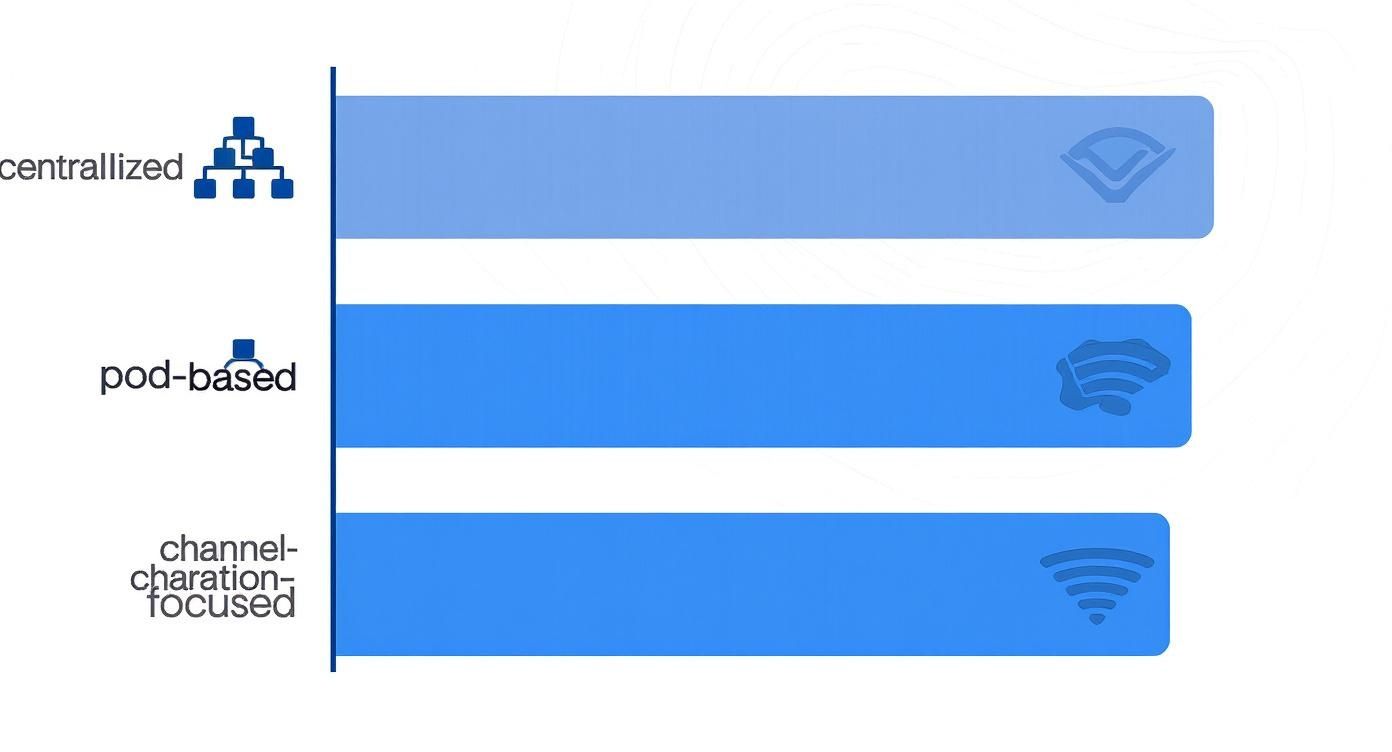
As you can see, each model plays to a different strength—from the top-down consistency of a centralized team to the deep expertise you get with a channel-focused group.
The Growth And Demand Generation Engine
Think of these roles as the engine room of your marketing department. They're the ones directly responsible for filling the sales pipeline and are obsessed with numbers, experiments, and building scalable systems.
- Head of Growth/Growth Marketer: This isn't just a trendy title for a marketer. A true growth marketer is a scientist who lives at the intersection of marketing, product, and data. Their job is to run rapid experiments across the entire customer funnel—from acquisition to retention—to find new, scalable ways to grow the business. Their primary KPI should be tied directly to revenue or user activation.
- Demand Generation Manager: This person is the architect of your lead-generating machine. They own the channels and campaigns that create qualified leads for sales, and their world revolves around metrics like MQLs, SQLs, and pipeline value. They’re masters of paid media, email marketing, and conversion rate optimization on proven channels.
A classic mistake is hiring a "demand gen manager" when what you really need is a versatile growth marketer. The first optimizes known channels; the second discovers new ones. Make sure you know which problem you're solving first.
The Storytellers And Brand Builders
This is the group that creates a compelling narrative to attract and educate your audience. They build the brand's authority and create the assets that fuel the entire demand engine.
- Product Marketing Manager (PMM): Your PMM is the critical link between product, marketing, and sales. They need to understand the customer inside and out, craft powerful messaging and positioning, and arm the sales team with everything they need to win deals. A PMM’s success is measured by product adoption, competitive win rates, and how effective the sales team is.
- Content Strategist/Manager: Your first content hire shouldn't just be a good writer; they need to be a strategic generalist. This person owns the entire content ecosystem, from the editorial calendar to distribution. They understand how to create assets for every stage of the buyer’s journey and should be measured on traffic, engagement, and, most importantly, content-sourced pipeline.
The Crucial Support System
As your team grows, you'll need specialists who make everyone else better at their jobs. These roles build the operational backbone that allows marketing to scale without falling apart.
- Marketing Operations (Ops): Often the unsung hero of a scaling team, Marketing Ops owns the martech stack, manages the data, and builds the automated workflows that keep everything running. They make sure lead scoring is accurate, attribution is clean, and the team has the dashboards they need. A great Ops hire can unlock 10-20% efficiency gains across the entire department.
- Designer: Good design isn't a "nice-to-have." It's essential for building trust in a crowded market. A versatile designer can create everything from website assets and ad creatives to sales decks and ebooks, ensuring your brand looks professional and consistent at every single touchpoint.
Clearly defining these roles is the foundation of a high-performing team. To get this right from the start, you can utilize a Team Role Generator to create clear job descriptions that align with your structure. It’s a simple way to make sure every new hire has a clear, impactful mandate from day one.
How to Sequence Your Marketing Hires
Hiring the right person at the wrong time is one of the most expensive mistakes a startup can make. I’ve seen it happen again and again. You can have the perfect marketing team structure mapped out on a whiteboard, but if you hire a senior VP of Marketing before you have a single repeatable lead source, you’re just burning cash.
The key is to sequence your hires to match your company's actual stage of growth, not the one you wish you were at.
Moving from founder-led sales to your first dedicated marketing hire is a huge step. It’s a signal that you’re ready to build a real engine for growth, not just rely on the founder’s network and hustle. So, who should that first person be?
It’s tempting to go after a big-name leader who has scaled a team before. It feels safe. But it's often a trap. A senior leader is a strategist, a manager, and a budget owner. If you don’t have a team for them to lead or a budget for them to manage, they'll get frustrated, and you won't see the results you need.
Real-World Scenario: The Premature Leader
I once saw a promising Series A startup hire a former VP of Marketing from a well-known tech giant. They spent months searching for the "perfect" leader. But once on board, the new VP was totally lost. Their expertise was in managing a $5 million budget and a team of 15 specialists. The startup needed someone to roll up their sleeves and write copy, set up Google Ads, and figure out basic lead nurturing. The VP was gone within six months, and the company lost a critical window of opportunity.
This is why your first marketing hire needs to be a doer, not a delegator.
Your First Hire: The T-Shaped Marketer
Instead of a senior leader, your first full-time marketer should be a T-shaped marketer. This is someone with a broad understanding of many marketing disciplines (the top of the 'T') but deep, hands-on expertise in one or two specific areas that are critical for your business right now.
For most B2B tech startups, that deep expertise has to be in demand generation. You need someone who can build a pipeline, period.
Their skills might look something like this:
- Broad Skills: Basic SEO, content writing, social media management, email marketing.
- Deep Skills: Paid media (LinkedIn/Google Ads), marketing automation (like HubSpot or Marketo), and analytics.
This person is a versatile athlete. They can write a blog post in the morning, launch a LinkedIn ad campaign in the afternoon, and build a lead-nurturing workflow before they log off. They are laser-focused on generating tangible results—MQLs, demos, and pipeline—from day one.
Scaling From Generalist To Specialist
Once your T-shaped marketer has validated a few channels and started building a predictable flow of leads, it's time to add specialists to pour gas on the fire. Your hiring sequence should follow your momentum.
-
The Content Creator: If your first hire proves that content—like blog posts, case studies, or webinars—is a reliable source of leads, your next hire should be a dedicated content creator. This person takes the content strategy to the next level, scaling production and freeing up your generalist to focus purely on distribution and demand.
-
The Product Marketer: As your sales team grows and the competitive landscape gets tougher, a product marketer becomes absolutely essential. This person owns positioning, messaging, and sales enablement, ensuring your go-to-market message is sharp and your sales team is equipped to win deals.
-
The Marketing Ops Specialist: When your marketing stack gets clunky and your data is a mess (and it will be), it’s time for a marketing ops hire. This person will clean up your CRM, build scalable automation, and create the dashboards that give you real insight into what’s actually working.
This methodical approach ensures each new hire has a clear purpose and adds immediate value.
At this stage, you might also consider bringing in strategic guidance without the full-time cost. Exploring how to hire a fractional CMO can be a smart move to get senior-level strategy to guide your growing team before you're ready for a full-time VP. It’s the perfect way to bridge the gap between tactical execution and high-level planning.
Integrating AI into Your Team's Workflow

Let's get one thing straight: AI isn't coming for your marketing team's jobs. It's coming for the tedious, soul-crushing parts of their jobs—the stuff that gets in the way of high-impact work. The real conversation around AI in a modern marketing team structure isn’t about replacement; it’s about amplification.
Think of it as giving every person on your team a super-powered assistant. Smart tools for content creation, data analysis, and workflow automation are unlocking massive efficiencies. This lets even the leanest teams focus their brainpower on what humans do best: strategy, creativity, and building genuine relationships.
Reshaping Roles, Not Removing Them
The arrival of AI fundamentally changes the job description for many marketing roles. It elevates them from pure tactical execution to strategic oversight. This isn't a future prediction; it's happening right now.
An AI-powered platform can tear through mountains of performance data in seconds, spotting trends that might take a human analyst days to uncover. This doesn't make the analyst obsolete. It transforms their role from a data wrangler into a strategic interpreter, freeing them up to focus on the why behind the numbers and what the team should do next.
This evolution is playing out everywhere. Projections show AI adoption will hit 60% across global marketing departments by the end of 2025. It's a seismic shift where AI takes over routine tasks, allowing marketers to step into more strategic roles. Campaign managers, for example, can now orchestrate 3 to 4 times more initiatives by automating things like data reporting, giving them more time for creative strategy and predictive modeling.
The goal isn’t to "do more with less." It's to "achieve more with the same." AI handles the grunt work, so your team can focus on the growth work.
An AI-Assisted Workflow In Action
So, what does this actually look like day-to-day for a B2B tech marketing team? It means building your structure around an AI-assisted workflow.
-
Content Team: Your writers no longer stare at a blank page. They use AI to generate outlines, speed up research, and produce first drafts. Their role evolves into that of a strategic editor—refining the AI's output with unique insights, brand voice, and customer stories. They can scale production without burnout.
-
Demand Generation Team: Instead of manually A/B testing ad copy for weeks, your demand gen manager uses AI to predict which creative will win before a campaign even launches. They spend their time on high-level audience strategy and offer development, not endless micro-tweaks.
-
Marketing Ops: Your ops specialist leverages AI to build smarter, dynamic lead scoring models and automate complex nurture sequences that adapt to a prospect's behavior in real-time. This turns marketing automation from a rigid, rule-based system into an intelligent, responsive engine.
By weaving these tools into your daily operations, you're not just adding tech; you're redesigning how work gets done. You can unlock immediate impact with simple AI hacks for B2B marketing teams to make this transition feel natural and effective. This approach empowers even small teams to punch way above their weight, driving results that were once only possible for massive enterprises.
How to Lead and Scale Your Marketing Team
Getting the org chart right on paper? That’s the easy part. The real work—and where most startups get it wrong—is the day-to-day leadership that molds a group of talented individuals into a high-octane growth machine.
This is truer than ever in our remote and hybrid world. Leadership isn’t about managing tasks from a corner office anymore. It's about intentionally building a culture of trust, creativity, and accountability, no matter where your people log in from.
Fostering Culture in a Remote World
A strong, creative culture is the bedrock of a scalable team. The move to distributed work has completely changed how marketing teams operate, making intentional leadership non-negotiable. It's a real problem—surveys show that only 23% of employees on remote or hybrid marketing teams feel 'very engaged' at work.
That engagement gap is a killer for creativity and collaboration, especially when you need content creators, analysts, and designers to riff off each other seamlessly. You can dig deeper into the data in this deep dive on virtual team culture.
To fight this, leaders have to be deliberate about creating connection. A weekly team meeting isn't going to cut it.
- Set a Clear Communication Cadence: Create predictable touchpoints. Think daily stand-ups for quick syncs and dedicated weekly sessions for bigger strategic conversations.
- Run Inclusive and Effective Meetings: Every meeting invite should have a clear agenda and a goal. In a hybrid setup, make it a rule: if one person is remote, everyone joins from their own laptop. It levels the playing field instantly.
- Make Space for Casual Connection: A dedicated Slack channel for non-work chatter or scheduled virtual coffee breaks can feel forced, but they work. These small moments build the personal trust that fuels great work.
Setting the Right KPIs and Feedback Loops
As you scale, clear goals and constant feedback are the guardrails that keep everyone pointed in the same direction. Your org chart defines reporting lines, sure, but motivating targets are what actually drive performance.
Don't just hand down revenue goals from on high. Connect each person’s daily work to the bigger picture. A content writer’s KPI isn’t just ‘publish 4 blog posts.’ It’s ‘drive 50 qualified leads from organic search this month.’ See the difference?
To support those KPIs, you need robust feedback loops:
- Regular One-on-Ones: These are non-negotiable. Hold them weekly or bi-weekly, and focus on career growth, roadblocks, and honest feedback—not just a list of project updates.
- Peer Feedback Sessions: Build a culture where team members are comfortable giving each other constructive feedback. This is absolutely vital for pod-based teams where collaboration is everything.
- Celebrate the Experiments: You have to foster a "safe-to-fail" environment. When someone takes a smart risk that doesn’t pan out, praise the attempt publicly. This is how you encourage the innovation needed to find your next growth channel.
Common Questions About Marketing Team Structures
When you're building a B2B marketing team, the questions can feel endless. There’s no single "right" answer—the best marketing team structure depends entirely on your company's stage, goals, and the complexity of your product.
Let's cut through the noise and tackle the most common questions I hear from founders and marketing leaders.
What Is The Best Structure For A Small B2B Startup?
For a tiny B2B startup, usually under $1M ARR, you want a centralized team of one to three marketers who can do a bit of everything. Think of it as a "generalist" model built for pure speed and agility.
Your first marketing hire should absolutely be a "T-shaped" marketer. This is someone with a broad understanding of many channels but deep, hands-on expertise in one or two critical areas, like demand generation or content. This person almost always reports directly to a founder.
This lean setup lets you experiment like crazy and keeps marketing perfectly in sync with the business goals, without getting bogged down by a complex hierarchy.
At this early stage, action is everything. Perfection can wait. A small, tight-knit team can test channels, learn what works, and pivot on a dime without waiting for layers of approval. That’s exactly what a startup needs to find its footing.
When Should We Switch To A Pod-Based Team?
You'll know it's time to consider pods when your company starts serving multiple, distinct product lines or target audiences. The clearest sign is when your single, centralized team becomes a bottleneck.
If one team can no longer give each product or segment the specialized focus it needs to grow, it's time to evolve. This shift often happens as a company scales past the $10M-$20M ARR mark.
Pods empower small, cross-functional teams to own the entire marketing funnel for their specific area. It's a game-changer for increasing both speed and accountability.
How Should We Structure KPIs And Reporting Lines?
Your reporting lines should always be a direct reflection of your org structure. It’s pretty straightforward.
- In a Centralized Model: Specialists (like your SEO or Content person) report up to a functional lead (e.g., Head of Demand Gen), who then reports to the CMO or VP of Marketing.
- In a Pod Model: It gets a bit more complex. Team members often have dual reporting—they report to their pod lead for project-specific goals and to a functional head (like a Head of Content) for career development, skill-building, and best practices.
KPIs have to cascade from the top down. The CMO owns the big revenue targets, the Head of Demand Gen is on the hook for pipeline goals, and a Content Manager is measured on things like traffic and conversions. Every single role's KPIs must clearly support the team's overarching business objectives.
Building and leading a high-performing marketing team requires senior expertise, but startups can't always afford a full-time executive. Value CMO provides fractional CMO services to give your B2B tech company the strategic leadership it needs to build the right team, define your growth plan, and accelerate revenue—without the full-time overhead. Learn more about our approach.