
Let's get one thing straight: marketing operations (MOps) is the engine room of your marketing department. Forget the stuffy definitions for a minute. While your creative and campaign teams are at the helm steering the ship, MOps is the crew below deck, tuning the engine and calibrating the systems to make sure everything runs at peak power.
What Is Marketing Operations, Really?
Think of it like building a high-performance race car. You can have the best driver in the world and a killer paint job, but if the engine isn't finely tuned and the dashboard isn't accurate, you're not winning anything.
Marketing operations is that team of engineers and mechanics. They're the ones who build the performance machine your marketing team runs on, connecting your brilliant strategy to real, measurable execution.
This is the function that stops B2B tech startups from just guessing and hoping for the best. MOps builds the systems, processes, and data frameworks that let you make smart, informed decisions. It’s what turns chaotic, reactive marketing into a predictable, scalable revenue machine. It's how marketing finally gets to prove its value with hard numbers, not just cool ideas.
The Backbone of Predictable Growth
At the end of the day, MOps is all about driving efficiency and effectiveness. A solid MOps function doesn't just manage a bunch of tools; it architects the entire operational framework that marketing lives on. It makes sure every dollar you spend and every hour your team works is tracked, analyzed, and optimized for the best possible return.
To give you a clearer picture, here’s a quick breakdown of what MOps handles.
Marketing Operations at a Glance
| Pillar | Core Responsibility |
|---|---|
| People & Process | Designing and documenting repeatable workflows for everything from lead handoffs to campaign launches. Makes sure everyone knows their role. |
| MarTech Stack | Selecting, integrating, and managing the marketing technology (like HubSpot, Salesforce, etc.) to create a seamless system that works together. |
| Data & Analytics | Ensuring data is clean, accurate, and accessible. Turns raw numbers into reliable business intelligence and performance dashboards. |
| Measurement & Reporting | Creating the reports that track KPIs and clearly demonstrate marketing's impact on revenue. This is how you prove ROI. |
Simply put, a well-run MOps function is what makes scalable growth possible.
Marketing operations transforms marketing from a cost center into a documented, data-backed revenue driver. It provides the structure needed to scale, the data needed to prove ROI, and the efficiency needed to outpace the competition.
By building this foundational layer, MOps frees up the rest of the team to do what they do best: create amazing content, build the brand, and talk to customers. A modern team structure reflects this, with operations playing a central, supportive role. For any B2B tech company, figuring out how MOps fits into your ideal B2B marketing team structure is a critical step for growth. And if you want to go a layer deeper, this guide on What is Marketing Operations? is a great resource.
The Four Pillars of Modern Marketing Operations
To really get what marketing operations is, you have to break it down. A high-performing MOps function isn’t just one thing; it's a balanced system built on four essential pillars that have to work together. Get these pillars strong and aligned, and you've got a foundation for marketing that's efficient, scalable, and actually tied to revenue.
Think of it like building a house. You can't just throw up walls and a roof and hope for the best. You need a solid foundation (Data), a clear architectural blueprint (Process), the right tools and materials (Technology), and a skilled crew to put it all together (People). If any one of those is weak, the whole structure is at risk.
The visual below shows how these systems, processes, and data points connect, with MOps right in the middle.
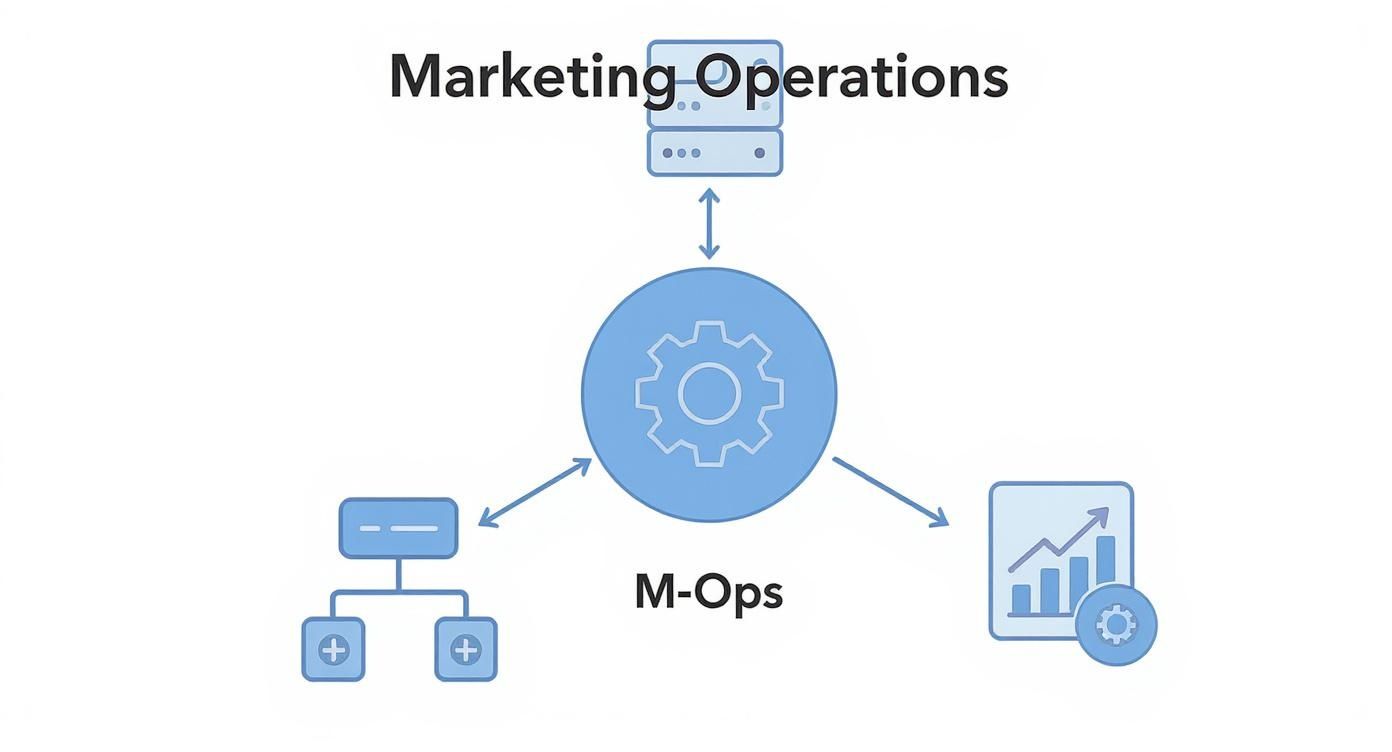
This map isn't just a diagram; it's a picture of MOps acting as the central nervous system, coordinating everything that makes modern marketing run.
Pillar 1 People
At its heart, MOps is driven by people with a very specific, and rare, mix of skills. They’re part strategist, part technologist, and part project manager. This isn’t about filling seats; it’s about having the right roles filled by people who can bridge the gap between a creative marketing idea and the technical work needed to make it happen.
Key roles usually include:
- MOps Managers who run the day-to-day and make sure campaigns go off without a hitch.
- MarTech Specialists who own and optimize the entire technology stack.
- Marketing Analysts who dig deep into the data to pull out insights you can actually use.
Without the right team, the best tech and processes in the world will just gather dust. The people pillar ensures there's both strategic oversight and hands-on expertise to make the whole system fire on all cylinders.
Pillar 2 Process
Process is the blueprint for how work gets done. Simple as that. It’s about building repeatable, scalable workflows that kill chaos and guarantee consistency. For a B2B tech startup where everything moves at light speed, solid processes are what separate the teams that scale from the ones that are constantly putting out fires.
MOps is in charge of architecting and documenting these critical workflows.
A documented process is the difference between "I think this is how we do it" and "This is the proven, most efficient way to get it done." It’s the key to unlocking true scalability and getting new hires up to speed fast.
A classic example is the lead management process. A MOps team designs exactly what happens from the moment a lead hits your CRM to the second it's handed to sales. This covers everything—lead scoring rules, routing logic, and the service-level agreements (SLAs) for follow-up. A bad process here means leads get lost and revenue is left on the table. A good one ensures every single opportunity is handled correctly, every single time.
Pillar 3 Technology
Technology, or the MarTech stack, is all the software and tools your marketing team uses to get work done and measure it. The market is flooded with thousands of tools, and the MOps team is responsible for making sense of it all. This is about way more than just buying the latest shiny object.
Their job is to:
- Select the right tools that solve actual business problems, not just create them.
- Integrate those tools so they talk to each other and share data without breaking.
- Manage the stack to make sure it’s being used correctly and delivering a positive ROI.
When a stack is poorly managed, you get a "Frankenstack"—a clunky, disconnected mess of expensive software that creates more work than it saves. But a well-managed stack acts as a force multiplier, automating grunt work and giving everyone a single source of truth for performance data.
Pillar 4 Data
Data is the foundation holding up the other three pillars. Without clean, accurate, and accessible data, your processes are based on guesses, your tech is useless, and your people are making decisions in the dark. A core function of MOps is to act as the steward of all marketing data.
This job comes with a few key responsibilities:
- Data Governance: Setting the rules for how data is collected, stored, and used.
- Data Hygiene: Regularly cleaning the database to kill duplicates and fix bad entries.
- Reporting and Analytics: Turning raw numbers into clear dashboards that show what’s working, what isn’t, and why.
Ultimately, the data pillar is what allows marketing to stop being seen as a "cost center" and prove its value as a revenue driver. By providing reliable business intelligence, MOps gives leaders the confidence to make strategic, data-backed decisions that fuel real growth.
Measuring Success with MOps KPIs
If you can’t measure it, you can’t prove its value. That simple truth is why marketing operations is so critical. It’s what moves your team beyond vanity metrics like social media likes and website visits to focus on the key performance indicators (KPIs) that actually connect marketing efforts to business growth.
A strong MOps function doesn’t just report on the numbers; it builds the systems that track them with total accuracy. This is the difference between saying, "We got a lot of clicks this month," and confidently stating, "Our latest campaign generated a qualified pipeline worth $250,000."
That kind of precision lets marketing have real conversations with leadership, armed with data that proves its direct impact on the bottom line.
Key Metrics Owned by Marketing Operations
While you can track dozens of metrics, a few core KPIs tell the real story about marketing's contribution to revenue. MOps makes sure the data feeding these numbers is clean, reliable, and automated.
Here are a few of the big ones:
-
Customer Acquisition Cost (CAC): This is the total cost of your marketing and sales efforts to acquire one new customer. MOps ensures every campaign cost is logged and attributed correctly so you know exactly what you're spending to win. A falling CAC means you're getting more efficient.
-
Marketing-Sourced Pipeline: This metric tracks the total value of all sales opportunities that came from marketing activities. It's one of the clearest ways to show how marketing is directly filling the sales funnel with potential revenue.
-
Lead-to-Customer Conversion Rate: What percentage of your leads actually turn into paying customers? MOps builds the lead lifecycle tracking in your CRM to measure this, revealing the true quality of your leads and the health of your funnel.
These aren't just numbers on a spreadsheet; they are vital signs for your business. For a deeper dive, check out our guide on the specific metrics that matter for growth.
From Data Points to Strategic Insights
The real power of marketing operations isn't just tracking KPIs—it's using them to tell a story and guide decisions. When you can trust the data, you can start asking much smarter questions.
A great MOps team doesn't just deliver reports. They deliver insights that lead to action, helping you optimize spend, improve performance, and double down on what’s actually working.
For instance, by analyzing CAC by channel, you might find that your paid search ads cost $5,000 per customer while your content marketing efforts only cost $1,200. That insight immediately tells you where to shift your budget for better returns. To see how these metrics are often visualized, check out these KPI dashboard examples.
The Growing Importance of MOps
Marketing operations has become a central nervous system for companies everywhere, especially as business goes digital. In fact, 91.9% of firms now assign digital responsibilities to marketing, with 76.3% giving analytics duties directly to MOps teams.
This shift shows how MOps now sits at the heart of campaign execution, technology management, and data-driven strategy. The proof is in the performance: companies with mature marketing operations are 2.3 times more likely to beat their revenue targets.
This makes understanding what marketing operations is—and how to measure it—a top priority for any B2B tech startup trying to build a predictable engine for growth.
How AI and Automation Are Reshaping MOps
The future of marketing operations isn’t some far-off concept; it’s already here, and it’s being powered by AI and automation. These aren’t just trendy terms. They’re fundamentally changing how MOps teams work, shifting them from reactive task-doers to proactive strategists.
Think of it this way: traditional MOps is like a skilled pit crew, manually tuning a race car for peak performance. AI and automation add a real-time telemetry system that predicts engine wear before it happens and tweaks the fuel mixture on the fly. It doesn’t replace the crew; it just gives them superhuman foresight and efficiency.

This shift is happening fast. A recent report shows that 72% of high-performing marketing teams now use AI for things like audience segmentation and campaign optimization. More importantly, companies putting AI to work in their operations see a 40% boost in campaign efficiency and a 28% jump in lead conversion rates. The full breakdown is in the 2025 State of Marketing Operations Report.
Automating the Repetitive to Unleash Strategy
At its most basic level, automation is about freeing your team from the tedious, mind-numbing work that eats up their day. This is where MOps can deliver immediate, tangible value.
Just think about the common tasks automation can handle without breaking a sweat:
- Data Hygiene: Automatically cleaning and standardizing new leads the moment they hit your CRM. No more database decay.
- Lead Routing: Instantly assigning new leads to the right sales rep based on territory or company size, killing the manual handoff.
- Reporting: Scheduling and sending out weekly performance dashboards to stakeholders, saving hours of pulling data and building charts.
By taking these jobs off your team's plate, you free up their brainpower. Instead of drowning in operational details, they can focus on analyzing performance, refining lead scoring, or getting more from your MarTech stack.
Automation handles the 'what' so your team can focus on the 'why' and the 'what's next.' It’s how you scale operations without scaling headcount at the same pace.
Using AI for Smarter Decision-Making
While automation follows the rules you set, AI takes it a step further. It learns from data to make predictions and recommendations, essentially turning your historical data into a crystal ball for future performance.
Here’s how AI is already making a real-world impact:
- Predictive Lead Scoring: Instead of a simple points system, AI analyzes thousands of data points to flag the leads most likely to convert, helping sales focus their energy where it counts.
- Dynamic Content Personalization: AI can tailor website content, emails, and ads to individual users in real-time based on their behavior, which dramatically increases engagement.
- Budget Optimization: AI models can analyze campaign data to recommend where to best allocate your marketing budget for maximum ROI. It takes the guesswork out of spending.
Putting AI to work requires a smart approach. It starts with clean, structured data and a clear idea of the business problems you're trying to solve. For a practical look at the available tech, our guide on AI marketing automation tools is a great starting point for B2B tech companies.
The bottom line? AI and automation aren't just "nice-to-haves" anymore. They are essential for any modern, high-performing marketing operations function.
Overcoming Common Marketing Operations Hurdles
Building a solid marketing operations function isn't a straight line. It’s an adventure, and every good adventure has a few dragons to slay. For B2B tech startups, these dragons usually show up when rapid growth starts to expose cracks in the foundation you built on the fly.
The good news? These problems are completely normal. The goal isn’t to dodge every challenge but to know how to fix them when they pop up. By tackling these issues head-on, you can turn operational chaos into a smooth system that actually fuels growth instead of slowing it down.
Let's look at the two biggest beasts MOps teams almost always face: the dreaded "Frankenstack" and the silent killer of bad data.
Taming the Frankenstack
The Frankenstack is what happens when you collect MarTech tools like they're going out of style, but without a clear strategy. You grab a tool for email, another for social, a third for analytics, and before you know it, you’ve built a monster—a messy, disconnected pile of software that creates more manual work than it saves.
This is a classic startup problem. You add tools reactively to solve an immediate pain, but you end up with siloed data, a frustrated team, and a big bill for overlapping features. It's no surprise that many B2B teams only use 58% of their MarTech stack's full potential. Taming this beast starts with a simple but powerful tech audit.
A MarTech audit isn't about blaming anyone for past decisions. It's about making smart, future-focused choices to build a stack that actually serves your business goals.
Running an audit is straightforward:
- List Every Tool: Get a simple list going. What do you pay for? Who uses it? What’s its main job?
- Map Capabilities: Find the overlaps. Are you paying for two different email automation platforms? Why?
- Assess Utilization: Talk to your team. Are they actually using these tools? If not, find out if it's a training issue or if the tool just isn't right for the job.
- Evaluate ROI: Does each tool deliver more value than it costs? Be honest about which platforms are actually driving results versus just looking busy.
This process gives you a clear map to consolidate your stack, cut redundant spending, and make sure your tools finally work together as one cohesive system.
Cleaning Up Dirty Data
The second big hurdle is bad data. It’s less obvious than a clunky tech stack but far more dangerous. Dirty data—incomplete records, duplicates, outdated info—poisons everything your marketing team touches. It leads to embarrassing personalization mistakes, shaky reports, and flawed strategic decisions. When your data is a mess, you can't trust your own insights.
And this problem is everywhere. On average, 20-30% of a company's data is just plain wrong. If a third of your lead data is bad, you're wasting a third of your effort right out of the gate.
The fix is to build strong data hygiene protocols. This isn't a one-and-done cleanup; it’s an ongoing commitment to keeping your database clean and reliable.
Here are the first steps to creating a culture of clean data:
- Standardize Data Entry: Create simple, clear rules for how data gets into your CRM. For example, mandate state abbreviations ("CA," not "California" or "Cali").
- Implement Deduplication Rules: Use your CRM's built-in tools to automatically find and merge duplicate contacts and companies as they're created.
- Schedule Regular Cleanses: Block out time each quarter to run data cleanliness reports. Use that time to fix errors, scrub inactive contacts, and enrich records that are missing key info.
By fixing your processes for both technology and data, you turn your marketing operations from a source of friction into a powerful engine for predictable, scalable growth.
When to Invest in Marketing Operations
So, you know what Marketing Operations is. But when do you actually pull the trigger and invest in it?
It’s a tricky question because rapid growth can easily mask the cracks forming in your foundation. Things might feel like they're working, but underneath, chaos is brewing. Repetitive manual tasks, inconsistent campaign results, and a nagging feeling that you’re flying blind are all classic early warning signs.
Think about your team spending hours manually routing leads, only to find out valuable prospects are still falling through the cracks. That’s a MOps problem.
You’re likely hitting the tipping point if you recognize a few of these headaches:
- Broken lead follow-up is letting high-value prospects go cold.
- You have no clear ROI reporting that connects marketing spend to actual pipeline.
- Your customer data is a mess—a data chaos of duplicates and missing fields.
- Your MarTech stack feels more like a tangled mess of wires than a well-oiled machine.
When two or more of these sound painfully familiar, it’s officially time to get serious about building a real MOps function.
Identifying Your Growth Signals
Once you’ve spotted the triggers, you need a smart way to decide how to plug the holes. Your path forward depends on your budget, your timeline, and the specific skills you’re missing.
- Start with an honest look at your team's internal bandwidth and expertise.
- Run the numbers: what’s the true cost of a full-time hire versus bringing in a fractional CMO?
- Line up your decision with your revenue goals. How fast do you need to move?
“Investing in operations is like tuning a car engine before a race; neglect it and you won’t finish.”
A clear-eyed assessment here will save you from either overspending or under-investing, both of which can stall your momentum.
Weighing Your Hiring Options
You generally have three ways to build up your MOps muscle:
| Option | Pros | Cons |
|---|---|---|
| Full-Time Specialist | Deep, dedicated expertise | High overhead and a long ramp-up time |
| Fractional CMO (Value CMO) | Senior leadership on demand | Limited hours, works as an external partner |
| Consultancy Project | Delivers on a focused project | No ongoing ownership or accountability |
A full-time hire is a great move if you have a steady budget and enough work to keep them busy. But let’s be real—recruiting the right person can take months, and the salary can be a heavy lift for a growing company.
The fractional CMO model from Value CMO, on the other hand, gives you access to seasoned leadership without the full-time price tag. You get a strategic roadmap, expert advice on your martech stack, and hands-on coaching for your team.
Making the Best Choice
Before you make a move, get clear on a few things:
- What are your most painful, immediate needs versus your long-term goals?
- Who on your team currently owns process, people, technology, and data? Map it out.
- Define what success looks like. Is it pipeline growth, a lower CAC, or better conversion rates?
By tying your investment to a concrete KPI—like reducing Customer Acquisition Cost by 20%—you build in accountability from day one.
Key takeaway: Don’t guess when it’s time to hire for MOps. The signals are usually clear. Just make sure you pick the right model for your specific growth stage.
In the fast-paced world of B2B tech, waiting for your processes to completely break down before investing in MOps is a surefire way to lose momentum. If manual work, bad data, or a fuzzy ROI are holding you back, it's time to act.
Whether that means hiring your first specialist or partnering with a fractional CMO like Value CMO, the choice you make today will build the predictable growth engine you need for tomorrow.
Growth always starts with getting your operations right. Contact Value CMO to talk about your roadmap.
Common Questions About Marketing Operations
As you start digging into MOps, a few questions always pop up. Let's clear the air on the big ones, whether you're a one-person show or scaling fast.
Is Marketing Operations the Same as Marketing Automation?
That's a big one, and the answer is a hard no. They work together, but they’re not the same thing.
Think of it like a professional kitchen. Marketing operations is the entire system—the head chef designing the menu (strategy), the layout of each station (process), the inventory system (data), and how the whole crew works together.
Marketing automation, on the other hand, is one specific piece of equipment, like a high-tech convection oven. It’s a vital tool, for sure, but it’s only one part of the whole operation.
Marketing automation is a toolset; marketing operations is the strategic framework that makes those tools actually work. You can switch on automation without MOps, but you won't do it well or scalably.
How Can a Small Startup Start with MOps on a Tight Budget?
You don't need a huge team or a pricey tech stack to get the benefits of a MOps mindset. For an early-stage B2B startup, the first steps with the biggest impact are often free—they just cost you a bit of focused time.
Start with these two areas:
- Map Your Process: Grab a whiteboard and sketch out your current lead management flow. How does a prospect get from a form submission into the hands of a sales rep? Just getting it down on paper will immediately show you where the leaks and bottlenecks are.
- Clean Your Data: Block out a few hours and get into your CRM. Merge duplicate contacts, standardize job titles, and make sure key fields like industry and company size are actually filled in. This simple move improves your targeting and makes your reporting more accurate overnight.
What's the First Step to Building a MOps Function?
If you’re ready to build a real MOps function from scratch, it's easy to get overwhelmed. The trick is to start with a quick audit before you start buying or building anything new. Don't jump straight to hiring someone or signing up for new software.
Here’s a simple, three-step plan to get started:
- Audit Your Stack: List every single marketing tool you pay for. What does it do? Who uses it? Is it actually delivering any value?
- Document Your Core Processes: Write down, step-by-step, how you run your top three marketing plays (e.g., webinar promotions, lead nurturing, monthly reporting).
- Find the Biggest Pain Point: Looking at your audits, what’s the one thing causing the most friction? Is it bad data? A broken handoff between marketing and sales? Fix that one thing first.
This approach ensures you’re solving a real, immediate problem, which builds momentum and proves the value of MOps right away.
Ready to build a marketing function that drives predictable growth without the overhead? The team at Value CMO provides the senior leadership to build your strategic roadmap, fix your operational hurdles, and scale your revenue engine. Learn more at https://valuecmo.com.