Tired of the same old marketing advice? It’s easy to get lost in a sea of buzzwords and theories. What really sets high-growth B2B companies apart is how they take proven strategies and execute them with a dash of creativity and a ton of precision. The problem isn't a lack of information—it's knowing what truly works and why.
You don't just need definitions. You need a playbook.
This article cuts through the noise to give you 10 powerful B2B marketing strategy examples, diving deep into what makes them tick. We're not just listing companies; we're breaking down their tactics, getting inside their strategic thinking, and showing you the steps you can actually replicate. For each example, we'll unpack:
- The Strategy: What they did and the big idea behind it.
- The Execution: A look at the specific channels and tactics they put into play.
- The Takeaways: Actionable insights you can start using for your own growth.
Let's ditch the abstract concepts and get real. We'll explore real-world campaigns that built authority, generated pipeline, and drove revenue. Think of these as blueprints for building your own marketing success story.
1. Account-Based Marketing (ABM)
Imagine flipping the traditional marketing funnel upside down. That's Account-Based Marketing (ABM). Instead of casting a wide net and hoping for the best, ABM is a super-focused strategy that treats your most valuable accounts like their own little markets. It’s all about getting your sales and marketing teams to work together, creating personalized campaigns that speak directly to the key decision-makers within a handful of target companies.
This laser focus is what makes it one of the most powerful b2b marketing strategy examples, especially if you have a complex, high-value sales cycle. It's about building real relationships, not just racking up a high volume of so-so leads.
Key Example: Salesforce
Salesforce is a pro at using ABM to land and expand its footprint in Fortune 500 companies. Their teams pinpoint key accounts, map out everyone on the buying committee, and then create content and events tailored to each person's specific challenges. This "white-glove" approach shows they've done their homework and truly understand the client's business—a game-changer for closing massive deals.
Actionable Takeaways for Your Strategy
- Start Small: Don't try to boil the ocean. Kick things off with a pilot program targeting 10-20 accounts to iron out your process.
- Personalize Your Content: Create custom case studies, webinars, or proposals that speak directly to the unique pain points of each target account.
- Team Up: Make sure your sales and marketing folks are talking constantly, sharing insights, and coordinating their outreach for a smooth customer experience. For more on this, check out some B2B lead generation best practices.
2. Content Marketing & Thought Leadership
Content Marketing & Thought Leadership is the long game. It's all about creating and sharing valuable, relevant, and consistent content to attract and keep a specific audience. The end goal? To establish your company and its leaders as the go-to experts in your industry. This strategy builds trust long before anyone is even thinking about buying.

By offering helpful resources like whitepapers, original research, and insightful blog posts, you're directly addressing your audience's problems. That's why it's a must-have in any list of b2b marketing strategy examples. It fuels lead generation, helps your sales team, and cements your brand's authority. To see these ideas in action, take a look at these B2B content marketing examples.
Key Example: HubSpot
HubSpot wrote the book on B2B content marketing. They built their entire marketing machine around giving away free, high-value content through their blog, academy, and reports like the "State of Inbound." This educational approach pulls in millions of visitors, generates a massive number of leads, and has positioned them as the ultimate authority on inbound marketing—all while gently nudging you toward their software.
Actionable Takeaways for Your Strategy
- Create Cornerstone Content: Develop a massive, in-depth guide or report on a core topic in your industry. This can act as a central hub for lots of smaller, related content pieces.
- Repurpose Like a Pro: Turn one big piece of content, like a webinar, into a bunch of different assets: blog posts, social media snippets, infographics, and email newsletters.
- Bring Your Own Data: Stand out from the crowd by conducting your own surveys or research. Unique data gets shared, earns backlinks, and builds some serious authority. To dive deeper, review some B2B content marketing best practices.
3. LinkedIn-Based Marketing & Social Selling
LinkedIn-Based Marketing & Social Selling is about using the world's biggest professional network to build your brand's authority, find high-quality leads, and start real sales conversations. This strategy involves both your marketing and sales pros using the platform to research prospects, build genuine relationships, and create opportunities through sharing great content, encouraging employee advocacy, and targeted outreach.
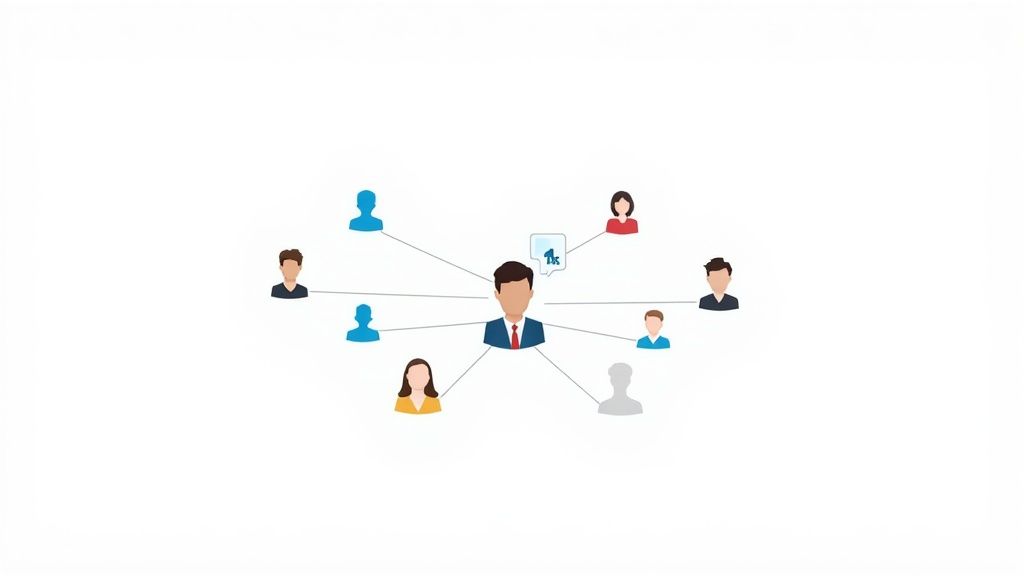
It has become one of the most essential b2b marketing strategy examples because it gives you a direct line to decision-makers in a professional setting. This approach is fantastic for building credibility and nurturing prospects long before they're ready to buy, making your sales cycle a whole lot smoother.
Key Example: IBM
IBM's employee advocacy program on LinkedIn is a perfect example of social selling done right. The company encourages thousands of its employees—from engineers to execs—to share company content and their own industry insights. This tactic massively expands IBM's reach and gives the brand a human face, building trust in a way a corporate page never could. It essentially turns their entire workforce into a powerful, authentic marketing team.
Actionable Takeaways for Your Strategy
- Start an Employee Advocacy Program: Give your team pre-approved content and encourage them to share it. You'll tap into their collective networks and give your brand's visibility a huge boost.
- Post Consistently: Aim to share valuable content 3-5 times a week. Mix it up with different formats like text-only posts, videos, and articles to keep your audience engaged.
- Use LinkedIn Sales Navigator: For a more targeted approach, use Sales Navigator to find key decision-makers, understand what they care about by seeing their activity, and engage with them in a meaningful way.
4. Email Marketing & Marketing Automation
Email marketing, especially when you add automation to the mix, is still a powerhouse for B2B communication. This strategy goes way beyond your standard newsletter. It's about using automation platforms to send personalized, timely messages based on what a prospect does, who they are, and where they are in their buying journey. It lets you nurture leads at scale, guiding them from curious to sales-ready without a ton of manual work.
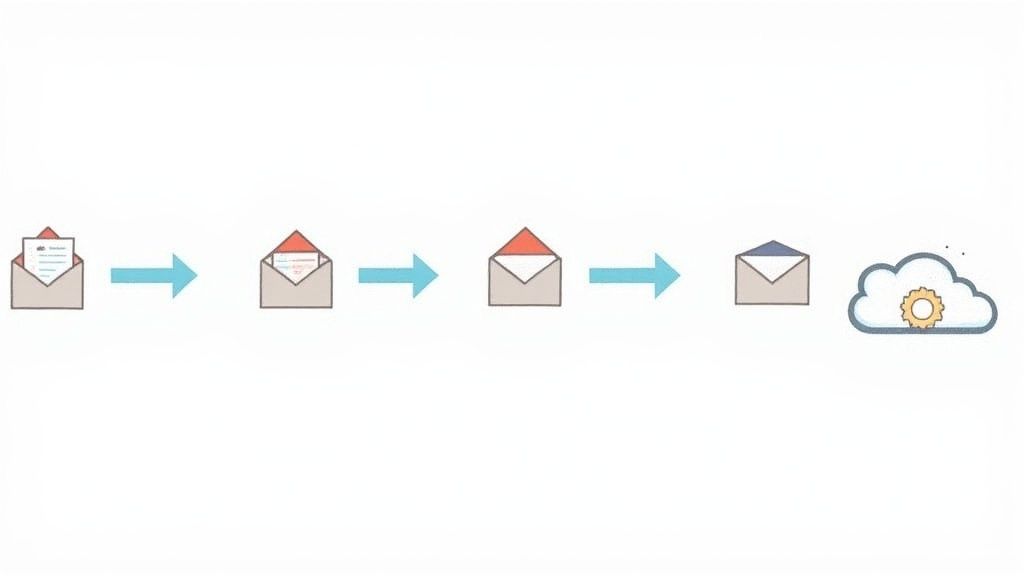
This powerful combo is one of the most effective b2b marketing strategy examples because you're building a direct line to your potential customers, delivering value right to their inbox. It’s fantastic for building relationships, educating prospects, and flagging the hottest leads for your sales team.
Key Example: HubSpot
Naturally, HubSpot is a master of its own game, using its software to run some seriously sophisticated email automation. When you download one of their ebooks, you're automatically dropped into a nurture sequence. The emails you get next offer related content, webinars, and product info, all triggered by what you've already clicked on. This smart, behavioral approach ensures every email feels helpful, not just pushy.
Actionable Takeaways for Your Strategy
- Segment Your Audience: Please don't send the same email to everyone! Group your lists by industry, job role, or engagement level to make sure your message really hits home.
- Set Up Lead Scoring: Give points to leads based on their actions (like opening an email or visiting your pricing page). This helps you automatically see who's ready for a sales call.
- Create Nurture Sequences: Build automated email workflows that educate new leads and gently guide them through the process of considering your solution. To get started, you can explore some tips on how to implement marketing automation.
5. SEO & Organic Search Marketing
Search Engine Optimization (SEO) is all about making your website more visible on search engines like Google. For B2B companies, it's about grabbing the attention of decision-makers who are actively looking for solutions. You do this by targeting the specific, high-intent keywords they use during their (often long) buying journey. It's a long-term investment that builds a steady stream of highly qualified, inbound traffic.
A solid SEO plan is one of the most powerful b2b marketing strategy examples because it positions your brand as a trusted expert. When you consistently show up with the answers to your audience's biggest questions, you build credibility and attract leads who already know they have a problem and are looking for a fix.
Key Example: HubSpot
HubSpot is the gold standard for B2B content and SEO. They've built a massive library of incredibly valuable content—blogs, templates, free tools—all optimized for keywords their ideal customers are searching for. Their "Topic Cluster" model, where a central "Pillar Page" links out to related, more specific content, has helped them dominate the search results for countless marketing and sales terms, driving millions of organic visitors every single month.
Actionable Takeaways for Your Strategy
- Map Keywords to the Buyer Journey: Figure out which keywords people use when they're just becoming aware of a problem ("how to improve sales productivity"), when they're considering options ("best CRM for small business"), and when they're ready to decide ("HubSpot vs. Salesforce").
- Create Topic Clusters: Build comprehensive content hubs around your core business topics. Start with a big, long-form pillar page and support it with detailed blog posts that all link back to it.
- Don't Forget Technical SEO: Make sure your site is fast, mobile-friendly, and easy for search engines to crawl. Even the best content in the world won't matter if your site has a weak technical foundation.
6. Events & In-Person/Virtual (Webinars, Trade Shows & Conferences)
Events, whether you’re shaking hands at a trade show or connecting through a screen in a webinar, are amazing platforms for direct engagement. They give B2B companies a chance to educate prospects, show off complex products, and build real relationships in a focused environment. This strategy helps you cut through the digital noise and create memorable, interactive experiences for your brand.
By bringing together a captive audience, events become a powerful tool for generating and nurturing leads. This face-to-face (or screen-to-screen) interaction makes it one of the most effective b2b marketing strategy examples for building trust quickly and moving prospects further down the sales funnel.
Key Example: HubSpot
HubSpot’s annual INBOUND conference is the perfect example of event marketing done right. It started as a small user conference and has blossomed into a massive, industry-defining event that pulls in tens of thousands of marketers and business leaders. By mixing high-value educational sessions, celebrity speakers, and tons of networking, HubSpot solidifies its place as a thought leader while generating a huge pipeline of qualified leads.
Actionable Takeaways for Your Strategy
- Solve a Specific Problem: Design your event, especially a webinar, around a single, pressing challenge your target audience has. This will guarantee better attendance and engagement.
- Promote Like Crazy: Start promoting your event at least 2-3 weeks ahead of time across email, social media, and paid ads to get as many people signed up as possible.
- Plan an Aggressive Follow-Up: Have a multi-touch follow-up sequence ready to go within 24-48 hours after the event to turn those warm leads into sales conversations. To make sure your online events are a hit, getting familiar with virtual event best practices is key.
7. Paid Advertising (PPC, LinkedIn Ads, Display)
Paid advertising gives you a direct and scalable way to get your brand in front of the right B2B buyers. Unlike organic strategies that can take a while to gain traction, paid channels like Google Ads and LinkedIn Ads give you immediate visibility. They let you target prospects with incredible precision based on things like their job title, industry, company size, and online behavior.
This speed and accuracy make paid advertising one of the most powerful b2b marketing strategy examples for generating qualified leads fast and testing out new marketing messages. It’s like placing your solution directly in the path of decision-makers who are actively looking for it.
Key Example: ServiceTitan
ServiceTitan, a software platform for contractors, has built a massive business on the back of smart, aggressive paid advertising. They dominate search results for keywords in their industry (like "plumbing software") and use sophisticated LinkedIn campaigns to target business owners. By mixing high-intent search ads with super-targeted social ads, they capture existing demand and build brand awareness at the same time, creating a powerful engine for growth.
Actionable Takeaways for Your Strategy
- Target with Precision: Use LinkedIn's powerful targeting options to run campaigns aimed at specific job titles and company lists. This makes your ad spend much more efficient.
- Optimize Your Landing Pages: Make sure that when someone clicks your ad, they land on a dedicated, high-converting page with a clear call-to-action and no distractions.
- Use Remarketing: Re-engage prospects who visited your site but didn't convert. You can serve them targeted ads on social media or other websites to keep your brand top-of-mind.
8. Referral & Partner Marketing Programs
Referral and partner marketing programs turn your network of happy customers, industry friends, and strategic allies into a powerful lead-gen machine built on trust. Instead of doing all the work yourself, this strategy incentivizes and empowers others to send qualified prospects your way. This creates a high-conversion channel that leverages existing relationships.
This approach is one of the most cost-effective b2b marketing strategy examples because it taps into the credibility of people who already know and trust you. A warm introduction from a trusted source is so much more impactful than a cold email, often shortening sales cycles and boosting win rates.
Key Example: HubSpot
HubSpot's Solutions Partner Program is a masterclass in B2B partner marketing. They give marketing agencies the training, resources, and co-marketing support they need to sell and service HubSpot's software. This creates a win-win ecosystem where partners grow their own businesses by bringing new customers to HubSpot, and those customers get expert help. This program is a huge reason for HubSpot's dominance, creating a massive, motivated, and highly skilled external sales team.
Actionable Takeaways for Your Strategy
- Create Clear Incentives: Offer compelling rewards like commissions, revenue sharing, or exclusive perks that motivate partners and customers to send new business your way.
- Make Referring Easy: Give people a simple, trackable way to submit referrals. Arm your partners with pre-made marketing materials, messaging, and sales guides.
- Nurture Your Network: Treat your partners like an extension of your team. Keep in regular contact, offer support, and recognize their contributions to keep them engaged and successful.
9. Case Studies & Social Proof Marketing
Case Studies and Social Proof Marketing is a strategy that’s all about building trust by showing off real customer success. Instead of just telling prospects your solution works, you show them. This approach uses detailed customer stories, testimonials, and other forms of validation from real people to prove your value and quiet any doubts a buyer might have.
This is a cornerstone among b2b marketing strategy examples because it provides the hard evidence that decision-makers crave. It shifts the conversation from abstract benefits to proven, real-world results, which is incredibly persuasive when a buyer is close to making a decision.
Key Example: Slack
Slack's customer stories are a perfect example of social proof. They don't just list features; they show you exactly how companies like Intuit and Trivago completely transformed their internal communication. By organizing their stories by industry and company size, Slack lets potential customers see a reflection of their own challenges and imagine a similar success story for themselves.
Actionable Takeaways for Your Strategy
- Use the Challenge-Solution-Result Framework: Structure your case studies to tell a compelling story. Start with the customer's pain point, explain how you helped, and finish with specific, measurable results.
- Quantify Everything: Numbers are powerful. Metrics like "reduced project time by 30%" or "increased team efficiency by 25%" are much more convincing than vague statements.
- Diversify Your Proof: Don't just stick to written case studies. Create video testimonials, plaster client logos on your homepage, and use powerful quotes in your sales decks to build a wall of social proof.
10. Influencer & Executive Advocacy Programs
Influencer and executive advocacy programs use the credibility of trusted voices to get your marketing message out there authentically. Instead of just relying on branded ads, this strategy involves partnering with industry experts and encouraging your own internal leaders to build their personal brands. They share insights and endorsements that really connect with niche audiences.
This approach puts a human face on your B2B company. It's one of the most powerful b2b marketing strategy examples for building trust and establishing yourself as a thought leader in a noisy market. A recommendation from a respected peer often carries a lot more weight than traditional marketing.
Key Example: Hootsuite
Hootsuite was one of the first to really nail employee advocacy. Their program empowers thousands of employees—from the C-suite to customer support—to act as brand ambassadors on social media. By giving them curated content and easy-to-use sharing tools, Hootsuite massively increased its social reach, turning its own team into a highly effective and authentic marketing channel.
Actionable Takeaways for Your Strategy
- Empower Your Internal Leaders: Find executives who are genuinely interested in building a professional profile and give them content support, talking points, and a clear social media plan.
- Focus on Authenticity: Encourage your advocates to share their own unique perspectives, not just sales pitches. The goal is to build a community and earn trust.
- Make Sharing Effortless: Use tools to create a library of pre-approved social media posts that employees can easily share with their networks in just a few clicks.
10 B2B Marketing Strategies Comparison
| Strategy | Implementation Complexity 🔄 | Resource Requirements & Scalability ⚡ | Expected Outcomes & Impact ⭐📊 | Ideal Use Cases 💡 | Key Advantages ⭐ |
|---|---|---|---|---|---|
| Account-Based Marketing (ABM) | High 🔄 — cross-team coordination, deep account research | High resources; low scalability without automation or larger team ⚡ | Very high-value deals and ROI for targeted accounts; longer sales cycles 📊 | Enterprise deals, strategic renewals, high-value target accounts 💡 | Hyper-personalization, sales-marketing alignment, clear attribution ⭐ |
| Content Marketing & Thought Leadership | Medium 🔄 — ongoing editorial process and expertise | Moderate resources; highly scalable over time with evergreen assets ⚡ | Builds long-term trust and organic lead flow; lower CPL over time 📊 | Brand building, demand generation, executive positioning, SEO support 💡 | Evergreen assets, authority building, cost-effective long-term ROI ⭐ |
| LinkedIn-Based Marketing & Social Selling | Medium 🔄 — platform management, consistent posting & outreach | Moderate resources; scalable via employee advocacy and ads ⚡ | High-quality leads and direct access to decision-makers; variable ROI 📊 | B2B professional services, account targeting, sales outreach 💡 | Professional targeting, networking, employee amplification ⭐ |
| Email Marketing & Marketing Automation | Medium-High 🔄 — workflow setup, integration, data hygiene | Low–Moderate resources; highly scalable personalization at volume ⚡ | Very high ROI and measurable pipeline generation; predictable nurture outcomes 📊 | Lead nurturing, onboarding, lifecycle marketing, lead qualification 💡 | Measurable, scalable personalization, excellent ROI per spend ⭐ |
| SEO & Organic Search Marketing | High 🔄 — technical SEO + content + link building | Moderate–High resources; long-term investment with compounding returns ⚡ | Sustainable, high-quality organic traffic and low long-term CPL (6–12+ months) 📊 | Long-term demand gen, content hubs, high-intent search capture 💡 | Sustainable traffic growth, authority, cost-efficiency over time ⭐ |
| Events & In-Person/Virtual (Webinars, Trade Shows) | Medium-High 🔄 — logistics, promotion, platform management | Moderate–High resources; virtual lower cost, in-person costly to scale ⚡ | Strong direct engagement and high-quality leads; immediate interactions 📊 | Product demos, thought leadership, networking, launch events 💡 | Direct engagement, networking, repurposable content for demand gen ⭐ |
| Paid Advertising (PPC, LinkedIn Ads, Display) | Medium 🔄 — campaign setup, continuous optimization | High budget potential; highly scalable by spend ⚡ | Immediate visibility and leads; measurable ROI but higher CPL in competitive spaces 📊 | Fast lead generation, demand capture, complement organic ramp-up 💡 | Speed to market, precise targeting, clear attribution ⭐ |
| Referral & Partner Marketing Programs | Medium 🔄 — partner enablement, tracking and incentives | Low–Moderate resources; hard to scale quickly without broad networks ⚡ | Very high conversion rates and low CAC; slower volume growth 📊 | Viral SaaS growth, channel expansion, customer advocacy programs 💡 | Trusted recommendations, high conversion, low acquisition cost ⭐ |
| Case Studies & Social Proof Marketing | Low–Medium 🔄 — content creation, approvals from customers | Low resources but requires willing customers; scalable through repurposing ⚡ | Highly influential for late-stage buyers; improves close rates and trust 📊 | Sales enablement, late-stage evaluation, proposal support 💡 | Demonstrates real results, reduces buying risk, easy to repurpose ⭐ |
| Influencer & Executive Advocacy Programs | Medium 🔄 — relationship building and content coordination | Low–Moderate resources; depends on executive/influencer availability ⚡ | Increased reach and credibility; engagement lift but ROI harder to attribute 📊 | Brand awareness, executive positioning, niche audience engagement 💡 | Authentic endorsements, amplified reach, strong engagement lift ⭐ |
Turning Examples into Your Growth Engine
So, we've walked through ten powerful B2B marketing strategy examples, from the surgical precision of ABM to the brand-building power of thought leadership. Each story, whether from a scrappy startup or a massive corporation, offers more than just a good read—it provides a blueprint you can adapt for your own growth.
The common thread connecting all these approaches is a relentless focus on the customer. Winning strategies don't start with a cool new channel; they begin with a deep, genuine understanding of your buyer's challenges, motivations, and decision-making process. The most successful campaigns we looked at didn't just sell something; they solved a specific, high-stakes problem for a well-defined audience.
From Inspiration to Implementation
Reading about these b2b marketing strategy examples is the first step. The real magic happens when you translate these ideas into a solid action plan that fits your business. The goal isn't to copy and paste a strategy but to take its core principles and reassemble them to fit your market, your resources, and your goals.
Here are a few key things to keep in mind:
- Strategy Over Tactics: Don't chase every shiny new marketing trend. Instead, pick one or two core strategies that really align with your ideal customer. A startup on a tight budget will get more mileage out of content and SEO, while a company targeting a few huge accounts should go all-in on ABM.
- Integration is Key: The best marketing machines don't rely on just one thing. Notice how many examples mix content marketing with LinkedIn, or use paid ads to boost their case studies. Your strategies should work together, creating a flywheel where each part makes the others stronger.
- Measure What Matters: Every successful example was backed by data. Whether it was tracking pipeline in an ABM campaign or measuring organic traffic from SEO, great marketers are obsessed with metrics. Define your key performance indicators (KPIs) upfront so you can make decisions based on data, not just guesses.
The biggest lesson here is that marketing excellence comes from disciplined focus. It’s about choosing to do a few right things exceptionally well, rather than trying to do everything at once. This clarity is what separates stagnant businesses from those that achieve sustainable, scalable growth. By taking these lessons to heart, you can turn these examples from mere inspiration into your company's own repeatable growth engine.
Feeling inspired but not sure how to turn these strategies into a focused, data-driven plan for your company? Value CMO provides the fractional CMO leadership you need to clarify your go-to-market strategy, align your team, and execute with precision—all without the cost of a full-time executive. Learn how we can help you build your growth engine at Value CMO.