Think of a marketing consultant as a strategic partner—someone who comes in from the outside to help you figure out your growth problems and then designs a clear, data-driven roadmap to fix them. Their whole job is to bring an expert, unbiased eye to line up what you’re doing in marketing with your biggest business goals.
The goal? Make sure every single dollar you spend is actually pushing the company forward.
Beyond Buzzwords: What a Marketing Consultant Actually Does

Let's cut through the jargon. Imagine your B2B tech startup is a high-performance race car, but for some reason, it’s sputtering and losing speed. Your team is busy driving, but they’re just too close to the action to figure out what's wrong under the hood.
A marketing consultant is the master mechanic who shows up. They don't just give the car a polish; they run diagnostics on the entire machine—your market position, your sales process, and how you find customers. They find the misfiring cylinders and draw up a precise plan to rebuild your growth engine for peak performance.
A Strategic Architect, Not Just a Tactic Executor
A lot of founders fall into the trap of thinking marketing is just running ads or posting on social media. While those are tactics, a consultant’s real value is in the strategy that makes those tactics click. They’re less worried about the day-to-day tasks and more focused on building the systems that make those tasks effective in the first place.
Here’s what that looks like in the real world:
- Diagnosing Growth Bottlenecks: They dig into your data to find out exactly why your sales pipeline is flat or why those promising leads just aren't converting.
- Developing a Cohesive Strategy: They create a unified game plan that finally connects your product, sales, and marketing teams so everyone is pulling in the same direction.
- Providing an Objective Viewpoint: They offer unbiased, data-backed advice, free from the internal politics or "we've always done it this way" thinking that can kill growth.
This kind of strategic oversight is becoming more and more critical. The global marketing consulting market was valued at $31,256.1 million in 2021 and is on track to hit $46,490.7 million by 2033, which tells you there’s a huge demand for this kind of specialized expertise. You can read the full research about marketing consulting market growth to see the trend for yourself.
A great consultant provides the 'why' behind the 'what.' They make sure your marketing isn’t just a bunch of random activities but a deliberate, interconnected system designed to bring in predictable revenue.
To put it simply, a consultant architects your entire growth plan. They help you see how all the pieces fit together, from high-level brand positioning down to the nitty-gritty of your tech stack. This is a must for anyone looking to build a strong B2B marketing team structure.
To help clear things up, here's a quick breakdown of how a consultant stacks up against a full-time hire.
Marketing Consultant vs In-House Marketer
| Aspect | Marketing Consultant | In-House Marketer |
|---|---|---|
| Focus | High-level strategy, system design, problem-solving | Day-to-day execution, campaign management, content creation |
| Scope | Project-based or fractional; focused on specific outcomes | Broad, ongoing responsibilities across multiple channels |
| Perspective | Objective and external; brings insights from other industries | Deeply embedded in company culture and knows the product inside and out |
| Cost | Retainer or project fee; no overhead like benefits/taxes | Full-time salary plus benefits, training, and overhead costs |
| Speed to Impact | Can spot issues and build a plan in weeks | Needs some ramp-up time for onboarding and getting used to the culture |
Both roles are super valuable, but they serve completely different purposes. A consultant sets the direction, while an in-house marketer pilots the ship.
The Four Hats a Great Marketing Consultant Wears
To really get what a marketing consultant does, it helps to think of them as a specialist who plays four distinct roles for your business. Before we dive in, it’s worth understanding the concept of wearing many hats and how a single pro can shift gears to solve different problems.
A great consultant moves between these roles without missing a beat, using the right skills at exactly the right time. Think of them like a one-person special forces unit—they’re the navigator, the communications expert, and the field medic all rolled into one. Each "hat" is a core function they use to build a marketing machine that doesn't just run, but wins.
The Strategist Sees the Whole Battlefield
First and foremost, a consultant is a Strategist. This isn't about picking which social media channels to post on. It's about getting a 10,000-foot view of the entire competitive landscape. Like a general planning a military campaign, they map out the terrain—your market, your competitors, and your ideal customers.
The strategist's job is to define the clearest path to victory. They tackle the big questions:
- Where’s the biggest market opportunity we aren't even touching?
- How do we position our product so our competitors become irrelevant?
- What’s the most direct route to hitting our revenue goals in the next 12 months?
This role is all about direction and high-level planning. The deliverable isn't a to-do list; it's a rock-solid, documented plan that gets your entire leadership team on the same page about where you’re going and why.
The Analyst Uncovers Hidden Opportunities
Next, the consultant puts on the Analyst hat. If the strategist draws the map, the analyst finds the hidden caves and secret passages by digging into the data. This is where gut feelings get tossed out and replaced with cold, hard facts. They become a detective, sifting through clues in your website analytics, CRM data, and market research.
The analyst uncovers insights that are often invisible when you're on the inside. They might find that your most profitable customers all come from a single, overlooked channel, or that a competitor has a glaring weakness in their messaging. This data-first approach makes sure the strategy is built on reality, not just wishful thinking.
A consultant acting as an analyst connects the dots between what the data says and what your business should do next. Their work turns raw numbers into smart, actionable steps.
The Architect Designs the Growth Engine
Once the strategy is set and the data is clear, the consultant becomes the Architect. This is where the blueprint for your growth machine gets drawn up. They design the specific systems, funnels, and processes needed to execute the strategy—not just efficiently, but in a way that can scale.
This could mean designing a lead generation funnel from scratch, structuring a content marketing program that actually gets results, or mapping out a customer onboarding sequence that turns new users into raving fans. They aren't necessarily the ones laying every brick, but they're the ones who design the building to make sure it's sound, scalable, and built to last.
The Advisor Provides Unbiased Counsel
Finally, a consultant wears the hat of the Advisor. In this role, they give your leadership team unbiased, expert guidance. Because they aren’t a full-time employee, they’re free from internal politics and can give you the candid feedback you might not get from anyone else.
They act as a sounding board for new ideas, help you sidestep costly marketing mistakes before you make them, and keep your team laser-focused on the big strategic priorities. This ongoing counsel ensures the plan stays on track and adapts as the market shifts, making them an invaluable partner in your long-term success.
Inside the Marketing Consultant's Playbook
So, how does a consultant actually turn a conversation into revenue? It’s not about magic wands or secret formulas. It's a disciplined, repeatable process designed to get your business from where it is to where it needs to be, without all the guesswork.
Think of it as a playbook they run, tweaking every step to fit your specific goals and market. It usually breaks down into four core phases, building a marketing engine that doesn’t just run fast but runs for the long haul. This infographic gives you a bird's-eye view of how a consultant works through the journey.
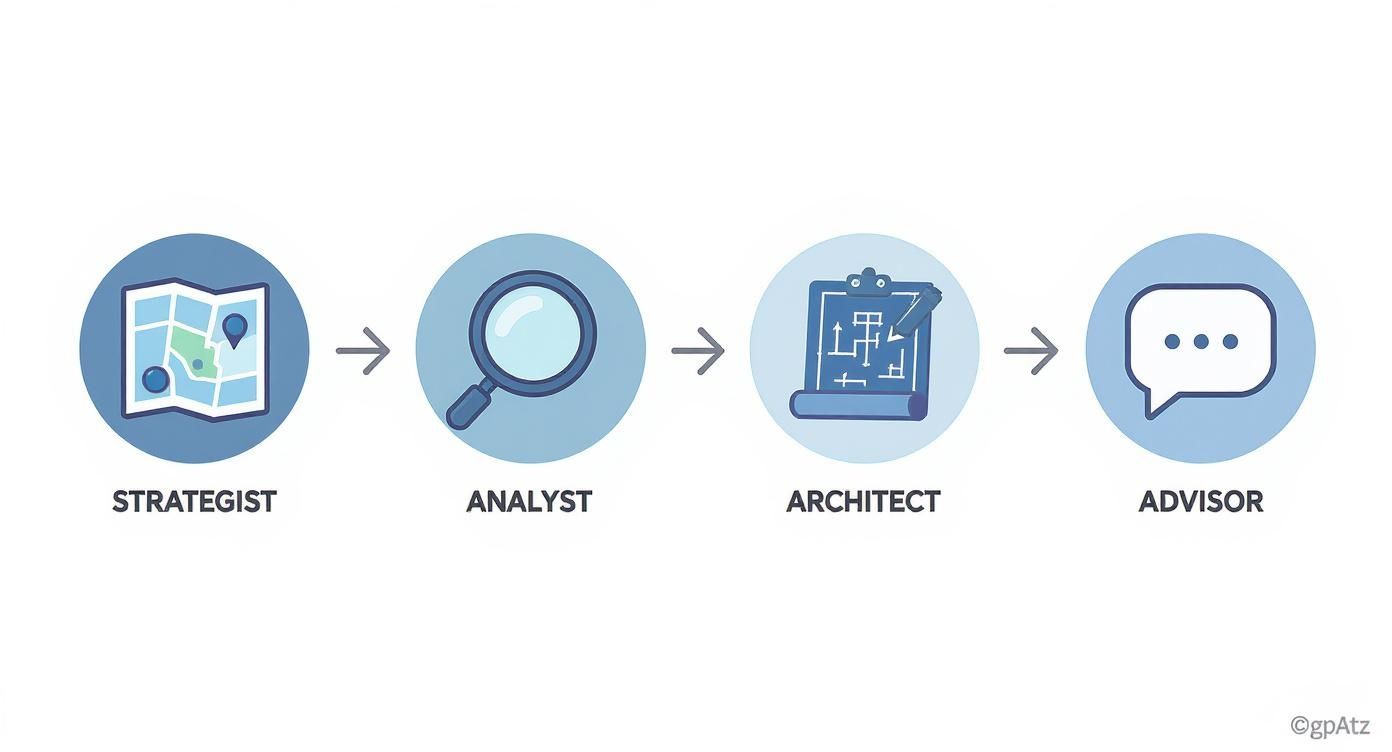
As you can see, a good consultant wears multiple hats—strategist, analyst, architect, and advisor—and knows exactly which one to put on at each stage.
Discovery and Audit
The first step is always Discovery & Audit. A great consultant never walks in with a one-size-fits-all solution. Instead, they become a student of your business, digging deep to understand your goals, your biggest roadblocks, and what you’ve tried so far.
This phase is all about rolling up their sleeves and getting into the weeds:
- Poring over your existing data, analytics, and customer feedback.
- Interviewing the key players, from the CEO down to the sales team on the front lines.
- Sizing up your competitors and mapping out the entire market landscape.
This deep dive is non-negotiable. It’s like a doctor running diagnostics before writing a prescription; it ensures the final strategy is built on reality, not just assumptions.
Strategy Development
Next up is Strategy Development. This is where all those raw insights from the audit get molded into a clear, data-driven plan. We're not talking about a fluffy mission statement here; this is a detailed roadmap with specific, measurable Key Performance Indicators (KPIs).
A solid strategy clearly defines your ideal customer, nails down your messaging, and maps out the exact channels you’ll use to reach them. It’s the perfect time to plug into a comprehensive B2B marketing strategy framework to give your plan the structure it needs to succeed.
Implementation and Oversight
With a strategy locked in, the focus shifts to Implementation & Oversight. Depending on how you’ve set things up, the consultant might guide your in-house team, help you hire the right talent, or manage outside agencies to get the work done.
Their job here is to make sure the strategy comes to life exactly as planned, keeping every moving part on track and tightly aligned with your business goals.
Analysis and Iteration
Finally, the process moves into a continuous loop of Analysis & Iteration. Marketing isn't a "set it and forget it" game. The consultant obsessively tracks results against the agreed-upon KPIs, reports back on what’s working (and what isn't), and uses that data to constantly fine-tune the approach.
This feedback loop is what makes sure your marketing gets smarter and more efficient over time, squeezing every drop of value out of your investment.
This kind of hands-on, specialized approach is quickly becoming the norm. The global consulting market is now valued at over $1 trillion, and independent experts are carving out a bigger piece of the pie as companies hunt for specialized skills. In fact, 58% of consultants now work with six or fewer clients a year, signaling a clear shift toward deeper, more focused partnerships. You can discover more insights about consulting industry trends on consultingsuccess.com.
Finding the Right Specialist for Your Tech Startup

Generic marketing playbooks just don't fly in the high-stakes world of B2B tech. Your challenges are unique—from explaining a complex SaaS product to a niche audience to getting buy-in from enterprise decision-makers. The only way to win is to find an expert who already speaks your language.
Think of it like hiring a doctor. You wouldn't see a general practitioner for open-heart surgery; you’d go straight to a cardiologist. The same logic applies here. Nailing down your most pressing problem is the first step to finding a consultant who delivers real results, not just a bunch of fancy slide decks.
The Go-to-Market (GTM) Strategist
Launching a new product or breaking into a new market? The Go-to-Market (GTM) Strategist is your launch commander. They don't just "put your product out there." They build a meticulous, coordinated battle plan to make sure it lands with maximum impact.
This is the specialist who answers your most critical launch questions: Who are our first 10 customers? What’s the right pricing model to gain traction without leaving money on the table? Which channels will get us there the fastest? Crafting sharp startup marketing strategies to build that initial momentum is their bread and butter.
The Account-Based Marketing (ABM) Specialist
When your startup’s entire future hinges on landing a handful of huge, high-value clients, you need an Account-Based Marketing (ABM) Specialist. Traditional marketing is like casting a wide net and hoping to catch a few good fish. ABM is more like spear-fishing.
This consultant treats each target company as its own "market of one," orchestrating hyper-personalized campaigns to engage key people across the organization. They shift your focus from chasing scattered leads to building strategic relationships that close major contracts.
An ABM consultant helps you stop shouting into a crowd and start having meaningful, one-on-one conversations with the exact companies you want to win. It’s precision hunting, not random fishing.
The Content and SEO Strategist
In B2B tech, trust is the ultimate currency. A Content and SEO Strategist is the architect of your credibility. They build an inbound lead engine that attracts, educates, and converts customers by making you the undisputed expert in your space.
They’ll map out a content plan—from deep-dive blog posts and whitepapers to technical webinars—that solves your audience’s biggest problems. The goal is to make sure you show up every time they search for a solution. It's not just about writing; it's about building a trusted resource that grows both your brand and your pipeline.
The Marketing Operations (MarOps) Guru
Finally, there’s the Marketing Operations (MarOps) Guru. This is the tech-savvy specialist who builds the engine that makes all your marketing run smoothly and scale without breaking. They are masters of the marketing tech stack, making sure your CRM, automation platforms, and analytics tools all talk to each other.
A MarOps consultant designs the systems that track leads, measure ROI, and automate repetitive tasks, freeing up your team to focus on strategy. This demand for operational expertise is exploding, with the marketing consulting market forecast to grow by $40.7 billion between 2024 and 2029.
For startups that need leadership that covers both strategy and operations, understanding what is a fractional CMO can be a total game-changer.
Every startup faces different hurdles. The key is matching your specific business challenge to the right kind of expertise. This table breaks down which specialist to call for some common B2B tech headaches.
Which Marketing Consultant Specialization Is Right for You?
| Your Business Challenge | Relevant Consultant Specialization | Key Deliverable |
|---|---|---|
| "We're launching a new product and need to make a splash." | Go-to-Market (GTM) Strategist | A comprehensive launch plan with a clear customer profile, pricing, and channel strategy. |
| "Our sales team is chasing too many small, low-quality leads." | Account-Based Marketing (ABM) Specialist | A targeted campaign to engage and win a list of high-value enterprise accounts. |
| "We're invisible online and need to generate inbound leads." | Content and SEO Strategist | An editorial calendar and content that ranks for key terms, driving qualified organic traffic. |
| "Our marketing tools are a mess, and we can't track ROI." | Marketing Operations (MarOps) Guru | An integrated and automated tech stack with clear dashboards for performance tracking. |
Picking the right consultant isn’t just about getting advice; it's about bringing in a specialist who has solved your exact problem before and can deliver a tangible result.
When Is the Right Time to Hire a Marketing Consultant?
Figuring out the right moment to bring in a consultant is a huge decision. Go too early, and you'll burn through precious cash. Wait too long, and you're leaving growth on the table.
So, how do you know when to pull the trigger? It’s less about a specific date on the calendar and more about recognizing a few classic signs in your startup’s journey.
Most B2B tech founders eventually hit a wall where the scrappy tactics that landed their first 10 customers just stop working. This is the most common signal: you’ve hit a frustrating growth plateau. Your team is busy, activity is high, but the revenue needle just won’t budge. This is the perfect time to find an expert who knows what a marketing consultant does to break through that ceiling.
An outside perspective is powerful. A good consultant can see the root problems your team is too close to notice, spotting bottlenecks and unlocking new ways to grow.
Key Moments to Make the Call
It’s not always about being stuck. Sometimes, the best time to hire a consultant is when you're gearing up for a big leap forward. A proactive investment in expertise before a critical moment can be the difference between a smooth launch and a costly misstep.
Consider bringing in a consultant when you are:
- Preparing for a Critical Product Launch: You only get one chance to make a first impression. A consultant can build a go-to-market strategy that ensures your launch makes waves from day one.
- Needing to Pivot Your Strategy: The market shifted, a new competitor popped up, or your initial assumptions were flat-out wrong. A consultant helps you navigate that urgent pivot with a clear, data-backed plan.
- Facing a Niche Expertise Gap: Your team is solid, but they’ve never tackled something specific like enterprise-level Account-Based Marketing (ABM) or expanding internationally. A specialist brings that missing skill set without the long-term cost of a full-time hire.
Hiring a consultant isn't a sign of weakness; it's a sign of strategic maturity. It’s about recognizing that you need specialized expertise to get to the next stage of growth and making a smart, proactive investment in your future.
Moving From Reactive to Proactive
Honestly, the best time to hire a consultant is just before you think you desperately need one.
When you make the call from a place of strategy instead of panic, you give both your team and the consultant the breathing room needed to build a solid foundation for real success.
If you find yourself saying, "Our marketing just feels stuck," or "We have this huge opportunity, but we're not sure how to grab it," that’s your cue. It’s time to find a partner who can bring the clarity and direction you need to get unstuck and moving forward, faster.
Your Questions About Marketing Consultants, Answered
You’ve seen what a marketing consultant does, the roles they can play, and when it makes sense to bring one on board. But you’re probably still wrestling with a few practical questions. Let’s tackle the common ones that pop up when founders are weighing this decision.
Think of this as the final gut-check—just straight answers to help you move forward with confidence.
Consultant vs. Agency: What’s the Difference?
This is easily the most common point of confusion. The simplest way to think about it is architect vs. construction crew. They solve different problems, even though they work in the same world.
A marketing consultant is the architect. Their job is strategic. They diagnose foundational problems, map out the landscape, and create the master blueprint for growth. They focus on the why and the what—building a high-level plan that ties your marketing directly to your business goals.
An agency, on the other hand, is the builder. They're an execution partner focused on the how. They’re the team running the ads, writing the social posts, and managing the day-to-day campaigns from the blueprint. A consultant gives you the roadmap; an agency drives the car.
They often work together. A good consultant can oversee an agency’s work, making sure every tactic they execute lines up perfectly with the bigger business strategy.
How Much Does a Marketing Consultant Cost?
This is the big one, and the honest answer is: it depends. The cost is a mix of the consultant’s experience, the project's scope, and how the work is structured.
Here are the usual pricing models you'll see:
- Hourly Rate: This can be anything from $100 to over $500 per hour for true experts. It’s best for smaller, one-off advisory tasks.
- Project-Based Fee: A flat fee for a specific outcome, like a full go-to-market strategy. These typically run from $5,000 to $25,000+.
- Monthly Retainer: This is common for ongoing guidance. A retainer ensures you have consistent access to their strategic brain as your team puts the plan into action.
The key is to reframe the cost as an investment. You aren't measuring a great consultant by the hours they log. You're measuring them by the revenue they help you generate or the expensive mistakes they help you avoid.
What Should I Look for in a B2B Tech Consultant?
For a B2B tech company, generic marketing experience just won’t cut it. You need someone who gets your world—long sales cycles, highly technical buyers, and complex products.
When you're evaluating a consultant, zero in on these three things:
- Proven, Relevant Experience: Ask for case studies and talk to their references—specifically from companies that look like yours. They need a track record of success in your niche or one very close to it.
- Strategic Thinking: A great consultant asks tough questions about your business model and revenue, not just your landing pages. They should challenge your assumptions and push for clarity.
- Sharp Analytical and Communication Skills: They have to be good with data and able to turn numbers into a clear story. Just as important, they must be a great communicator who can get your whole leadership team on the same page.
A consultant for a B2B tech startup should feel more like a strategic business partner than a marketing vendor. Their focus should be on driving real business outcomes, not just marketing metrics.
What Are the Typical Deliverables?
While every project is different, the outputs are concrete and actionable. You're not just paying for conversations; you're paying for a clear path forward.
Common deliverables you can expect include:
- A comprehensive marketing audit that benchmarks your current performance.
- In-depth competitor and market analysis to spot threats and opportunities.
- Detailed customer personas and journey maps.
- A fully documented marketing strategy and roadmap that lays out channels, content, budget, KPIs, and how to measure it all.
At the end of the day, the real deliverable isn't a slide deck. It's an actionable plan that gets rid of the guesswork and gives your team the confidence to execute, driving measurable growth.
Ready to build a marketing engine that delivers predictable revenue? Value CMO provides the senior strategic leadership your B2B tech startup needs without the full-time overhead. We build a clear, data-driven roadmap to accelerate your growth.