

A marketing positioning matrix is a visual tool that helps you see where your brand and your competitors live in the minds of your customers. Think of it as a strategic GPS for your market. It shows you exactly where you stand, where the competition is crowded, and—most importantly—where the open road is.
Your Brand's Strategic Map in a Crowded Market
Ever tried finding a specific type of restaurant in a new city without a map? You know there are options, but you're blind to where they are, what they offer, or if there's a perfect, uncrowded spot waiting for you. The marketing positioning matrix is that map for your brand.
It’s a simple chart that plots your company and its rivals on a two-axis grid. These axes aren't just random lines; they represent the two most important things customers are weighing when they make a decision. For a B2B tech company, this could be something like ‘Innovative Features vs. User Simplicity’ or ‘Affordability vs. Premium Support.’
This simple visual cuts right through all the market noise. It helps you:
- See the whole playing field: Get an honest, at-a-glance view of the competitive landscape.
- Spot the "blue oceans": Find those uncontested market spaces where your brand has plenty of room to grow.
- Steer clear of "red oceans": Identify the overcrowded areas where the fight for customers is bloody and it’s tough to stand out.
- Sharpen your messaging: Once you know your position, you can craft a message that really hits home with your target audience.
The Origins of Positioning
This idea isn't new. It has its roots in the early days of advertising, back when agencies realized they weren't just selling products—they were selling a specific idea or "position" in the consumer's mind. Around the 1920s, forward-thinking ad execs started focusing on brand personality to shape perception, laying the groundwork for the strategic tools we rely on today. This early obsession with the 'mental map' consumers hold of brands is the core idea behind the modern positioning matrix. For a deeper dive, you can explore the history of marketing positioning.
"Perceptual maps provide a visual representation of the competitive landscape that identifies industry rivals sharing similar characteristics.” – Jill Avery, Professor at Harvard Business School
This classic perceptual map from 1968 is a perfect example, showing how people viewed different car brands way back when.
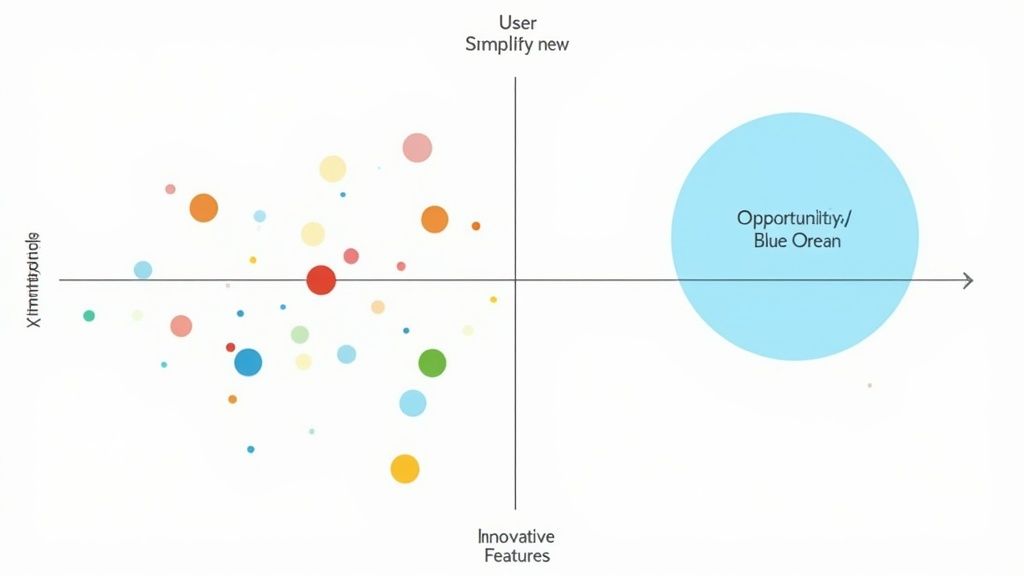
You can see a clear gap in the market for a car that is both sporty and practical. That empty space on the map isn't just a blank—it's a massive business opportunity just waiting for a brand to claim it.
Choosing the Right Axes for Your Matrix
The power of your positioning matrix lives and dies by its axes. Think of them as the true north on your strategic map. Pick the wrong ones, and you'll end up with a blurry, useless chart. But get them right, and you’ll have a crystal-clear guide to every real opportunity in your market.
It's the difference between navigating with a child’s crayon drawing and a high-resolution satellite image.
Most teams just default to the classic "Price vs. Quality" grid. It’s a decent starting point, sure, but it almost never uncovers the deep, actionable insights B2B tech companies actually need to win. Your buyers are making complex decisions based on things far more specific than just cost. The real magic happens when you move beyond generic ideas and pinpoint the dimensions your customers truly value.
Uncovering What Customers Actually Value
To find powerful axes, you have to get out of the building. Your internal assumptions are the single biggest threat to creating an effective matrix. What your engineers think is the most important feature might be a minor detail to the person signing the check. This is where deep customer understanding becomes your most valuable asset.
Start by brainstorming potential attributes with your team. Think about every touchpoint and consideration in your buyer's journey.
- Product Attributes: How does your product actually work for them? Think ease of integration, depth of customization, scalability, or data security levels.
- Support & Service: How do you help customers win? This could be 24/7 live support, dedicated account managers, or a self-service knowledge base.
- Brand Perception: How do people see you? Are you the legacy player, the nimble innovator, or the niche specialist?
This process requires a solid grasp of who your buyers are. You also need to know what the competitive landscape looks like, so you aren't fighting for a position that's already crowded. Learning about conducting competitive analysis is a great way to ground your choices in solid market data.
From Generic Ideas to Strategic Axes
Once you have a long list of potential attributes, you need to validate them. This means getting real feedback. Talk to your sales team about the questions prospects ask. Survey current customers about why they chose you. Analyze online reviews for your competitors.
There's a massive gap between what companies think they deliver and what customers feel they get. Research shows that while 80% of CEOs believe they deliver a superior experience, only 8% of their customers agree. That gap is exactly why you can't rely on internal beliefs.
The most common mistake is building a positioning matrix in an echo chamber. You end up basing the axes on what you think matters. The most insightful matrices are always built from the outside in, reflecting the true decision-making criteria of your customers.
To make this tangible, let’s look at how to turn generic ideas into strategic B2B axes.
This table shows how you can move from vague concepts to the kind of specific, insightful axes that reveal real market gaps.
Comparison of Potential Axes for a B2B SaaS Company
| Axis Category | Generic Example (Less Insightful) | Specific B2B Example (More Insightful) |
|---|---|---|
| Product Capability | "Features" | "Depth of Workflow Customization" |
| Onboarding | "Ease of Use" | "Time to First Value (in hours)" |
| Customer Support | "Good Service" | "Average First-Response Time" |
| Integration | "Connects to Other Tools" | "Number of Native API Integrations" |
| Pricing Model | "Price" | "Predictability of Monthly Cost" |
A generic axis like "Features" tells you almost nothing. But an axis like "Depth of Workflow Customization" immediately creates a much more meaningful comparison between you and your competitors.
This is where well-defined buyer personas become essential. If you haven't nailed these down yet, take the time to learn how to create buyer personas that reflect the real-world pains and motivations of your audience. This helps you filter your long list of attributes down to the two that matter most.
The goal is simple: pick two axes that are not only important to your customers but also highlight meaningful differences across the competitive landscape. That’s how you find the strategic gaps where your brand can thrive.
How to Build Your Positioning Matrix
Alright, you get the theory. Now it’s time to roll up your sleeves and actually build one of these things. This isn’t some abstract marketing exercise; think of it as a strategic workshop for your brand. We'll walk through it step-by-step to make it tangible, actionable, and a lot less intimidating than it sounds.
Imagine assembling a piece of furniture. If you just dump all the parts on the floor, you've got a confusing mess. But with clear instructions, you end up with something solid and useful. To bring each step to life, we’ll follow a fictional B2B startup, "SyncUp," a new project management tool.
Step 1: Identify Your True Competitors
First things first: who are you really up against in the mind of your customer? It’s not always who you think. Your list needs a mix of the obvious players and the not-so-obvious ones.
-
Direct Competitors: These are the names that come up in every sales call—the ones offering a very similar solution to the same audience. For SyncUp, this would be the heavyweights like Asana, Trello, and Monday.com.
-
Indirect Competitors: These guys solve the same core problem but with a totally different approach. Think of tools like Smartsheet (which is basically a spreadsheet on steroids) or even the scrappy combo of Slack and Google Docs that teams often use to get by.
-
Emerging Competitors: You have to keep an eye on the new kids on the block. They might be small now, but they’re often targeting a specific, underserved niche with a vengeance. SyncUp might notice a new AI-powered project management tool that’s starting to get traction with remote-first companies.
The goal here is to land on a focused list of 5-7 key competitors. Too few, and you won't get a clear picture of the landscape. Too many, and your map will become a cluttered, unreadable mess.
Step 2: Gather Market Data and Customer Perceptions
This is the most critical step, and frankly, the one most teams skip. Building a matrix on internal assumptions is like trying to navigate a city with a map you drew from memory—it’s guaranteed to be wrong. You need real-world data to understand how customers actually see the market.
Don’t just trust your gut. Research shows that 87% of customers will pay more for products from brands they trust, and that trust is built on a clear understanding of what they value.
Here’s where you can dig for gold:
- Customer Surveys: Ask your current customers why they chose you over others. What other tools did they look at? Use simple rating scales, like "On a scale of 1-10, how would you rate our ease of use compared to Competitor X?"
- Online Reviews: Dive into sites like G2, Capterra, and TrustRadius. They are treasure troves of raw, honest customer language about your strengths and—more importantly—your competitors' weaknesses.
- Sales Team Feedback: Your sales reps are on the front lines every single day. They know the objections, the must-have features, and the competitors that come up in every demo. Talk to them.
For SyncUp, the team discovers a pattern in reviews: while customers love Asana's power, many describe its setup as "overwhelming." That single word is a crucial piece of perception data.
Step 3: Finalize Your Two Most Impactful Axes
With your competitor and customer data in hand, you can now revisit the axes we talked about earlier. The goal is to distill all that feedback into the two most important dimensions that define your market—the two factors customers weigh most heavily when making a choice.
This isn't about picking random features. It's a process of narrowing down what truly matters.

You move from a big list of ideas to the two axes that best capture the decision-making process in your market.
The SyncUp team brainstorms possibilities: "Price," "Number of Features," "Ease of Use," and "Integration Capability." After digging through their research, they realize the biggest trade-off for their customers is between deep functionality and a simple, intuitive user experience.
They lock in their axes. The Y-axis will be "Beginner-Friendly to Expert-Focused," and the X-axis will be "Standalone Tool to Integrated Platform." These axes perfectly capture the core tensions in their market.
Step 4: Plot Everyone on the Map
Now for the fun part. Draw your two axes on a whiteboard or in a design tool to create four quadrants. Using your research, start plotting where each competitor—and your own brand—lands on the grid.
Make this a team activity. Debate the placements. Argue your case. Point back to specific customer quotes or review data to justify each position. It's not about being scientifically perfect down to the millimeter; it’s about reflecting the market's general perception.
SyncUp plots Asana firmly in the "Expert-Focused" and "Integrated Platform" quadrant. Trello lands squarely in "Beginner-Friendly" and "Standalone Tool." They then place themselves in the "Beginner-Friendly" and "Integrated Platform" space, a position they believe is wide open.
Step 5: Analyze the Map and Find Your Opportunity
With all the brands plotted, take a step back and look at the whole map. This is your moment of clarity. Where are the clusters? And, more importantly, where are the wide-open spaces?
Those empty areas on your matrix are your potential market opportunities—the "blue oceans" where you can operate with less direct competition. This visual insight is the entire point of the exercise.
The SyncUp team sees it immediately. The quadrant for a beginner-friendly tool that also integrates deeply with other platforms is practically empty. This single insight becomes the foundation of their entire go-to-market strategy.
They can now confidently build their messaging around being "the powerful project management tool that’s actually easy to use and connects with everything."
By following these five steps, you turn a complex, noisy market into a simple, actionable map that guides your messaging, product development, and overall strategy.
Real-World Marketing Positioning Matrix Examples
Frameworks are great on a whiteboard, but the real magic happens when you see them in action. A marketing positioning matrix isn't just a classroom exercise; it's a tool that market-leading companies use to carve out their territory and win. Seeing how others have successfully drawn their maps brings the entire concept to life.
Let's break down a few concrete examples from the B2B tech world to show you exactly how this looks in the wild. These case studies will give you a clear picture of what a successful positioning strategy looks like when it moves from theory to reality.
Asana vs. Jira: Finding the User-Friendly Sweet Spot
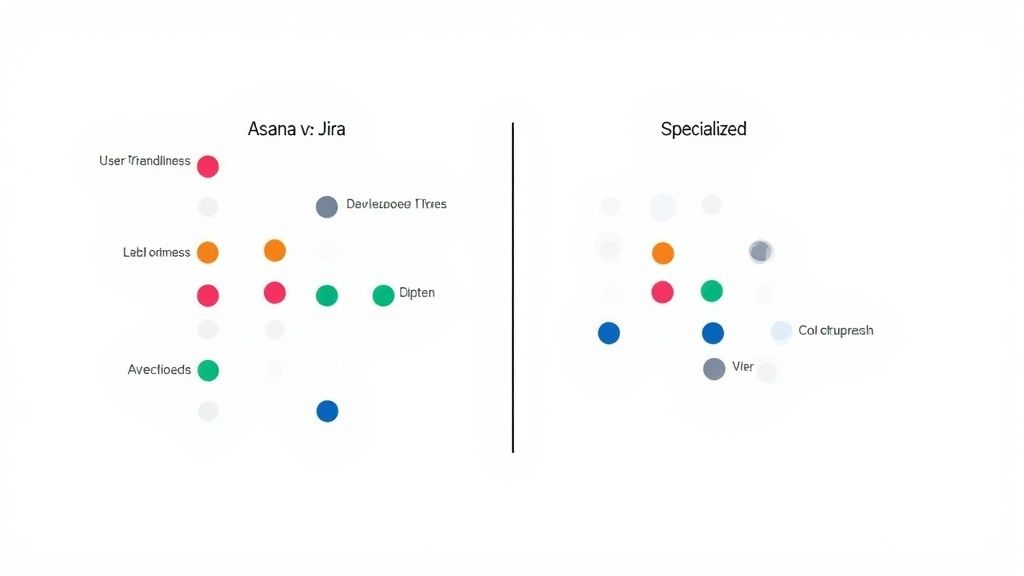
The project management software space is famously crowded. For years, Atlassian's Jira was the undisputed king, but it ruled a very specific kingdom: software development teams. Jira is incredibly powerful and customizable, but for anyone non-technical, it can feel like trying to fly a 747 just to get across town.
This complexity created the perfect opening for Asana. They were smart. They didn't try to out-feature Jira head-on. Instead, they built their positioning matrix around two key axes:
- Y-Axis: Developer-Focused Power vs. General Team Usability
- X-Axis: Niche Project Tool vs. Company-Wide Collaboration
Jira sat comfortably in the "Developer-Focused Power" and "Niche Project Tool" quadrant. Asana spotted the massive, underserved space: a tool that was powerful enough for the whole company but designed with usability for everyone at its core.
They positioned themselves as the friendly, intuitive alternative for marketing, sales, and operations teams—the very people who found Jira too complex. Their entire brand, from website copy to ad campaigns, hammered this message home. This sharp positioning allowed them to sidestep a direct fight with a giant and build a loyal following in a completely different part of the market.
HubSpot: Owning the All-in-One Platform Position
HubSpot’s rise is another masterclass in strategic positioning. When they entered the market, the landscape was a mess of disconnected "point solutions." Companies were juggling one tool for email marketing, another for CRM, a third for social media, and on and on.
HubSpot recognized the pain this caused. Managing dozens of tools was inefficient, expensive, and created data silos that killed visibility. They mapped this reality on a positioning matrix:
- Y-Axis: Specialized Point Solution vs. All-in-One Platform
- X-Axis: Small Business Focus vs. Enterprise Focus
They saw competitors like Salesforce dominating the enterprise space with powerful, complex platforms. Meanwhile, countless smaller tools were fighting over specific functions for small businesses. HubSpot identified the gap: an all-in-one platform built specifically for small and mid-sized businesses (SMBs).
This "single source of truth" positioning was a game-changer. It wasn't just about features; it was about solving a fundamental operational headache for their target audience. By claiming this unoccupied quadrant, HubSpot created a category of one and became the go-to solution for companies wanting to simplify their entire marketing and sales stack.
This strategy helped them achieve a killer product-market fit in a crowded space. Finding that alignment is crucial, and understanding the nuances of product-market fit in the AI era adds another layer for modern tech companies.
Apple: Reshaping the Entire Smartphone Market
While not strictly B2B tech, no discussion on positioning is complete without tipping a hat to Apple. The launch of the iPhone in 2007 is a landmark example of how positioning can literally redraw an entire market map.
Before the iPhone, the market was split. BlackBerry owned the business world with a focus on productivity (think email). Nokia and Motorola fought for consumers with simpler, feature-limited devices.
Apple didn't just find a gap; it created a whole new quadrant. It defined its space by pitting an app-based ecosystem against fixed-functionality devices, all while prioritizing a revolutionary touch interface and seamless software. This move shows how a positioning matrix can help you not just find an open space, but redefine the rules of competition altogether.
How to Use Your Matrix for Better Strategy
You’ve built your map—now it’s time to start navigating. A finished marketing positioning matrix isn't just a static picture to show in a meeting. It’s a living tool meant to guide smarter, faster, and more confident decisions every single day.
The real payoff isn't in making the map; it's in using it to chart a clear path forward. This visual guide is the key to answering critical questions like, "Where's the path of least resistance in this crowded market?" or "What unique story can we tell that no one else can?"
Ultimately, the goal is to turn this one-time exercise into the bedrock of your ongoing business strategy.
Identifying Strategic Opportunities
Think of your matrix as a treasure map where the empty spaces mark where the gold is buried. These gaps, or "blue oceans," point to underserved customer needs and areas with little or no competition. By studying the map, you can pinpoint these high-potential zones and make them your strategic focus.
For example, if your matrix shows a pile-up of competitors offering high-cost, complex solutions for enterprise clients, you might spot a wide-open field for a simple, affordable tool aimed at small businesses. This kind of clarity can be a game-changer, and it's a core part of any essential guide to marketing for small business. It helps you aim your resources where they’ll make the biggest splash.
Sharpening Your Marketing Message
Once you’ve locked in your strategic position, you can build a marketing message that clicks with your target audience and draws a clear line between you and everyone else. Your spot on the map dictates the story you tell. It becomes the heart of your brand’s narrative and shapes every piece of content you create.
This is all about defining what makes you uniquely valuable. If you want to go deeper, our guide on how to create a value proposition gives you a great framework for turning that position into a message that sells. Your matrix gives you the what (your position), and your value prop gives you the how (the promise you make to customers).
Here’s how to put it into action:
- Refine your website copy: Make sure your homepage headline and key landing pages immediately shout out your unique position.
- Adjust ad campaigns: Target keywords and audiences that line up with your strategic sweet spot, steering clear of head-to-head fights where you can.
- Guide your sales team: Arm them with clear talking points on how to explain your unique advantages during demos and calls.
A well-defined position, born from a marketing positioning matrix, acts as a filter for all marketing activities. If an action doesn't reinforce your chosen spot on the map, you shouldn't be doing it. It brings focus and discipline to your entire strategy.
Informing Your Product Roadmap
A positioning matrix isn’t just for marketers; it’s a critical tool for your product team, too. It shows how your product stacks up against competitors and shines a light on feature gaps or chances to innovate. If your goal is to be the "most user-friendly" option, but customers see your product as clunky, that's a direct signal to your product roadmap.
This data-driven approach really works. A 2023 survey of global marketing managers found that over 70% said these tools improved their market segmentation accuracy by at least 30%. Even better, companies that regularly update their matrices have seen up to a 15% jump in market share in tough industries.
The matrix helps your team prioritize what to build next, focusing on features that will strengthen your desired market position. This ensures you're not just building a product that meets customer needs, but one that truly stands apart.
Common Mistakes to Avoid
Even the best map is useless if you don’t know how to read it. Building a marketing positioning matrix is a huge step forward, but a few common mistakes can turn your strategic guide into a chart that just plain misleads you. Think of this as a friendly heads-up on the pitfalls we’ve seen countless teams fall into.
Steering clear of these traps is everything. It’s what ensures your hard work results in a sharp, powerful tool that actually guides your business forward—instead of sending you down a dead-end street based on flawed assumptions.
Mistake 1: Working from Internal Assumptions
This is the most common and dangerous mistake: building your matrix in an echo chamber. This happens when your team plots competitors and defines the axes based on what you think the market values, not what customers actually say.
Your engineers might be convinced a new feature is a game-changer, but your customers might not even notice it.
-
What Happens: Your matrix becomes a reflection of internal biases, not market reality. You end up chasing a position nobody cares about and building messaging that doesn't connect with real buyer pain points.
-
How to Fix It: Get out of the building. Base every single decision on external data—customer surveys, sales call transcripts, and online reviews from sites like G2 and Capterra. Let your customers tell you what the axes should be.
Mistake 2: Choosing Vague or Irrelevant Axes
Another classic blunder is defaulting to overly generic axes like “Price vs. Quality.” While simple, these broad terms rarely uncover meaningful strategic gaps in a complex B2B tech market.
What does "high quality" even mean to your specific buyer? Is it reliability? User experience? Or lightning-fast customer support?
Vague axes lead to a vague strategy. The goal of a positioning matrix isn't just to make a chart; it's to find a clear, defensible position in the market. Specificity is your best friend here.
If your axes don't reflect the actual trade-offs customers are making when they choose a solution, your map will be blurry and totally unactionable. You need dimensions that create real separation between competitors and shine a light on genuine market opportunities.
Mistake 3: Creating It and Forgetting It
Finally, too many teams treat the positioning matrix as a one-and-done project. They create a beautiful map in a workshop, present it once, and then it gathers digital dust in a forgotten folder.
Markets aren’t static; they’re living, breathing ecosystems.
-
What Happens: Your once-accurate map quickly becomes outdated as new competitors emerge, customer needs shift, and existing players change their strategies. A map from last year might be leading you toward an opportunity that simply no longer exists.
-
How to Fix It: Treat your marketing positioning matrix like a living document. Revisit and update it at least once a year, or anytime there's a major market shift. This keeps your strategy locked in with the current landscape, not the one that existed last quarter.
A Few Final Questions
Still have a couple of things on your mind? Good. Smart strategists ask questions. Here are the most common ones we hear when teams start using a positioning matrix.
How Often Should I Update My Matrix?
Think of your matrix as a living snapshot of the market, not a framed picture you hang on the wall and forget. Markets move, competitors pivot, and customer needs change.
As a rule of thumb, give it a full refresh at least once a year. You'll also want to revisit it anytime something big happens—like a new rival entering the scene or a major shift in technology.
Isn't This Just a Perceptual Map?
Great question. The terms get thrown around interchangeably, but there's a key difference in who's holding the pen.
A perceptual map is usually built from quantitative customer survey data. It shows you where customers perceive you to be. A marketing positioning matrix, on the other hand, is the tool your team builds to decide where you strategically want to be. One is about perception, the other is about intention.
Can a Small Business or Startup Really Use This?
Absolutely. In fact, it might be even more critical for smaller players. You don't have the budget to be everything to everyone, so focus is your superpower.
You don’t need expensive market research firms, either. Your data can come from customer interviews, G2 reviews, sales call notes, and just being deeply embedded in your niche. The principles scale down perfectly.
What if My Market Has More Than Two Key Factors?
This is a common hurdle, especially in complex B2B tech spaces. Trying to cram five important differentiators onto two axes feels wrong, because it is.
The solution? Create multiple matrices. Map your position on 'Integration vs. Usability' first. Then, create a separate one for 'Support Quality vs. Price'. Analyzing your position from a few different angles gives you a much richer, more three-dimensional view of the competitive landscape.
Ready to build a strategy that carves out your unique space in the market? At Value CMO, we help B2B tech companies clarify their positioning and build growth roadmaps that actually work. We bring the senior marketing leadership you need to win, without the full-time overhead.
Learn how our fractional CMO services can accelerate your growth