Let's be honest, trying to lower your customer acquisition cost isn't about slashing your budget across the board. It's more of a mindset shift: moving from spending more to spending smarter.
This means you stop leaning so heavily on expensive paid ads and start thinking like a long-term investor. You'll want to optimize your conversion funnel, delight your existing customers so they become a referral engine, and build an SEO presence that pays you back for years to come.
It's really a game of efficiency, not just volume.
Understanding Your True Customer Acquisition Cost
Before you can make a single cut, you need to take a painfully honest look at what it really costs to land a new customer. Your Customer Acquisition Cost (CAC) isn't just another metric on a dashboard; it’s the financial story of your entire growth engine.
Nailing this number is the first—and most critical—step toward making it better.
The basic formula sounds simple enough: just divide your total sales and marketing spend by the number of new customers you brought in over a specific period. But as always, the devil is in the details, and this is exactly where most B2B startups trip up.
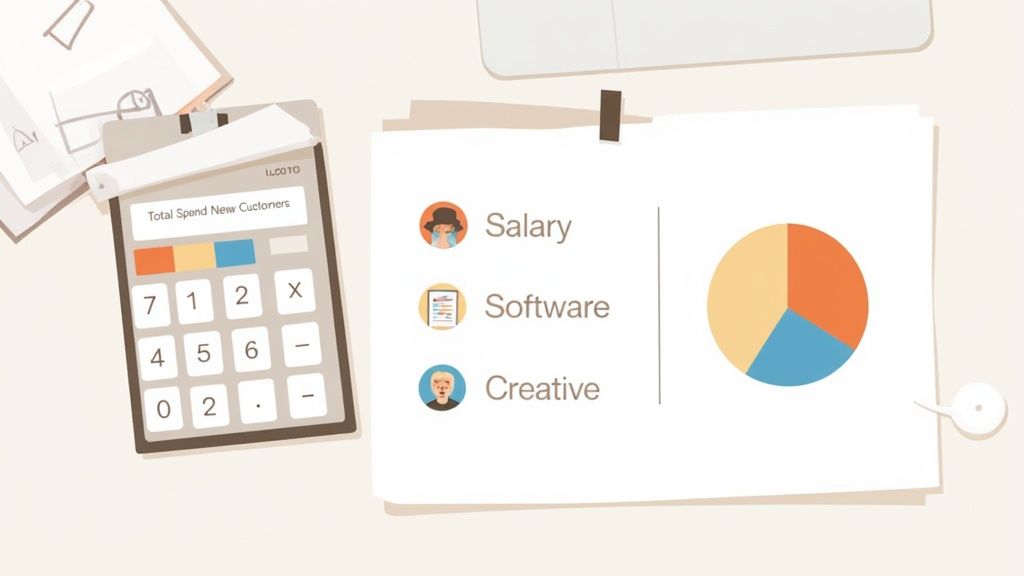
The most common mistake? Only counting your direct ad spend. Your true CAC includes every single dollar you spent on acquisition—from the salaries of your sales and marketing team to the subscription costs for your CRM and automation tools.
What Goes into a Real CAC Calculation
To get an accurate baseline, you have to be thorough. Don't just gloss over these often-forgotten expenses that inflate your real acquisition cost:
- Salaries and Benefits: The full compensation for every single person on your marketing and sales teams.
- Software and Tools: Your HubSpot or Salesforce subscription, analytics software, and any other tech you're paying for.
- Creative and Production Costs: Fees for freelancers, agency partners, content creation, and any video production.
- Ad Spend: The direct cost of your paid campaigns across every channel, like Google Ads, LinkedIn, and social media.
Calculating this monthly is good practice, but I’ve found that a quarterly review gives you a much more stable, big-picture view. It smooths out the peaks and valleys from individual campaigns and gives you a reliable benchmark to measure your progress against.
Knowing your true CAC isn’t just about trimming fat; it's about understanding the fundamental health of your business model. This gets even more powerful when you learn how to create buyer personas and can see which customer segments cost the most (or least) to acquire.
A high CAC isn't always a disaster, especially when you're in an aggressive growth phase. But an unknown CAC? That's a serious blind spot that can burn through your runway faster than you think.
Your Quick Guide to Lowering CAC
To give you a clear roadmap, here's a breakdown of the core strategies we'll be diving into. Think of this as your cheat sheet for turning high acquisition costs into sustainable, efficient growth.
| Strategy Area | Primary Goal | Key Action |
|---|---|---|
| Ideal Customer Profile (ICP) | Eliminate wasted spend | Focus your budget on high-LTV, low-churn prospects. |
| Conversion Rate Optimization (CRO) | Get more from existing traffic | A/B test your landing pages, CTAs, and forms. |
| Content & SEO | Build a long-term asset | Create high-intent content that attracts organic leads. |
| Customer Retention & Referrals | Lower your net CAC | Set up loyalty programs and automate referral requests. |
| Channel Optimization | Spend your money smarter | Double down on high-performing channels, and cut the losers. |
Each of these areas represents a major lever you can pull to directly influence your acquisition costs. Let's get into the specifics.
Focus on Retention to Lower Acquisition Costs
This might sound a little backward, but one of the fastest ways to slash your customer acquisition cost is to stop obsessing over acquisition. Instead, shift your focus to the customers you already have. You wouldn’t try to fill a leaky bucket without patching the holes first, and the same logic applies to your customer base.
When you’re a B2B tech startup, it’s so easy to get fixated on top-of-funnel metrics and landing new logos. But this tunnel vision ignores a massive opportunity sitting right in front of you. Every customer who churns isn’t just lost revenue—they represent a failed acquisition investment that you now have to spend all over again just to replace them.
The Real Value of a Happy Customer
A happy customer does so much more than just pay their subscription on time. They become a powerful, low-cost growth engine for your entire business. They are your best source of case studies, glowing reviews, and the kind of honest product feedback you simply can't buy.
Even better, they become your most effective sales team through referrals. A warm lead from a trusted peer is infinitely more valuable—and cheaper to close—than a cold lead you paid for through an ad campaign.
The math here is overwhelmingly clear: keeping customers is a direct path to a healthier bottom line. Shifting even a small slice of your focus from acquisition to retention can have an outsized impact on your profitability and growth.
Industry benchmarks show that acquiring a new customer can be anywhere from 5 to 25 times more expensive than keeping an existing one. On top of that, a tiny 5% improvement in customer retention can boost profits by 25% to 95%. These aren't just vanity metrics; they're hard numbers that make the financial power of retention impossible to ignore.
Building a Retention-First Culture
So, how do you actually put this into practice? It starts by treating customer success as a core part of your growth strategy, not just a support function you hand off to a separate team.
Nail the Onboarding Experience
The first 90 days of a customer's journey are completely make-or-break. A confusing or frustrating onboarding process is a fast track to churn. Your one and only goal should be to get them to their first "aha!" moment as quickly and smoothly as possible.
- Create a guided setup: Don't just dump new users into your software and hope for the best. Use simple checklists, helpful tooltips, and a welcome email series to walk them through the essential first steps.
- Offer proactive support: Schedule a quick onboarding call or assign a dedicated success manager to answer questions before they turn into frustrations.
- Celebrate early wins: Acknowledge when they complete a key action in your platform. This reinforces the value they're getting and builds positive momentum.
Transform Customers into Advocates
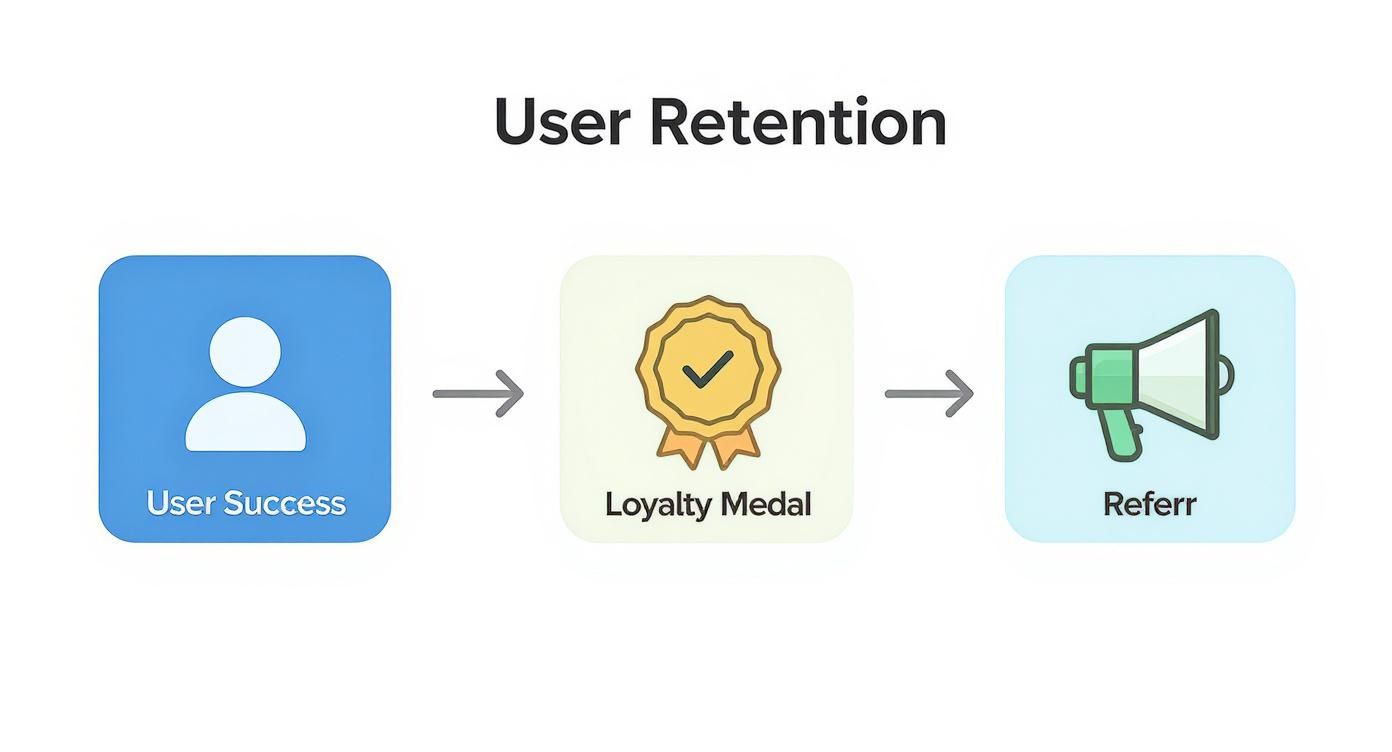
Once a customer is successfully onboarded and seeing real value, the next step is to turn them into advocates for your brand. This is how you build a referral engine that actively drives down your CAC.
A simple referral program can be incredibly effective. For example, you could offer a one-month credit or a gift card for every new customer they send your way who signs up. This formalizes word-of-mouth and gives your happiest users a tangible reason to spread the word.
The key is to make it dead simple for them. Give them a unique referral link and maybe even some pre-written email or social media templates they can copy and paste. By turning your best customers into a marketing channel, you create a sustainable source of high-quality, low-cost leads that compounds over time. For more in-depth strategies to keep your existing customers and boost loyalty, explore these 10 Customer Retention Strategies That Work.
Plug Costly Leaks in Your Conversion Funnel
You're spending good money to get people in the door, but how many are quietly slipping out the back before they ever become a customer?
Think of your marketing funnel like a plumbing system. A few small, hidden leaks can waste a shocking amount of resources over time. Finding and plugging those leaks is one of the most direct, high-impact ways to slash your customer acquisition cost.
This isn't about some massive, expensive website overhaul. It’s about making small, data-backed tweaks that smooth out the customer journey.
I’ve seen tiny changes produce massive results. One B2B startup I worked with saw a 30% lift in sign-ups just by clarifying their landing page headline to better match their ad copy. Simple as that.
Another company cut their demo request drop-offs in half—literally—by removing just two unnecessary fields from their form. Small wins like these add up fast.
Where to Look for Leaks
Your conversion funnel has a few key stages where prospects are most likely to get frustrated and leave. When you're ready to do an audit, focus your attention on these high-leverage areas first.
- Landing Pages: Is there a jarring mismatch between your ad and what the user sees on the page? Does it load at a snail's pace? Is your call-to-action (CTA) buried or confusing?
- Pricing Pages: Is your pricing clear and easy to understand at a glance? Complex tiers or hidden fees are a huge source of friction that will scare potential buyers away.
- Sign-up and Demo Forms: Are you asking for their life story upfront? Every single field you add increases the odds that someone will give up. Stick to the absolute essentials.
The goal here is simple: remove every possible bit of friction standing between a prospect's initial interest and them taking the next step. You want to make it ridiculously easy for them to say "yes."
This classic conversion funnel visual from Wikipedia shows how the pool of potential customers shrinks at each step of the journey.
Your job is to make the bottom of that funnel wider by making each stage more efficient.
Data-Driven Fixes for Common Leaks
Once you've flagged the problem spots, it's time to start testing solutions. This is where you let data, not your gut, lead the way.
Improving conversion rates at these key stages—from landing pages to onboarding flows—can lead to major reductions in CAC. Simple A/B tests on headlines, button colors, or form layouts can push more users through the funnel, making your entire acquisition engine more efficient. If you want to dive deeper into the numbers, Relay42 offers some great insights on funnel optimization.
As you get more sophisticated, you can use marketing automation to nurture leads who abandon the process. Setting up workflows to re-engage prospects with targeted emails or content is a game-changer. Our guide on how to implement marketing automation is a great starting point for that.
The flow from that initial conversion to long-term retention is where you turn a new user into a valuable asset. Optimizing each step isn't just about closing one deal; it's about building a sustainable growth loop for the future.
Using AI for Smarter Customer Acquisition
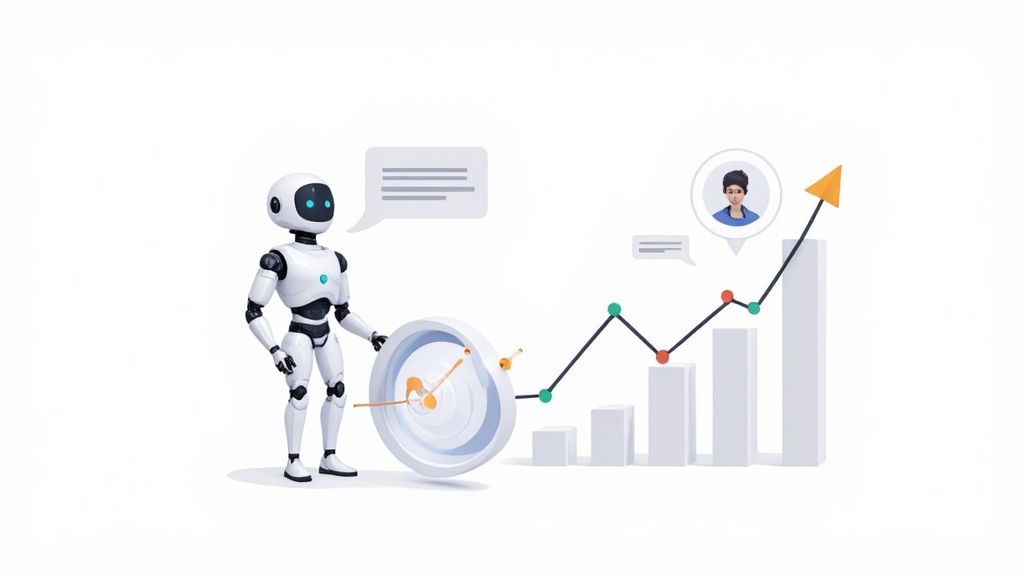
AI in marketing has moved way past the buzzword stage. It's now a practical toolkit that makes every dollar you spend work harder. The best part? You don't need a team of data scientists to tap into it. Modern AI-powered platforms are accessible enough to give any B2B startup a serious edge.
The whole idea is to shift from educated guesses to data-backed precision. Instead of manually trying to piece together your ideal audience, AI platforms can chew through thousands of data points to pinpoint high-converting lookalike audiences you’d never find on your own. Your ads get in front of the right people, much faster.
This isn’t just a small tweak—it’s a direct hit to your bottom line. Companies that have jumped on AI for customer acquisition are seeing their CAC drop by as much as 50%, especially in competitive sectors like SaaS and fintech. That massive improvement comes from AI’s ability to optimize targeting, automate segmentation, and personalize outreach at a scale no human team could ever hope to match.
Putting AI into Practice
Getting started with AI is more about picking the right tools than it is about building some complex system from the ground up. Here are a couple of high-impact ways you can use AI to bring down those acquisition costs right now.
-
Predictive Lead Scoring: Stop letting your sales team waste their valuable time on dead-end leads. AI can analyze a prospect’s behavior, firmographics, and engagement to predict how likely they are to buy. This lets your team focus only on the people who are actually ready for a conversation.
-
Intelligent Chatbots: Imagine having a sales development rep who works 24/7, never sleeps, and qualifies leads instantly. That's what a smart chatbot can do. It can handle those initial questions, book demos, and route the high-value prospects straight to your team, all while you’re focused on other things.
The real power of AI is in automation and efficiency. It takes over the repetitive, data-heavy tasks, freeing up your team to do what they do best: build relationships and close deals.
Making AI Work for You
Weaving these tools into your workflow doesn't have to be some huge, drawn-out project. Many of the ad platforms and CRMs you're probably already using have these features built right in. The goal is simple: let the tech do the heavy lifting of finding and qualifying leads. This makes your ad spend much more efficient and helps shorten your sales cycle.
Smarter targeting and personalization are your most direct path to a lower customer acquisition cost. When you focus your energy only on the most promising leads, you cut out wasted spend and seriously boost the ROI of your entire marketing operation.
To go a bit deeper, check out our guide on some simple AI hacks for B2B marketing teams that you can put into play this week.
Building an SEO Engine for Long-Term Growth
Paid ads get you traffic today, but it’s basically rented. The second you stop paying the bills, the traffic disappears. A smart SEO strategy, on the other hand, is like owning the house. It's an investment that builds a valuable, long-term asset that brings in customers for free.
This is about shifting from just "making content" to engineering a sustainable, high-intent customer acquisition machine. It’s the single most powerful way to methodically drive down your blended CAC over time.
Target Problems, Not Just Keywords
The real magic in SEO isn't just chasing broad, high-volume keywords. It’s about zeroing in on the specific problems your ideal customers are trying to solve right before they pull out their credit card. These are your "problem-aware" keywords, and they carry massive commercial intent.
Think about the difference. A search for "what is CRM software" is just research. But a search for "best CRM for B2B tech startups under 50 employees" is basically a shopping trip. That second person is actively looking to buy a solution.
Your goal isn't just to rank on Google. It's to become the go-to resource for your ideal customer at the exact moment they are ready to make a change. This is how you attract qualified leads who are already halfway to a sale before they even talk to your team.
For those digging deeper into modern search, this guide on SEO for AI offers some valuable insights into where these strategies are heading.
Create Content That Closes Deals
Once you've locked onto these high-intent searches, your job is to create strategic assets—not just blog posts—that directly answer the call. Forget the generic, top-of-funnel articles. Focus on content that gives real, tangible value and gently nudges the user toward your solution.
Here are a few formats I’ve seen deliver high-quality leads again and again:
- Detailed Comparison Guides: Create an honest, in-depth comparison between your product and two or three key competitors. This move positions you as a trusted advisor and intercepts buyers in the final stages of their decision-making process.
- Implementation Checklists: Offer a free, downloadable checklist that helps a prospect solve one small piece of their problem right away. It provides immediate value and captures their email for future nurturing.
- Insightful Case Studies: Go beyond the standard "customer X saw Y results" format. Tell a compelling story about the specific challenges your customer faced and the concrete steps they took—with your help—to overcome them.
This approach turns your website from a simple brochure into an always-on lead generation engine. Each new piece of content you create becomes another door for a qualified prospect to walk through, steadily building momentum and cutting your reliance on pricey paid channels. It's a slow burn, for sure, but the payoff is a sustainable, low-cost growth model that lasts.
Your Questions About Cutting CAC, Answered
Trying to get a handle on customer acquisition cost always brings up a few key questions. Here are the most common ones I hear from B2B tech founders and marketers who are serious about building a more efficient growth engine.
What Is a Good Customer Acquisition Cost for a B2B Startup?
There’s no magic number here. A “good” CAC is always relative to your Customer Lifetime Value (LTV).
The gold standard benchmark you should be aiming for is an LTV-to-CAC ratio of at least 3:1. Plain and simple, this means for every dollar you spend to bring in a new customer, they should generate at least three dollars in revenue over their time with you.
Sure, early-stage startups chasing aggressive growth might live with a lower ratio for a bit. But as you find your footing and start to scale, getting that ratio up should be a top priority.
How Often Should I Calculate and Review My CAC?
For the best visibility, I'd suggest calculating your blended CAC monthly and doing a deeper, more strategic review every quarter.
- Monthly checks give you immediate feedback on new campaigns or channel tests. You'll see what's working right now.
- Quarterly reviews smooth out the short-term bumps and give you a more stable, big-picture view of your performance and trends over time.
And for any specific campaign? You absolutely must calculate its isolated CAC. This is non-negotiable for understanding the direct return on your investment and making smarter calls on where to put your budget next.
Don't get fixated on the blended, company-wide number. The real gold is found when you dig into channel-specific and campaign-specific CAC. That’s what tells you exactly where your money is working hardest.
Which Marketing Channels Typically Have the Lowest CAC?
Over the long haul, organic channels almost always win the race for the lowest CAC. Things like SEO, content marketing, and customer referrals consistently deliver the most cost-effective growth.
These channels demand a real upfront investment of time and resources—no question about it. But you're building assets that generate qualified leads pretty much forever, without needing constant ad spend. Think of it like building a factory that produces customers on autopilot.
Paid channels like Google or LinkedIn Ads are brilliant for speed and predictability, but they definitely come at a premium. The smartest play is a balanced one: use paid channels for that initial traction and a few quick wins while you build your organic engine for sustainable, low-cost growth that will pay you back for years.
Ready to build a data-driven growth roadmap that lowers your CAC and accelerates revenue? Value CMO provides the senior marketing leadership you need to clarify your strategy, focus your budget, and execute with precision. Get the fractional CMO guidance your B2B tech startup deserves.